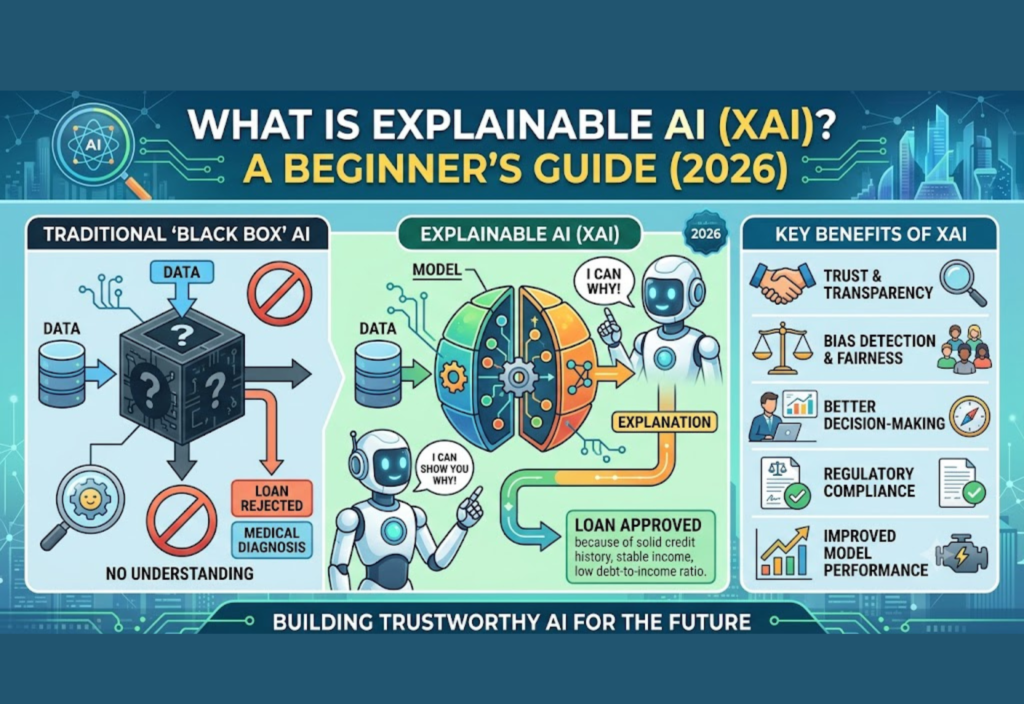
Explainable AI (XAI) is one of the fastest-growing fields in artificial intelligence in 2026. As AI becomes part of healthcare, banking, education, e-commerce, and cybersecurity, people are asking an important question: How does AI make its decisions? Traditional AI systems often provide answers without explaining the reasoning behind them. Explainable AI (XAI) solves this problem by making AI systems more transparent and understandable.
Today, AI can recommend movies, detect fraud, diagnose diseases, and even help businesses make strategic decisions. However, if users cannot understand why an AI reached a particular conclusion, trust becomes a challenge. Explainable AI helps bridge this gap by providing clear explanations that humans can understand.
In this beginner’s guide, you’ll learn what Explainable AI (XAI) is, how it works, why it matters, its benefits, real-world applications, challenges, and future trends.
What Is Explainable AI (XAI)?
Explainable AI (XAI) refers to a collection of methods and technologies that make artificial intelligence models easier for humans to understand. Instead of simply showing a prediction or recommendation, XAI explains the factors that influenced the result.
For example, imagine a bank using AI to evaluate loan applications. Instead of only displaying “Application Rejected,” an Explainable AI system might explain that the applicant’s debt ratio is too high, the credit score is below the required level, and the income does not meet the bank’s criteria.
This level of transparency allows users to understand AI decisions rather than blindly accepting them.
Why Is Explainable AI (XAI) Important?
Artificial intelligence is now used in industries where decisions directly affect people’s lives. Doctors use AI to identify diseases, banks use it for fraud detection, and employers use AI to screen job applications.
If these systems cannot explain their decisions, users may lose confidence in them.
Explainable AI (XAI) is important because it:
- Builds trust between humans and AI.
- Makes AI decisions easier to understand.
- Improves accountability.
- Helps identify unfair or biased decisions.
- Supports compliance with AI regulations.
- Makes debugging AI systems easier.
As governments introduce new AI regulations, explainability is becoming an essential requirement rather than an optional feature.
How Does Explainable AI (XAI) Work?
(Insert Image Here)
Explainable AI uses different techniques to reveal how machine learning models make decisions.
Feature Importance
Feature importance identifies which input variables had the biggest impact on the prediction.
For example, in a house price prediction model, the AI may determine that location contributed 45%, house size 30%, and nearby schools 15% toward the final estimated value.
Decision Trees
Decision trees show every decision step clearly, making them one of the easiest AI models to understand.
Visual Explanations
Image-based AI systems can highlight the exact parts of an image that influenced the prediction. In healthcare, this helps doctors verify AI-generated diagnoses.
Local Explanations
Local explanations describe why a single prediction was made. This is useful when users want to understand one specific AI decision.
Benefits of Explainable AI (XAI)
Explainable AI provides several advantages for businesses and users.
Builds User Trust
People are more likely to trust AI when they understand how decisions are made.
Reduces Bias
Transparent models make it easier to identify and correct unfair patterns.
Easier Debugging
Developers can quickly find errors and improve AI performance.
Better Decision-Making
Explainable AI supports collaboration between human experts and AI systems.
Regulatory Compliance
Many industries now require organizations to explain automated decisions, making Explainable AI increasingly valuable.
Real-World Applications of Explainable AI (XAI)
(Insert Images Here)
Healthcare
Doctors use Explainable AI to analyze medical images, detect diseases, and understand AI-assisted diagnoses.
Banking
Financial institutions use Explainable AI for fraud detection, credit scoring, and loan approvals while providing customers with understandable explanations.
Cybersecurity
Security teams rely on Explainable AI to detect malware, suspicious activities, and network attacks while understanding why alerts are generated.
E-commerce
Online stores use Explainable AI to explain product recommendations based on customer interests, purchase history, and browsing behavior.
Education
Educational platforms use AI to personalize learning experiences while allowing teachers to understand why certain recommendations are made.
Challenges of Explainable AI (XAI)
Although Explainable AI has many benefits, it also faces several challenges.
- Complex deep learning models remain difficult to explain completely.
- More transparency can require additional computing resources.
- Technical explanations may be difficult for non-experts to understand.
- Balancing explainability and prediction accuracy can be challenging.
Researchers continue developing better techniques to improve transparency without sacrificing performance.
Explainable AI (XAI) vs Traditional AI
| Traditional AI | Explainable AI (XAI) |
|---|---|
| Focuses mainly on prediction accuracy | Focuses on accuracy and transparency |
| Limited insight into decisions | Clear explanations |
| Difficult to audit | Easier to audit |
| Lower user confidence | Higher trust |
| Harder to detect bias | Easier to identify bias |
Future of Explainable AI (XAI)
(Insert Images Here)
The future of Explainable AI looks promising. As AI adoption continues to grow, organizations will increasingly invest in transparent and responsible AI systems.
Future developments are expected to include:
- Better AI explanation dashboards
- More transparent large language models
- Stronger AI governance
- Improved human-AI collaboration
- Industry-specific explainability standards
Explainable AI will become a key part of healthcare, finance, manufacturing, education, and government services over the coming years.
Frequently Asked Questions
What is Explainable AI (XAI)?
Explainable AI (XAI) is a set of methods that helps people understand how artificial intelligence systems make decisions.
Why is Explainable AI important?
It improves transparency, trust, fairness, accountability, and supports responsible AI adoption.
Which industries use Explainable AI?
Healthcare, banking, cybersecurity, education, retail, manufacturing, insurance, and government organizations all benefit from Explainable AI.
Can Explainable AI reduce bias?
Yes. Explainable AI helps identify unfair patterns and supports the development of more responsible AI systems.
Conclusion
Explainable AI (XAI) is transforming artificial intelligence by making powerful AI systems easier to understand, trust, and improve. Instead of treating AI as a mysterious black box, Explainable AI provides meaningful insights into how decisions are made. As AI continues to shape industries around the world, transparency will become just as important as accuracy. Whether you are a student, developer, business owner, or technology enthusiast, understanding Explainable AI (XAI) will help you prepare for a future where responsible and trustworthy AI is the standard rather than the exception.