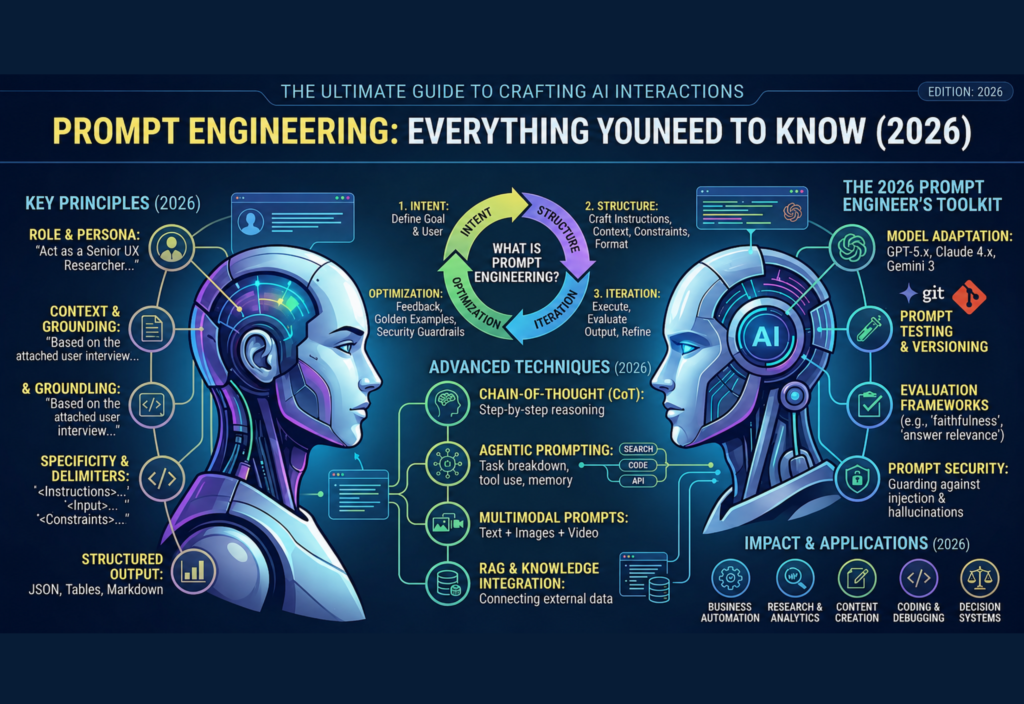
Artificial Intelligence (AI) is transforming the way people work, learn, and create content. Today, AI tools can write articles, generate images, create videos, build software, summarize research papers, and automate business workflows. However, the quality of AI-generated content depends on one important factor—the instructions given to the AI. This is where Prompt Engineering plays a vital role.
Prompt Engineering is one of the most valuable AI skills in 2026 because it helps users communicate effectively with AI systems. Instead of asking random or unclear questions, users create detailed prompts that guide AI toward producing accurate, relevant, and high-quality responses. Whether you are a student, writer, marketer, developer, educator, researcher, or business owner, learning Prompt Engineering can improve your productivity and help you achieve better results with AI tools.
In this beginner-friendly guide, you will learn what Prompt Engineering is, why it matters, how it works, and the most popular prompting techniques used to get better responses from AI.
What Is Prompt Engineering?
Prompt Engineering is the process of writing clear, detailed, and structured instructions that help an AI model generate the desired output. A prompt can be a question, a command, a paragraph, or a complete set of instructions that tells the AI exactly what task it needs to perform.
Think of AI as a highly skilled assistant. If you ask a vague question, the answer may also be vague. However, if you clearly explain your goal, provide context, and specify the format you want, the AI can produce a much more useful response.
The quality of the output depends largely on the quality of the prompt.
Basic Prompt
Write an article about cybersecurity.
This prompt tells the AI the topic but provides very little guidance. It does not mention the audience, article length, tone, or structure.
Improved Prompt
Write a 1,000-word beginner-friendly article about cybersecurity. Use simple English, include H2 headings, practical examples, FAQs, and an SEO-friendly conclusion.
This prompt is much more effective because it clearly explains the topic, target audience, writing style, word count, and structure. As a result, the AI can generate content that requires fewer edits and better meets the user’s expectations.
A well-written prompt not only improves accuracy but also saves time and increases productivity.
Why Is Prompt Engineering Important?
As AI tools continue to evolve, learning how to communicate with them effectively has become an essential digital skill. Prompt Engineering allows users to generate more accurate responses while reducing the need for repeated prompts or extensive editing.
Instead of relying on trial and error, users can create prompts that clearly describe their goals and expectations. This helps AI deliver more relevant, useful, and high-quality results.
Prompt Engineering benefits individuals, businesses, educators, and developers in many ways.
Produces More Accurate Responses
A detailed prompt gives AI the information it needs to understand your request. This leads to responses that are more relevant and closely aligned with your objectives.
Saves Time
A clear prompt often produces the desired result on the first attempt. Users spend less time rewriting prompts or editing AI-generated content.
Improves Content Quality
Content creators use Prompt Engineering to produce SEO-friendly articles, engaging blog posts, product descriptions, newsletters, and social media content with greater consistency.
Helps Generate Better Code
Developers use AI to write code, fix bugs, explain programming concepts, and generate documentation. Clear prompts improve both the quality and reliability of the generated code.
Supports Faster Research
Researchers and students use AI to summarize articles, explain complex concepts, compare information, and organize large amounts of data into easy-to-read formats.
Increases Productivity
Businesses use Prompt Engineering to automate repetitive tasks, create reports, draft emails, generate marketing content, and improve internal workflows.
Reduces Misunderstandings
Detailed prompts reduce ambiguity, helping AI generate responses that closely match the user’s expectations.
As AI becomes part of everyday work, Prompt Engineering is quickly becoming a must-have professional skill.
How Does Prompt Engineering Work?
Before generating a response, AI models analyze every part of your prompt. They identify keywords, understand context, recognize relationships between ideas, and predict the most appropriate response based on the information provided.
The clearer your instructions are, the more accurately the AI can understand your request and generate useful content.
A high-quality prompt generally includes four essential elements.
Clear Objective
Every prompt should begin with a clear objective. Tell the AI exactly what you want it to do.
For example:
Basic Request
Explain cloud computing.
Improved Request
Explain cloud computing for beginners using simple language and practical real-world examples.
The second request clearly defines the audience and the style of explanation, resulting in a more useful response.
Provide Context
Context gives AI additional background information that helps it better understand your request.
Instead of writing:
Write a product description.
Try writing:
Write a persuasive product description for wireless noise-cancelling headphones designed for university students.
Including details about the product and target audience helps AI generate content that is more relevant and engaging.
Specify the Desired Format
AI can produce content in many different formats. Specifying the format before generating content helps ensure the response is immediately usable.
Common formats include:
- Blog articles
- Emails
- Bullet-point lists
- Tables
- Product descriptions
- Social media captions
- Tutorials
- Checklists
- Reports
- FAQs
Choosing the desired format saves editing time and improves consistency.
Add Constraints
Constraints help AI generate content that meets your exact requirements.
Useful constraints include:
- Write between 800 and 1,000 words.
- Use simple English.
- Avoid technical jargon.
- Include practical examples.
- Add H2 and H3 headings.
- Optimize the content for SEO.
- Include a Frequently Asked Questions section.
- Finish with a strong conclusion.
Adding these details makes the output more structured, informative, and ready to publish.
Popular Prompt Engineering Techniques
Different AI tasks require different prompting strategies. Understanding these techniques helps you choose the best approach for writing, coding, research, marketing, and creative projects.
Zero-Shot Prompting
Zero-shot prompting asks AI to perform a task without providing any examples.
For example:
Summarize this article in 150 words.
Since the task is straightforward, AI can complete it using its existing knowledge.
Zero-shot prompting works well for simple tasks such as summarization, translation, answering questions, and generating short explanations.
Few-Shot Prompting
Few-shot prompting provides one or more examples before asking AI to perform a similar task.
For example, if you want AI to write product descriptions in a specific style, you can first provide two sample descriptions. AI analyzes those examples and generates new content using a similar tone, structure, and writing style.
This technique is especially useful for maintaining consistency across multiple pieces of content.
Role Prompting
Role prompting assigns AI a specific role before giving instructions.
Examples include:
- Act as an SEO expert.
- Act as a professional teacher.
- Act as a software developer.
- Act as a digital marketing strategist.
- Act as a travel consultant.
- Act as a business advisor.
Giving AI a role helps it produce responses that are more accurate, relevant, and appropriate for the task.
Step-by-Step Prompting
For complex tasks, it is often better to ask AI to solve the problem one step at a time rather than requesting the final answer immediately.
For example:
Explain how to build a WordPress website step by step for beginners.
This approach is particularly useful for:
- Programming
- Mathematics
- Scientific research
- Business planning
- Data analysis
- Technical documentation
Breaking a complex task into smaller steps helps AI generate more organized, detailed, and reliable responses.
Benefits of Prompt Engineering
Prompt Engineering provides significant advantages for beginners, professionals, students, educators, and businesses. Instead of spending time rewriting prompts or correcting inaccurate AI responses, users can achieve better results by giving AI clear, structured, and detailed instructions.
Whether you are creating content, writing code, conducting research, or managing business tasks, effective prompts help improve both efficiency and output quality.
Produces More Accurate Responses
A detailed prompt helps AI understand exactly what you want. By including the objective, context, audience, and desired format, you reduce misunderstandings and receive responses that are more relevant and useful.
For example, instead of asking AI to “write about SEO,” you could ask it to “write a 1,200-word beginner-friendly SEO guide with H2 headings, practical examples, FAQs, and an SEO-optimized conclusion.” The second prompt is much more specific, resulting in higher-quality content.
Saves Time
One of the biggest benefits of Prompt Engineering is time savings. A well-crafted prompt often produces the desired output on the first attempt, reducing the need for repeated questions or extensive editing.
This allows professionals, students, and businesses to complete projects more quickly and focus on higher-value tasks.
Improves Productivity
Prompt Engineering increases productivity by helping users complete writing, coding, brainstorming, research, and planning tasks more efficiently.
Businesses also use AI to automate repetitive work, generate reports, draft emails, prepare presentations, and create marketing materials. Better prompts improve the quality of these outputs while reducing manual effort.
Supports Creativity
Prompt Engineering is also valuable for creative work. Writers, designers, marketers, and content creators use AI to generate blog ideas, advertising campaigns, video scripts, product descriptions, storytelling concepts, and social media content.
Providing detailed creative instructions encourages AI to produce more original and engaging ideas.
Enhances Learning
Students and educators use AI to explain complex topics, summarize textbooks, prepare quizzes, generate lesson plans, and create study materials.
Well-written prompts allow AI to deliver personalized explanations that match the learner’s knowledge level, making education more effective and accessible.
Real-World Applications of Prompt Engineering
Prompt Engineering is now used across a wide range of industries because it helps professionals communicate more effectively with AI systems and achieve better results.
Content Writing
Content creators, bloggers, journalists, and copywriters use Prompt Engineering to create:
SEO-friendly blog posts
Website content
Product descriptions
Email newsletters
Social media posts
Landing pages
Detailed prompts help maintain a consistent tone, writing style, and structure while reducing editing time.
Software Development
Developers use AI to:
Write code
Debug software
Explain programming concepts
Generate documentation
Optimize algorithms
Learn new programming languages
Providing detailed technical instructions helps AI generate cleaner, more reliable code.
Digital Marketing
Marketing professionals use AI to create:
SEO articles
Keyword ideas
Meta titles and descriptions
Email campaigns
Google Ads copy
Social media advertisements
Marketing strategies
Prompt Engineering enables marketers to produce highly targeted and engaging content.
Education
Teachers use AI to prepare lesson plans, classroom activities, quizzes, presentations, and assignments.
Students benefit from AI-generated explanations, summaries, practice questions, and personalized learning materials.
Customer Support
Businesses increasingly rely on AI-powered chatbots to answer customer questions, resolve common issues, and provide technical assistance.
Well-designed prompts help chatbots deliver accurate, helpful, and consistent responses, improving the customer experience.
AI Image Generation
Prompt Engineering is equally important when generating AI images.
A detailed image prompt may include:
Art style
Lighting
Camera angle
Background
Color palette
Composition
Mood
Resolution
The more descriptive the prompt, the closer the generated image will match the user’s vision.
Common Prompt Engineering Mistakes to Avoid
Even experienced AI users sometimes make mistakes that reduce the quality of generated responses. Avoiding these common errors can significantly improve your results.
Writing Vague Instructions
General prompts often produce broad or incomplete answers. Always explain exactly what you want AI to do.
Providing Little or No Context
Without enough background information, AI must make assumptions. Adding context helps generate more relevant and accurate responses.
Combining Multiple Tasks
Avoid asking AI to perform several unrelated tasks in a single prompt.
Instead, break large requests into smaller, focused prompts.
Forgetting the Output Format
Always specify the format you need, such as:
Blog article
Email
Checklist
Table
Report
FAQ section
This reduces editing time and produces content that is easier to use.
Ignoring the Target Audience
Content written for beginners differs greatly from content intended for professionals.
Always mention who the content is for so AI can adjust the language and level of detail accordingly.
Leaving Out Important Details
Include important requirements such as:
Word count
Tone
Writing style
SEO optimization
Practical examples
Headings
Call-to-action
These details help AI generate content that better matches your expectations.
Best Practices for Writing Better Prompts
Writing effective prompts is a skill that improves with practice. Following these best practices will help you consistently receive better AI-generated responses.
Clearly Define Your Goal
Know exactly what you want AI to accomplish before writing the prompt.
Provide Enough Background Information
Relevant context helps AI understand your request more accurately.
Mention the Target Audience
Specify whether the content is intended for:
Beginners
Students
Developers
Marketers
Business owners
Professionals
This helps AI adjust the complexity and tone of its response.
Specify the Desired Format
Tell AI exactly what type of content you need, such as:
Blog post
Email
Tutorial
Checklist
Table
Presentation outline
Product description
This makes the output easier to use without major revisions.
Include Tone, Style, and Word Count
Useful instructions include:
Professional tone
Friendly tone
Beginner-friendly English
1,000–1,500 words
SEO optimized
Include FAQs
These details help AI generate publication-ready content.
Break Complex Tasks into Smaller Steps
Large projects become easier when divided into manageable sections.
For example:
Create an outline.
Write the introduction.
Expand each section.
Add FAQs.
Write the conclusion.
This approach improves organization and overall quality.
Review and Improve Your Prompt
If the first response isn’t exactly what you need, refine your prompt by adding more details rather than repeating the same request.
Small improvements in wording often produce significantly better results.
Prompt Engineering vs Traditional Search
| Traditional Search | Prompt Engineering |
|---|---|
| Finds existing web pages | Generates customized responses |
| Requires multiple searches | Often completes tasks in one request |
| Provides static information | Creates personalized content |
| Limited interaction | Interactive conversations |
| Focuses on finding information | Focuses on solving problems and creating content |
Unlike traditional search engines, AI systems can generate original content, explain complex ideas, summarize information, assist with coding, and support creative work through effective prompting.
The Future of Prompt Engineering
Prompt Engineering will continue to evolve as artificial intelligence becomes more advanced. Although modern AI models understand natural language better than ever before, clear instructions will remain essential for producing reliable and high-quality outputs.
Several important trends are expected to shape the future of Prompt Engineering.
AI-Assisted Prompt Optimization
Future AI tools will automatically improve prompts before generating responses, making Prompt Engineering easier for beginners and professionals alike.
Multimodal Prompting
Users will increasingly interact with AI through combinations of:
Text
Images
Voice
Video
This will create richer and more natural AI experiences.
Industry-Specific Prompt Libraries
Organizations will develop optimized prompt collections tailored for industries such as healthcare, finance, education, marketing, and software development.
Smarter AI Assistants
Future AI assistants will better understand context, remember previous conversations, and deliver more personalized support.
Wider Business Adoption
As AI becomes more common across industries, Prompt Engineering will become an essential workplace skill. Professionals who know how to communicate effectively with AI will have a significant competitive advantage.
Frequently Asked Questions (FAQs)
What is Prompt Engineering?
Prompt Engineering is the process of writing clear and structured instructions that help AI systems generate accurate, useful, and relevant responses.
Why is Prompt Engineering important?
It improves response quality, saves time, increases productivity, and helps users get better results from AI-powered tools.
Who should learn Prompt Engineering?
Students, writers, developers, marketers, educators, researchers, business owners, and anyone who regularly uses AI can benefit from learning Prompt Engineering.
Do I need programming knowledge to learn Prompt Engineering?
No. Prompt Engineering does not require coding skills. Anyone can learn it by practicing how to write effective prompts.
Can Prompt Engineering improve AI-generated content?
Yes. Well-designed prompts usually produce content that is more accurate, engaging, organized, and aligned with the user’s goals.
Conclusion
Prompt Engineering has become one of the most valuable skills in the era of artificial intelligence. By learning how to write clear, structured, and detailed prompts, users can unlock the full potential of AI for writing, coding, research, education, marketing, design, and business automation.
Instead of relying on trial and error, effective prompting helps generate more accurate, creative, and reliable results while saving time and increasing productivity. Whether you are creating blog posts, building software, conducting research, or growing a business, mastering Prompt Engineering can significantly improve the quality of your work.
As AI continues to evolve beyond 2026, Prompt Engineering will remain an essential digital skill. Individuals and organizations that develop strong prompting abilities will be better prepared to work smarter, make informed decisions, and maximize the benefits of artificial intelligence in both personal and professional environments.