Python continues to dominate the programming world in 2026, and for good reason. It is easy to learn, highly readable, and supported by one of the largest developer communities in the world. From artificial intelligence and machine learning to web development, cybersecurity, automation, cloud computing, and data science, Python is used in almost every area of modern software development.
However, Python’s greatest strength is not just its simple syntax. Its real power comes from thousands of open-source libraries that allow developers to build powerful applications without reinventing the wheel. Instead of writing every function from scratch, programmers can use tested and optimized libraries to complete tasks more efficiently.
Whether you are a beginner learning Python for the first time or an experienced developer building production-ready software, choosing the right libraries can dramatically improve your productivity. The right toolkit helps you write cleaner code, reduce development time, solve complex problems, and focus on creating better software.
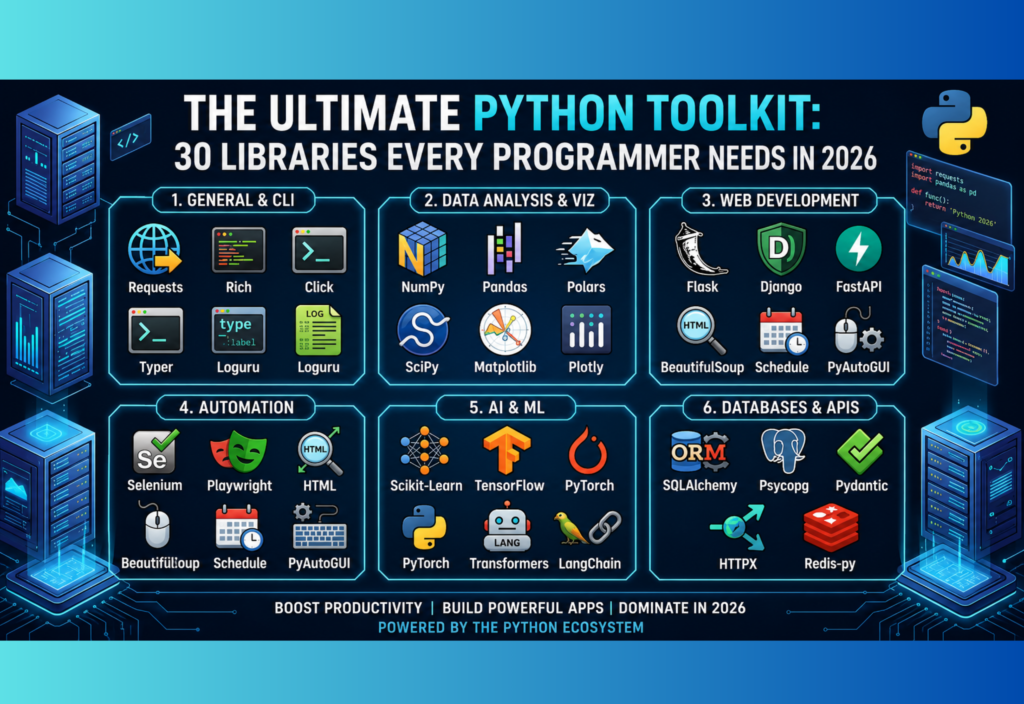
In this comprehensive guide, you’ll discover 30 Python libraries every programmer needs in 2026. Each library has been selected because it is widely used, actively maintained, and valuable for real-world projects.
Why Python Libraries Matter
Python libraries are collections of reusable code that solve common programming problems. Instead of creating every feature yourself, you can import reliable libraries and focus on developing your application’s unique functionality.
Using the right libraries provides several advantages:
- Faster software development
- Cleaner and more organized code
- Reduced debugging time
- Better performance
- Easier maintenance
- Access to advanced technologies
- Strong community support
- Regular updates and improvements
As Python continues to evolve, its library ecosystem grows even stronger. Consequently, learning these libraries is one of the smartest investments you can make as a programmer.
Categories of Python Libraries
Python offers libraries for almost every type of software project. Understanding these categories makes it easier to choose the right tools.
Popular categories include:
- Web Development
- Artificial Intelligence
- Machine Learning
- Automation
- Data Science
- Cybersecurity
- Cloud Computing
- API Development
- Database Management
- Testing
- Visualization
- Command-Line Applications
Rather than trying to learn every library at once, focus on the ones that match your career goals and project requirements.
Essential Python Libraries Every Programmer Should Learn
1. Requests
The Requests library is one of the first libraries every Python programmer should learn. It simplifies working with HTTP requests and makes it easy to communicate with websites, REST APIs, and online services.
Instead of dealing with complex networking code, developers can retrieve data using just a few lines of Python.
Common Uses
- API integration
- Web services
- Authentication
- Downloading data
- REST API communication
Why It Matters
Almost every modern application communicates with external services. Requests makes this process straightforward and reliable.
2. Rich
Rich transforms ordinary terminal applications into attractive command-line interfaces.
Key Features
- Colorful terminal output
- Progress bars
- Tables
- Syntax highlighting
- Markdown rendering
- Beautiful tracebacks
Developers frequently use Rich to improve debugging tools and automation scripts.
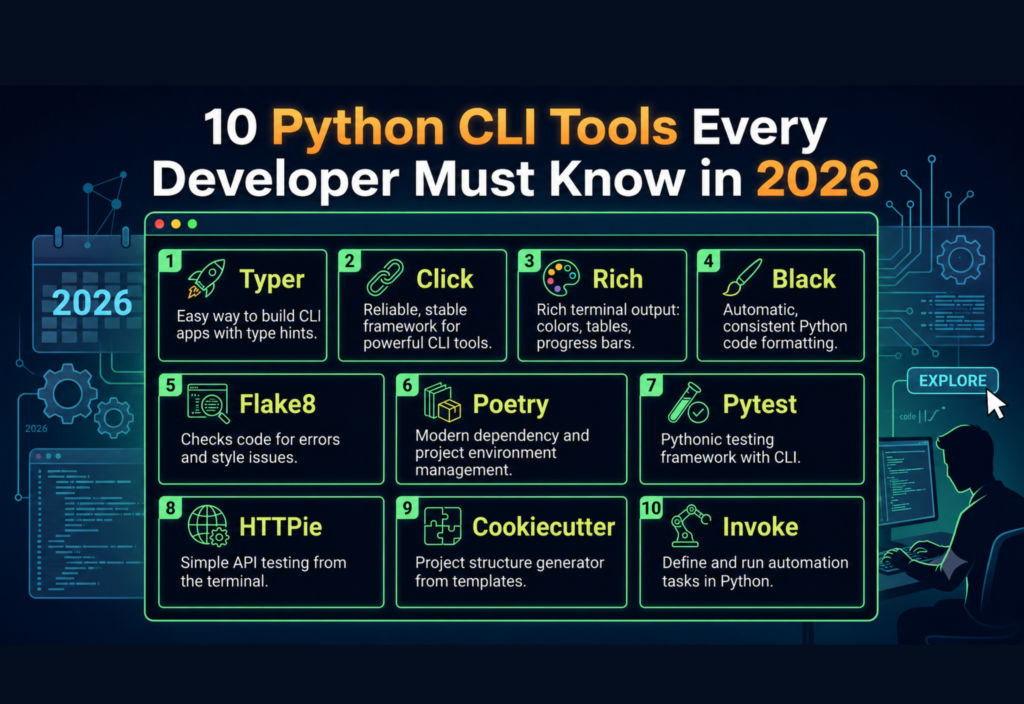
3. Click
Click is a powerful library for creating professional command-line applications.
Instead of manually parsing command-line arguments, Click provides decorators and helper functions that simplify development.
Common Projects
- Automation tools
- Deployment scripts
- Administrative utilities
- Internal developer tools
4. Typer
Typer builds on modern Python features to create fast and user-friendly command-line applications.
Advantages
- Automatic help pages
- Type validation
- Cleaner syntax
- Better developer experience
Many developers now prefer Typer when building modern CLI applications.
5. Loguru
Every software project needs reliable logging.
Loguru simplifies logging while offering advanced capabilities.
Features
- File rotation
- Error tracking
- Custom formatting
- Better debugging
- Exception handling
Because troubleshooting becomes easier with proper logs, Loguru is a valuable addition to almost any Python project.
Python Libraries for Data Analysis
Data analysis remains one of Python’s strongest areas. The following libraries are widely used by analysts, researchers, engineers, and AI professionals.
6. NumPy
NumPy is the foundation of scientific computing in Python.
Key Features
- High-performance arrays
- Mathematical operations
- Matrix calculations
- Numerical computing
- Linear algebra
Many other Python libraries depend on NumPy internally.
7. Pandas
Pandas is one of the most popular libraries for working with structured data.
Common Uses
- Cleaning datasets
- Filtering information
- Creating reports
- Reading Excel files
- CSV processing
- Database analysis
Its DataFrame structure has become an industry standard.
8. Polars
Polars is a fast-growing alternative to Pandas.
Benefits
- Faster execution
- Lower memory usage
- Large dataset support
- Modern query engine
As datasets continue to grow, Polars is becoming increasingly popular among data engineers.
9. SciPy
SciPy extends NumPy with advanced scientific computing capabilities.
It Provides Tools For
- Optimization
- Statistics
- Signal processing
- Scientific calculations
- Engineering applications
Researchers and scientists rely on SciPy for solving complex mathematical problems.
10. Matplotlib
Matplotlib allows developers to create professional charts and graphs.
Supported Charts
- Line charts
- Bar charts
- Pie charts
- Scatter plots
- Histograms
Clear data visualization helps developers communicate insights more effectively.
11. Plotly
Unlike traditional chart libraries, Plotly creates interactive visualizations.
Best Uses
- Dashboards
- Business intelligence
- Web analytics
- Financial reports
- Interactive charts
Because users can zoom, filter, and interact with charts, Plotly is ideal for modern web applications.
Python Libraries for Web Development
Python is also one of the most popular languages for web development. Modern frameworks simplify the process of building secure, scalable, and high-performance websites.
12. Flask
Flask is a lightweight web framework that emphasizes flexibility and simplicity.
Best For
- REST APIs
- Small web applications
- Microservices
- Learning web development
- Rapid prototyping
Although Flask is simple, it can power highly scalable applications with the right architecture.
13. Django
Django is a full-featured web framework designed for larger projects.
Built-in Features
- Authentication
- Database management
- Security
- Templates
- Administration panel
Many businesses choose Django because it promotes rapid development while following best security practices.
14. FastAPI
FastAPI has become one of the fastest-growing Python frameworks for API development.
Advantages
- Excellent performance
- Automatic API documentation
- Data validation
- Asynchronous support
- Modern Python typing
FastAPI is widely used for AI applications, cloud services, and backend systems.
15. Jinja2
Jinja2 is a modern templating engine that allows developers to generate dynamic HTML pages with clean and reusable templates.
Key Features
- Template inheritance
- Variables and loops
- Conditional statements
- Reusable components
- Secure HTML rendering
Best For
- Dynamic websites
- Email templates
- Dashboard interfaces
- Web applications
Python Libraries for Automation
Automation is one of Python’s greatest strengths. These libraries help developers eliminate repetitive tasks and improve productivity.
16. Selenium
Selenium is the industry standard for browser automation and web testing.
Common Uses
- Website testing
- Form automation
- Login automation
- Data collection
- Web application testing
17. Playwright
Playwright is a modern browser automation library supporting Chromium, Firefox, and WebKit.
Advantages
- Faster execution
- Cross-browser testing
- Better reliability
- Automatic waiting
- Modern API
Many developers now prefer Playwright because of its speed and stability.
18. BeautifulSoup
BeautifulSoup makes extracting information from HTML and XML documents extremely simple.
Common Uses
- Web scraping
- News aggregation
- Product monitoring
- Research
- Data extraction
It works especially well with the Requests library.
19. Schedule
Schedule is a lightweight task scheduler that helps automate recurring jobs.
Examples
- Daily reports
- Email reminders
- Backup automation
- Database cleanup
- System monitoring
Its simple syntax makes it ideal for beginners.
20. PyAutoGUI
PyAutoGUI controls the mouse, keyboard, and screen automatically.
Best Uses
- Desktop automation
- GUI testing
- Repetitive office tasks
- Productivity scripts
Because it simulates user actions, it works with many desktop applications.
Python Libraries for Artificial Intelligence and Machine Learning
Artificial Intelligence continues to be one of Python’s strongest ecosystems. These libraries help developers build intelligent applications.
21. Scikit-Learn
Scikit-Learn provides beginner-friendly machine learning algorithms.
Features
- Classification
- Regression
- Clustering
- Model evaluation
- Feature engineering
It is often the first machine learning library that new AI developers learn.
22. TensorFlow
TensorFlow is Google’s deep learning framework.
Common Applications
- Neural networks
- Computer vision
- Natural language processing
- Recommendation systems
- Predictive analytics
It powers many production AI systems around the world.
23. PyTorch
PyTorch is another leading deep learning framework that is especially popular in research and AI startups.
Benefits
- Dynamic computation graphs
- Easy debugging
- Flexible architecture
- Strong community support
Many cutting-edge AI models are developed using PyTorch.
24. Transformers
The Transformers library provides access to modern language models for natural language processing.
Common Applications
- AI chatbots
- Text summarization
- Translation
- Question answering
- Text generation
- Sentiment analysis
It has become an essential tool for developers building AI-powered applications.
25. LangChain
LangChain helps developers create applications powered by Large Language Models (LLMs).
Popular Use Cases
- AI assistants
- Document question answering
- Retrieval-Augmented Generation (RAG)
- Workflow automation
- Multi-step AI applications
As AI adoption grows, LangChain continues to gain popularity.
Python Libraries for Databases and APIs
26. SQLAlchemy
SQLAlchemy simplifies database management through Object Relational Mapping (ORM).
Supported Databases
- PostgreSQL
- MySQL
- SQLite
- Microsoft SQL Server
Using SQLAlchemy reduces the amount of SQL code developers need to write.
27. Psycopg
Psycopg is one of the most widely used PostgreSQL adapters for Python.
Features
- High performance
- Secure connections
- Transaction management
- Advanced PostgreSQL support
28. Pydantic
Pydantic validates data using Python type hints.
Benefits
- Cleaner code
- Automatic validation
- Error handling
- JSON serialization
FastAPI relies heavily on Pydantic for request validation.
29. HTTPX
HTTPX is a modern alternative to Requests that supports asynchronous networking.
Best For
- Fast APIs
- Cloud services
- High-performance applications
30. Redis-py
Redis-py allows Python applications to communicate with Redis databases.
Typical Uses
- Caching
- Session management
- Background jobs
- Real-time applications
It helps improve application speed and scalability.
Which Python Libraries Should Beginners Learn First?
If you’re just starting with Python, learning every library at once can feel overwhelming. Instead, begin with the essentials and expand your toolkit gradually.
A good beginner roadmap includes:
- Requests
- NumPy
- Pandas
- Flask
- BeautifulSoup
- Matplotlib
- Scikit-Learn
After gaining confidence, move on to FastAPI, Playwright, LangChain, and TensorFlow.
Best Practices for Using Python Libraries
To get the most value from Python libraries:
- Read the official documentation before using a new library.
- Keep packages updated to benefit from improvements and security fixes.
- Use virtual environments to isolate project dependencies.
- Install only the libraries you actually need.
- Write clean, well-documented code.
- Test your applications regularly before deployment.
Following these practices helps you build reliable and maintainable software.
Frequently Asked Questions
Which Python library should beginners learn first?
Most beginners start with Requests, NumPy, Pandas, and Flask because these libraries introduce common development concepts while remaining easy to learn.
Which Python library is best for Artificial Intelligence?
TensorFlow, PyTorch, Scikit-Learn, Transformers, and LangChain are among the most popular libraries for AI and machine learning projects.
Are all Python libraries free?
Most popular Python libraries are open source and available free of charge. However, some cloud services or commercial platforms built around them may require paid subscriptions.
Do I need to learn all 30 libraries?
No. Focus on the libraries that match your career goals. Web developers may prioritize Django and FastAPI, while data scientists can benefit more from Pandas, NumPy, and Scikit-Learn.
Conclusion
Python’s extensive ecosystem is one of the main reasons it remains one of the world’s most popular programming languages. These 30 Python Libraries Every Programmer Needs cover a wide range of tasks, including web development, automation, data analysis, artificial intelligence, database management, and API development.
Rather than trying to master every library immediately, build your knowledge step by step. Start with the tools that support your current projects, practice through real-world applications, and continue exploring new libraries as your experience grows. Over time, a strong understanding of these libraries will help you write cleaner code, solve problems more efficiently, and become a more versatile Python developer in 2026 and beyond.