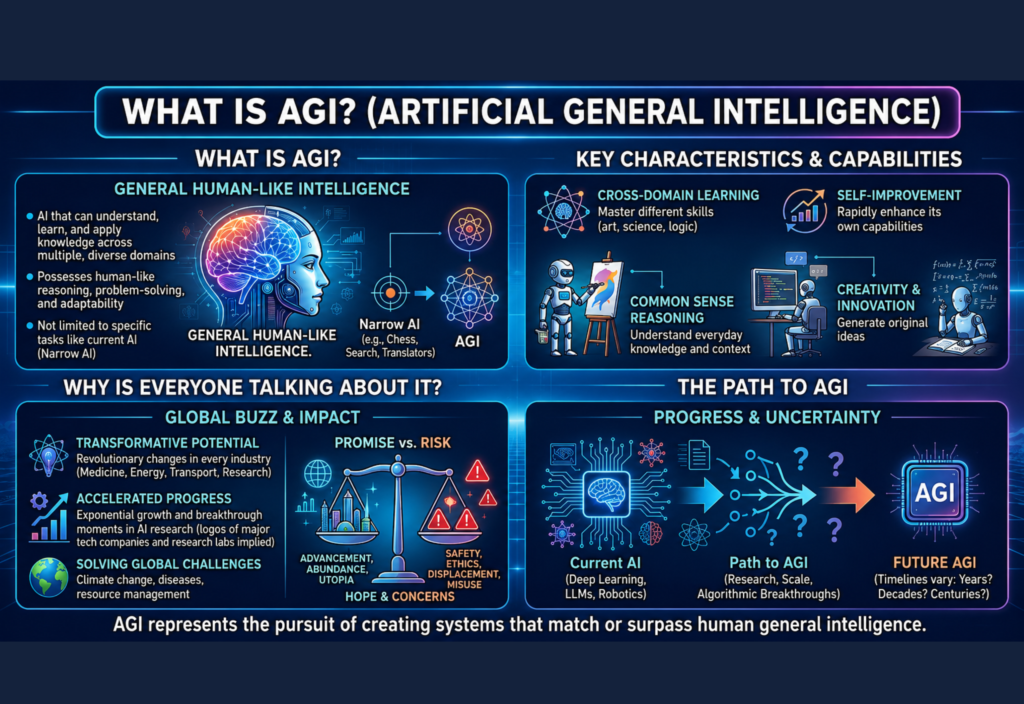
Artificial General Intelligence (AGI) is one of the most discussed concepts in the future of artificial intelligence. Unlike traditional AI systems that are created for specific tasks, AGI aims to develop machines that can learn, understand, reason, and solve different types of problems with human-like flexibility.
Artificial Intelligence has already changed the way people work and communicate. Today, AI tools can write articles, create images, analyze information, translate languages, generate computer code, and help businesses make better decisions. These technologies have improved productivity for students, professionals, and organizations worldwide.
As AI continues to advance, researchers are exploring the possibility of creating more powerful systems that can adapt to new situations without needing separate training for every task. This is why Artificial General Intelligence has become one of the most important topics in modern technology.
In this complete guide, we will explore what AGI means, how it differs from current AI, why researchers are working toward it, its possible benefits, challenges, and how it could shape the future.
What Is Artificial General Intelligence (AGI)?
Artificial General Intelligence refers to a theoretical type of artificial intelligence that can perform a wide range of intellectual tasks similar to human intelligence.
Unlike current AI systems that focus on specific functions, an AGI system would have the ability to:
- Understand new information
- Learn from experience
- Solve unfamiliar problems
- Apply knowledge across different fields
- Make decisions based on reasoning
For example, today’s AI tools may specialize in writing, image recognition, data analysis, or language translation. Each system is designed for a particular purpose and usually performs best within its trained area.
A future AGI system would be much more flexible. It could learn a new skill, understand a different subject, and apply previous knowledge to solve completely new problems.
This ability to transfer knowledge between different areas is one of the main ideas behind general intelligence.
How Does AGI Work?
Although true AGI has not been created yet, researchers believe it would require several advanced technologies working together.
Some important areas involved in AGI research include:
Machine Learning
Machine learning allows computers to identify patterns from large amounts of data. A more advanced system would need to continuously learn and improve from new experiences.
Natural Language Understanding
An advanced intelligent system would need to understand human language, context, emotions, and complex conversations rather than simply predicting words.
Reasoning and Problem Solving
Human intelligence involves logical thinking and decision-making. Future systems would need stronger reasoning abilities to analyze situations and create solutions.
Memory and Learning
Current AI systems often have limited memory. A more advanced intelligence would require long-term memory to remember information and use past experiences when solving problems.
Robotics and Real-World Interaction
Some researchers believe physical interaction with the real world could be important for developing more complete intelligence. Robots powered by advanced AI may learn through observation and experience.
How Is AGI Different From Current AI?
The biggest difference between modern AI and AGI is flexibility.
Today’s AI systems are known as Narrow AI because they are designed for specific tasks.
Examples include:
- Chatbots that answer questions
- Image generators that create pictures
- Recommendation systems that suggest products
- Translation tools that convert languages
These systems can perform extremely well, but they do not have general understanding.
The following comparison explains the difference:
| Current AI | Artificial General Intelligence |
|---|---|
| Designed for specific tasks | Designed for many different tasks |
| Requires specialized training | Can learn more generally |
| Limited adaptability | Can adjust to new situations |
| Works within defined boundaries | Can solve unfamiliar problems |
| Available today | Still under research |
For example, a current AI model may write an article about healthcare but may not independently learn how to become a doctor, understand real-world experiences, and transfer that knowledge to another profession.
A future AGI system would aim to combine multiple abilities into one adaptable intelligence.
Why Is AGI Becoming More Popular?
Interest in AGI has increased because artificial intelligence has improved faster than many experts expected.
Modern AI models can already perform impressive tasks such as:
- Creating human-like text
- Writing programming code
- Generating realistic images
- Summarizing large documents
- Supporting research activities
These developments have encouraged scientists and technology companies to explore the next stage of AI evolution.
Major organizations are investing heavily in artificial intelligence research because advanced systems could create major changes in industries, economies, and everyday life.
Universities and research institutions are also studying areas such as:
- AI reasoning
- Autonomous learning
- Human-computer interaction
- Advanced robotics
- Intelligent decision-making
Although AGI remains a future goal, rapid progress in AI has increased interest in understanding how close humanity may be to achieving it.
Why Could AGI Be Important?
If successfully developed, AGI could influence almost every major industry.
Unlike traditional software that follows fixed instructions, an advanced intelligent system could analyze complex situations and create solutions independently.
Potential benefits could include:
- Faster medical discoveries
- More personalized education
- Improved scientific research
- Better business decisions
- More efficient automation
For example, researchers could use advanced AI systems to analyze millions of scientific papers and discover patterns that humans may take years to identify.
Businesses could use intelligent systems to improve planning, customer service, and decision-making.
However, developing such powerful technology also creates important responsibilities. Safety, ethics, and human control will be essential factors in future AI development.
Benefits of Artificial General Intelligence (AGI)
Although AGI is still a future concept, researchers believe it could provide major benefits across different industries. Because these systems would be able to learn, adapt, and solve complex problems, they could help humans complete tasks more efficiently.
Some of the most important potential benefits include:
Smarter Healthcare and Medical Research
Healthcare is one of the fields that could benefit greatly from advanced artificial intelligence.
Future intelligent systems could help doctors analyze:
- Medical records
- Laboratory reports
- Patient histories
- Medical images
- Research data
These systems could assist healthcare professionals in detecting diseases earlier and creating more personalized treatment plans.
Researchers may also use advanced AI to accelerate drug discovery by analyzing huge amounts of scientific information. Instead of spending years testing possibilities manually, scientists could receive AI-assisted insights much faster.
However, these technologies would work as support tools for doctors rather than completely replacing medical experts.
Personalized Education
Education could become more personalized with advanced AI systems.
Traditional education often provides the same learning material to all students, even though every learner has different abilities and challenges.
Future AI-powered education platforms could:
- Understand individual learning styles
- Identify knowledge gaps
- Recommend suitable lessons
- Provide instant feedback
- Create personalized study plans
This could help students learn at their own pace and make education more accessible worldwide.
Teachers could also use intelligent tools to analyze student progress and improve teaching strategies.
Faster Scientific Discoveries
Scientific research often requires analyzing enormous amounts of information.
Advanced AI could help researchers discover new patterns in areas such as:
- Medicine
- Climate science
- Physics
- Space exploration
- Renewable energy
By processing complex data faster, AI systems could support scientists in developing new technologies and solving difficult problems.
For example, AI-assisted research could help discover new materials, improve energy storage, and develop better solutions for environmental challenges.
Business Growth and Productivity
Businesses are expected to benefit significantly from more advanced AI capabilities.
Organizations could use intelligent systems to:
- Analyze market trends
- Improve customer experiences
- Automate complex workflows
- Support decision-making
- Optimize business operations
Employees could spend less time on repetitive tasks and focus more on creative, strategic, and problem-solving activities.
Companies that successfully adopt advanced AI technologies may gain a competitive advantage in the digital economy.
Helping Solve Global Problems
Some experts believe advanced AI could help humanity address major global challenges.
Potential applications include:
- Predicting natural disasters
- Improving food production
- Managing energy resources
- Fighting climate change
- Optimizing transportation systems
By analyzing massive amounts of information, AI could identify solutions that may be difficult for humans to discover alone.
Challenges and Risks of AGI
While the potential benefits are significant, developing AGI also creates many challenges.
Researchers agree that powerful AI systems must be developed carefully to ensure they remain safe, reliable, and beneficial for society.
Job Automation and Workforce Changes
One of the biggest concerns surrounding advanced AI is its impact on employment.
As machines become more capable, some repetitive tasks may become automated.
Jobs involving routine data processing, customer support, and certain administrative tasks could change significantly.
However, technological progress has historically created new opportunities as well. Future workers may need to develop skills related to:
- AI management
- Creativity
- Critical thinking
- Technology adaptation
- Human-AI collaboration
The future of work will likely involve humans and AI systems working together rather than complete replacement.
AI Safety and Control
Safety is one of the most important challenges in developing advanced intelligence.
Researchers need to ensure that future AI systems:
- Follow human instructions
- Make reliable decisions
- Avoid harmful actions
- Remain under proper control
Creating safe and trustworthy systems will require extensive testing, monitoring, and responsible development practices.
Privacy and Data Security
More advanced AI systems may require access to large amounts of information.
This creates concerns about:
- Personal privacy
- Data protection
- Cybersecurity
- Unauthorized access
Strong security systems and clear regulations will be necessary to protect sensitive information.
Organizations will need responsible approaches to collecting and using data.
Ethical Concerns
Advanced AI raises many ethical questions.
Important discussions include:
- Who is responsible when AI makes mistakes?
- How can AI decisions remain fair?
- How can bias be reduced?
- How can transparency be improved?
Governments, researchers, and technology companies are working on guidelines to encourage safe and responsible AI development.
Is ChatGPT an Example of AGI?
Many people believe that advanced AI chatbots are already examples of AGI, but current systems do not meet the full definition.
Tools like ChatGPT can perform many impressive tasks, including:
- Answering questions
- Writing content
- Helping with programming
- Summarizing information
- Explaining complex topics
However, they are still considered specialized AI systems because they do not have complete human-like understanding, independent learning, or the ability to handle every intellectual task.
A true AGI system would be able to learn new abilities, understand unfamiliar situations, and transfer knowledge between completely different areas without requiring separate training.
What Does the Future of AGI Look Like?
The future timeline of AGI remains uncertain.
Some researchers believe it could happen within the coming decades, while others think achieving this level of intelligence may take much longer.
Regardless of the timeline, AI research continues to move forward rapidly.
Future developments may focus on:
- Better reasoning abilities
- Improved memory systems
- Advanced robotics
- Human-like learning
- More reliable AI decision-making
If developed responsibly, AGI could become one of the most transformative technologies in human history.
However, cooperation between researchers, governments, and organizations will be essential to ensure that advanced AI is developed safely.
Frequently Asked Questions
What Does AGI Stand For?
AGI stands for Artificial General Intelligence. It refers to a theoretical form of AI that can learn, understand, and solve a wide range of intellectual tasks.
Does AGI Exist Today?
No. Current AI systems are powerful but are still designed for specific purposes. True AGI has not been achieved yet.
What Is the Difference Between AI and AGI?
Artificial Intelligence is a broad field that includes many technologies. AGI is a future concept focused on creating systems with general learning and reasoning abilities.
Will AGI Replace Humans?
AGI may change many jobs and industries, but many experts believe it will mainly transform the way humans work by creating new opportunities and improving productivity.
Which Industries Could Benefit From AGI?
Healthcare, education, finance, manufacturing, science, transportation, and software development could benefit from advanced AI systems.
Conclusion
Artificial General Intelligence represents one of the biggest goals in the field of artificial intelligence. While today’s AI systems are already powerful, they are mainly designed for specific tasks.
The idea behind AGI is to create machines that can learn, reason, adapt, and solve problems across different areas with greater flexibility.
Although true AGI has not been developed yet, ongoing research continues to push the boundaries of what artificial intelligence can achieve.
Understanding the opportunities and challenges of this technology will help individuals, businesses, and governments prepare for a future where AI plays an even greater role in society.