Artificial intelligence is changing quickly. In 2026, AI is moving beyond simple chat and question answering. A new generation of AI systems can understand goals, plan tasks, use digital tools, and complete several steps with less human input.
These systems are known as AI agents.
Unlike a basic chatbot, an AI agent can do more than provide information. For example, it may research a topic, organize data, use software, check results, and continue working until a specific task is complete.
As a result, AI agents are becoming useful in business, marketing, software development, research, customer service, online shopping, and many other areas.
In this guide, you will learn what AI agents are, how they work, the main types of AI agents, real-world examples, benefits, limitations, and practical uses in 2026.
What Are AI Agents?
An AI agent is an AI-powered software system that can work toward a specific goal.
To achieve that goal, the agent can understand instructions, collect information, make decisions, use tools, take actions, and check the results.
The main difference is simple.
A normal chatbot mainly gives you an answer. An AI agent can take several steps to complete a task.
For example, imagine telling an AI:
“Find five useful blog topics for my website, research them, and create an SEO content plan.”
A basic chatbot may give you five topic ideas. However, an AI agent could handle a larger workflow.
It may:
Understand your goal.
Research relevant topics.
Check useful search terms.
Compare different ideas.
Organize the information.
Create a content plan.
Review the results.
Make changes when needed.
Therefore, an AI agent is better understood as a goal-focused AI system rather than just a chatbot.
How Are AI Agents Different From Chatbots?
AI chatbots, AI assistants, and AI agents can look similar. However, they usually have different levels of capability.
Traditional Chatbots
Traditional chatbots are mainly built to answer questions and follow simple conversation flows.
For example, a customer-service chatbot may answer:
What are your opening hours?
How can I reset my password?
Where is my order?
What is your return policy?
These systems can be useful. However, their ability to complete complex tasks is often limited.
AI Assistants
AI assistants are more flexible than traditional chatbots.
They can understand natural language, remember conversation context, help with different tasks, and sometimes use external tools.
For instance, an AI assistant may help write an email, summarize a document, create a plan, or analyze information.
AI Agents
AI agents can go a step further.
Instead of waiting for instructions after every step, an agent can work through a task based on a defined goal.
For example, it may decide what information is needed, select an available tool, perform an action, check the result, and continue to the next step.
AI Agents vs Chatbots vs AI Assistants
Answers Questions
Traditional Chatbot: Yes
AI Assistant: Yes
AI Agent: Yes
Understands Natural Language
Traditional Chatbot: Yes
AI Assistant: Yes
AI Agent: Yes
Uses External Tools
Traditional Chatbot: Limited
AI Assistant: Often
AI Agent: Core capability
Performs Multiple Steps
Traditional Chatbot: Limited
AI Assistant: Sometimes
AI Agent: Yes
Plans Tasks
Traditional Chatbot: Limited
AI Assistant: Moderate
AI Agent: Yes
Maintains Context
Traditional Chatbot: Limited
AI Assistant: Often
AI Agent: Usually
Takes Actions
Traditional Chatbot: Rarely
AI Assistant: Sometimes
AI Agent: Frequently
Adapts During a Task
Traditional Chatbot: Limited
AI Assistant: Moderate
AI Agent: Yes
Works Toward a Goal
Traditional Chatbot: Limited
AI Assistant: Yes
AI Agent: Strongly goal-oriented
How Do AI Agents Work?
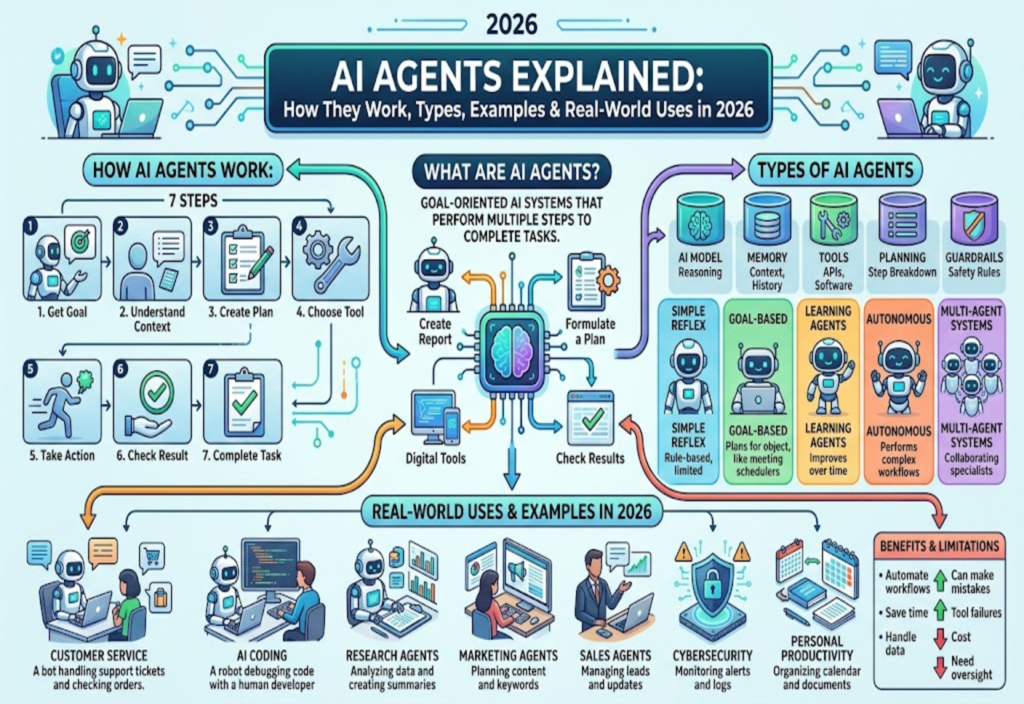
AI agents usually follow a series of steps.
The exact process can vary from one system to another. Still, most advanced agents include several common parts.
1. The Agent Receives a Goal
First, the agent needs to understand what you want.
For example, the goal could be:
Create a report.
Research a topic.
Find suitable products.
Organize customer requests.
Analyze a spreadsheet.
Prepare a marketing plan.
A clear goal helps the agent choose the right actions.
2. The Agent Understands the Context
Next, the system collects information related to the task.
This information may come from:
Your instructions
Previous messages
Documents
Databases
Websites
Business software
Connected tools
With better context, the agent can make more useful decisions.
3. The Agent Creates a Plan
After understanding the goal, the agent can break the task into smaller steps.
For example, suppose the goal is to create a market research report.
The agent may first:
Define the research topic.
Collect relevant information.
Review competitors.
Organize the findings.
Identify important patterns.
Create the report.
Check the final result.
This step-by-step process makes complex tasks easier to manage.
4. The Agent Chooses a Tool
Many AI agents can use external tools.
For example, an agent may have access to:
Search tools
Databases
APIs
Calculators
File systems
Business applications
Calendar tools
CRM software
The available tools depend on how the agent has been designed.
5. The Agent Takes Action
Once the agent decides what to do, it can perform an action.
For example, it may:
Search for information.
Read a document.
Update a record.
Analyze data.
Create a file.
Prepare a message.
Run a calculation.
However, the agent can only perform actions that its connected tools and permissions allow.
6. The Agent Checks the Result
After an action, the agent can examine what happened.
If the result is not correct, the system may try another approach.
For example, an agent researching a topic may find that one source does not contain enough information. It can then continue searching for better information.
This feedback step makes agent systems more flexible than simple automated workflows.
7. The Agent Completes the Task
Finally, the agent provides the requested result.
The complete process can look like this:
Goal → Understand → Plan → Use Tools → Take Action → Check Results → Continue → Complete
Main Components of an AI Agent
Several parts work together to create an AI agent.
AI Model
The AI model provides the language and reasoning abilities of the system.
It helps the agent understand instructions, process information, and decide what to do next.
Memory
Memory helps an agent keep useful information during a task.
Some systems can also store selected information for future interactions.
For example, an agent may remember important project details so that the user does not have to repeat them every time.
Tools
Tools allow an agent to interact with other systems.
Without tools, an AI may mainly generate text or other content. With tools, it can perform actions in a connected digital environment.
Planning
Planning helps an agent break a large task into smaller steps.
As a result, the system can handle workflows that would be difficult to complete in one action.
Reasoning
Reasoning helps the agent choose between different actions.
For example, if one tool does not provide the required information, the agent may decide to use another available method.
Guardrails
Guardrails are rules that control what an agent can do.
For example, a business may require approval before an agent can:
Send an important email.
Make a purchase.
Delete a file.
Change financial information.
Publish content.
Therefore, guardrails are an important part of safe AI agent design.
Feedback
Feedback helps the agent check whether its actions are producing the expected result.
When something goes wrong, the system may adjust its next step.
Types of AI Agents
There are several ways to classify AI agents.
Each type is designed for different levels of complexity and decision-making.
Simple Reflex Agents
Simple reflex agents respond to current information using fixed rules.
For example:
If condition A happens, perform action B.
These agents work well for predictable tasks. However, they have limited flexibility.
Model-Based Agents
Model-based agents maintain information about their environment.
Because of this, they can make decisions even when they cannot see every part of the current situation.
Goal-Based Agents
Goal-based agents focus on achieving a specific objective.
For example, an agent may need to find a suitable meeting time for several people.
It can consider the available information and choose actions that move it toward the goal.
Utility-Based Agents
Utility-based agents consider the value of different possible results.
For example, an agent may compare options based on:
Cost
Time
Quality
Risk
Efficiency
This approach can help when several possible solutions are available.
Learning Agents
Learning agents can improve their behavior using feedback or new information.
As a result, they may become more useful over time when the system is properly designed and monitored.
Autonomous Agents
Autonomous agents can complete multiple steps with limited human input.
However, autonomy can vary widely.
Some agents may only perform a few actions. Others may handle longer workflows within specific limits.
Multi-Agent Systems
A multi-agent system uses several AI agents together.
Each agent can have a different role.
For example:
Agent 1 researches information.
Agent 2 analyzes the research.
Agent 3 prepares the report.
Agent 4 checks the final output.
This approach can be useful for larger workflows.
Real-World Uses of AI Agents
AI agents can be used in many industries.
Their exact role depends on the tools, data, and permissions available to them.
Customer Service
Customer-service agents can help businesses manage common support requests.
For example, an agent may:
Understand a customer question.
Search a knowledge base.
Check order information.
Find a solution.
Create a support ticket.
Send the customer an appropriate response.
Escalate difficult cases.
Therefore, the agent can support the entire workflow instead of simply answering one question.
AI Coding Agents
Coding agents are becoming useful for software development.
Depending on their setup, they can help developers:
Understand existing code.
Write new code.
Find errors.
Suggest fixes.
Run tests.
Review changes.
Explain technical problems.
However, developers should still review important code before using it in production systems.
AI Research Agents
Research agents can help collect and organize information.
A typical research workflow may include:
Understanding the research question.
Finding relevant sources.
Collecting information.
Comparing findings.
Organizing the evidence.
Creating a summary.
Human review remains important because AI systems can misunderstand information or use unreliable sources.
Marketing Agents
Marketing teams can use AI agents for repetitive research and planning tasks.
Possible uses include:
Keyword research.
Content planning.
Competitor research.
Campaign analysis.
Audience research.
Content organization.
Report preparation.
As a result, marketers can spend less time on repetitive data work.
Sales Agents
Sales teams often handle many repeated tasks.
AI agents can assist with:
Lead research.
Customer research.
CRM updates.
Follow-up preparation.
Meeting preparation.
Sales reports.
For customer-facing communication, businesses may still require human approval.
Finance and Accounting
AI agents can support administrative financial workflows.
For example, they may help:
Organize invoices.
Categorize transactions.
Prepare reports.
Review documents.
Identify unusual entries for human review.
Because financial information can be sensitive, strong access controls are important.
Online Shopping
AI agents can also help users research products.
Instead of checking many pages manually, a user could provide requirements such as:
Budget
Features
Size
Compatibility
Brand preferences
The agent can then organize available information and help with comparison.
Healthcare Administration
Healthcare organizations can use AI systems for administrative work.
Possible uses include:
Appointment coordination.
Document organization.
Patient communication.
Information retrieval.
Administrative data processing.
However, healthcare applications require strong privacy and security controls. Important medical decisions should also receive appropriate professional oversight.
Cybersecurity
Security teams can use AI agents to process large amounts of security information.
For example, an agent may help:
Review alerts.
Summarize incidents.
Search security records.
Identify related events.
Prepare reports.
Because cybersecurity systems can affect sensitive infrastructure, careful testing and permission management are essential.
Personal Productivity
Personal AI agents can help users manage everyday digital tasks.
For example, they may assist with:
Calendar planning.
Document organization.
Research.
Task management.
Email preparation.
Project planning.
The exact capabilities depend on the applications connected to the agent.
Benefits of AI Agents
AI agents can provide several practical benefits.
They Automate Multi-Step Work
Traditional automation often focuses on a fixed sequence.
AI agents can handle workflows where the next action may depend on the result of the previous step.
They Reduce Repetitive Tasks
Agents can handle repetitive digital work.
As a result, employees can spend more time on tasks that require creativity, communication, and human judgment.
They Can Save Time
When several manual steps are connected, an agent may reduce the time needed to complete the workflow.
They Can Handle Large Amounts of Information
AI agents can process and organize large volumes of digital information quickly.
This can be useful for research, reporting, customer service, and data analysis.
They Can Work With Existing Software
Agents can become more useful when they are connected to tools that businesses already use.
For example, an agent can potentially combine information from a database, CRM, document system, and communication platform.
Limitations of AI Agents
AI agents also have important limitations.
AI Agents Can Make Mistakes
An agent can misunderstand instructions or use incorrect information.
Therefore, important results should be reviewed when accuracy matters.
Tools Can Fail
An external website, API, database, or software system may become unavailable.
When this happens, the agent may not be able to complete the task.
Long Workflows Increase Risk
The more steps an agent performs, the more opportunities there are for errors.
For this reason, complex workflows need proper testing and monitoring.
Poor Instructions Can Cause Problems
An agent needs clear instructions.
If the goal is unclear, the agent may produce an unexpected result.
AI Agents Can Cost Money
Advanced agents may require:
AI model usage.
API costs.
Software subscriptions.
Computing resources.
Development work.
Monitoring systems.
Therefore, businesses should compare the cost with the value of the workflow being automated.
Human Oversight May Still Be Needed
AI agents are not automatically suitable for every task.
High-impact decisions may require human review, approval, or supervision.
AI Agent Security
Security becomes especially important when an agent can take actions.
Give Only Necessary Permissions
An agent should receive access only to the systems it needs.
For example, an agent that only needs to read documents may not need permission to delete them.
Use Human Approval
Important actions can require human approval.
For instance, a business may require approval before an agent sends a sensitive message or changes important records.
Protect Private Information
Agents may work with confidential documents and personal information.
Therefore, businesses need appropriate data protection and access controls.
Monitor Agent Actions
Activity logs can help organizations understand what an agent did.
This can make it easier to investigate errors and improve the system.
Test Before Launch
An agent should be tested before it receives access to important systems.
Testing should include normal situations as well as unexpected cases.
AI Agents vs Traditional Automation
Traditional automation usually follows fixed rules.
For example:
When a customer submits a form → send a confirmation email.
The workflow is predictable.
An AI agent can handle a more flexible task.
For example:
Read the customer request → understand the problem → check relevant information → select the correct workflow → prepare a response → escalate if needed.
Therefore, traditional automation works well for fixed processes, while AI agents can be useful when the workflow requires more flexible decisions.
What Is Agentic AI?
Agentic AI is a term used for AI systems that can work toward goals and take actions with some level of independence.
These systems can combine several technologies, including:
AI models
Planning
Memory
Tools
External data
Automation
Feedback
Safety controls
However, not every agentic system has the same level of autonomy.
One system may only recommend an action. Another may execute the action after receiving approval. A more autonomous system may complete several steps automatically.
AI Agents and Jobs
AI agents may change many digital workflows.
However, the effect can vary from one job to another.
Work that contains repetitive digital tasks may be easier to automate. At the same time, new roles can appear around AI systems.
These roles may include:
AI workflow design.
Agent development.
AI supervision.
Quality testing.
Data management.
AI security.
Human-agent collaboration.
Instead of looking only at entire jobs, it can be more useful to examine which tasks within a job can be automated.
How to Build an AI Agent
Building an AI agent can be simple or highly technical.
The approach depends on the task and the required level of autonomy.
Define One Clear Goal
Start with a specific task.
For example:
“Read new customer requests and organize them by support category.”
This is easier to build and test than a vague goal such as:
“Manage my entire business.”
Choose the Required Tools
Next, decide which tools the agent needs.
These could include:
Search tools.
Databases.
APIs.
Business software.
File systems.
Communication platforms.
Set Clear Permissions
Decide what the agent can access.
Also, define what it cannot change or delete.
Create Clear Instructions
The agent should have clear rules about:
Its purpose.
Available tools.
Expected output.
Restrictions.
Approval requirements.
Error handling.
Test the Agent
Before using the agent in a real workflow, test it with different situations.
For example, test:
Normal requests.
Missing information.
Incorrect information.
Unexpected inputs.
Tool failures.
Monitor Performance
After launch, continue checking the results.
Track things such as:
Completion rate.
Error rate.
Human intervention.
Time saved.
Cost per task.
These measurements can show where the agent needs improvement.
How Small Businesses Can Use AI Agents
AI agents are not only useful for large companies.
Small businesses can also use them for practical tasks.
Customer Support
An agent can organize common customer questions and prepare responses.
Content Planning
It can help research topics, organize keywords, and create content plans.
Lead Management
An agent can collect lead information and organize it for the sales team.
Administrative Tasks
Businesses can use agents to organize documents, reports, schedules, and routine information.
E-Commerce
Online stores can use agents to assist with product research, customer questions, and order-related tasks.
Business Reports
An agent can organize business data and prepare easy-to-read reports.
How to Choose an AI Agent
Choosing an AI agent should begin with the problem, not the technology.
Identify the Workflow
First, find a task that takes too much time or involves repeated manual work.
Check the Required Integrations
Make sure the agent can work with the software and data required for the task.
Consider the Risk
A content-planning agent has different risks from an agent that can change financial records.
Therefore, permissions should match the level of risk.
Measure the Results
Before and after implementation, compare useful measurements such as:
Time required.
Cost.
Error rate.
Completion rate.
Human involvement.
This helps determine whether the workflow is actually improving.
The Future of AI Agents
AI agents are likely to become more common in digital products and business software.
Instead of manually moving information between several applications, users may increasingly describe an outcome and allow software to coordinate the required steps.
For example, a business owner could ask an agent to:
“Prepare my weekly business report.”
The agent could potentially collect approved data, organize the information, identify important changes, create a report, and send it for human review.
However, the future of AI agents will depend on more than powerful AI models.
Reliable tools, strong security, accurate information, clear permissions, and effective monitoring will also matter.
Are AI Agents Fully Autonomous?
Not always.
The word agent does not mean that a system can operate without human control.
There are different levels of autonomy.
Human-Controlled Agents
The agent suggests an action, but a person approves it.
Semi-Autonomous Agents
The agent completes routine tasks automatically but asks for approval before important actions.
Highly Autonomous Agents
The agent can complete a larger workflow independently within predefined limits.
The right level depends on the task, available controls, and potential risks.
AI Agents vs AI Automation
AI automation and AI agents are related, but they are not exactly the same.
Traditional automation usually follows predefined rules.
For example:
If a new order arrives → send a confirmation email.
An AI agent can handle a more flexible workflow.
For example:
Read the order request → understand the situation → check the order system → find relevant information → prepare a response → take the approved action.
Therefore, automation is often rule-based, while AI agents can make more flexible decisions within a defined workflow.
Frequently Asked Questions About AI Agents
What is an AI agent in simple words?
An AI agent is an AI-powered system that works toward a goal. It can understand instructions, use tools, take actions, and check results.
What is the difference between an AI agent and a chatbot?
A chatbot mainly responds to conversations. In contrast, an AI agent can plan and perform multiple actions to complete a task.
Can AI agents use external tools?
Yes. Many AI agents can use tools such as search systems, databases, APIs, software applications, and file systems.
Can AI agents work without humans?
Some agents can perform tasks with limited human input. However, the level of independence depends on the system and the task.
Are AI agents expensive?
Costs vary. They can depend on AI model usage, tools, APIs, software, infrastructure, development, and monitoring.
Can small businesses use AI agents?
Yes. Small businesses can use them for customer support, content planning, research, reporting, lead management, and administrative work.
Are AI agents safe?
AI agents can include security controls, but they still require careful design. Permissions, monitoring, testing, and human oversight can reduce risks.
Will AI agents replace all jobs?
The effect will vary across jobs and industries. AI agents are more directly related to automating particular tasks and workflows than automatically replacing every part of a job.
Final Thoughts
AI agents are changing the way people can use artificial intelligence.
A traditional chatbot mainly provides answers. An AI agent can go further by understanding a goal, planning steps, using tools, taking actions, and checking results.
In 2026, these systems are being used across areas such as customer service, software development, marketing, research, sales, administration, cybersecurity, and personal productivity.
At the same time, AI agents have limitations. They can make mistakes, depend on external tools, require clear instructions, and create security concerns when given access to important systems.
For that reason, successful AI agent systems need more than a powerful AI model. They also need clear goals, suitable tools, limited permissions, testing, monitoring, and appropriate human oversight.
The key idea is simple: AI agents are goal-oriented AI systems that can coordinate multiple steps to complete tasks.
As the technology continues to develop, AI agents may become a normal part of websites, business software, online services, and everyday digital work.