Search is changing fast in 2026. In the past, people mostly used Google and other search engines to find web pages. Now, people can also ask AI search tools questions and get direct answers.
Because of this change, website owners need to think about more than traditional SEO. A website may rank in normal search results, but its information may also need to be easy for AI systems to understand.
This is where Generative Engine Optimization (GEO) comes in.
In simple words, GEO means creating useful online content that AI search systems can understand, find, and use when they create answers.
Therefore, GEO is becoming an important topic for bloggers, businesses, publishers, and website owners.
In this complete guide, you will learn what GEO means, how it works, how GEO is different from SEO, and how to prepare your website for AI search in 2026.
What Is Generative Engine Optimization?
Generative Engine Optimization (GEO) is the process of improving online content so that AI-powered search systems can better understand and use that information when creating answers.
Traditional SEO mainly aims to help a website appear in search results.
GEO looks at a slightly different part of search. It focuses on how AI systems understand information and use sources when creating an answer.
For example, a person may ask:
“What are the benefits of AI automation for small businesses?”
With traditional search, the user may see a list of web pages.
However, an AI search tool may read information from several sources and create a short answer.
As a result, website owners now have another goal. They want their content to be clear, useful, accurate, and easy to understand.
Why Is GEO Important in 2026?
AI search is changing how people find information.
Instead of opening many websites, a user can ask one detailed question. The AI system can then provide a direct response.
Because of this, businesses and bloggers need to understand how AI search works.
At the same time, traditional SEO still matters. GEO does not remove the need for SEO.
Instead, GEO adds another part to a modern content plan.
How Does AI Search Work?
AI search can use different systems to find and explain information. The exact process can change from one platform to another.
Still, the basic process is easy to understand.
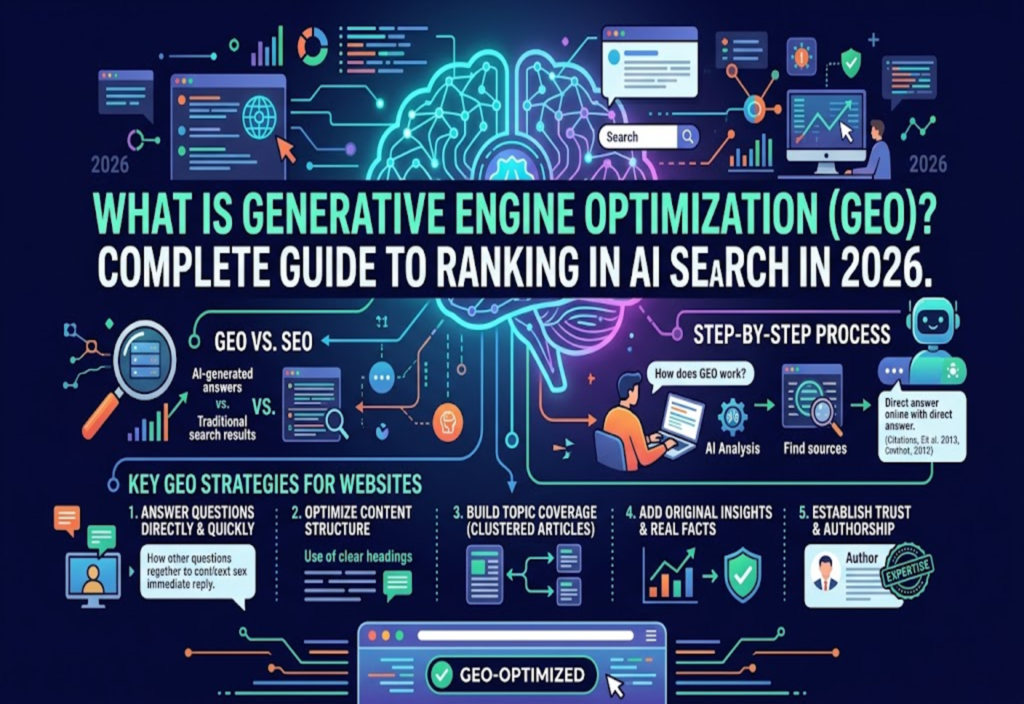
Step 1: A User Asks a Question
First, a person enters a question into an AI search tool.
For example:
“How can I make my website faster?”
The question can be short. It can also be long and detailed.
Step 2: The AI Understands the Question
Next, the system looks at the meaning of the question.
It tries to understand what the user wants.
For example, the user may want:
A definition
A guide
A comparison
A list
A solution
A product
A current fact
Therefore, understanding the question is an important part of AI search.
Step 3: The System Finds Information
After that, the AI system may look for useful information.
Depending on the system, it can use websites, documents, databases, or other sources.
The system then has information that can help answer the question.
Step 4: The System Checks the Information
Next, the system may look at different sources.
It can compare information and find useful details.
For this reason, websites should provide clear and accurate information.
Step 5: The AI Creates an Answer
Finally, the system creates a response for the user.
Some AI search systems may also show links or citations.
Therefore, a website can gain visibility when its information is used in an AI-generated answer.
GEO vs SEO
GEO and SEO are related, but they are not exactly the same.
SEO mainly focuses on traditional search results.
On the other hand, GEO focuses on AI-generated search answers.
| SEO | GEO |
|---|---|
| Focuses on search engine results | Focuses on AI-generated answers |
| Uses keywords and search intent | Uses clear answers and useful information |
| Works with search rankings | Works with AI source selection |
| Uses technical SEO | Also needs clear content and good structure |
| Builds search traffic | Can increase AI search visibility |
| Focuses strongly on web pages | Focuses on useful information and sources |
However, you do not have to choose between SEO and GEO.
A good website can use both.
Does GEO Replace SEO?
No. GEO does not replace SEO.
Traditional SEO is still important for website visibility.
For example, SEO helps with:
Keywords
Search intent
Page titles
Headings
Internal links
Technical SEO
Page speed
Mobile design
Search rankings
Meanwhile, GEO puts more attention on:
Clear answers
Useful facts
Good structure
Topic coverage
Trust
Original information
Easy-to-understand content
Therefore, the two methods can work together.
Why Search Intent Matters for GEO
Search intent means the reason behind a search.
In other words, it tells you what the person really wants.
For example, someone searches:
“What is GEO?”
That person probably wants a simple explanation.
Another person searches:
“How to optimize a website for AI search?”
That person wants a practical guide.
Similarly, someone may search:
“Best GEO tools for websites.”
That person may want a list of tools.
Because these searches have different goals, the content should also be different.
Find the Main Question
First, find the main question behind the keyword.
Then, answer that question clearly.
After that, cover related questions.
This approach helps readers find the information they need.
How to Optimize Content for GEO
There is no magic trick that guarantees a place in every AI answer.
Still, you can follow several useful practices.
1. Answer the Question Quickly
Start important sections with a direct answer.
Do not make readers go through five paragraphs before they find the main point.
For example:
Instead of writing a long introduction, start with:
“GEO is the process of improving online content so AI search systems can understand and use it more easily.”
Then explain the topic in more detail.
2. Use Clear Headings
Clear headings make an article easier to read.
They also help readers find specific information.
For example, you can use headings such as:
What Is GEO?
How Does GEO Work?
GEO vs SEO
How to Improve GEO
Common GEO Mistakes
As a result, both readers and search systems can understand the page structure more easily.
3. Keep Paragraphs Short
Long paragraphs can make an article hard to read.
Instead, keep each paragraph focused on one main idea.
Also, use short sentences when possible.
This makes your content easier to scan.
4. Cover the Topic Fully
Do not focus on one keyword only.
Instead, cover the main topic from different useful angles.
For example, an article about GEO can discuss:
GEO meaning
AI search
SEO
Search intent
Content structure
AI answers
Trust
Internal links
Technical SEO
Content updates
Therefore, readers can get more value from one page.
5. Add Real Facts
Useful facts can make content stronger.
For example, instead of saying:
“AI search is changing the internet.”
Explain what is changing.
You can discuss direct answers, longer questions, AI summaries, source links, and new search habits.
In this way, your statement becomes clearer.
6. Use Simple Examples
Examples can make difficult ideas easier.
For instance, an online store can provide clear product details such as:
Product name
Main features
Size
Price
Material
Use
Common questions
As a result, users can understand the product faster.
Build Strong Topic Coverage
One article is not always enough to cover a large topic.
Therefore, create several useful articles around the same subject.
This is often called a topic cluster.
Create Related Articles
For example, an AI website can create a group of articles about AI agents.
The group may include:
What Are AI Agents?
How Do AI Agents Work?
AI Agents vs Chatbots
AI Agent Frameworks
AI Agent Tools
AI Agent Security
AI Agent Use Cases
Then, connect these articles with internal links.
This helps readers move from one related topic to another.
Add Internal Links
Internal links connect pages on the same website.
For example, your GEO article can link to your AI SEO article.
Then, your AI SEO article can link back to the GEO guide.
As a result, visitors can learn more without leaving your website.
Why Original Content Matters
The internet already contains millions of articles.
Because of this, simply rewriting another article may not give readers much new value.
Instead, try to add something useful and original.
Add Your Own Examples
You can explain an idea with your own examples.
For example, if you test an AI tool, explain:
What the tool does
How you used it
What worked
What did not work
Who may find it useful
This gives readers information that a basic definition may not provide.
Share Real Experience
When possible, add your own tests and results.
You can include:
Screenshots
Tests
Examples
Comparisons
Step-by-step results
However, only share results that you actually tested.
Why Trust Matters in GEO
Trust is important for online content.
People want accurate information. AI systems also need useful sources.
Therefore, make your website clear and trustworthy.
Show the Author
Add an author name to important articles.
You can also add a short author bio.
The bio can explain the writer’s experience with the topic.
Use Reliable Sources
When you mention research, numbers, or important facts, use reliable sources.
For example, you can use:
Official websites
Government sources
Research papers
University sources
Official product documentation
In addition, link to the original source when possible.
Keep Facts Accurate
Always check important facts before publishing.
This is especially useful for topics such as:
AI tools
Software features
Prices
Security
Technology
Legal rules
Financial information
If information changes, update the article.
Can Structured Data Help GEO?
Structured data is extra information added to a webpage.
It helps search systems understand what a page is about.
For example, structured data can describe:
Articles
Products
Events
Organizations
FAQs
Reviews
However, structured data does not guarantee an AI search result.
Still, correct structured data can help search systems understand a page more clearly.
Use Correct Structured Data
Only use structured data that matches the page.
For example, do not mark an article as a product review if it does not contain a real review.
Therefore, accuracy should always come first.
Create Content Around Questions
People often search by asking questions.
AI search makes this even more common because users can write questions in a natural way.
Use Question-Based Headings
For example, instead of using only:
GEO
you can use:
What Is Generative Engine Optimization?
You can also use:
How Does GEO Work?
Another useful heading can be:
How Is GEO Different From SEO?
These headings tell readers exactly what they will learn.
Add Useful FAQs
An FAQ section can answer common questions.
However, do not add questions just to increase word count.
Every answer should provide useful information.
Keep Your Content Fresh
AI search and online tools change quickly.
Because of this, old content can become outdated.
For example, a tool may change its features or pricing.
Therefore, review important articles from time to time.
Update Old Information
Check your articles for:
Old facts
Broken links
Old screenshots
Old tool names
Old prices
Old examples
Missing information
Then, update the content where needed.
Do Not Change the Date Only
Changing the article date does not automatically make the content fresh.
Instead, make real changes.
Add new information.
Remove old information.
Fix errors.
Improve unclear sections.
As a result, the update provides real value.
Technical SEO Still Matters
GEO does not remove the need for technical SEO.
Your website still needs to work well for people and search systems.
Make Your Website Easy to Crawl
Search systems need to access your important pages.
Therefore, check your website settings and make sure important pages are not blocked by mistake.
Improve Page Speed
Slow websites can create a poor user experience.
So, try to improve page speed.
You can:
Compress images
Remove unnecessary scripts
Reduce large files
Use good hosting
Keep website code clean
Make Your Website Mobile Friendly
Many people use phones to browse the web.
Therefore, your website should work well on small screens.
Check your:
Text size
Buttons
Menus
Images
Tables
Forms
Navigation
A mobile-friendly design makes reading easier.
Why Internal Links Are Important
Internal links connect related pages.
They help visitors discover more content.
They can also help search systems understand the relationship between pages.
Use Clear Anchor Text
Avoid using only:
“Click here”
Instead, use useful text such as:
“learn more about AI SEO”
This tells the reader what the linked page is about.
Use Helpful External Links
External links can support important information.
For example, when discussing an AI product, you can link to its official documentation.
Similarly, research claims can link to the original study.
Choose Original Sources
Whenever possible, use the original source.
For example, an official company page may be better than a random blog when discussing an official product feature.
Therefore, always check where your information comes from.
Common GEO Mistakes
GEO is still a new area for many website owners.
As a result, some people may use the wrong methods.
Here are common mistakes to avoid.
Mistake 1: Using Too Many Keywords
Do not repeat the same keyword in every sentence.
Keyword stuffing can make content hard to read.
Instead, use natural language.
Mistake 2: Writing Only for AI
Your readers should come first.
Do not make your article strange or difficult just because you want AI systems to understand it.
Write clear content for people.
Good content can also be easier for machines to understand.
Mistake 3: Making Big Promises
Avoid statements such as:
“This method guarantees AI search rankings.”
No method can guarantee that.
AI systems can change their search methods and results.
Therefore, use realistic language.
Mistake 4: Copying Other Websites
Copying content does not create real value.
Instead, add your own examples, research, tests, and explanations.
Mistake 5: Ignoring SEO
GEO does not mean you should stop doing SEO.
Continue working on:
Technical SEO
Search intent
Keywords
Internal links
Page speed
Mobile design
Helpful content
Mistake 6: Making Content Long Without Value
Long content is not automatically better.
For example, a 3,000-word article with repeated ideas may be less useful than a clear 1,500-word guide.
Therefore, focus on value instead of word count.
GEO for Blogs
Blog owners can use GEO by answering real questions.
First, choose a topic that your audience cares about.
Then, find related questions.
After that, create a useful guide that answers those questions.
Also, add examples and trusted sources.
GEO for E-Commerce Websites
Online stores can also improve their content for AI search.
Product pages should clearly explain what a product is and who it is for.
Include details such as:
Product name
Features
Size
Price
Material
Benefits
Use cases
Common questions
Clear product pages can help customers make better decisions.
GEO for Software Websites
Software companies should explain their products in simple language.
For example, create pages for:
Features
Pricing
Tutorials
Use cases
Integrations
Help guides
FAQs
In addition, keep the information updated when the software changes.
GEO for Local Businesses
Local businesses should keep their online information accurate.
Important details include:
Business name
Address
Phone number
Opening hours
Services
Service area
Also, keep these details consistent across major websites and business profiles.
GEO for Technology Websites
Technology websites have many opportunities to create useful GEO content.
For example, a technology website can cover:
AI agents
AI automation
Generative AI
AI search
AI SEO
RAG
AI coding tools
AI security
AI APIs
Then, connect these topics with internal links.
This creates a useful network of related information.
How to Measure GEO Results
GEO is still developing.
Therefore, there is no single number that can tell you whether your GEO strategy is successful.
Instead, check several signals.
Watch Search Traffic
Use your search and analytics tools to track:
Clicks
Impressions
Search terms
Organic traffic
Page views
This can show how your content performs in normal search.
Check AI Mentions
You can also test AI search tools.
Ask questions related to your topic.
Then, check which websites and sources appear in the answers.
However, do not treat one AI answer as a permanent result.
AI answers can change over time.
Check Referral Traffic
If an AI search service sends visitors to your website, check your analytics.
This can help you understand whether AI search is bringing new visitors.
Check Conversions
Traffic is useful, but it is not the only goal.
Also check whether visitors:
Subscribe
Contact your business
Buy a product
Download a file
Read more articles
Choose metrics that match your website goals.
Useful Tools for GEO
You do not need a special GEO tool to begin.
Instead, you can use tools that already help with SEO and website analysis.
Search Performance Tools
These tools can show:
Search clicks
Impressions
Search queries
Page performance
Therefore, they can help you understand how your content performs in normal search.
Analytics Tools
Analytics tools can show:
Visitors
Traffic sources
Popular pages
User actions
Conversions
SEO Tools
SEO tools can help with:
Keyword research
Competitor research
Technical checks
Backlink analysis
Content planning
AI Search Testing
You can also test your content manually.
Ask AI search tools questions about your topic.
Then, see which sources they use.
Repeat the test at different times because AI answers can change.
A Simple GEO Strategy for 2026
If you are new to GEO, do not make the process too hard.
Start with these steps.
Step 1: Choose a Useful Topic
Pick a topic that matches your website.
Also, make sure your audience is interested in it.
Step 2: Find Real Questions
Look for questions people ask about the topic.
Then, group similar questions together.
Step 3: Answer the Main Question
Give a clear answer near the beginning.
After that, explain the topic in more detail.
Step 4: Use Clear Headings
Break the article into useful H2 and H3 sections.
This makes the page easier to read.
Step 5: Add Examples
Use simple examples to explain difficult ideas.
Also, add facts when they help the reader.
Step 6: Add Internal Links
Connect the new article with other useful pages on your website.
This helps readers find more information.
Step 7: Add Trust Signals
Show the author.
Use reliable sources.
Keep facts accurate.
Step 8: Check the Article
Before publishing, check for:
Spelling errors
Broken links
Old facts
Repeated ideas
Long paragraphs
Missing information
Step 9: Keep Improving
Finally, review the article after some time.
If the topic changes, update the content.
GEO and AI-Generated Search Answers
AI search can change the way people interact with search results.
In the past, users often opened several pages.
Now, a user may first read an AI-generated answer.
That answer may use information from more than one source.
Because of this, website owners should focus on creating useful information that can stand on its own.
However, there is no guarantee that an AI system will select a specific website.
The system can change its results at any time.
GEO and AI Agents
AI agents can search for information and complete tasks.
For example, an AI agent may research a topic before preparing a report.
During that process, it may need information from different websites.
Therefore, clear and useful content can help your website become a useful information source.
This is another reason to build strong topic coverage.
The Future of GEO
Search is becoming more conversational.
People can now ask longer questions.
They can also ask follow-up questions.
For example, a person may first ask:
“What is AI automation?”
Then, they may ask:
“Which tasks can I automate?”
After that, they may ask:
“Which tools should I use?”
This creates a different search experience.
More Natural Questions
People can search using normal language.
Therefore, content should also answer questions in a natural way.
More Focus on Trust
Users need accurate information.
AI systems also need useful sources.
For this reason, authorship, facts, sources, and clear explanations are becoming important parts of online content.
More Personalized Search
AI search results may vary by user, platform, location, and context.
Therefore, do not assume that every person will see the same answer.
GEO Best Practices Checklist
Before publishing an article, use this simple checklist:
Understand the search intent.
Answer the main question quickly.
Use clear H2 and H3 headings.
Keep paragraphs short.
Use simple language.
Add useful examples.
Add accurate facts.
Explain difficult terms.
Use keywords naturally.
Add internal links.
Use trusted external sources.
Show the author.
Keep information updated.
Make the page mobile friendly.
Improve page speed.
Check technical SEO.
Avoid keyword stuffing.
Avoid false claims.
Add original value.
Review the article regularly.
Final Thoughts
Generative Engine Optimization is becoming an important part of modern search.
However, GEO is not a secret trick.
It is not about filling an article with keywords.
Instead, it is about creating useful information that people can understand and AI systems can process.
Traditional SEO still matters.
At the same time, AI search is creating new ways for people to discover information.
Therefore, website owners should work on both SEO and GEO.
Start with your audience.
Answer real questions.
Use simple language.
Add useful examples.
Support important facts.
Build related content.
Keep your website healthy.
Finally, update your content when information changes.
By following these steps, you can prepare your website for the changing search environment in 2026.
Frequently Asked Questions About GEO
What does GEO stand for?
GEO stands for Generative Engine Optimization. It means improving online content so AI-powered search systems can understand and potentially use that information in their answers.
Is GEO the same as SEO?
No. SEO mainly focuses on traditional search results. GEO focuses more on AI-generated search answers. However, both methods can work together.
Does GEO replace SEO?
No. SEO is still important. GEO should be used as an additional part of your search strategy.
Can GEO guarantee AI search rankings?
No. There is no guaranteed method for appearing in every AI-generated answer.
How can I start GEO?
Start by answering real questions clearly. Then improve your content structure, facts, internal links, authorship, and technical SEO.
Does structured data help GEO?
Correct structured data can help search systems understand webpage information. However, it does not guarantee AI search visibility.
Should I use keywords for GEO?
Yes, but use them naturally. Focus on the user’s question instead of repeating the same keyword many times.
Is long-form content better for GEO?
Not always. Good content should be as long as needed to answer the topic. Quality is more important than word count.
How often should I update GEO content?
Update important content when facts, tools, prices, links, or other details change. Regular checks can help keep your information accurate.
What is the main goal of GEO?
The main goal is to create useful, clear, accurate, and well-organized information that people can use and AI-powered search systems can understand.