IVR vs AI has become one of the biggest discussions in customer service as businesses look for faster, smarter, and more efficient ways to support customers. Traditional Interactive Voice Response (IVR) systems have been used for decades to automate phone calls, but modern customers now expect natural conversations, instant answers, and personalized support.
Instead of navigating long phone menus and pressing multiple buttons, customers want to explain their problems in their own words. This growing demand has led many organizations to replace traditional IVR systems with AI Voice Agents powered by artificial intelligence, natural language processing (NLP), and machine learning.
In this guide, you’ll learn the key differences between IVR vs AI, understand why businesses are making the switch, and discover how AI Voice Agents are transforming customer service in 2026.
What Is IVR?
Interactive Voice Response (IVR) is an automated telephone system that allows customers to interact with a business through voice prompts or keypad selections.
A typical IVR system might ask customers to choose from options such as:
- Press 1 for Sales
- Press 2 for Billing
- Press 3 for Technical Support
- Press 4 to Speak with an Agent
IVR systems help businesses automate repetitive customer service tasks and reduce the workload on support teams.
Common uses include:
- Call routing
- Balance inquiries
- Appointment scheduling
- Order tracking
- Payment processing
- Customer verification
Although IVR improves efficiency, it follows predefined rules and cannot fully understand natural conversations.
As customer expectations continue to evolve, these limitations have become increasingly noticeable.
What Are AI Voice Agents?
AI Voice Agents are intelligent virtual assistants that communicate with customers using natural language instead of menu-based options.
They combine several advanced technologies, including:
- Artificial Intelligence (AI)
- Natural Language Processing (NLP)
- Speech Recognition
- Machine Learning
- Conversational AI
Instead of asking customers to press buttons, AI Voice Agents allow people to speak naturally.
For example, a customer can simply say:
“I want to check the status of my recent order.”
The AI understands the request, retrieves the required information, and responds conversationally.
Moreover, AI Voice Agents continue learning from previous interactions, making future conversations more accurate and personalized.
How AI Voice Agents Work
Unlike traditional IVR systems, AI Voice Agents process conversations intelligently.
The workflow generally follows these steps:
Listen to the Customer
The AI converts spoken words into text using speech recognition technology.
Understand Customer Intent
Natural Language Processing analyzes what the customer actually wants rather than matching simple keywords.
Process the Request
The AI connects with company databases, CRM systems, or external services to retrieve information.
Generate a Response
Using conversational AI, the system responds naturally instead of reading scripted menu options.
Learn from Interactions
Machine learning continuously improves the AI’s understanding based on customer conversations.
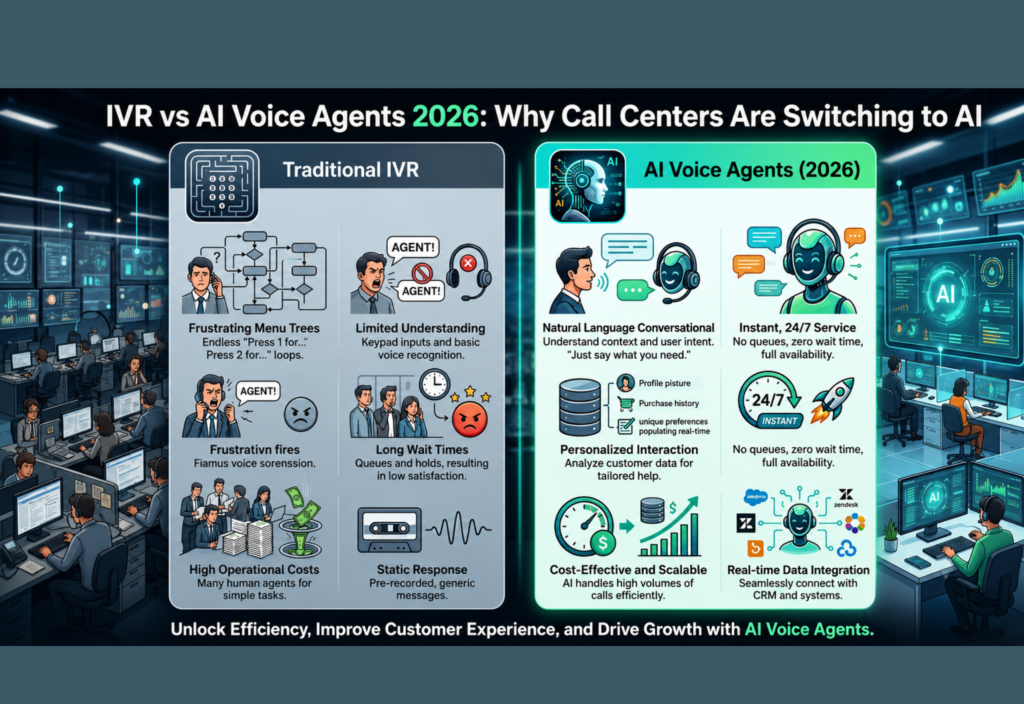
IVR vs AI: Key Differences
When comparing IVR vs AI, the biggest difference lies in how customers interact with the system.
Communication
Traditional IVR
- Menu-based navigation
- Keypad selections
- Scripted responses
AI Voice Agents
- Natural conversations
- Voice commands
- Human-like responses
Understanding Customer Requests
Traditional IVR
- Limited understanding
- Fixed commands
- Rule-based interactions
AI Voice Agents
- Context awareness
- Intent recognition
- Flexible conversations
Customer Experience
Traditional IVR often requires customers to navigate multiple menus before reaching the right department.
AI Voice Agents allow customers to explain their problem immediately, creating a smoother and more satisfying experience.
Learning Ability
Traditional IVR systems remain unchanged unless manually updated.
In contrast, AI Voice Agents continuously improve through machine learning, allowing them to become smarter over time.
Language Support
Most IVR systems support only a limited number of languages.
Modern AI Voice Agents can communicate in multiple languages while recognizing different accents and speech patterns.
Availability
Both technologies provide 24/7 customer support.
However, AI Voice Agents offer much richer conversations while remaining available around the clock.
Problem Solving
IVR systems handle simple tasks effectively.
AI Voice Agents manage both routine requests and more complex customer interactions with greater accuracy.
Why Traditional IVR Is Becoming Less Effective
Although IVR still serves many businesses, customer expectations have changed significantly.
Some common frustrations include:
- Long phone menus
- Endless button pressing
- Repeating information after transfers
- Limited understanding
- Slow issue resolution
- Poor personalization
As a result, many customers prefer businesses that provide faster and more natural support experiences.
Why Call Centers Are Switching to AI
Businesses are adopting AI Voice Agents because they improve customer satisfaction while reducing operational costs.
Faster Customer Service
Instead of navigating several menu options, customers simply explain their problem.
The AI immediately identifies the request and provides an appropriate solution.
This significantly reduces waiting times.
Better Customer Experience
Customers prefer conversations over complicated phone menus.
AI Voice Agents understand customer intent, ask relevant follow-up questions, and provide personalized responses.
Consequently, customer satisfaction improves considerably.
Lower Operating Costs
Managing a large customer support team can be expensive.
AI Voice Agents handle thousands of conversations simultaneously without requiring additional staff.
Therefore, businesses reduce operating expenses while maintaining high-quality support.
24/7 Availability
Unlike human agents, AI never requires breaks or vacations.
Customers receive assistance anytime, including nights, weekends, and holidays.
This continuous availability improves customer loyalty.
Personalized Conversations
Modern AI systems remember previous interactions.
For example, returning customers may receive personalized recommendations based on:
- Purchase history
- Previous support requests
- Account information
- Customer preferences
This creates a much more engaging experience.
Benefits of AI Voice Agents
Businesses implementing AI Voice Agents enjoy numerous advantages.
Increased Productivity
AI automates repetitive tasks such as:
- Appointment booking
- Order tracking
- Billing inquiries
- Password resets
- Frequently asked questions
Human agents can then focus on solving more complex customer issues.
Smarter Call Routing
AI understands customer intent immediately.
Instead of transferring calls multiple times, it routes customers directly to the appropriate department.
This improves first-call resolution rates.
Better Business Insights
Every customer interaction generates valuable information.
AI analyzes conversations to identify:
- Common customer problems
- Frequently asked questions
- Product feedback
- Customer satisfaction trends
These insights help businesses improve products and services.
Multilingual Support
Many AI Voice Agents support dozens of languages.
Consequently, businesses can serve international customers without hiring separate language-specific support teams.
Challenges of AI Voice Agents
Although AI offers many advantages, there are still some limitations.
Businesses should consider the following challenges:
- Understanding strong regional accents
- Handling highly emotional conversations
- Protecting sensitive customer information
- Integrating with older business systems
- Training AI with high-quality data
Fortunately, AI technology continues improving each year, making these challenges less significant over time.
Best Use Cases for AI Voice Agents
AI Voice Agents work particularly well across many industries.
Popular applications include:
- Customer support
- Banking services
- Healthcare appointment scheduling
- E-commerce order tracking
- Insurance claims
- Travel bookings
- Utility companies
- Technical support
- Restaurant reservations
As AI capabilities expand, businesses continue discovering new ways to automate customer interactions.
Frequently Asked Questions
What is the main difference between IVR and AI Voice Agents?
Traditional IVR relies on menu-based navigation and predefined rules, while AI Voice Agents understand natural language and hold conversational interactions with customers.
Can AI Voice Agents replace human agents?
AI handles repetitive and routine customer requests efficiently. However, complex situations requiring empathy, negotiation, or critical decision-making still benefit from human support.
Are AI Voice Agents available 24/7?
Yes. AI Voice Agents provide continuous customer support throughout the day without requiring breaks or shifts.
Which businesses benefit most from AI Voice Agents?
Organizations with high call volumes—including e-commerce stores, banks, healthcare providers, telecom companies, insurance firms, and customer support centers—often see the greatest benefits.
Final Thoughts
The comparison between IVR vs AI clearly demonstrates why businesses are rapidly adopting AI Voice Agents in 2026. While traditional IVR systems remain useful for basic automation, they often struggle to meet modern customer expectations for speed, personalization, and natural communication.
AI Voice Agents offer a more advanced solution by understanding conversational language, delivering instant responses, reducing waiting times, and providing personalized customer experiences around the clock. They also improve operational efficiency by automating repetitive tasks and allowing human agents to focus on more complex issues.
As artificial intelligence continues to evolve, AI-powered voice technology will become an even more important part of customer service. Businesses that embrace AI today will be better positioned to deliver faster, smarter, and more satisfying customer support while staying competitive in an increasingly digital world.