Artificial Intelligence (AI) has become one of the most powerful technologies shaping digital marketing in 2026. Businesses of every size are using AI to better understand customer behavior, automate repetitive tasks, improve marketing campaigns, and create more personalized experiences. Instead of replacing marketers, AI acts as a smart assistant that helps professionals make faster decisions while allowing them to focus on creativity, strategy, and building stronger customer relationships.
From content creation and search engine optimization to predictive analytics and customer support, AI is helping companies achieve better results with less manual effort. However, the most successful businesses combine AI-powered automation with human expertise to deliver authentic and valuable customer experiences.
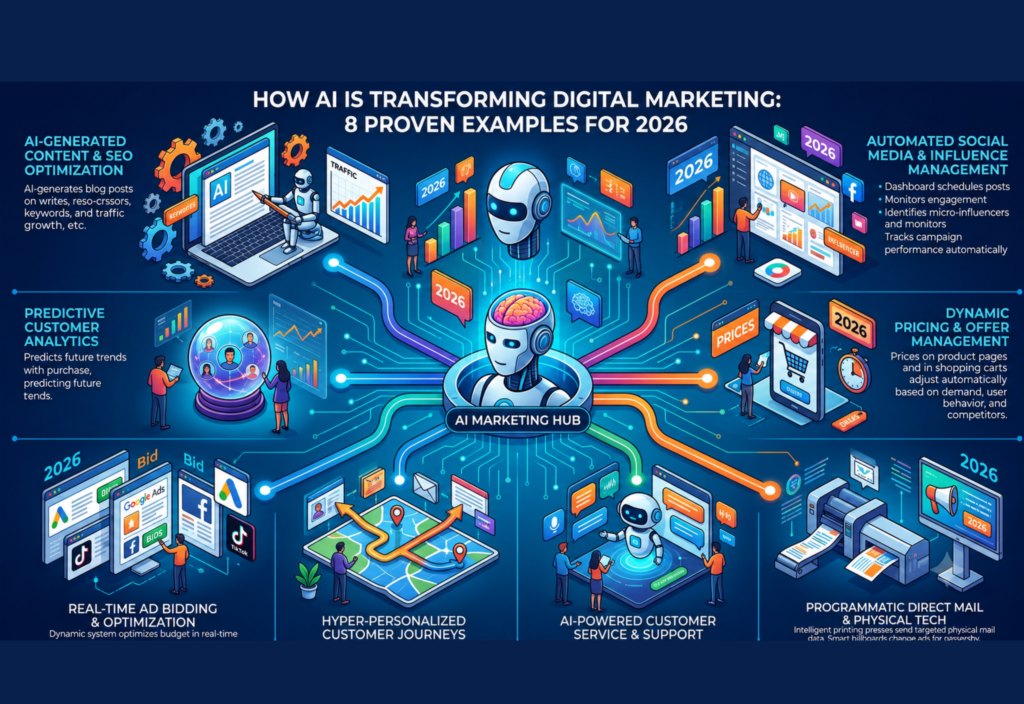
In this guide, we’ll explore eight proven ways AI is transforming digital marketing in 2026 and why it has become an essential part of modern marketing strategies.
Why AI Matters in Digital Marketing
Today’s customers expect personalized recommendations, instant responses, and relevant content across every digital platform. Meeting these expectations manually is difficult, especially as businesses continue to collect larger amounts of customer data.
AI helps marketers by:
- Automating repetitive marketing tasks
- Improving customer experiences
- Analyzing large datasets quickly
- Supporting smarter business decisions
- Increasing campaign efficiency
- Reducing operational costs
Rather than replacing marketing professionals, AI gives them more time to focus on creativity, strategy, and customer engagement.
1. Personalized Customer Experiences
One of AI’s biggest advantages is its ability to deliver personalized experiences for every customer. Instead of showing identical content to everyone, AI analyzes customer behavior and recommends products, services, or content based on individual interests.
AI can consider:
- Browsing history
- Previous purchases
- Search behavior
- Location
- Device type
- Customer preferences
For example, an online clothing store can recommend products similar to those a customer recently viewed, while a software company can display different landing pages for beginners and experienced users.
Personalization helps businesses increase customer satisfaction, improve engagement, encourage repeat purchases, and achieve higher conversion rates.
2. AI-Powered Content Creation
Creating high-quality content consistently requires significant time and planning. AI writing assistants help marketers generate blog outlines, email drafts, social media captions, product descriptions, FAQs, and video scripts much faster.
Although AI speeds up content production, human review remains essential. Every piece of AI-generated content should be checked for accuracy, originality, readability, and brand consistency before publication.
Businesses that combine AI efficiency with human creativity produce content that is more engaging, trustworthy, and valuable for readers.
3. Smarter SEO Optimization
Search engine optimization continues to evolve, and AI has become an important part of successful SEO strategies.
Modern AI tools help marketers:
- Discover valuable keyword opportunities
- Analyze competitors
- Improve content structure
- Understand search intent
- Suggest related topics
- Detect technical SEO issues
Instead of focusing on a single keyword, AI encourages businesses to create comprehensive content that answers multiple related questions. This approach improves topical authority and increases the likelihood of achieving better search engine rankings.
4. Predictive Analytics
Predictive analytics allows businesses to make smarter marketing decisions by analyzing historical customer data and identifying future trends.
AI can help predict:
- Customer purchase behavior
- Product demand
- Campaign performance
- Customer lifetime value
- Best publishing times
- Churn risk
For example, an online retailer can identify customers who are likely to stop purchasing and automatically send personalized offers before they leave. This proactive approach improves customer retention while reducing marketing costs.
5. AI Chatbots and Customer Support
Customer support has changed significantly with the adoption of AI-powered chatbots. Unlike traditional automated replies, modern AI chatbots can understand customer questions, provide relevant answers, and assist users around the clock.
Businesses use AI chatbots to:
- Answer frequently asked questions
- Track customer orders
- Schedule appointments
- Recommend products and services
- Collect customer inquiries
- Provide 24/7 support
These capabilities improve response times, reduce operational costs, and increase customer satisfaction. While AI handles routine queries efficiently, human support remains important for resolving complex issues and building stronger customer relationships.
6. AI-Powered Email Marketing
Email marketing continues to be one of the most effective digital marketing channels, and AI has made it even more powerful. Instead of sending the same message to every subscriber, AI analyzes customer behavior to create highly personalized email campaigns.
AI helps marketers:
- Personalize subject lines
- Segment email subscribers
- Recommend relevant products
- Optimize email sending times
- Predict open and click-through rates
- Improve campaign performance
By delivering personalized emails, businesses can increase engagement, strengthen customer relationships, and improve conversion rates.
7. AI in Paid Advertising
Managing advertising campaigns manually can be time-consuming and expensive. AI helps marketers optimize advertising budgets by analyzing campaign performance in real time and making intelligent adjustments automatically.
AI can:
- Optimize bidding strategies
- Identify high-performing audiences
- Test multiple ad variations
- Reduce unnecessary advertising costs
- Improve return on investment (ROI)
- Monitor campaign performance continuously
For example, if one advertisement performs better than others, AI can automatically allocate more budget to the successful campaign. This allows businesses to maximize results while minimizing wasted advertising spend.
8. AI and Social Media Intelligence
Social media platforms generate enormous amounts of customer data every day. AI helps businesses analyze this information to understand audience behavior and improve marketing strategies.
AI can identify:
- Trending topics
- Customer interests
- Brand mentions
- Audience sentiment
- Competitor activity
- Best publishing times
By analyzing these insights, businesses can create more relevant content, improve engagement, and respond to customer needs more effectively. AI also helps marketers discover emerging trends before they become mainstream, giving businesses a competitive advantage.
Benefits of AI in Digital Marketing
Businesses that use AI responsibly can experience several important benefits, including:
- Improved productivity
- Faster decision-making
- Better customer experiences
- More accurate audience targeting
- Higher conversion rates
- Lower marketing costs
- Stronger campaign performance
- More efficient use of marketing budgets
Rather than replacing marketing teams, AI helps professionals work more efficiently while focusing on strategy, creativity, and customer relationships.
Challenges of AI in Digital Marketing
Although AI offers many advantages, businesses should also be aware of its limitations.
Data Privacy: Customer information should always be collected and managed responsibly while complying with privacy regulations.
Content Accuracy: AI-generated content should be reviewed carefully before publication to ensure accuracy and reliability.
Human Creativity: AI can assist with ideas and automation, but authentic storytelling, emotional connection, and creative strategy still depend on human expertise.
Ethical AI Use: Businesses should use AI responsibly, avoid misleading content, and maintain transparency whenever appropriate.
Best Practices for Using AI
To get the best results from AI in digital marketing:
- Combine AI with human creativity.
- Review and verify AI-generated content.
- Protect customer privacy.
- Focus on creating original, valuable content.
- Monitor campaign performance regularly.
- Keep learning as AI technology evolves.
These practices help businesses build trust while maximizing the benefits of artificial intelligence.
Final Thoughts
Artificial intelligence has become an essential part of digital marketing in 2026. From personalized customer experiences and AI-powered content creation to SEO, predictive analytics, chatbots, email marketing, paid advertising, and social media intelligence, AI enables businesses to market more efficiently and make smarter decisions.
However, technology alone is not enough. Long-term success depends on combining AI with human creativity, ethical decision-making, and a deep understanding of customer needs. Businesses that embrace AI while maintaining authenticity and delivering real value will be better positioned to build stronger customer relationships and stay competitive in the rapidly evolving digital landscape.