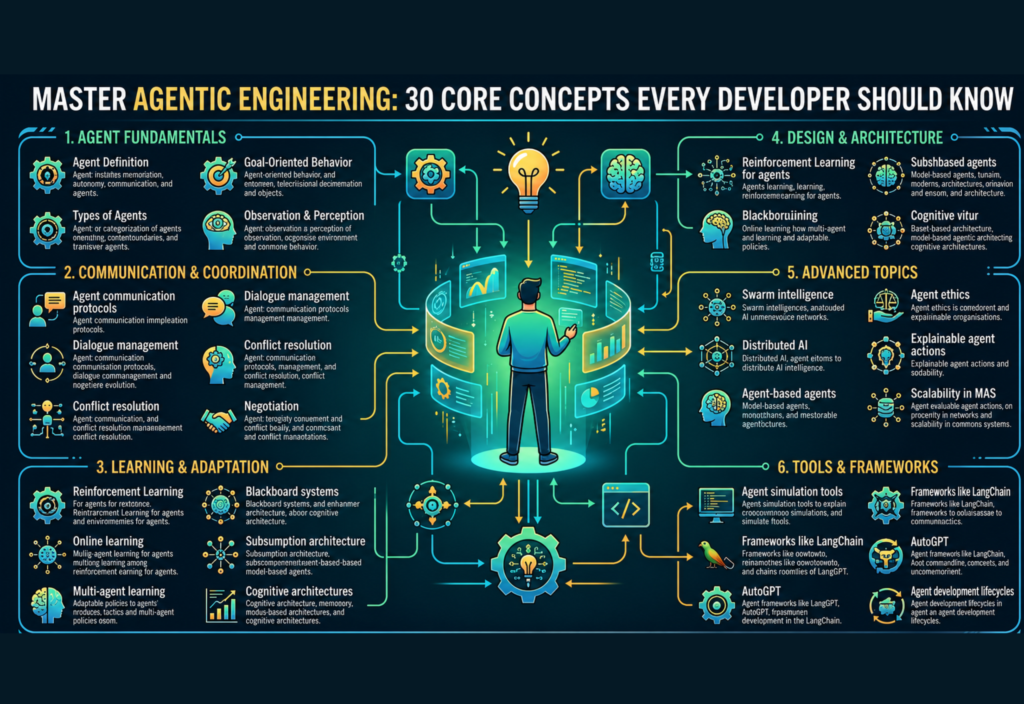
Artificial intelligence is evolving rapidly, and Agentic Engineering is becoming one of the most important skills for developers building modern AI applications. Unlike traditional software that simply follows predefined rules, Agentic Engineering focuses on designing intelligent AI agents that can reason, plan, use tools, remember information, and complete complex tasks with minimal human intervention. As businesses increasingly adopt autonomous AI systems, understanding Agentic Engineering is essential for developers, software engineers, researchers, and AI enthusiasts who want to stay ahead in 2026.
From workflow automation and intelligent assistants to AI-powered research and customer support, agentic systems are changing how software is built. Learning the core concepts behind these systems helps developers create scalable, secure, and reliable AI applications that solve real-world problems efficiently.
In this guide, you’ll learn the 30 core concepts of Agentic Engineering that every developer should understand before building autonomous AI agents.
What Is Agentic Engineering?
Agentic Engineering is the process of designing, developing, deploying, and managing AI agents capable of working independently toward specific goals. These AI systems combine reasoning, planning, memory, tool usage, and decision-making to solve problems far more effectively than traditional rule-based automation.
Unlike conventional software, AI agents continuously evaluate information, adapt to changing situations, communicate with external tools, and improve outcomes based on context.
Today, Agentic Engineering is widely used in:
- AI coding assistants
- Customer support automation
- Business workflow automation
- Research assistants
- Software development
- Data analysis
- Intelligent personal assistants
As AI technology advances, Agentic Engineering is becoming a fundamental skill for building the next generation of intelligent software.
Why Is Agentic Engineering Important?
Modern businesses expect AI systems to perform more than simple conversations. They need intelligent applications capable of making decisions, solving multi-step problems, and working autonomously.
Some major benefits of Agentic Engineering include:
- Improved automation
- Better decision-making
- Increased productivity
- Reduced manual work
- Smarter AI assistants
- Faster workflow execution
- Better scalability
As organizations adopt AI across different industries, developers who understand Agentic Engineering will have a significant advantage.
Goal-Oriented Design
Every successful AI agent begins with a clearly defined objective.
Goal-oriented design ensures that an AI agent always understands what it is trying to accomplish before taking action. A clear objective helps the system prioritize tasks, avoid unnecessary operations, and generate consistent results.
Without well-defined goals, AI agents may produce inconsistent or inefficient outcomes.
Reasoning
Reasoning enables an AI agent to evaluate information before responding.
Instead of producing the first possible answer, the agent analyzes available knowledge, considers multiple possibilities, and selects the most appropriate solution.
Strong reasoning improves:
- Accuracy
- Reliability
- Problem solving
- Decision quality
Reasoning is one of the core foundations of Agentic Engineering.
Planning
Planning allows AI agents to divide large objectives into smaller, manageable tasks.
Instead of solving an entire problem at once, the agent creates an organized sequence of actions.
Effective planning helps:
- Reduce errors
- Improve efficiency
- Simplify complex workflows
- Complete long-running tasks successfully
Planning is essential for autonomous AI systems that operate without constant human supervision.
Memory
Memory allows AI agents to remember previous conversations, completed tasks, and user preferences.
Instead of forgetting earlier interactions, intelligent agents maintain relevant information throughout a workflow.
Different types of memory include:
- Short-term memory
- Long-term memory
- Conversation history
- Task memory
- Knowledge memory
Memory significantly improves user experience by creating more natural and personalized interactions.
Context Management
Context management ensures that an AI agent always understands the current situation.
Maintaining relevant context prevents confusion during long conversations and enables more accurate responses.
Good context management allows agents to:
- Continue previous discussions
- Understand user intent
- Maintain workflow consistency
- Avoid repeated actions
Without proper context management, even advanced AI systems can become unreliable.
Tool Integration
Modern AI agents become significantly more powerful when connected to external tools.
Instead of relying only on built-in knowledge, they can interact with:
- APIs
- Databases
- Search engines
- Cloud services
- Local software
- Business applications
Tool integration enables AI agents to complete real-world tasks instead of simply generating text.
Task Decomposition
Complex problems become much easier when divided into smaller tasks.
Task decomposition allows AI agents to:
- Break projects into manageable steps
- Solve problems systematically
- Reduce complexity
- Improve success rates
This approach is widely used in advanced Agentic Engineering workflows.
Workflow Automation
Workflow automation allows AI agents to complete repetitive processes automatically.
Examples include:
- Processing documents
- Sending emails
- Managing customer requests
- Organizing research
- Updating databases
- Scheduling tasks
By automating routine work, organizations save time while improving efficiency and consistency.
Decision Making
Decision-making enables AI systems to evaluate available information and choose the most suitable action.
Good decision-making depends on:
- Context
- Goals
- Available resources
- Previous outcomes
- External information
Reliable decision-making is one of the defining characteristics of intelligent AI agents.
Error Recovery
Even advanced AI systems occasionally make mistakes.
A well-designed agent should detect problems, recover automatically when possible, and continue working without requiring constant human intervention.
Effective error recovery includes:
- Detecting failures
- Retrying operations
- Logging errors
- Suggesting alternative solutions
- Recovering interrupted workflows
This greatly improves reliability in production environments.
Multi-Agent Collaboration
Some AI applications require multiple intelligent agents working together.
For example:
- One agent performs research.
- Another analyzes information.
- A third writes reports.
- A fourth reviews the final output.
This collaborative approach improves scalability, efficiency, and specialization, making it a powerful technique in modern Agentic Engineering systems.
Prompt Engineering
Prompt Engineering remains one of the most valuable skills when building AI agents.
Well-written prompts help AI systems:
- Understand user intent
- Produce accurate responses
- Follow instructions correctly
- Reduce hallucinations
- Maintain consistent formatting
Even the most advanced AI model performs better when given clear, structured prompts.
Retrieval-Augmented Generation (RAG)
Retrieval-Augmented Generation (RAG) allows AI agents to retrieve external information before generating responses.
Instead of relying entirely on the model’s internal knowledge, RAG combines AI reasoning with external data sources such as:
- Knowledge bases
- Company documents
- PDFs
- Databases
- Search indexes
This approach significantly improves factual accuracy and enables AI agents to provide more reliable and up-to-date answers.
Knowledge Bases
Knowledge bases store structured information that AI agents can access whenever needed.
Examples include:
- Internal company documentation
- Product manuals
- Customer support articles
- Research databases
- Technical documentation
Using organized knowledge bases helps improve response consistency, accuracy, and overall decision quality.
API Communication
API communication allows AI agents to interact with third-party services and software systems.
Through APIs, agents can:
- Retrieve real-time information
- Send data to external platforms
- Automate workflows
- Connect with business software
- Perform cloud-based operations
API integration is a key component of modern Agentic Engineering because it enables AI systems to perform meaningful real-world tasks rather than simply generating text.
State Management
State management is an essential concept in Agentic Engineering because it allows AI agents to keep track of their progress while completing long-running tasks. Instead of repeating the same action or losing track of previous steps, the agent maintains its current state throughout the workflow.
Effective state management helps AI agents:
- Track completed tasks
- Resume interrupted workflows
- Avoid duplicate actions
- Improve workflow consistency
- Handle complex multi-step processes
Without proper state management, autonomous AI systems can become unreliable and inefficient.
Feedback Loops
Feedback loops enable AI agents to improve their performance over time. By analyzing previous actions and outcomes, an agent can refine future decisions and optimize workflow execution.
Benefits of feedback loops include:
- Improved accuracy
- Better decision-making
- Continuous optimization
- Reduced errors
- Enhanced user experience
Feedback mechanisms are an important part of modern Agentic Engineering because they help AI systems become more effective through continuous evaluation.
Human Oversight
Although AI agents can operate independently, human supervision remains important for high-impact decisions.
Human oversight allows developers or users to:
- Review AI-generated outputs
- Approve critical actions
- Correct mistakes
- Ensure compliance with business policies
- Reduce operational risks
Combining automation with human review creates safer and more reliable AI systems.
Security
Security is one of the most important pillars of Agentic Engineering. AI agents often process sensitive information, connect to external services, and perform automated tasks that require strong protection.
Developers should implement security measures such as:
- Secure authentication
- API protection
- Data encryption
- Access control
- Regular software updates
- Activity monitoring
A secure AI system protects both users and organizational data from unauthorized access.
Privacy
Privacy should always be considered when developing AI applications. Users trust AI systems with personal and business information, making responsible data handling essential.
Good privacy practices include:
- Collecting only necessary data
- Protecting confidential information
- Following privacy regulations
- Minimizing external data exposure
- Providing transparency about data usage
Strong privacy policies increase user confidence and improve long-term adoption.
Scalability
As AI applications grow, they must continue performing efficiently even when handling larger workloads.
Scalable Agentic Engineering systems are designed to support:
- More users
- Larger datasets
- Additional AI agents
- Higher request volumes
- Expanded business operations
Building scalability into the architecture from the beginning reduces future development challenges.
Performance Optimization
Users expect AI applications to deliver fast and accurate responses. Performance optimization focuses on reducing latency while maximizing resource efficiency.
Common optimization techniques include:
- Selecting efficient AI models
- Optimizing prompts
- Using caching
- Reducing unnecessary API calls
- Monitoring system resources
- Improving workflow efficiency
Well-optimized AI agents provide a better user experience while reducing operational costs.
Model Selection
Choosing the right AI model is one of the most important decisions in Agentic Engineering.
The ideal model depends on several factors:
- Project goals
- Hardware availability
- Required accuracy
- Response speed
- Memory usage
- Budget
Smaller models often perform well for local applications, while larger language models provide stronger reasoning capabilities for enterprise projects.
Cost Optimization
Running AI agents can become expensive if infrastructure is not managed carefully.
Developers can reduce costs by:
- Selecting efficient models
- Scaling resources intelligently
- Minimizing unnecessary computations
- Optimizing workflows
- Monitoring cloud usage
Cost optimization allows businesses to deploy AI solutions more efficiently without sacrificing performance.
Logging
Logging records important system events that help developers monitor and troubleshoot AI applications.
Useful logs include:
- User requests
- AI responses
- API activity
- Workflow execution
- Error reports
- Performance metrics
Detailed logging simplifies debugging and helps maintain reliable production systems.
Evaluation
Regular evaluation measures the quality and reliability of AI agents.
Important evaluation metrics include:
- Accuracy
- Task completion rate
- Response quality
- Latency
- Reliability
- User satisfaction
Continuous testing ensures AI systems continue meeting business requirements over time.
Adaptability
One of the greatest strengths of Agentic Engineering is adaptability. AI agents should be capable of adjusting to changing environments, updated information, and evolving user requirements.
Adaptable systems can:
- Learn new workflows
- Respond to changing business needs
- Integrate new tools
- Handle unexpected situations
- Improve long-term usefulness
Flexible AI solutions remain valuable as technology continues to evolve.
Reliability
Reliability means users can consistently depend on an AI agent to perform correctly.
Reliable AI systems typically include:
- Comprehensive testing
- Automatic recovery mechanisms
- Continuous monitoring
- Error handling
- Stable infrastructure
Consistency builds trust and encourages wider adoption of autonomous AI applications.
Ethical Development
Responsible AI development is a fundamental part of Agentic Engineering. Developers should design AI systems that are fair, transparent, and accountable.
Ethical development includes:
- Reducing algorithmic bias
- Explaining AI decisions
- Respecting user privacy
- Protecting sensitive information
- Following legal regulations
- Promoting responsible AI usage
Ethical AI strengthens user trust and supports long-term success.
Continuous Learning
Artificial intelligence evolves rapidly. Developers who practice Agentic Engineering should continuously update their knowledge by learning new frameworks, research findings, and best practices.
Ways to continue learning include:
- Reading AI research papers
- Following industry experts
- Building practical projects
- Exploring open-source tools
- Participating in developer communities
- Experimenting with new AI models
Continuous learning helps developers remain competitive in the rapidly changing AI landscape.
Best Practices for Agentic Engineering
Building intelligent AI agents requires careful planning and strong software engineering principles. Following best practices improves reliability, scalability, and long-term maintainability.
Some recommended best practices include:
- Start with simple workflows before adding advanced autonomy.
- Define clear objectives for every AI agent.
- Keep workflows modular and easy to maintain.
- Validate AI-generated outputs before executing critical actions.
- Monitor system performance continuously.
- Test every workflow thoroughly.
- Secure all API integrations.
- Protect sensitive user information.
- Maintain detailed documentation.
- Include human oversight for high-impact decisions.
Applying these practices helps developers create dependable and production-ready AI systems.
Why Agentic Engineering Matters
As organizations increasingly adopt intelligent automation, Agentic Engineering is becoming one of the most valuable skills in software development.
Modern AI agents can:
- Solve multi-step problems
- Plan complex workflows
- Collaborate with other AI agents
- Use external tools and APIs
- Make intelligent decisions
- Automate repetitive work
- Improve productivity across industries
From healthcare and finance to education, software development, research, and customer support, Agentic Engineering is transforming how intelligent applications are built and deployed.
Frequently Asked Questions
What is Agentic Engineering?
Agentic Engineering is the process of designing and developing autonomous AI agents that can reason, plan, remember information, use external tools, and complete tasks with minimal human intervention.
Why is Agentic Engineering important?
It enables developers to build intelligent AI systems capable of handling complex workflows, improving productivity, and automating business processes more effectively than traditional software.
Do I need programming experience to learn Agentic Engineering?
Basic programming knowledge is helpful, especially in Python, but beginners can also start learning the core concepts through practical projects and AI development frameworks.
Which industries benefit from Agentic Engineering?
Healthcare, finance, education, customer service, research, software development, manufacturing, logistics, and many other industries are adopting Agentic Engineering to improve automation and decision-making.
Conclusion
Agentic Engineering represents the future of intelligent software development. Rather than creating applications that simply respond to commands, developers can build AI agents capable of reasoning, planning, remembering context, collaborating with other systems, and completing complex tasks with minimal supervision.
By mastering these 30 core concepts of Agentic Engineering, developers gain the skills needed to design secure, scalable, and reliable AI-powered applications. From goal-oriented design and memory management to workflow automation, ethical development, and continuous learning, each concept plays a critical role in building modern autonomous systems.
As businesses continue investing in artificial intelligence, expertise in Agentic Engineering will become increasingly valuable. Learning these principles today will help you build smarter AI applications, solve real-world problems, and stay competitive in the rapidly evolving world of AI.