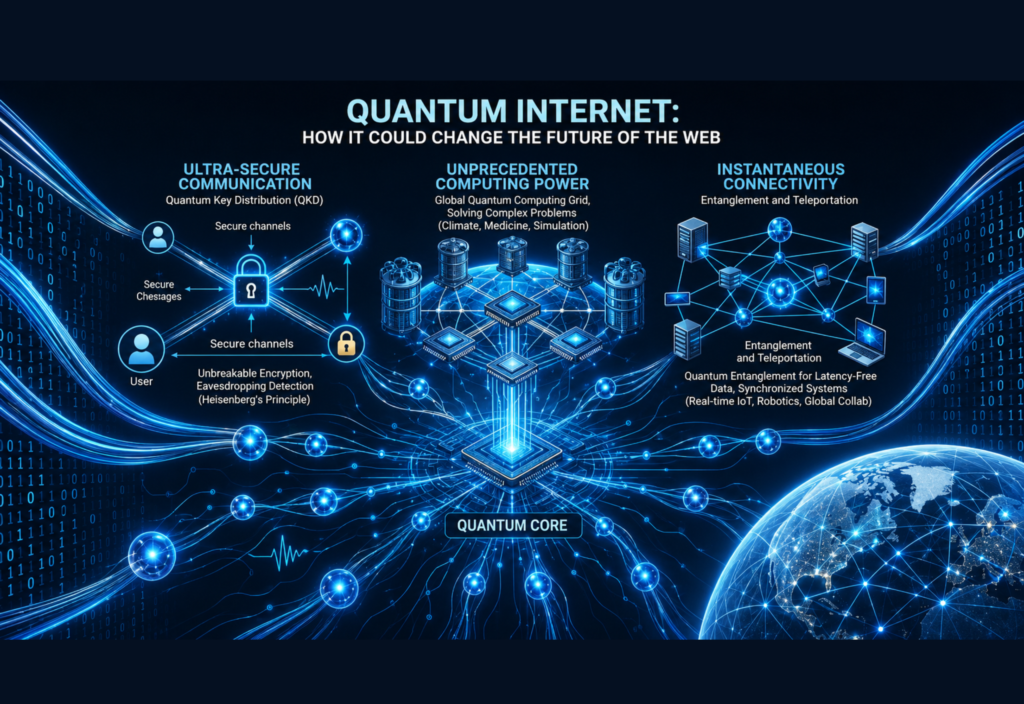
Artificial intelligence, cloud computing, and next-generation communication technologies are transforming the digital world faster than ever before. One of the most exciting innovations is the Quantum Internet, a revolutionary communication system that has the potential to redefine how information is shared and protected. Unlike today’s internet, which relies on traditional encryption and binary data, this emerging technology uses the principles of quantum mechanics to enable ultra-secure communication and advanced networking capabilities.
Although the technology is still in the research and development phase in 2026, governments, universities, and leading technology companies are investing billions of dollars to make it a reality. Experts believe this next-generation communication system could transform cybersecurity, scientific research, healthcare, finance, cloud computing, and many other industries over the coming decades.
In this guide, you’ll learn how it works, its key features, benefits, real-world applications, major challenges, and when this revolutionary technology is expected to become commercially available.
What Is the Quantum Internet?
The Quantum Internet is a next-generation communication network that uses quantum bits (qubits) instead of traditional binary bits to exchange information securely.
Unlike the current internet, where information travels as electrical or optical signals, quantum communication relies on the principles of quantum physics, including quantum entanglement and quantum superposition.
These properties allow information to be transmitted in ways that are extremely difficult to intercept without detection, making future communication significantly more secure.
Rather than replacing today’s internet overnight, this emerging communication network is expected to work alongside existing networks while supporting applications that require the highest levels of security and reliability.
How Quantum Networking Works
Instead of sending ordinary digital data, the Quantum Internet uses qubits, which behave very differently from traditional computer bits.
The communication process generally follows these steps.
Step 1: Create Qubits
Specialized quantum devices generate qubits using photons or other quantum particles.
Step 2: Establish Quantum Entanglement
Pairs of qubits become linked through a phenomenon called quantum entanglement. Even when separated by long distances, changes in one particle are connected to the other.
Step 3: Secure Data Transmission
Information is exchanged through these quantum states. If someone attempts to intercept the transmission, the quantum state changes immediately, alerting the communicating systems.
Step 4: Verify the Connection
Both devices confirm that the transmitted information remains unchanged before completing the communication.
This process creates a level of security that is fundamentally different from traditional encryption methods.
Key Features of This Next-Generation Network
Several advanced technologies make the Quantum Internet unique.
Ultra-Secure Communication
One of its biggest advantages is enhanced security. Because quantum states cannot be copied or observed without altering them, unauthorized access becomes much easier to detect.
Quantum Encryption
Instead of relying solely on mathematical encryption algorithms, future networks can use Quantum Key Distribution (QKD) to exchange encryption keys securely.
Faster Quantum Computing Collaboration
Scientists may eventually connect multiple quantum computers together, allowing them to solve complex scientific and engineering problems much faster than isolated machines.
Improved Reliability
Researchers are developing advanced methods to reduce communication errors while maintaining highly secure connections over long distances.
Benefits of Quantum Communication
Although still experimental, the Quantum Internet offers several exciting advantages.
Stronger Cybersecurity
Future communication systems could dramatically reduce the risk of hacking, data theft, and unauthorized surveillance.
Better Protection for Sensitive Data
Organizations handling confidential information—including banks, hospitals, and government agencies—could benefit from highly secure communication channels.
Scientific Innovation
Connecting quantum computers through secure networks could accelerate discoveries in medicine, materials science, and climate research.
Support for Emerging Technologies
The Quantum Internet could also improve future applications involving:
Artificial Intelligence (AI)
Cloud computing
Smart cities
Autonomous vehicles
Advanced robotics
Internet of Things (IoT)
These innovations may become more reliable and efficient with secure quantum communication.
Real-World Applications
Although the Quantum Internet is still under development, experts believe it could transform many industries by providing highly secure communication and enabling new digital capabilities.
Quantum Internet in Cybersecurity
One of the biggest advantages is stronger protection against cyber threats. Since any attempt to intercept quantum data changes its state, unauthorized access becomes much easier to detect.
Possible applications include:
Secure banking transactions
Government communications
Military networks
Financial systems
Digital identity verification
Quantum Internet in Healthcare
Hospitals and research organizations could safely exchange sensitive medical information without exposing patient records.
Potential uses include:
Secure patient data sharing
Remote medical consultations
Medical research collaboration
AI-assisted healthcare systems
Quantum Internet for Scientific Research
Scientists working in different countries could securely exchange research data while connecting quantum computers to solve complex scientific problems.
This may accelerate progress in:
Medicine
Climate science
Physics
Space exploration
Materials engineering
Quantum Internet and Artificial Intelligence
Future AI systems could work alongside quantum computers to solve highly complex tasks much faster than today’s computing systems.
Possible improvements include:
Machine learning
Drug discovery
Financial forecasting
Robotics
Weather prediction
Challenges Before Mass Adoption
Despite its enormous potential, several technical challenges remain before the Quantum Internet becomes widely available.
Expensive Infrastructure
Building a global quantum communication network requires new fiber-optic cables, quantum repeaters, satellites, and advanced communication equipment. Developing this infrastructure will require significant investment.
Limited Communication Distance
Quantum signals become weaker over long distances. Researchers are developing quantum repeaters to extend communication without losing security.
Complex Hardware
Quantum communication systems require specialized hardware that often operates under carefully controlled conditions, making deployment expensive and technically challenging.
Global Standards
Countries and technology companies must agree on international standards before large-scale adoption becomes possible.
Classical Internet vs Quantum Networking
Security
Today’s Internet: Protects data using standard encryption methods.
Quantum Internet: Uses quantum encryption to provide much stronger security.
Data Processing
Today’s Internet: Transfers information using binary bits (0 and 1).
Quantum Internet: Uses qubits that can exist in multiple quantum states.
Cybersecurity
Today’s Internet: May become vulnerable as computing power increases.
Quantum Internet: Detects interception attempts through quantum physics principles.
Communication
Today’s Internet: Depends on traditional networking technologies.
Quantum Internet: Uses quantum entanglement for highly secure communication.
Privacy
Today’s Internet: Relies on encryption algorithms.
Quantum Internet: Security is built directly into the laws of quantum mechanics.
When Will It Become Available?
As of 2026, the Quantum Internet remains in the research and testing phase. Universities, governments, and major technology companies continue developing the hardware and communication protocols needed for practical deployment.
Many experts expect:
Larger pilot projects before 2030
Early commercial use during the 2030s
Wider adoption as quantum technologies mature
Until then, existing internet technologies and 5G/6G networks will continue evolving alongside quantum communication research.
The Future of Secure Communication
The Quantum Internet has the potential to transform how people communicate, share information, and protect digital assets.
Future possibilities include:
Highly secure online banking
Faster scientific discoveries
Smarter AI systems
Advanced cloud computing
More secure government communications
Connected smart cities
Safer healthcare networks
Although widespread adoption will take time, the Quantum Internet is expected to become an important part of the future digital infrastructure.
Final Thoughts
The Quantum Internet represents one of the most significant advancements in modern communication technology. Rather than simply increasing internet speed, it introduces an entirely new approach to secure data transmission based on the principles of quantum physics.
As research continues, this next-generation communication network could revolutionize cybersecurity, healthcare, scientific research, artificial intelligence, and global communications. While commercial deployment is still several years away, ongoing progress in 2026 is laying the foundation for a safer, faster, and more intelligent digital future.