Artificial Intelligence (AI) is changing the way people create digital content, and Generative AI is at the center of this transformation. Unlike traditional AI systems that mainly analyze or classify information, Generative AI can create completely new content from simple text prompts. Whether you need a blog post, an image, a short video, computer code, or even music, modern AI models can generate high-quality results in just a few seconds.
In 2026, businesses, students, marketers, developers, designers, and content creators rely on AI-powered tools every day to improve productivity and reduce the time spent on repetitive tasks. Instead of starting from scratch, users simply describe what they need, and AI produces content that can be edited, refined, and published much faster than traditional methods.
This guide explains how this technology works, how it creates text and images, and why it has become one of the most important innovations in the digital world.
What Is Generative AI?
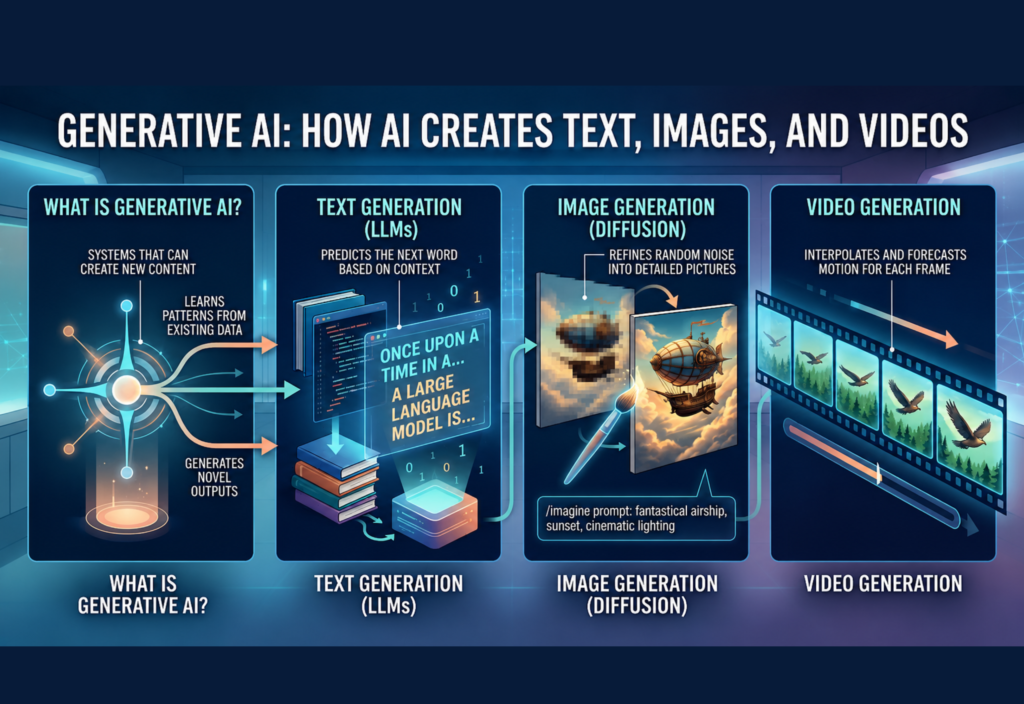
Generative AI is a branch of artificial intelligence that creates original content by learning patterns from enormous datasets. During training, AI models study billions of examples, including books, websites, images, videos, audio recordings, and programming code. Rather than copying existing material, the models learn relationships, structures, and patterns that help them produce new content.
This technology can generate many types of digital content, including:
- Blog posts and articles
- Emails and business documents
- Product descriptions
- Marketing copy
- Images and illustrations
- Short videos
- Computer code
- Music and audio
- Research summaries
For example, instead of simply identifying objects in a photograph, AI can create a completely new image based on a written description. Similarly, it can write a detailed article, summarize a lengthy report, or generate software code from a short instruction.
Because of these capabilities, Generative AI has become one of the fastest-growing technologies across education, business, software development, healthcare, marketing, and media.
How Does Generative AI Work?
Although the technology behind AI models is highly advanced, the overall process can be understood through three simple stages.
Training the AI Model
The first stage involves training the model using massive collections of information gathered from various sources. During this process, AI learns language patterns, visual structures, coding syntax, logical relationships, and writing styles.
Instead of memorizing every sentence or image, the system identifies statistical patterns that help it predict what should come next. This learning process enables it to generate new and meaningful content rather than repeating existing material.
For example, AI learns:
- Grammar and sentence structure
- Vocabulary and writing styles
- Relationships between ideas
- Visual objects and colors
- Programming languages and coding patterns
The larger and better the training data, the more capable the AI model becomes.
Understanding User Prompts
Once training is complete, the AI responds to user instructions called prompts.
A prompt tells the AI what the user wants to create. It may include details such as:
- Topic
- Writing style
- Target audience
- Tone
- Format
- Length
- Keywords
For example:
Write a beginner-friendly article explaining renewable energy in simple English.
The AI analyzes every part of the request before generating content.
Generally, detailed prompts produce more accurate and useful results than short or vague instructions.
Generating the Output
After understanding the prompt, the AI predicts the most appropriate sequence of words, pixels, or other digital elements to create content that matches the request.
Although the process happens within seconds, the model performs millions of calculations before producing the final result.
The generated content can then be reviewed, edited, and customized by the user to meet specific needs.
How AI Creates Text
One of the most popular uses of Generative AI is text generation. Modern systems rely on Large Language Models (LLMs), which are trained to understand grammar, context, facts, and language patterns.
These models can produce many different types of written content, including:
- Blog articles
- News summaries
- Emails
- Business reports
- Social media captions
- Product descriptions
- Marketing copy
- Research summaries
- Computer code
- Creative stories
For example, a user can enter the prompt:
Write a 700-word blog post about sustainable technology for beginners.
Within seconds, the AI organizes the information into logical sections, writes clear paragraphs, creates headings, and delivers a complete draft.
Another major advantage is flexibility. The same AI model can write in different styles depending on the request. It can produce professional business reports, academic explanations, conversational blog posts, persuasive marketing content, or creative storytelling.
However, users should always review AI-generated text before publishing. Human editing helps improve accuracy, add personal expertise, and ensure the information is current and relevant.
How AI Creates Images
Text-to-image generation is one of the most exciting developments in modern artificial intelligence. Instead of drawing images manually, users simply describe what they want using natural language.
For example, a prompt like:
A futuristic smart city with flying vehicles, green parks, and solar-powered skyscrapers at sunset.
allows the AI to analyze every detail in the description. It understands the requested objects, colors, lighting, composition, artistic style, and perspective before generating a completely original image.
Modern AI image generators can create:
- Realistic landscapes
- Digital artwork
- Product mockups
- Architecture concepts
- Fantasy scenes
- Technology illustrations
- 3D-style graphics
- Marketing visuals
This technology is helping businesses and creators produce professional-quality graphics much faster than traditional design workflows. Bloggers can create featured images, marketers can generate advertising visuals, and designers can quickly develop concepts without starting from a blank canvas.
Despite these advantages, human creativity remains essential. Designers often refine AI-generated images by adjusting colors, layouts, branding elements, or adding their own artistic touch to achieve the desired result.
How AI Creates Videos
Another exciting capability of Generative AI is video generation. Instead of filming scenes with cameras or creating animations frame by frame, users can simply describe what they want using text prompts. The AI then generates a video that matches the description.
For example, a prompt like:
“A satellite orbiting Earth above glowing city lights with cinematic camera movement.”
allows the AI to understand the environment, objects, lighting, camera angles, and movement. It creates multiple image frames, adds smooth transitions, applies realistic motion, and combines everything into a short video.
Modern AI video generators can also convert images into animated scenes, create talking avatars, and produce marketing videos with voiceovers and captions.
Today, AI-generated videos are widely used for:
- Marketing campaigns
- Product demonstrations
- Educational tutorials
- Social media content
- Business presentations
- Animated explainers
- Training materials
- Promotional advertisements
As AI models continue to improve, video quality is becoming more realistic while production costs and editing time continue to decrease. This makes video creation accessible to businesses and creators of all sizes.
Benefits of Generative AI
Generative AI offers significant advantages for individuals, businesses, educators, and developers. It helps users complete tasks more efficiently while encouraging creativity and innovation.
Some of the biggest benefits include:
Faster Content Creation
Instead of spending hours writing articles, designing graphics, or editing videos, users can create high-quality content in minutes.
Increased Productivity
Businesses can automate repetitive tasks such as writing emails, preparing reports, generating product descriptions, and creating marketing materials. Employees can focus on more strategic and creative work.
Cost Savings
Small businesses and startups can reduce expenses by using AI tools for content creation, graphic design, coding assistance, and customer support instead of outsourcing every task.
Enhanced Creativity
AI can generate ideas, suggest designs, create outlines, and produce multiple versions of content. Creators can use these outputs as inspiration rather than starting with a blank page.
Multilingual Support
Many AI tools can generate content in multiple languages, making it easier for businesses to reach global audiences.
Coding Assistance
Developers use AI to write code, explain programming concepts, detect errors, and speed up software development projects.
Faster Research
AI can summarize lengthy reports, organize information, and highlight key insights, helping students, researchers, and professionals save valuable time.
Limitations of Generative AI
Although Generative AI is incredibly powerful, it is not perfect. Users should understand its limitations before relying on AI-generated content.
Inaccurate Information
AI may occasionally generate incorrect or outdated information. This is why fact-checking remains essential, especially for medical, financial, or legal content.
Hallucinations
Sometimes AI produces answers that sound convincing but are completely incorrect. These responses are known as AI hallucinations and require careful human review.
Copyright and Ethical Concerns
Users should respect copyright laws and avoid using AI to copy or imitate protected works without permission. Responsible use is important for maintaining trust and originality.
Dependence on Quality Prompts
The quality of AI-generated content depends heavily on the prompt. Clear, detailed instructions generally produce better results than short or vague requests.
Subscription Costs
While many AI tools offer free plans, advanced features such as higher-quality outputs, faster processing, and larger usage limits often require paid subscriptions.
Human Review Is Still Necessary
AI is an excellent assistant, but it cannot fully replace human judgment, creativity, or expertise. Reviewing and editing AI-generated content helps improve accuracy, tone, and reliability.
Real-World Applications of Generative AI
Generative AI is transforming industries around the world by improving efficiency and supporting innovation. Organizations are using AI to automate workflows, enhance customer experiences, and create digital content at scale.
Some of the most common applications include:
- Writing blog posts and website content
- Designing logos and marketing graphics
- Creating advertisements and social media campaigns
- Developing software and writing code
- Building AI-powered customer support chatbots
- Producing educational materials and online courses
- Generating business reports and presentations
- Assisting with medical research and documentation
- Creating AI-generated videos for marketing and training
- Summarizing research papers and large documents
As technology continues to evolve, even more industries are expected to integrate AI into their daily operations.
The Future of Generative AI
The future of AI looks incredibly promising. Researchers are developing more advanced models capable of understanding longer conversations, following complex instructions, and generating even more realistic content.
Future improvements may include:
- Higher-quality AI-generated videos
- More realistic image generation
- Better reasoning and problem-solving abilities
- Faster response times
- Improved personalization
- Stronger privacy and security features
- Seamless integration with business software
- More efficient AI assistants for everyday work
Rather than replacing people, AI is expected to become a collaborative partner that helps users work faster, make better decisions, and unlock new creative possibilities.
Businesses that learn to use AI effectively will likely gain a competitive advantage in productivity, innovation, and customer engagement.
Final Thoughts
Generative AI is transforming the way people create text, images, videos, and other forms of digital content. By understanding natural language prompts, modern AI systems can generate high-quality outputs in seconds, making them valuable tools for students, professionals, developers, marketers, and business owners.
Although this technology offers impressive speed and creativity, human expertise remains essential for reviewing information, maintaining accuracy, and adding originality. AI should be viewed as a powerful assistant that enhances human capabilities rather than replacing them completely.
As Generative AI continues to evolve throughout 2026 and beyond, it will play an even greater role in content creation, software development, education, healthcare, business automation, and countless other industries. Learning how to use these tools responsibly today will help individuals and organizations stay prepared for the future of AI-powered innovation.