Artificial Intelligence (AI) is transforming the way people live, work, learn, and communicate. AI vs Machine Learning vs Deep Learning vs Generative AI is one of the most searched topics because these technologies are becoming part of everyday life. From virtual assistants and recommendation systems to self-driving cars and AI-powered chatbots, intelligent technologies are changing how businesses operate and how people interact with digital tools.
Although these terms are closely connected, they are not the same. Artificial Intelligence is the broad field, while Machine Learning, Deep Learning, and Generative AI are specialized branches that solve different types of problems. Understanding their differences helps students, professionals, developers, marketers, and business owners choose the right technology for specific tasks.
In this beginner-friendly guide, you’ll learn the difference between AI, Machine Learning, Deep Learning, and Generative AI, how each technology works, and where they are used in the real world.
What Is Artificial Intelligence (AI)?
Artificial Intelligence (AI) is the broad field of computer science that focuses on building machines capable of performing tasks that normally require human intelligence.
Instead of simply following fixed instructions, AI systems can analyze information, recognize patterns, understand language, solve problems, and make decisions. Because of these capabilities, AI is now used in almost every major industry.
Today, Artificial Intelligence powers many technologies that people use every day. For example, AI helps virtual assistants answer questions, recommends movies on streaming platforms, detects fraud in banking systems, and improves navigation in self-driving vehicles.
As AI continues to advance, it serves as the foundation for several specialized technologies, including Machine Learning, Deep Learning, and Generative AI.
Common Examples of Artificial Intelligence
Artificial Intelligence is already part of everyday life. Some of the most common examples include:
- Virtual assistants like Siri and Google Assistant
- AI-powered chatbots
- Voice recognition systems
- Recommendation engines on Netflix and YouTube
- Fraud detection software used by banks
- Smart home devices
- Autonomous vehicles
- AI-powered search engines
- Healthcare diagnostic systems
- Language translation tools
These applications demonstrate how AI improves convenience, efficiency, and decision-making across different industries.
What Is Machine Learning (ML)?
Machine Learning (ML) is a branch of Artificial Intelligence that enables computers to learn from data instead of relying only on manually programmed instructions.
Rather than telling a computer exactly what to do in every situation, developers train Machine Learning models using large datasets. The model identifies patterns within the data and gradually improves its predictions over time.
For example, an email service can learn to recognize spam messages by analyzing thousands of emails. As more examples become available, the system becomes better at identifying unwanted messages without requiring new programming.
Because Machine Learning continuously improves through experience, it is widely used for prediction, classification, and recommendation tasks.
Types of Machine Learning
Machine Learning includes several different learning methods. Each one is designed for specific types of problems.
Supervised Learning
Supervised Learning uses labeled data where the correct answers are already known.
The model learns by comparing its predictions with the correct results and gradually improves its accuracy.
Common examples include:
- Email spam detection
- House price prediction
- Medical diagnosis
- Image classification
Unsupervised Learning
Unsupervised Learning works with unlabeled data.
Instead of receiving correct answers, the model discovers hidden patterns and relationships on its own.
Businesses commonly use this approach for:
- Customer segmentation
- Market analysis
- Product recommendations
- Data clustering
Reinforcement Learning
Reinforcement Learning teaches AI through rewards and penalties.
Whenever the model makes a good decision, it receives a reward. Poor decisions result in penalties.
Over time, the AI learns which actions produce the best outcomes.
This method is commonly used in:
- Robotics
- Self-driving cars
- Game-playing AI
- Automated decision systems
Real-World Applications of Machine Learning
Machine Learning powers many digital services that millions of people use every day.
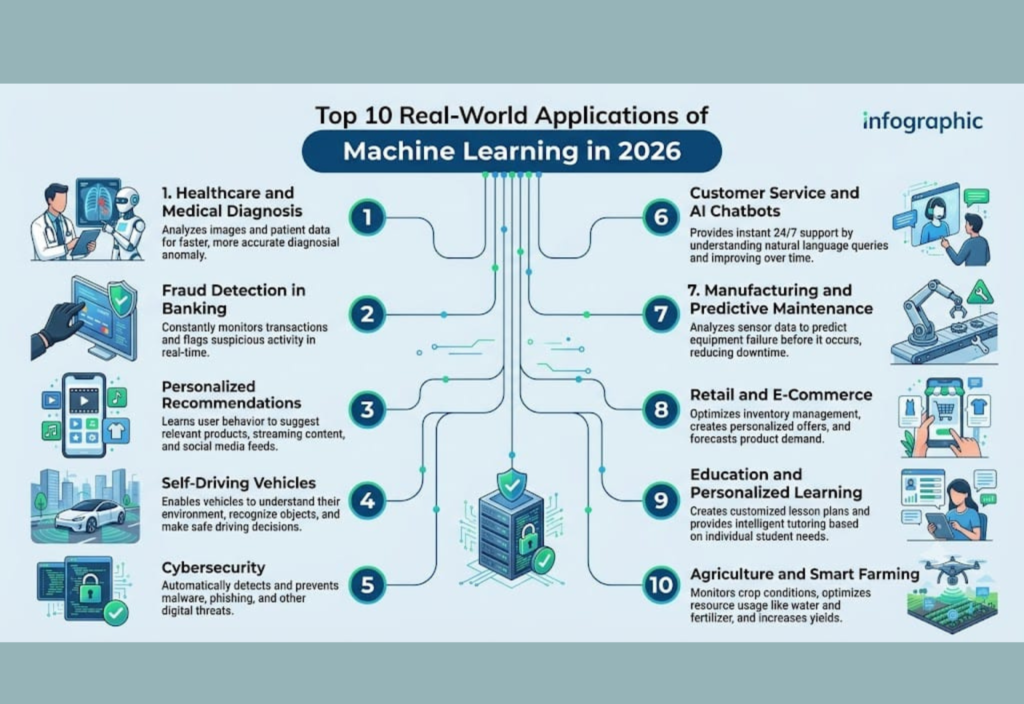
For a more detailed look at industry use cases, read our Top 10 Real-World Applications of Machine Learning in 2026.
Some popular applications include:
- Product recommendations on e-commerce websites
- Search engine ranking
- Credit card fraud detection
- Healthcare diagnosis support
- Predictive maintenance in manufacturing
- Weather forecasting
- Customer behavior analysis
- Financial risk assessment
- Demand forecasting
- Personalized online advertising
As organizations collect more data, Machine Learning becomes even more valuable for making accurate predictions and improving business decisions.
What Is Deep Learning (DL)?
Deep Learning (DL) is a specialized branch of Machine Learning that uses artificial neural networks inspired by the structure of the human brain.
Unlike traditional Machine Learning models, Deep Learning systems automatically learn important features directly from large datasets. Consequently, they require much less manual feature engineering.
Deep Learning performs exceptionally well when processing complex information such as images, speech, text, and video. Because of this capability, it has become one of the most important technologies behind modern Artificial Intelligence.
Today, Deep Learning powers many advanced AI applications, including image recognition, speech recognition, autonomous driving, and language understanding.
Common Examples of Deep Learning
Deep Learning is used in many advanced AI systems.
Some examples include:
- Facial recognition
- Image recognition
- Speech recognition
- Language translation
- Medical image analysis
- Self-driving vehicles
- Video analysis
- AI-powered voice assistants
- Handwriting recognition
- Natural language processing
These applications require AI to understand highly complex patterns that traditional Machine Learning models often struggle to process.
How Deep Learning Differs from Machine Learning
Although Deep Learning is part of Machine Learning, there are several important differences between the two.
Machine Learning often requires engineers to manually select useful features before training the model. Deep Learning, however, automatically discovers these features through multiple layers of artificial neural networks.
Another major difference is the amount of data required. Machine Learning can often perform well with smaller datasets. In contrast, Deep Learning usually requires enormous amounts of training data to achieve high accuracy.
Computing power is also different. Traditional Machine Learning models can often run on standard computers, while Deep Learning generally requires powerful GPUs and specialized hardware.
Despite these higher requirements, Deep Learning delivers outstanding performance for complex tasks involving language understanding, image recognition, speech processing, and computer vision.
As a result, Deep Learning has become one of the driving forces behind today’s most advanced Artificial Intelligence systems.
What Is Generative AI?
Generative AI is one of the newest and fastest-growing branches of Artificial Intelligence. Unlike traditional AI systems that mainly analyze, classify, or predict information, Generative AI creates entirely new content based on patterns learned during training.
Today, Generative AI can produce many different types of content, including:
- Blog posts and articles
- Emails
- Computer code
- Images
- Videos
- Music
- Presentations
- Product descriptions
- Marketing copy
- Business reports
Because it generates original content instead of simply retrieving existing information, Generative AI has become an essential tool for businesses, educators, developers, designers, and content creators.
How Does Generative AI Work?
Generative AI is built on advanced Deep Learning models trained using massive collections of text, images, audio, videos, and other digital content.
During training, the model learns grammar, language patterns, relationships, and structures from billions of examples. Later, when a user enters a prompt, the model predicts the most appropriate sequence of words, images, or other content based on what it has learned.
For example, if you ask an AI assistant to write a blog post about renewable energy, it does not search for a ready-made article. Instead, it creates original content by combining the knowledge and language patterns learned during training.
As a result, Generative AI can produce content that feels natural, creative, and relevant to the user’s request.
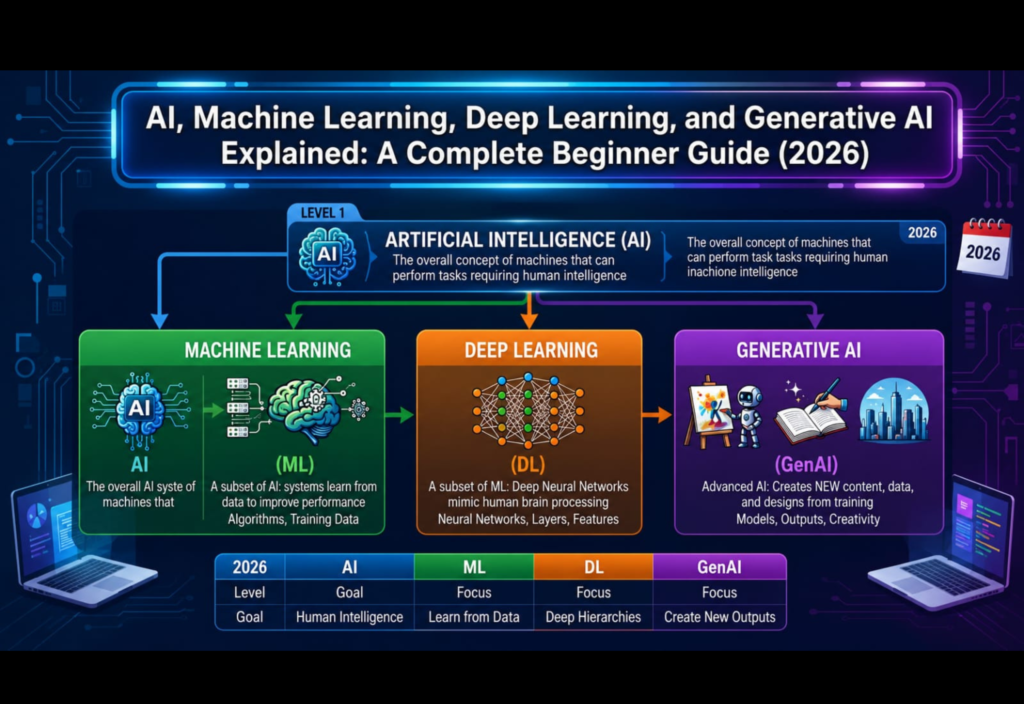
AI vs Machine Learning vs Deep Learning vs Generative AI
Although these technologies are closely connected, each one has a different purpose.
Artificial Intelligence (AI)
Artificial Intelligence is the broad field that focuses on building machines capable of performing tasks that normally require human intelligence.
Its primary goal is to enable computers to think, reason, solve problems, and make decisions.
Common examples include:
- Virtual assistants
- AI chatbots
- Smart robots
- Recommendation systems
Machine Learning (ML)
Machine Learning is a subset of Artificial Intelligence that allows computers to learn from data.
Instead of relying only on manually written rules, Machine Learning models improve their predictions through experience and training data.
Common examples include:
- Spam filters
- Fraud detection
- Product recommendations
- Demand forecasting
Deep Learning (DL)
Deep Learning is a specialized branch of Machine Learning that uses artificial neural networks.
These networks automatically identify complex patterns in large datasets, making Deep Learning ideal for advanced AI tasks.
Common examples include:
- Image recognition
- Speech recognition
- Facial recognition
- Self-driving vehicles
- Medical image analysis
Generative AI
Generative AI is built on Deep Learning models and focuses on creating new content instead of only analyzing information.
It can generate:
- Articles
- Images
- Videos
- Music
- Programming code
- Emails
- Presentations
This capability has transformed industries such as marketing, education, software development, and customer support.
Real-World Applications
Today, Artificial Intelligence technologies are used across almost every major industry.
Healthcare
Healthcare organizations use AI to analyze medical images, assist doctors with diagnosis, predict diseases, and accelerate medical research.
Education
Educational platforms use AI to provide personalized learning, language translation, automated grading, tutoring assistance, and interactive learning experiences.
Finance
Banks and financial institutions use Machine Learning to detect fraud, assess financial risk, automate customer support, and improve investment decisions.
Marketing
Businesses use Generative AI to create blog posts, advertising copy, email campaigns, product descriptions, and social media content.
Software Development
Developers rely on AI coding assistants to generate code, detect bugs, explain programming concepts, and improve productivity.
Customer Service
Modern AI chatbots answer customer questions, provide technical support, and deliver instant assistance twenty-four hours a day.
Benefits of AI Technologies
Artificial Intelligence and its related technologies provide many valuable advantages for both businesses and individuals.
Some of the biggest benefits include:
- Automating repetitive tasks
- Increasing productivity
- Saving time
- Reducing operational costs
- Improving decision-making
- Analyzing large datasets quickly
- Enhancing customer experiences
- Supporting innovation
- Improving business efficiency
- Delivering personalized recommendations
Because of these advantages, organizations around the world continue investing heavily in AI technologies.
Limitations and Challenges
Despite their impressive capabilities, AI technologies still face several important challenges.
Incorrect Information
AI systems may occasionally produce inaccurate or misleading responses. Therefore, important information should always be verified.
Data Quality
Machine Learning and Deep Learning models depend heavily on the quality of their training data. Poor-quality data often leads to poor results.
High Computing Costs
Large AI systems require powerful hardware, advanced GPUs, and significant computing resources, making development expensive.
Ethical Concerns
Issues such as bias, privacy, transparency, and responsible AI use remain major challenges for researchers and organizations.
Human Oversight
Although AI can automate many tasks, human expertise is still essential for critical decisions involving healthcare, law, finance, and public safety.
The Future of AI in 2026 and Beyond
Artificial Intelligence is advancing at an incredible pace. Researchers continue developing models that are more intelligent, efficient, and capable of understanding different types of information, including text, images, audio, and video.
In the coming years, AI is expected to:
- Provide more personalized digital assistants
- Improve multilingual communication
- Accelerate scientific discoveries
- Enhance healthcare diagnosis
- Increase business automation
- Support software development
- Create more advanced creative tools
- Improve education and online learning
- Strengthen cybersecurity
- Help businesses make smarter decisions
As these technologies continue evolving, AI will become an even more important part of everyday life.
Frequently Asked Questions (FAQs)
What is the difference between AI and Machine Learning?
Artificial Intelligence is the broad concept of creating intelligent systems, while Machine Learning is a branch of AI that enables computers to learn from data without being programmed for every task.
Is Deep Learning the same as Machine Learning?
No. Deep Learning is a specialized branch of Machine Learning that uses artificial neural networks to solve more complex problems.
What is Generative AI used for?
Generative AI creates original content such as articles, images, videos, music, presentations, programming code, and chatbot responses.
Can Generative AI replace humans?
No. Generative AI is designed to assist people by improving productivity and creativity. Human judgment and expertise remain essential for important decisions.
Why is Artificial Intelligence important?
Artificial Intelligence helps automate repetitive tasks, improve efficiency, analyze large datasets, support innovation, and create smarter solutions across industries.
Conclusion
Artificial Intelligence, Machine Learning, Deep Learning, and Generative AI are closely connected, but each technology has a unique purpose.
Artificial Intelligence is the broad field that enables machines to perform intelligent tasks. Machine Learning allows systems to learn from data and improve through experience. Deep Learning builds on Machine Learning by using advanced neural networks to solve complex problems involving language, speech, images, and video. Generative AI takes these capabilities a step further by creating original content such as text, images, code, audio, and presentations.
Understanding these technologies is valuable for students, developers, business owners, marketers, and professionals who want to stay competitive in the AI era. As Artificial Intelligence continues to evolve, learning the differences between these technologies will help you make better decisions, use AI tools more effectively, and prepare for future innovations.
Ultimately, AI is not replacing human intelligence—it is expanding what people can achieve by making work faster, smarter, and more efficient.