Machine learning (ML) has become one of the most influential technologies in today’s digital world. In 2026, it powers everything from online shopping recommendations and virtual assistants to medical diagnosis and self-driving vehicles. Businesses use machine learning to analyze massive amounts of data, automate repetitive tasks, improve customer experiences, and make faster decisions based on accurate predictions.
Unlike traditional computer programs that follow fixed instructions, machine learning systems improve over time by learning from data. The more quality data they receive, the better they become at recognizing patterns, making predictions, and solving complex problems.
Whether you use Google Search, Netflix, Amazon, Spotify, or online banking, chances are you interact with machine learning every day without realizing it. As AI continues to evolve, machine learning remains the foundation of many intelligent applications that make our daily lives easier and more efficient.
In this guide, we’ll explore the top 10 real-world applications of machine learning in 2026, explain how they work, and discover why organizations across every industry are investing heavily in this technology.
What Is Machine Learning?
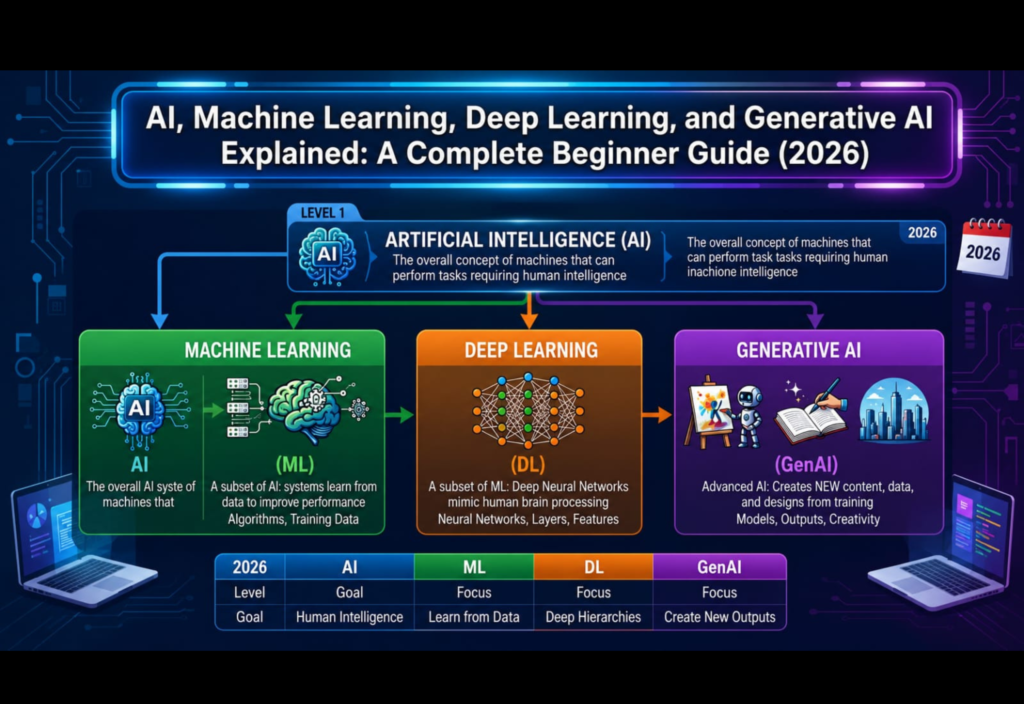
Machine learning is a branch of Artificial Intelligence (AI) that allows computers to learn from data instead of relying only on manually programmed rules. Rather than writing instructions for every possible situation, developers train machine learning models using large datasets.
The model identifies patterns and uses those patterns to make predictions when it encounters new information.
For example, an email spam filter learns which messages are unwanted by analyzing thousands of emails. Over time, it becomes better at recognizing spam without requiring constant manual updates.
Machine learning is commonly divided into three main types:
- Supervised Learning – Uses labeled data to make predictions.
- Unsupervised Learning – Finds hidden patterns in unlabeled data.
- Reinforcement Learning – Learns through trial and error by receiving rewards or penalties.
Today, these techniques power many AI systems used in healthcare, finance, retail, education, transportation, and manufacturing.
Why Machine Learning Matters in 2026
Machine learning has become essential because businesses generate enormous amounts of data every day. Analyzing this information manually would be nearly impossible.
Machine learning helps organizations process millions of records in seconds, identify trends, and make better decisions.
Some of the biggest advantages include:
- Faster decision-making
- Improved prediction accuracy
- Automation of repetitive work
- Better customer experiences
- Reduced operational costs
- Smarter business insights
- Continuous learning and improvement
From small startups to multinational companies, organizations are using machine learning to stay competitive in an increasingly AI-driven world.
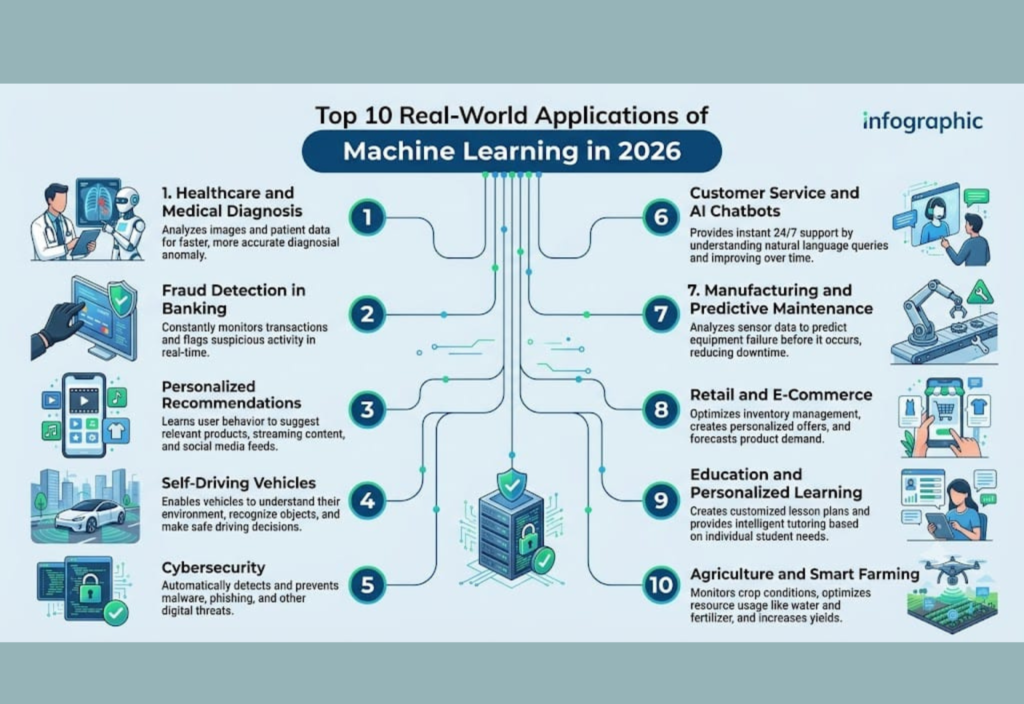
1. Healthcare and Medical Diagnosis
Machine learning is revolutionizing healthcare by helping doctors detect diseases earlier and make more accurate diagnoses.
Instead of replacing medical professionals, ML acts as an intelligent assistant that analyzes medical images, patient records, and laboratory results in a matter of seconds.
Hospitals use machine learning to identify conditions such as:
- Cancer
- Heart disease
- Diabetes
- Neurological disorders
Predictive models can also estimate a patient’s risk of developing certain illnesses, allowing doctors to recommend preventive treatments before serious complications occur.
Machine learning is also accelerating drug discovery, improving personalized medicine, and helping hospitals manage resources more efficiently.
2. Fraud Detection in Banking
Financial institutions process millions of transactions every day, making it difficult to detect fraudulent activity manually.
Machine learning models continuously analyze transaction patterns and quickly identify suspicious behavior that may indicate fraud.
For example, if a customer suddenly makes a large purchase in another country while simultaneously using their card locally, the system can immediately flag the transaction for review.
Modern banking systems also use machine learning for:
- Identity verification
- Anti-money laundering
- Credit risk analysis
- Fraud prevention
By learning from previous fraud cases, machine learning systems become more accurate over time.
3. Personalized Recommendations
Online platforms like shopping websites, streaming services, and social media rely heavily on machine learning recommendation systems.
These systems study:
- User behavior
- Search history
- Purchases
- Ratings
- Preferences
For example, an online store recommends products similar to previous purchases, while streaming platforms suggest movies or songs based on viewing history.
Personalized recommendations improve customer satisfaction, increase engagement, and help businesses generate higher sales.
4. Self-Driving Vehicles
Self-driving cars are among the most exciting applications of machine learning.
These vehicles use cameras, radar, LiDAR sensors, GPS, and AI models to understand their surroundings and make driving decisions in real time.
Machine learning helps autonomous vehicles:
- Detect pedestrians and cyclists
- Recognize traffic signs
- Stay within lanes
- Avoid collisions
- Plan safe routes
Many modern cars already use machine learning for adaptive cruise control, automatic parking, and emergency braking.
5. Cybersecurity
Cybersecurity threats continue to grow every year, making machine learning an essential tool for protecting digital systems.
Instead of relying only on traditional security rules, machine learning identifies unusual behavior that may indicate malware, phishing, ransomware, or hacking attempts.
Organizations use machine learning to:
- Detect malware automatically
- Identify suspicious login attempts
- Prevent phishing attacks
- Monitor network traffic
- Respond to threats in real time
Because cybercriminals constantly change their techniques, machine learning models continue learning from new attacks.
6. Customer Service and AI Chatbots
Businesses use AI chatbots powered by machine learning to provide fast and reliable customer support.
These systems understand customer questions, suggest helpful responses, and improve through previous interactions.
Benefits include:
- 24/7 customer support
- Faster response times
- Lower operational costs
- Improved customer satisfaction
- Better handling of repetitive questions
Machine learning allows chatbots to become more natural and accurate over time.
7. Manufacturing and Predictive Maintenance
Manufacturing companies use machine learning to monitor equipment and predict failures before they happen.
This approach, known as predictive maintenance, reduces downtime and helps businesses save money.
Machine learning analyzes sensor data to detect signs of wear and schedule maintenance before machines break down.
Benefits include:
- Increased productivity
- Improved product quality
- Reduced maintenance costs
- Longer equipment life
8. Retail and E-Commerce
Retail companies use machine learning to improve shopping experiences and increase sales.
AI analyzes customer behavior, purchase history, and browsing patterns to recommend products that match individual interests.
Machine learning helps retailers:
- Forecast demand
- Optimize inventory
- Personalize promotions
- Improve pricing strategies
- Reduce supply chain waste
These intelligent systems create smoother shopping experiences for customers.
9. Education and Personalized Learning
Educational platforms use machine learning to create customized learning experiences for students.
Instead of providing the same content to everyone, AI recommends lessons based on each learner’s progress, strengths, and weaknesses.
Machine learning supports:
- Intelligent tutoring systems
- Automated grading
- Student performance analysis
- Personalized study plans
- Learning progress tracking
This makes education more engaging and effective.
10. Agriculture and Smart Farming
Modern agriculture is becoming more data-driven through machine learning.
Farmers use AI to monitor crops, analyze soil quality, predict weather conditions, and optimize irrigation systems.
Machine learning improves:
- Crop yield prediction
- Disease detection
- Water management
- Fertilizer optimization
- Precision farming
These technologies help farmers produce more food while reducing costs.
Benefits of Machine Learning
Machine learning offers many advantages across industries.
Key benefits include:
- Faster decision-making
- Improved prediction accuracy
- Automation of repetitive tasks
- Personalized experiences
- Better security
- Lower operational costs
- Continuous improvement
As organizations collect more data, machine learning becomes even more valuable.
The Future of Machine Learning
Machine learning will continue to shape the future of technology.
Future developments will include:
- Smarter AI assistants
- Advanced robotics
- Improved healthcare systems
- Autonomous transportation
- Personalized digital services
Businesses will combine machine learning with Generative AI, AI agents, cloud computing, and Edge AI to create faster and smarter solutions.
Learning machine learning today can open career opportunities in AI engineering, data science, software development, healthcare, and finance.
Frequently Asked Questions
What is the most common application of machine learning?
Recommendation systems, fraud detection, healthcare solutions, and AI chatbots are some of the most common applications of machine learning.
Is machine learning the same as artificial intelligence?
No. Machine learning is a subset of artificial intelligence that allows computers to learn from data and improve without being manually programmed for every task.
Can beginners learn machine learning?
Yes. Beginners can start with AI basics, Python programming, and introductory machine learning concepts.
Which industries benefit most from machine learning?
Healthcare, finance, retail, manufacturing, education, cybersecurity, transportation, and agriculture benefit greatly from machine learning.
Conclusion
Machine learning has evolved into one of the most important technologies powering modern digital services. From healthcare and banking to education, retail, manufacturing, and agriculture, machine learning helps organizations make better decisions, automate complex tasks, and deliver personalized experiences.
As AI adoption continues to grow in 2026, understanding real-world applications of machine learning is more important than ever. Whether you are a student, developer, business owner, or technology enthusiast, learning machine learning concepts can help you stay ahead in an increasingly AI-driven world.