Artificial Intelligence is no longer limited to answering questions or generating text. In 2026, AI has evolved into intelligent agents that can plan tasks, use digital tools, browse information, analyze files, and complete multi-step workflows with minimal human input. One of the most exciting developments in this space is the ChatGPT Agent.
Unlike a traditional chatbot that only responds to prompts, a ChatGPT Agent can understand goals, break them into smaller tasks, and use available tools to complete them efficiently. Whether you want to automate research, organize information, create reports, or assist with business operations, ChatGPT Agent offers a smarter and more productive way to work.
In this beginner-friendly guide, you’ll learn what ChatGPT Agent is, how it works, why it matters, and how businesses and individuals are using AI agents to automate everyday tasks in 2026.
A ChatGPT Agent is an AI-powered assistant that can perform tasks on your behalf by combining reasoning, planning, and tool usage. Instead of simply answering a question, it works toward completing a goal.
For example, if you ask a normal chatbot to “find the latest AI news,” it may provide a summary based on available information. A ChatGPT Agent, however, can search trusted sources, organize the findings, compare updates, and present them in a structured report.
This ability to perform multiple connected actions makes AI agents far more useful than traditional chat interfaces.
How Is ChatGPT Agent Different from Regular ChatGPT?
Although both are powered by advanced AI models, their capabilities are different.
A regular chatbot is mainly designed to generate responses based on the prompt you provide.
A ChatGPT Agent goes further by:
- Planning multiple steps before responding.
- Using connected tools when needed.
- Working with documents and external data.
- Completing tasks instead of only generating text.
- Remembering the current workflow while solving complex problems.
This shift transforms AI from a conversation tool into a digital assistant capable of helping with real work.
How Does ChatGPT Agent Work?
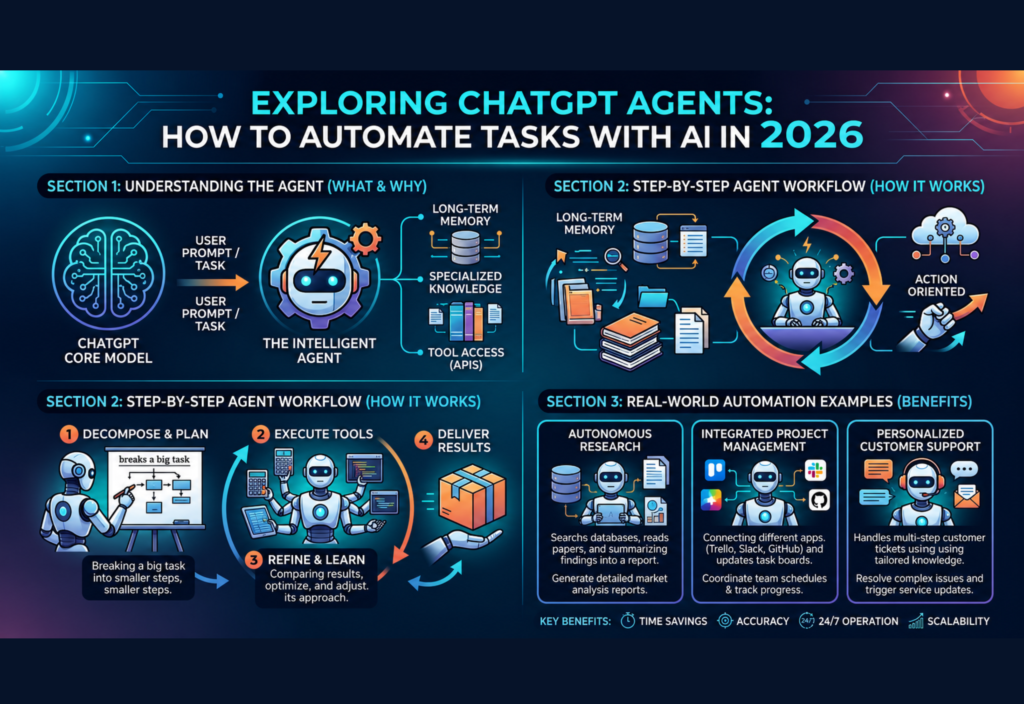
Behind the scenes, ChatGPT Agent combines several AI technologies to complete user requests efficiently.
Step 1: Understand the Goal
The process begins when the user gives the agent a task.
For example:
“Create a weekly social media content plan for my technology blog.”
Instead of generating an immediate answer, the agent first analyzes the overall objective.
Step 2: Break the Task into Smaller Steps
The AI divides the goal into manageable actions.
For the example above, it might:
- Identify the blog niche.
- Generate content ideas.
- Organize them by day.
- Suggest captions.
- Recommend hashtags.
- Format everything into a schedule.
This planning process helps produce more organized and useful results.
Step 3: Use Available Tools
Depending on the platform and permissions, the agent can use connected tools to gather or process information.
These tools may include:
- Web search
- Document readers
- File analysis
- Spreadsheet tools
- Code execution
- Knowledge bases
- Business applications
Instead of relying only on built-in knowledge, the agent can use these tools to improve accuracy and complete more complex tasks.
Step 4: Generate the Final Result
After collecting the required information and completing intermediate steps, the AI produces a clear and structured response.
Rather than answering only one question, it delivers the completed task in a format the user can immediately use.
Key Features of ChatGPT Agent
ChatGPT Agent includes several capabilities that make it more powerful than a traditional chatbot.
Intelligent Planning
The agent can organize complicated requests into logical steps before solving them.
Tool Integration
It works with supported tools to retrieve information, analyze files, or complete actions beyond text generation.
Context Awareness
The agent keeps track of the current objective throughout the workflow, reducing the need to repeat instructions.
Task Automation
Instead of simply responding to prompts, it can automate repetitive digital tasks and improve productivity.
Natural Conversations
Even while completing complex workflows, the interaction remains conversational and easy to understand.
What Can ChatGPT Agent Do?
The flexibility of ChatGPT Agent allows it to assist with many different activities.
Examples include:
- Writing blog articles
- Researching technical topics
- Summarizing long documents
- Creating marketing plans
- Organizing project notes
- Drafting emails
- Generating meeting summaries
- Planning travel itineraries
- Analyzing spreadsheets
- Brainstorming business ideas
As AI technology continues to improve, new capabilities are being added, making AI agents useful for professionals, students, developers, and businesses alike.
Why Businesses Are Adopting ChatGPT Agents
Organizations are increasingly using AI agents because they can automate routine work, improve productivity, and reduce the time spent on repetitive tasks.
Instead of switching between multiple software tools, employees can assign a goal to an AI agent and receive organized results in minutes. This helps teams focus on strategic work while the AI handles research, drafting, planning, and information management.
For many businesses, ChatGPT Agents are becoming valuable digital assistants that enhance efficiency without replacing human decision-making.
Real-World Uses of ChatGPT Agent
One of the biggest advantages of a ChatGPT Agent is its ability to automate practical, everyday tasks. Instead of simply answering questions, it helps users complete work more efficiently across different industries.
1. Content Creation
Content creators and bloggers use ChatGPT Agents to generate article ideas, create outlines, write drafts, optimize content for SEO, and repurpose blog posts into social media content.
For example, a blogger can ask the agent to create a month’s content calendar, generate SEO-friendly titles, and write engaging introductions in just a few minutes.
2. Customer Support
Businesses use AI agents to answer customer questions, summarize support tickets, retrieve company policies, and assist human support teams.
This reduces response times while improving customer satisfaction.
3. Marketing Automation
Marketing teams use ChatGPT Agents to:
- Create email campaigns
- Generate ad copy
- Write product descriptions
- Build social media calendars
- Analyze marketing performance
- Brainstorm campaign ideas
These tasks normally take hours but can be completed much faster with AI assistance.
4. Software Development
Developers rely on ChatGPT Agents to:
- Explain code
- Generate functions
- Debug programs
- Write documentation
- Review code quality
- Suggest improvements
Rather than replacing developers, AI agents work as intelligent coding assistants that speed up development.
5. Research and Learning
Students and professionals use AI agents to summarize lengthy reports, compare research papers, organize notes, and explain difficult concepts in simple language.
This makes learning faster and improves productivity.
Benefits of ChatGPT Agent
As AI technology continues to improve, ChatGPT Agents offer several important advantages.
Saves Time
Routine tasks such as writing emails, organizing information, and preparing reports can be completed much faster.
Improves Productivity
By automating repetitive work, users can focus on creative thinking and decision-making.
Better Organization
The agent can structure information into clear reports, lists, tables, and action plans.
Handles Multi-Step Tasks
Unlike traditional chatbots, ChatGPT Agents can break large goals into smaller steps and complete them in the correct order.
Easy to Use
Most ChatGPT Agents use natural language, allowing users to interact without learning programming or technical commands.
Limitations of ChatGPT Agent
Although ChatGPT Agents are powerful, they are not perfect.
Some limitations include:
- They may occasionally misunderstand complex instructions.
- Accuracy depends on the quality of the available information.
- Some advanced features require access to supported tools.
- Human review is still important for critical business, legal, or medical decisions.
- Performance varies depending on the platform and permissions available.
Understanding these limitations helps users use AI more effectively and responsibly.
Best Practices for Using ChatGPT Agent
To get the best results, follow these simple practices.
Give Clear Instructions
Instead of asking vague questions, provide specific goals and relevant details.
Break Large Projects into Steps
Complex projects are easier to manage when divided into smaller tasks.
Verify Important Information
Always review AI-generated content before publishing or making important decisions.
Use Trusted Data Sources
When possible, connect the agent to reliable documents, databases, or knowledge bases.
Experiment with Different Prompts
Small changes in wording often produce significantly better results.
ChatGPT Agent vs Traditional Chatbot
ChatGPT Agent
- Plans multi-step tasks before responding.
- Uses connected tools and external data.
- Automates workflows.
- Maintains context throughout a project.
- Designed for productivity and task completion.
Traditional Chatbot
- Responds to one prompt at a time.
- Limited tool integration.
- Primarily generates text responses.
- Less effective for complex workflows.
- Best suited for simple conversations and quick answers.
For businesses that need automation and advanced task management, ChatGPT Agents offer a much more capable solution.
The Future of ChatGPT Agents
AI agents are expected to become even more intelligent over the next few years. Future improvements may include better reasoning, stronger collaboration with other AI systems, deeper integration with business software, and more personalized assistance.
As organizations continue adopting AI, ChatGPT Agents are likely to become an essential part of workplaces, helping individuals and teams complete tasks faster while reducing repetitive work.
Frequently Asked Questions (FAQs)
What is a ChatGPT Agent?
A ChatGPT Agent is an AI assistant that can plan, reason, use tools, and complete multi-step tasks instead of simply answering questions.
How is ChatGPT Agent different from ChatGPT?
A standard chatbot mainly generates responses, while a ChatGPT Agent can automate workflows, interact with tools, and complete more complex tasks.
Can beginners use ChatGPT Agents?
Yes. Most AI agents are designed with natural language interfaces, making them easy for beginners to use without coding knowledge.
Can ChatGPT Agents replace human workers?
No. They are designed to assist people by automating repetitive tasks, not replace human creativity, judgment, or decision-making.
What industries use ChatGPT Agents?
They are used in marketing, customer support, software development, education, research, healthcare, finance, and many other industries.
Conclusion
ChatGPT Agents represent the next generation of artificial intelligence. Instead of acting as simple chatbots, they can understand goals, plan multiple steps, use external tools, and automate real-world tasks.
For individuals, ChatGPT Agents simplify learning, writing, research, and productivity. For businesses, they reduce manual work, improve efficiency, and help teams focus on higher-value activities.
As AI technology continues to evolve in 2026 and beyond, learning how to work with ChatGPT Agents will become an increasingly valuable skill for developers, professionals, entrepreneurs, and anyone looking to improve productivity with artificial intelligence.