Artificial intelligence continues to evolve at an incredible pace, and each new generation of large language models brings significant improvements in reasoning, coding, multimodal capabilities, and real-world usability. This GPT-5.6 Complete Guide explores how OpenAI’s latest AI model represents another step forward by delivering higher-quality responses, stronger instruction following, improved coding assistance, and more reliable performance across professional workflows.
Whether you’re a developer building AI-powered applications, a business exploring intelligent automation, a content creator looking for writing assistance, or a student learning about modern AI, understanding GPT-5.6 can help you make better decisions about adopting the latest AI technologies.
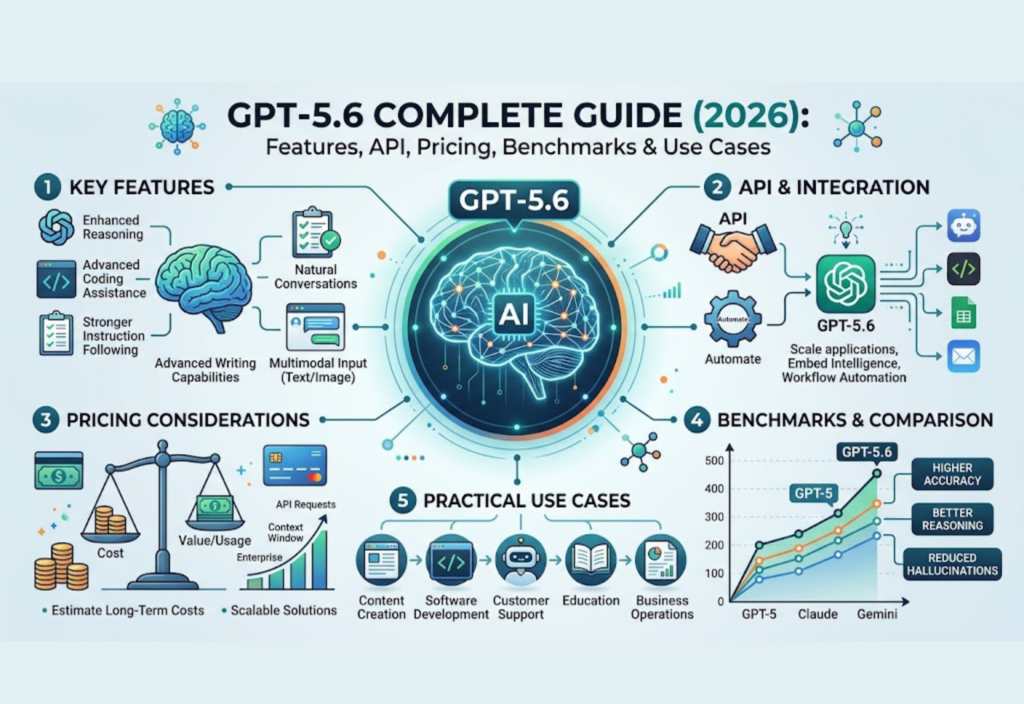
In this GPT-5.6 Complete Guide, you’ll learn what GPT-5.6 is, its key features, how it works, API capabilities, pricing considerations, benchmark performance, practical use cases, and how it compares with previous models.
What Is GPT-5.6?
GPT-5.6 is a modern large language model (LLM) developed by OpenAI. Like earlier GPT models, it is based on the Transformer architecture and is designed to understand natural language, generate human-like text, write and explain code, analyze information, summarize documents, and assist with a wide range of professional and creative tasks.
Unlike traditional software that follows fixed rules, GPT-5.6 predicts the most appropriate response by analyzing patterns learned from vast amounts of text during training. It can understand context, follow detailed instructions, and complete complex multi-step tasks more effectively than many earlier AI systems.
GPT-5.6 is designed to support a wide variety of applications, including:
- AI chatbots
- Coding assistants
- Research tools
- Content creation
- Customer support
- Business automation
- Education and tutoring
- Data analysis
- Document summarization
Its goal is not simply to generate text but to act as an intelligent assistant capable of improving productivity across different industries.
How Does GPT-5.6 Work?
GPT-5.6 processes information using deep neural networks built on the Transformer architecture. Instead of memorizing answers, it predicts the next most likely word or token based on the conversation and the information it has learned during training.
A typical workflow looks like this:
- The user submits a prompt or question.
- GPT-5.6 analyzes the prompt and understands its context.
- The model reasons through the request and generates a response token by token.
- The final output is presented as natural, human-like text.
When connected to external tools through APIs or AI agent frameworks, GPT-5.6 can also retrieve information, call external services, generate code, analyze files, and automate parts of larger workflows.
Key Features of GPT-5.6
GPT-5.6 introduces several improvements aimed at making AI more reliable, capable, and useful in everyday tasks.
1. Improved Reasoning
One of the biggest strengths of GPT-5.6 is its enhanced reasoning ability. It can better understand complex instructions, solve multi-step problems, and maintain logical consistency throughout longer conversations.
This makes it particularly useful for:
- Technical documentation
- Business planning
- Programming
- Research assistance
- Educational explanations
2. Better Coding Assistance
Developers can use GPT-5.6 to:
- Generate code
- Explain existing code
- Debug software
- Write documentation
- Convert code between programming languages
- Create SQL queries
- Build APIs
- Automate repetitive programming tasks
Because of its stronger reasoning capabilities, GPT-5.6 often provides more structured and maintainable code suggestions than earlier models.
3. Stronger Instruction Following
Earlier AI models occasionally misunderstood long or detailed prompts.
GPT-5.6 is designed to follow instructions more accurately by:
- Understanding multiple requirements
- Maintaining formatting
- Following constraints
- Producing consistent outputs
For example, it can generate an SEO-friendly article with a specific word count, heading structure, tone, and target audience more reliably.
4. Natural Conversations
GPT-5.6 produces responses that feel more conversational and context-aware.
It can:
- Remember previous parts of a conversation (within the available context)
- Ask clarifying questions when appropriate
- Maintain consistent tone
- Adapt responses for beginners or experts
This makes interactions smoother for customer support, tutoring, brainstorming, and collaborative work.
5. Advanced Writing Capabilities
GPT-5.6 supports many writing tasks, including:
- Blog articles
- Marketing copy
- Product descriptions
- Technical documentation
- Business reports
- Emails
- Social media content
- Documentation
- Research summaries
It can also rewrite, summarize, expand, or simplify existing content while maintaining readability.
6. Multimodal Capabilities
Modern AI systems increasingly support multiple input types rather than text alone.
Depending on how GPT-5.6 is integrated into an application, it may assist with:
- Text analysis
- Image understanding
- Document interpretation
- Charts and tables
- Visual reasoning
These capabilities allow developers to build richer AI-powered applications that combine different types of information.
7. API Integration
Developers can integrate GPT-5.6 into their own applications using APIs.
Common integrations include:
- Customer support chatbots
- AI writing assistants
- Internal business tools
- Knowledge management systems
- CRM platforms
- Workflow automation
- Educational software
API access enables organizations to embed AI into existing products and automate repetitive tasks while keeping humans involved in important decisions.
8. Business Productivity
Many organizations use large language models to reduce repetitive work and improve efficiency.
GPT-5.6 can help teams:
- Draft emails
- Summarize meetings
- Generate reports
- Organize research
- Analyze customer feedback
- Create documentation
- Support internal knowledge bases
Rather than replacing employees, it acts as a productivity assistant that helps people complete routine tasks more quickly.
What’s New in GPT-5.6?
Compared with previous generations, GPT-5.6 focuses on improving accuracy, usability, and developer experience.
Some expected improvements include:
- Better reasoning for complex tasks
- More accurate coding assistance
- Improved instruction following
- Reduced hallucinations in many scenarios
- Higher-quality writing output
- Better context handling
- Stronger API performance
- More reliable responses for enterprise workflows
These enhancements make GPT-5.6 suitable for both individual users and organizations looking to build AI-powered products.
Common Applications of GPT-5.6
GPT-5.6 can be used across many industries and professional workflows.
Some of the most common applications include:
Content Creation
Generate blog posts, articles, marketing copy, newsletters, product descriptions, and social media content more efficiently.
Software Development
Assist developers with coding, debugging, documentation, API integration, and code reviews.
Customer Support
Power intelligent chatbots capable of answering customer questions, summarizing conversations, and assisting support teams.
Education
Help students understand difficult concepts, create study materials, summarize textbooks, and provide personalized learning assistance.
Business Operations
Automate repetitive administrative work such as drafting emails, preparing reports, organizing documents, and generating meeting summaries.
PT-5.6 API, Pricing, Benchmarks, Comparison, Security, FAQs & Conclusion
In the first part of this guide, we explored what GPT-5.6 is, how it works, its major features, and its most common applications. In this section, we’ll look at API integration, pricing considerations, benchmark performance, comparisons with other leading AI models, security best practices, limitations, and frequently asked questions.
GPT-5.6 API Explained
One of GPT-5.6’s biggest strengths is its ability to integrate into websites, mobile apps, enterprise software, and custom business workflows through APIs.
Instead of using GPT-5.6 only through a chat interface, developers can connect the model directly to their own applications. This allows businesses to build intelligent software that can answer questions, generate content, automate repetitive work, analyze data, and interact with users in natural language.
Common API Use Cases
Developers can integrate GPT-5.6 into applications such as:
- AI customer support chatbots
- Content writing platforms
- Coding assistants
- Internal company knowledge bases
- Document summarization tools
- Email automation systems
- AI-powered search engines
- Educational learning platforms
- CRM and help desk software
- Business workflow automation
API integration enables organizations to build scalable AI solutions while maintaining control over how the model is used.
Pricing Considerations
The cost of using GPT-5.6 depends on several factors, including the model version, usage volume, input and output size, and the platform through which it is accessed.
Organizations planning large-scale deployments should consider:
- API usage costs
- Number of requests
- Context window size
- Infrastructure requirements
- Storage costs
- Monitoring and maintenance
- Security implementation
Small businesses and individual developers can often start with modest usage, while enterprise organizations should estimate long-term operating costs before deploying AI across multiple products.
GPT-5.6 Performance and Benchmarks
AI models are typically evaluated using benchmarks that measure reasoning, coding, mathematics, language understanding, and instruction-following performance.
While benchmark results provide useful insights, they should not be the only factor when choosing an AI model. Real-world performance depends on the quality of prompts, available tools, and the specific application.
GPT-5.6 is designed to deliver improvements in several important areas:
Better Reasoning
GPT-5.6 can solve more complex problems by following multi-step instructions and maintaining logical consistency throughout longer conversations.
Improved Coding
Developers benefit from more accurate code generation, debugging assistance, documentation, and code explanations across multiple programming languages.
Higher Accuracy
Compared with earlier generations, GPT-5.6 aims to reduce incorrect or misleading responses by improving instruction following and contextual understanding.
Longer Context Handling
The model can work more effectively with lengthy documents, conversations, and technical content, making it suitable for research, document analysis, and enterprise knowledge management.
GPT-5.6 vs GPT-5
Although both models belong to the same GPT family, GPT-5.6 introduces several refinements.
GPT-5 vs GPT-5.6
Reasoning
- GPT-5: Strong reasoning capabilities.
- GPT-5.6: More advanced reasoning with improved multi-step problem solving.
Coding
- GPT-5: Excellent coding assistance.
- GPT-5.6: More accurate code generation, debugging, and explanations.
Instruction Following
- GPT-5: Good at following prompts.
- GPT-5.6: Better consistency with complex instructions.
Long Context
- GPT-5: Strong long-context understanding.
- GPT-5.6: Enhanced handling of lengthy documents and conversations.
Writing Quality
- GPT-5: High-quality writing.
- GPT-5.6: More natural, structured, and context-aware responses.
Business Automation
- GPT-5: Excellent for automating workflows.
- GPT-5.6: More reliable for enterprise and business automation.
API Integration
- GPT-5: Supports API integration.
- GPT-5.6: Enhanced developer experience with improved API capabilities.
For many professional workflows, GPT-5.6 focuses on delivering more reliable, consistent, and practical outputs.
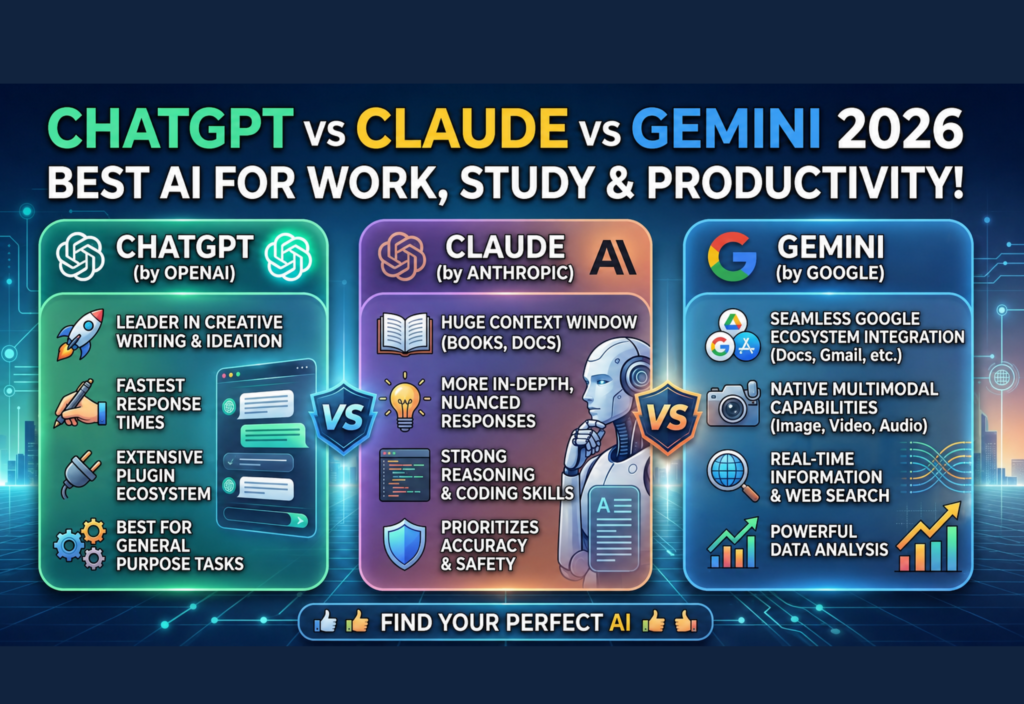
GPT-5.6 vs Claude
Both GPT-5.6 and Claude are advanced AI assistants, but they emphasize different strengths.
GPT-5.6
Best suited for:
- Software development
- AI applications
- Business automation
- API integration
- Technical documentation
- Coding workflows
Claude
Often preferred for:
- Long-form writing
- Document analysis
- Careful editing
- Detailed explanations
- Research assistance
The better choice depends on your workflow rather than one model being universally superior.
GPT-5.6 vs Gemini
Gemini is another leading AI model designed for productivity and multimodal applications.
GPT-5.6
- Strong coding capabilities
- Reliable API ecosystem
- Excellent instruction following
- Broad developer adoption
Gemini
- Deep integration with Google services
- Strong multimodal capabilities
- Useful for Google Workspace users
- Suitable for productivity tasks
Organizations should evaluate which ecosystem best matches their existing tools and requirements.
Security and Privacy
As AI systems become integrated into business operations, protecting data and maintaining user privacy become increasingly important.
Best Practices
- Encrypt sensitive information before storage or transmission.
- Implement role-based access controls.
- Authenticate users before allowing access to AI systems.
- Monitor API activity with audit logs.
- Avoid sending confidential information unless necessary.
- Keep software, APIs, and integrations updated.
- Review AI-generated outputs before making important business decisions.
Organizations should also comply with relevant privacy and data protection regulations applicable in their region.
Limitations of GPT-5.6
Despite its capabilities, GPT-5.6 is not perfect.
Hallucinations
Like other language models, GPT-5.6 may occasionally generate information that is inaccurate or unsupported. Important facts should always be verified using reliable sources.
Knowledge Limitations
The model may not always have access to the latest events unless connected to real-time tools or external data sources.
Prompt Quality Matters
The quality of the output depends heavily on the quality of the prompt.
For example:
❌ Weak Prompt
“Tell me about AI.”
✅ Better Prompt
“Write a 2,000-word beginner-friendly guide explaining GPT-5.6, including features, API integration, benchmarks, pricing, comparisons, FAQs, and practical examples.”
Specific prompts generally produce more accurate and useful responses.
Human Oversight
GPT-5.6 should support human decision-making rather than replace professional expertise in areas such as healthcare, finance, legal advice, engineering, or safety-critical systems.
Best Practices for Using GPT-5.6
To achieve the best results:
- Write clear and detailed prompts.
- Break complex tasks into smaller steps.
- Verify important facts before publishing.
- Combine GPT-5.6 with external tools when appropriate.
- Protect sensitive information.
- Keep a human involved in critical decisions.
- Continuously test and refine AI workflows.
Following these practices helps improve both accuracy and reliability.
Frequently Asked Questions (FAQs)
What is GPT-5.6 used for?
GPT-5.6 can assist with writing, coding, research, customer support, education, document analysis, business automation, and many other professional tasks.
Is GPT-5.6 better than GPT-5?
GPT-5.6 is designed to improve reasoning, instruction following, coding assistance, and overall reliability. The exact benefits depend on the specific task and implementation.
Can beginners use GPT-5.6?
Yes. Beginners can use GPT-5.6 through AI chat applications, while developers can integrate it into software using APIs.
Does GPT-5.6 replace software developers?
No. GPT-5.6 helps developers by generating code, explaining concepts, debugging programs, and automating repetitive tasks. Human expertise remains essential for designing, reviewing, and maintaining software.
Can businesses use GPT-5.6 securely?
Yes, provided organizations implement appropriate security measures, access controls, monitoring, and privacy practices while reviewing AI-generated outputs.
Which industries benefit the most?
GPT-5.6 can support many industries, including:
- Healthcare
- Education
- Finance
- Retail
- Customer Support
- Marketing
- Software Development
- Manufacturing
- Research
- Logistics
The best use cases depend on each organization’s needs.
Key Takeaways
- GPT-5.6 is an advanced large language model designed for reasoning, coding, writing, and business automation.
- API integration enables developers to build intelligent applications and automate complex workflows.
- Pricing depends on usage, infrastructure, and deployment requirements.
- GPT-5.6 improves reasoning, coding, instruction following, and long-context understanding compared with earlier GPT models.
- Strong security, privacy, and human oversight remain essential when deploying AI systems.
- Organizations should combine AI capabilities with responsible governance to maximize long-term value.
Final Conclusion
GPT-5.6 represents another important step in the evolution of modern artificial intelligence. By combining stronger reasoning, improved coding assistance, high-quality writing, and flexible API integration, it enables developers, businesses, educators, and creators to automate complex tasks and build more intelligent applications.
Rather than replacing human expertise, GPT-5.6 works best as a collaborative assistant that enhances productivity, accelerates problem-solving, and supports informed decision-making. As AI technology continues to advance, organizations that adopt it responsibly—while prioritizing security, transparency, and human oversight—will be well positioned to take advantage of the next generation of intelligent software.
Whether you’re exploring AI for personal learning, building commercial products, or modernizing business workflows, understanding GPT-5.6 provides a strong foundation for making informed decisions about the future of artificial intelligence.