Artificial intelligence is changing the way people interact with technology. From smartphones and smartwatches to AI-powered assistants, every new generation of devices is becoming more intelligent and capable. In 2026, one of the fastest-growing innovations is AI Glasses, a new category of smart wearables that combines artificial intelligence, augmented reality (AR), computer vision, voice assistants, and real-time connectivity into a lightweight wearable device.
Unlike traditional smart glasses that mainly displayed notifications, modern wearable devices can understand voice commands, recognize objects, translate languages, provide navigation, answer questions, summarize conversations, capture photos and videos, and even assist users while they work. These capabilities transform them into intelligent personal assistants that can be worn throughout the day.
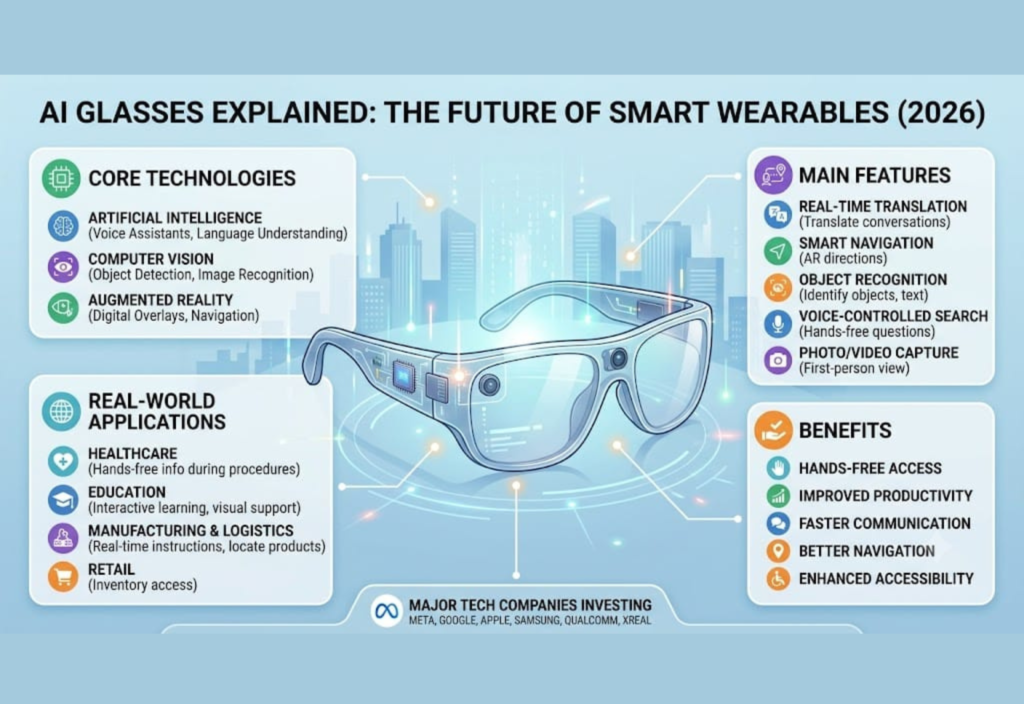
Major technology companies such as Meta, Google, Apple, Samsung, Qualcomm, and XREAL are investing heavily in wearable AI technology because many experts believe it could become the next major computing platform after smartphones. As hardware continues to improve, these smart wearables are becoming lighter, faster, and more affordable, making them increasingly practical for everyday use.
In this guide, you’ll learn what AI Glasses are, how they work, the technologies behind them, their practical applications, key benefits, challenges, and why many experts believe they represent the future of smart wearables.
What Are AI Glasses?
AI Glasses are wearable smart devices equipped with artificial intelligence that help users interact with digital information while remaining aware of their physical surroundings. Unlike smartphones that require users to constantly look at a screen, these glasses allow information to appear naturally through voice responses, audio feedback, or transparent visual displays.
Many models include cameras, microphones, speakers, sensors, and AI-powered software that continuously understand the surrounding environment.
Instead of taking out a phone, users can simply ask questions, receive directions, identify nearby objects, or control connected devices through voice commands.
Why Are AI Glasses Becoming So Popular?
Several technological advancements have made AI glasses more practical than ever before.
These include:
- Smaller AI chips
- Faster processors
- Improved battery technology
- Better cameras
- Advanced computer vision
- More accurate voice recognition
- Cloud-based AI processing
- On-device AI models
As a result, modern wearable devices are becoming more comfortable while offering significantly more intelligent features.
Growing interest in hands-free computing is another reason many experts believe AI glasses could play an important role in the future of personal technology.
How Do AI Glasses Work?
AI glasses combine several advanced technologies that continuously collect, process, and analyze information from the user’s surroundings.
The basic process looks like this:
- Cameras observe the environment.
- Microphones capture voice commands.
- AI analyzes images, sounds, and user requests.
- Computer vision identifies people, objects, and locations.
- The system generates useful information.
- Results appear through audio, displays, or augmented reality overlays.
Everything happens within seconds, creating a smooth and natural experience.
Core Technologies Behind AI Glasses
Artificial Intelligence
Artificial intelligence serves as the brain of the device.
It enables features such as:
- Voice assistants
- Image recognition
- Object detection
- Smart recommendations
- Language understanding
- Context awareness
AI continuously improves the user experience by learning from interactions.
Computer Vision
Computer vision allows the glasses to interpret visual information.
It helps identify:
- Objects
- Text
- Buildings
- Products
- Faces
- Landmarks
This technology enables real-world understanding beyond simple photography.
Augmented Reality (AR)
Some AI glasses project digital information directly into the user’s field of view.
Examples include:
- Navigation directions
- Notifications
- Live translations
- Weather updates
- Calendar reminders
This allows users to access information without interrupting their activities.
Voice Recognition
Modern wearable devices rely heavily on voice interaction.
Users can:
- Ask questions
- Send messages
- Set reminders
- Search the web
- Control smart home devices
- Start phone calls
Natural language processing makes conversations feel more human.
AI Assistants
Many AI glasses include built-in assistants capable of helping with daily tasks.
Examples include:
- Answering questions
- Managing schedules
- Providing travel information
- Summarizing meetings
- Recommending nearby places
- Translating conversations
These assistants continue improving as AI models become more advanced.
Main Features of AI Glasses
Modern AI glasses offer much more than simple notifications.
Popular features include:
Real-Time Translation
Users can translate conversations while traveling or communicating with people who speak different languages.
Smart Navigation
Instead of checking a phone, turn-by-turn directions appear through audio guidance or AR displays.
Object Recognition
The glasses can identify objects, landmarks, products, animals, and text in real time.
Voice-Controlled Search
Users can ask almost any question without touching a device.
Photo and Video Capture
Many models allow users to capture hands-free photos and videos from a first-person perspective.
Meeting Assistance
AI can summarize conversations, create notes, and remember important details from meetings.
Smart Notifications
Important calls, calendar reminders, and messages can be delivered without distracting users.
Real-World Applications
AI glasses are already being used across multiple industries.
Healthcare
Doctors can access patient information hands-free during procedures while improving efficiency and reducing interruptions.
Education
Students can receive interactive learning support, language translation, and visual explanations during lessons.
Manufacturing
Workers receive real-time instructions while assembling equipment or performing maintenance.
Retail
Store employees can instantly access inventory information, pricing, and customer assistance tools.
Logistics
Warehouse workers use wearable displays to locate products and complete orders more efficiently.
Travel
Tourists benefit from live translation, navigation, and information about nearby attractions without constantly checking a smartphone.
Entertainment
AI glasses support immersive gaming, live event experiences, and interactive digital content.
Benefits of AI Glasses
AI glasses are more than just wearable gadgets. They improve productivity, communication, and convenience by providing information exactly when users need it.
Some of the biggest benefits include:
- Hands-free access to information
- Faster communication
- Real-time language translation
- Improved workplace productivity
- Better navigation
- Instant visual search
- Smart reminders and notifications
- Enhanced accessibility
- Seamless AI assistance
- More natural interaction with technology
As AI models continue to improve, these benefits are expected to become even more valuable in everyday life.
AI Glasses vs Smart Glasses vs AR Glasses
Although these terms are often used interchangeably, they have different purposes.
AI Glasses
- Powered by artificial intelligence
- Understand voice commands
- Recognize objects
- Answer questions
- Provide intelligent assistance
- Can work with or without visual displays
Smart Glasses
- Connect to smartphones
- Display notifications
- Play music
- Support phone calls
- Offer basic wearable features
AR Glasses
- Overlay digital content onto the real world
- Display navigation
- Show 3D objects
- Support interactive learning
- Used in gaming, design, and enterprise applications
Modern AI glasses often combine smart wearable features with augmented reality and AI capabilities.
Best AI Glasses in 2026
Several companies are leading the wearable AI market.
Popular products include:
- Meta Ray-Ban Smart Glasses
- XREAL One Series
- Google Android XR Glasses
- Apple Vision ecosystem (AI-powered spatial computing)
- Samsung AI Smart Glasses
- TCL RayNeo Smart Glasses
- Viture Pro XR Glasses
Each product targets different users, including consumers, developers, businesses, and professionals.
Can AI Glasses Replace Smartphones?
Many technology experts believe AI glasses could eventually perform many everyday smartphone tasks.
Examples include:
- Phone calls
- Messaging
- Navigation
- Translation
- Photography
- Internet search
- AI assistance
- Smart home control
- Calendar management
However, smartphones are unlikely to disappear overnight.
For the next several years, both devices will probably work together while wearable technology continues to improve.
Privacy and Security Concerns
Like any connected device, AI glasses raise important privacy questions.
Some concerns include:
Always-On Cameras
People may worry about being recorded without their knowledge.
Personal Data
Wearable devices collect voice commands, location information, and usage data.
Companies must protect this information responsibly.
Facial Recognition
Some systems can recognize faces and identify individuals.
Responsible use and privacy regulations remain essential.
Cybersecurity
Connected devices must be protected from hacking through regular software updates and strong encryption.
As AI wearables become more common, security will remain a top priority.
Career Opportunities
The rapid growth of wearable AI is creating new job opportunities.
Popular careers include:
- AI Engineer
- Wearable Technology Developer
- AR Developer
- Computer Vision Engineer
- Embedded Systems Engineer
- UX Designer
- AI Product Manager
- Robotics Engineer
- Software Developer
- Hardware Design Engineer
Professionals with experience in AI and wearable technology are expected to be in high demand over the next decade.
Future of AI Glasses
The future of smart wearables looks extremely promising.
Experts expect future devices to include:
- Better AI assistants
- Longer battery life
- Smaller designs
- More powerful processors
- Improved augmented reality
- Live language translation
- Better health monitoring
- Seamless cloud connectivity
- More accurate computer vision
- Deeper integration with everyday life
As technology advances, AI glasses could become as common as smartphones are today.
Frequently Asked Questions
Are AI glasses the same as smart glasses?
No. AI glasses use artificial intelligence to understand voice, images, and user requests, while traditional smart glasses mainly provide connected features like notifications and calls.
Do AI glasses need an internet connection?
Some features require cloud connectivity, but newer models can perform several AI tasks directly on the device using on-device AI.
Can AI glasses translate languages?
Yes. Many modern models support real-time translation for conversations, signs, and text, making travel and communication easier.
Are AI glasses suitable for everyday use?
Yes. They are becoming lighter, more comfortable, and capable of handling everyday tasks such as navigation, communication, and AI assistance.
Conclusion
AI Glasses are shaping the future of wearable technology by combining artificial intelligence, computer vision, voice assistants, and augmented reality into a single smart device. They provide a more natural way to access digital information while improving productivity, navigation, communication, education, and entertainment.
Although challenges such as privacy, battery life, and hardware costs remain, continuous innovation is making these wearables more practical and accessible each year. As AI becomes more deeply integrated into everyday devices, this technology is expected to play a major role in the future of smart wearables and may eventually handle many tasks that people currently perform on smartphones.