The future of technology is moving beyond smartphones and traditional screens toward immersive digital experiences. Instead of relying only on keyboards, mice, or touchscreens, people will increasingly interact with digital content using hand gestures, voice commands, eye tracking, and their surrounding environment. This next generation of computing combines the physical and digital worlds to create more natural and intelligent interactions.
Leading technology companies are investing billions of dollars in this innovation because it has the potential to transform how people work, learn, communicate, shop, design, and entertain themselves. Rather than viewing information on a small display, users can place digital objects directly into their real-world environment and interact with them as if they were physically present.
Many experts believe this emerging technology could become the next major computing platform after smartphones. As hardware becomes lighter, faster, and more affordable, adoption is expected to grow rapidly across both consumer and business markets.
In this guide, you’ll learn what Spatial Computing is, how it works, the technologies behind it, its real-world applications, future career opportunities, and why many experts believe it could reshape the future of computing.
What Is Spatial Computing?
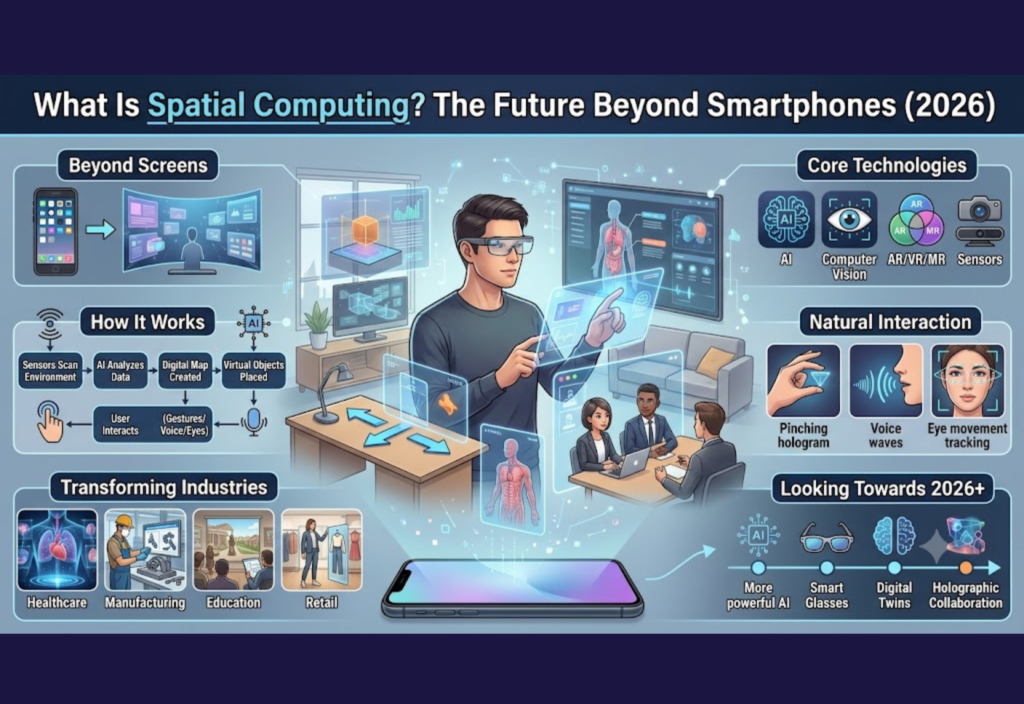
Spatial Computing combines the digital and physical worlds, allowing computers to understand spaces, objects, people, and movement in real time. Instead of interacting only through screens, users experience digital content that blends naturally with their surroundings.
For example, smart glasses can display navigation directions on the road, a virtual monitor can appear on your desk, and coworkers can collaborate using life-sized 3D holograms. These immersive experiences are made possible through this advanced technology.
Unlike traditional computing, which relies on keyboards and touchscreens, it enables more natural interaction through:
- Hand gestures
- Voice commands
- Eye tracking
- Body movement
- Environmental awareness
As a result, users enjoy a more intuitive, interactive, and immersive computing experience.
Why Is Spatial Computing Becoming So Important?
The way people use technology continues to evolve. Smartphones revolutionized communication, but they still require users to look down at a screen.
Spatial Computing aims to remove that limitation by bringing digital information into the real world.
Several factors are driving its rapid growth:
- More powerful AI models
- Faster processors
- Improved computer vision
- Advanced depth sensors
- Better battery technology
- High-speed wireless connectivity
- Lightweight smart glasses and headsets
Because these technologies are improving simultaneously, Spatial Computing is becoming increasingly practical for both businesses and consumers.
How Does Spatial Computing Work?
This technology combines artificial intelligence, sensors, cameras, and computer vision to understand and interact with the surrounding environment in real time.
The process is simple:
- Sensors scan the physical environment.
- Cameras capture images and movement.
- AI analyzes the collected data.
- A digital map of the surroundings is created.
- Virtual objects are accurately placed in the real world.
- Users interact through gestures, voice commands, or eye tracking.
All of these processes happen almost instantly, creating a smooth and immersive user experience.
Core Technologies Behind Spatial Computing
Artificial Intelligence (AI)
Artificial Intelligence is the brain behind Spatial Computing.
AI helps systems:
- Recognize people
- Detect objects
- Understand speech
- Predict user actions
- Process natural language
- Improve interactions over time
Without AI, Spatial Computing would not be intelligent enough to understand complex environments.
Computer Vision
Computer Vision allows machines to interpret images and videos much like humans do.
It helps devices:
- Identify objects
- Detect faces
- Measure distances
- Track movement
- Recognize locations
Computer vision enables virtual content to remain accurately positioned within the real world.
Augmented Reality (AR)
Augmented Reality overlays digital information onto the physical world.
Examples include:
- Navigation arrows
- Product visualization
- Interactive education
- Maintenance instructions
- Shopping experiences
Unlike Virtual Reality, AR keeps users connected to their real environment.
Virtual Reality (VR)
Virtual Reality creates fully immersive digital environments.
Users wear VR headsets to experience:
- Virtual classrooms
- Gaming worlds
- Training simulations
- Virtual meetings
- Digital tourism
VR is one of the major technologies supporting Spatial Computing.
Mixed Reality (MR)
Mixed Reality combines elements of both AR and VR.
Digital objects can interact naturally with real-world environments.
For example:
- A virtual television can remain fixed on your wall.
- Digital furniture can sit realistically inside your room.
- Virtual coworkers can appear around your meeting table.
Sensors and Cameras
Modern Spatial Computing devices include numerous sensors.
These include:
- Depth sensors
- Motion sensors
- LiDAR scanners
- GPS
- Cameras
- Eye-tracking sensors
Together, these components help devices understand physical spaces with remarkable accuracy.
Real-World Applications of Spatial Computing
Spatial Computing is already transforming multiple industries.
Healthcare
Doctors can visualize organs in 3D before surgery, improve medical training, and assist patients using immersive rehabilitation programs.
Education
Students can explore historical sites, conduct virtual science experiments, and interact with 3D learning materials, making education more engaging.
Manufacturing
Factories use Spatial Computing to guide workers through complex assembly processes, improve quality control, and reduce production errors.
Retail
Customers can virtually try on clothes, preview furniture in their homes, or explore products in interactive digital showrooms before making purchases.
Architecture and Construction
Architects can present life-sized building models, inspect construction projects remotely, and collaborate with clients in immersive environments.
Entertainment
Gaming, live events, sports, and virtual concerts are becoming more interactive through Spatial Computing experiences that blend digital content with the real world.
Business Collaboration
Companies are using immersive virtual workspaces where teams can collaborate on 3D designs, presentations, and meetings regardless of location.
Benefits of Spatial Computing
Spatial Computing offers far more than immersive visuals. It enables people to interact with digital information naturally while improving productivity, collaboration, and decision-making.
Some of its biggest advantages include:
- More natural human-computer interaction
- Improved remote collaboration
- Better learning experiences
- Higher workplace productivity
- Enhanced visualization of complex data
- Faster decision-making
- Reduced operational costs
- Improved customer experiences
- Greater accessibility through voice and gesture controls
As organizations adopt digital transformation strategies, these benefits make Spatial Computing increasingly valuable across industries.
Spatial Computing vs AR vs VR vs MR
Many people confuse these technologies, but they serve different purposes.
Spatial Computing
- Combines AI, sensors, computer vision, AR, and MR.
- Understands the physical environment.
- Allows natural interaction with digital objects.
Augmented Reality (AR)
- Adds digital information to the real world.
- Keeps users aware of their surroundings.
- Often used in navigation, shopping, and education.
Virtual Reality (VR)
- Creates a fully digital environment.
- Requires users to wear a VR headset.
- Commonly used in gaming, simulations, and training.
Mixed Reality (MR)
- Blends physical and digital environments.
- Digital objects interact realistically with the real world.
- Used for collaboration, design, and industrial applications.
Spatial Computing is the broader concept that combines these technologies with artificial intelligence and real-time environmental understanding.
Industries Using Spatial Computing
The adoption of Spatial Computing is expanding rapidly.
Industries benefiting from this technology include:
Healthcare
- Surgical planning
- Medical education
- Patient rehabilitation
- Remote consultations
Manufacturing
- Smart factories
- Equipment maintenance
- Worker training
- Quality inspections
Retail
- Virtual shopping
- Product visualization
- Interactive showrooms
- Personalized customer experiences
Education
- Interactive classrooms
- Virtual laboratories
- Historical recreations
- Science simulations
Real Estate
- Virtual property tours
- Interior design previews
- Building visualization
- Remote client presentations
Engineering
- 3D design reviews
- Digital prototypes
- Collaborative product development
- Equipment simulations
Entertainment
- Immersive gaming
- Live virtual concerts
- Interactive storytelling
- Sports experiences
Will Spatial Computing Replace Smartphones?
Many technology experts believe Spatial Computing could gradually reduce our dependence on smartphones, but it is unlikely to replace them completely in the near future.
Instead, smart glasses, wearable devices, and mixed reality headsets may handle many everyday tasks, such as:
- Navigation
- Video calls
- Messaging
- Web browsing
- Digital payments
- Shopping
- Entertainment
- Productivity
Rather than taking out a phone, users may simply look at digital information displayed within their surroundings or interact using voice and gestures.
For several years, smartphones and Spatial Computing devices are expected to work together before wearables become more common.
Challenges of Spatial Computing
Despite its potential, several challenges remain.
High Hardware Costs
Advanced headsets and smart glasses are still expensive for many consumers.
Battery Life
Powerful processors and sensors consume significant battery power.
Manufacturers continue working on more energy-efficient hardware.
Privacy Concerns
Always-on cameras and sensors raise important questions about user privacy and responsible data collection.
Companies must implement strong privacy protections and transparent policies.
Software Development
Building Spatial Computing applications requires expertise in:
- Artificial Intelligence
- Computer Vision
- 3D Development
- AR and VR
- User Experience Design
As a result, skilled developers remain in high demand.
Hardware Limitations
Future devices need to become:
- Smaller
- Lighter
- More comfortable
- More affordable
- More powerful
Continued innovation will help overcome these limitations.
Career Opportunities in Spatial Computing
As adoption grows, demand for professionals with Spatial Computing skills continues to increase.
Popular career paths include:
- Spatial Computing Developer
- AR Developer
- VR Developer
- Mixed Reality Engineer
- AI Engineer
- Computer Vision Engineer
- Robotics Engineer
- 3D Designer
- UX Designer
- Digital Twin Specialist
Learning these skills today can prepare professionals for future technology careers.
Future Trends (2026–2035)
Spatial Computing is expected to become increasingly integrated into everyday life over the next decade.
Emerging trends include:
- AI-powered smart glasses
- Digital twins for cities and industries
- Real-time language translation
- Holographic collaboration
- Smart factories
- Intelligent healthcare systems
- Autonomous robotics
- Spatial AI assistants
- Immersive remote education
- Next-generation wearable computers
As hardware improves and software becomes more intelligent, Spatial Computing may become as common as smartphones are today.
Frequently Asked Questions
Is Spatial Computing the same as Augmented Reality?
No. Augmented Reality (AR) is just one part of this technology. It also combines AI, computer vision, sensors, Virtual Reality (VR), and Mixed Reality (MR) to create immersive digital experiences.
Do I need a headset?
Not always. While many experiences use headsets or smart glasses, future applications may also work on smartphones, wearable devices, and other connected hardware.
Which industries benefit the most?
Healthcare, manufacturing, education, retail, engineering, real estate, logistics, entertainment, and enterprise collaboration are among the industries adopting this technology.
Is it a good career choice?
Yes. As businesses invest in immersive technologies and AI-powered solutions, professionals with skills in AI, computer vision, AR, VR, and mixed reality are expected to remain in high demand.
Conclusion
Spatial Computing is changing how people interact with technology by bringing the physical and digital worlds together. Instead of relying only on traditional screens, users can engage with digital content through gestures, voice commands, eye tracking, and intelligent environments. Advances in artificial intelligence, computer vision, augmented reality, and wearable devices are creating new opportunities across healthcare, education, manufacturing, retail, engineering, and entertainment.
Although challenges such as hardware costs, battery life, and privacy still exist, continuous innovation is making this technology more practical and accessible. As adoption continues to grow, it is expected to become a key part of the future beyond smartphones and reshape the way people work, learn, and connect with digital experiences.