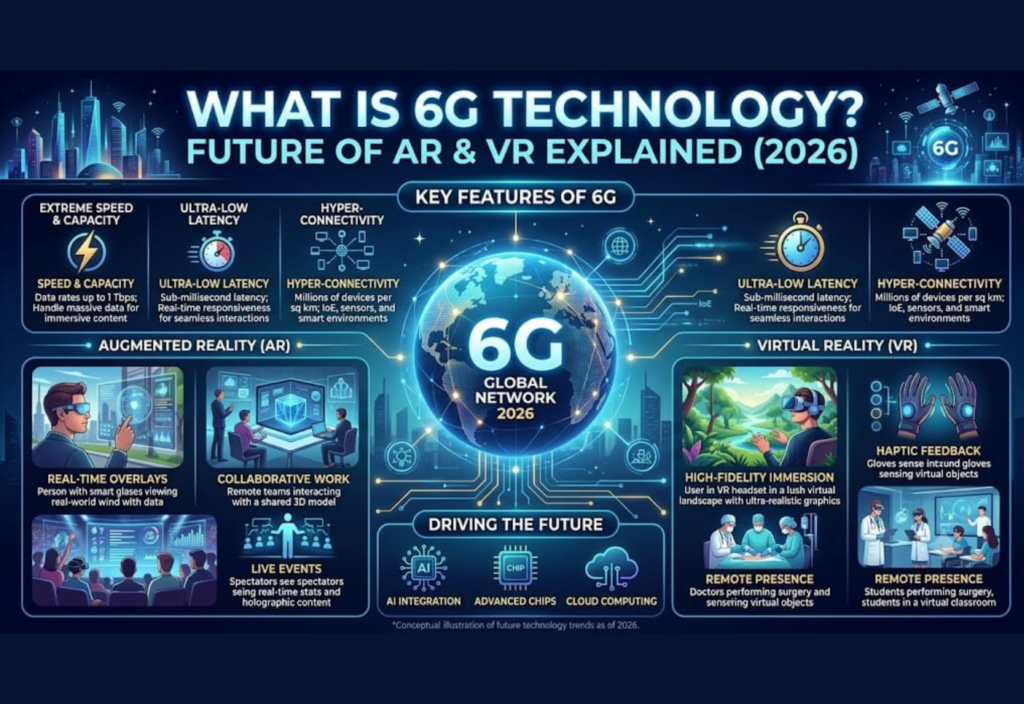
What Is 6G Technology? It is the next generation of wireless communication technology that is expected to succeed 5G and transform how people connect with the digital world. While 5G brought faster internet, lower latency, and support for smart devices, 6G aims to go much further by combining artificial intelligence, ultra-fast wireless communication, cloud computing, and immersive technologies like Augmented Reality (AR) and Virtual Reality (VR).
Although 6G is still in the research phase in 2026, governments, universities, and technology companies around the world are investing billions of dollars to develop the next generation of mobile networks. Experts believe commercial 6G services may begin appearing around 2030. The goal is not only to increase internet speed but also to create intelligent networks that can support billions of connected devices and deliver seamless digital experiences.
What Is 6G Technology?
6G, or the sixth generation of wireless communication, is designed to provide significantly higher speeds, lower latency, greater reliability, and smarter network management than current 5G networks. It is expected to use advanced technologies such as Artificial Intelligence (AI), Machine Learning (ML), edge computing, and the terahertz spectrum to deliver faster and more efficient communication.
Unlike previous mobile generations that mainly improved speed and connectivity, 6G is expected to make networks intelligent. This means the network itself can automatically optimize traffic, reduce congestion, improve security, and allocate resources where they are needed most.
The ultimate goal is to create a communication system where physical and digital environments work together in real time.
Key Features of 6G Technology
Ultra-Fast Internet Speeds
One of the biggest advantages of 6G is its expected speed. Researchers predict download speeds of up to 1 terabit per second (Tbps), which is many times faster than today’s 5G networks.
These speeds could allow users to download massive files in seconds, stream ultra-high-definition content without buffering, and run complex cloud applications effortlessly.
Extremely Low Latency
Latency refers to the delay between sending and receiving information. 6G aims to reduce latency to less than one millisecond, making communication almost instantaneous.
This will be especially important for:
- Autonomous vehicles
- Remote robotic surgery
- Cloud gaming
- Smart factories
- AR and VR applications
AI-Powered Networks
Artificial Intelligence is expected to become an essential part of 6G. Instead of simply transferring data, future networks will analyze traffic, predict network demand, improve security, and optimize performance automatically.
This intelligent network management will make wireless communication faster, safer, and more reliable.
Massive Device Connectivity
Future smart cities may include billions of connected devices, including sensors, vehicles, robots, cameras, and household appliances.
6G is designed to support this enormous number of devices without affecting network performance.
How 6G Will Improve AR and VR
Better Graphics
With ultra-fast internet speeds, most graphics processing could happen in powerful cloud servers instead of inside the headset. This would allow users to enjoy realistic graphics without needing expensive hardware.
Near-Zero Lag
Even small delays can break immersion or cause motion sickness in VR.
The ultra-low latency of 6G could provide smoother movement, faster response times, and a more natural virtual experience.
Cloud-Based Virtual Worlds
Future AR and VR experiences may run almost entirely from the cloud.
Users could instantly access large virtual environments, multiplayer games, educational simulations, and business meetings without downloading massive software updates.
Holographic Communication
One of the long-term goals of 6G is real-time holographic communication.
Instead of traditional video calls, users may communicate using realistic 3D holograms that appear almost as if people are physically present in the same room.
Real-World Applications of 6G
Smart Cities
Future cities could use millions of connected sensors to manage traffic, monitor pollution, improve public safety, optimize energy use, and automate public services.
Healthcare
Hospitals could benefit from faster medical imaging, AI-assisted diagnosis, remote robotic surgery, wearable health monitoring devices, and high-quality telemedicine.
Education
Students could attend immersive virtual classrooms, interact with realistic 3D educational models, and participate in AR-based science experiments from anywhere in the world.
Manufacturing
Factories may use intelligent robots, automated quality control systems, predictive maintenance, and digital twins to increase productivity while reducing downtime.
Entertainment
Streaming services, online gaming, live sports, and virtual concerts could become far more immersive thanks to higher bandwidth and lower latency.
Advantages of 6G Technology
Some of the expected benefits of 6G include:
- Extremely fast internet speeds
- Intelligent AI-powered network management
- Better AR and VR experiences
- Improved cloud computing
- Support for billions of connected devices
- Reliable communication for autonomous systems
- Higher energy efficiency
- More secure wireless communication
- Better global internet coverage through satellite integration
These improvements could create entirely new digital services that are impossible with today’s networks.
Challenges of 6G
Expensive Infrastructure
Building a global 6G network will require new antennas, satellites, fiber infrastructure, and advanced hardware, making deployment very expensive.
Security Risks
As billions of devices become connected, protecting user data and preventing cyberattacks will become increasingly important.
Technical Difficulties
Developing terahertz communication, intelligent networking, and advanced wireless technologies remains a major engineering challenge.
Device Upgrades
Existing smartphones will not support 6G. Consumers will eventually need new devices that are compatible with future networks.
6G vs 5G
5G
- Speed: Up to 20 Gbps
- Latency: 1–10 ms
- AI Integration: Limited
- AR & VR: Good
- Device Connectivity: Millions of devices
- Holographic Communication: Limited
6G (Expected)
- Speed: Up to 1 Tbps
- Latency: Less than 1 ms
- AI Integration: Built into the network
- AR & VR: Highly immersive
- Device Connectivity: Billions of devices
- Holographic Communication: Expected
When Will 6G Be Available?
As of 2026, 6G is still under active research and development. Technology companies, research institutions, and governments are testing new communication methods and developing international standards.
Most experts expect pilot projects before the end of the decade, while widespread commercial deployment is anticipated around 2030 or later. Until then, 5G will continue to evolve and support many advanced applications.
Conclusion
Understanding What Is 6G Technology helps us prepare for the next era of wireless communication. Unlike previous mobile generations that mainly focused on faster internet, 6G is expected to combine artificial intelligence, cloud computing, advanced networking, and ultra-low latency to create a truly intelligent digital ecosystem.
Its impact on AR and VR could be especially significant, enabling realistic virtual environments, cloud-based rendering, holographic communication, and immersive experiences for education, healthcare, entertainment, and business. Although commercial 6G networks are still several years away, ongoing research in 2026 is laying the foundation for a future where digital and physical worlds become more connected than ever before.