
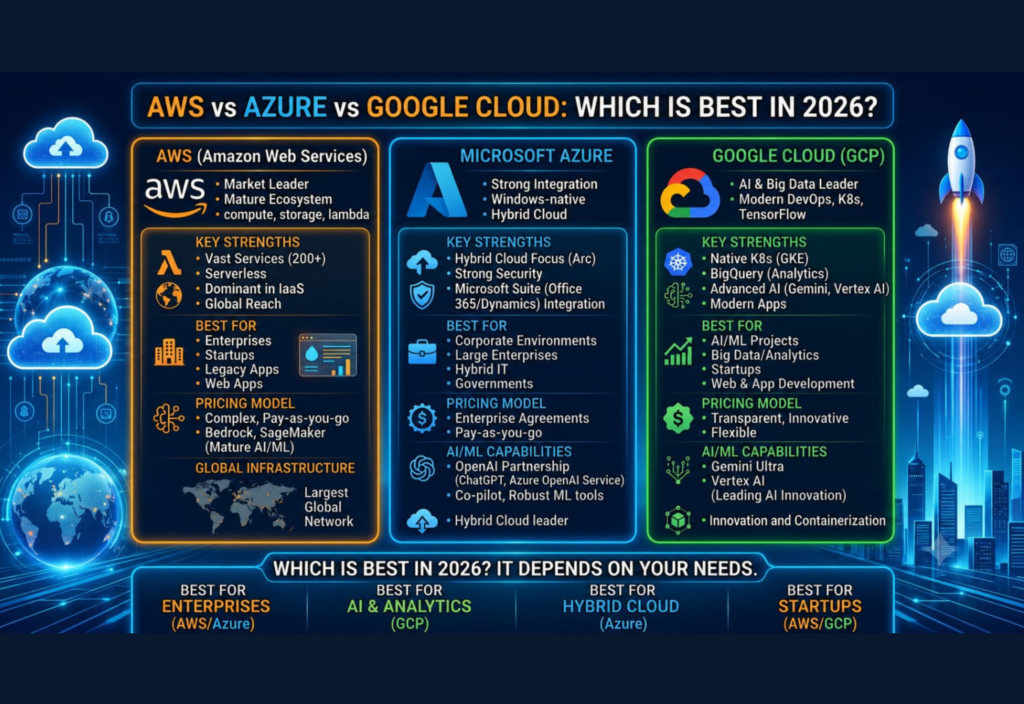
AWS vs Azure vs Google Cloud is one of the biggest cloud computing comparisons in 2026. Businesses, developers, startups, and enterprises all want to know which cloud platform offers the best value, performance, security, and scalability. Choosing between AWS vs Azure vs Google Cloud is important because the right platform can reduce costs, improve application performance, and support long-term business growth. Although all three providers deliver excellent cloud services, each one has different strengths and pricing models. Therefore, understanding their differences is essential before making a decision. In this guide, we compare AWS vs Azure vs Google Cloud in detail to help you select the platform that best fits your business needs.
What Is Cloud Computing?


Cloud computing is the delivery of computing services over the internet instead of relying on physical servers. These services include virtual machines, cloud storage, databases, networking, artificial intelligence, and analytics. Instead of purchasing expensive hardware, businesses can rent resources whenever they need them and pay only for what they use.
As a result, companies reduce infrastructure costs while improving flexibility and scalability. Moreover, cloud computing allows organizations to launch applications faster, protect important data, and serve users around the world. Today, businesses of every size use cloud platforms for websites, mobile applications, online stores, streaming services, healthcare systems, financial software, and educational platforms.
Some major benefits of cloud computing include:
- Lower infrastructure costs
- Faster deployment
- Flexible scalability
- Better security
- Global availability
- Automatic updates
- Reliable backup and disaster recovery
Amazon Web Services (AWS)
Amazon Web Services (AWS) was launched in 2006 and remains the world’s largest cloud computing platform. It offers more than 250 cloud services for computing, storage, networking, databases, analytics, artificial intelligence, and machine learning. Because of its massive infrastructure, AWS is trusted by startups, Fortune 500 companies, government agencies, and multinational organizations.
Popular AWS services include:
- Amazon EC2
- Amazon S3
- AWS Lambda
- Amazon RDS
- Amazon DynamoDB
- Amazon CloudFront
- Amazon SageMaker
Advantages of AWS
AWS offers one of the widest selections of cloud services available today. In addition, it has data centers in many regions around the world, allowing businesses to deliver fast performance to users. The platform also provides detailed documentation, a large developer community, and flexible pricing options.
Disadvantages of AWS
Although AWS is powerful, beginners may find it difficult to learn because of the large number of available services. Furthermore, understanding its pricing model sometimes requires careful planning, especially for large projects.
Microsoft Azure
Microsoft Azure entered the cloud market in 2010 and quickly became one of AWS’s strongest competitors. It is especially popular among organizations that already use Microsoft products such as Windows Server, Microsoft 365, SQL Server, and Active Directory. Consequently, businesses can migrate existing workloads to Azure with less effort.
Azure provides services for virtual machines, storage, databases, networking, DevOps, analytics, and artificial intelligence.
Popular Azure services include:
- Azure Virtual Machines
- Azure Blob Storage
- Azure SQL Database
- Azure Kubernetes Service (AKS)
- Azure Functions
- Azure AI Studio
Advantages of Azure
Azure integrates smoothly with Microsoft’s software ecosystem. Moreover, it offers excellent hybrid cloud capabilities, allowing businesses to connect on-premises systems with cloud infrastructure. Enterprise management tools and strong compliance features also make Azure a reliable option for large organizations.
Disadvantages of Azure
Some Azure services have complex names that may confuse beginners. However, users familiar with Microsoft products usually adapt to the platform quickly.
Google Cloud Platform (GCP)
Google Cloud Platform (GCP) focuses on cloud-native development, artificial intelligence, machine learning, and big data analytics. Unlike many traditional cloud providers, Google Cloud places a strong emphasis on innovation and developer-friendly tools. It is also the creator of Kubernetes, which has become the industry standard for container orchestration.
Popular Google Cloud services include:
- Compute Engine
- Cloud Storage
- Cloud SQL
- Google Kubernetes Engine (GKE)
- Vertex AI
- BigQuery
- Cloud Run
Advantages of Google Cloud
Google Cloud has a clean and modern interface, making it easy for beginners to learn. Additionally, its high-speed global network delivers excellent performance for cloud applications. The platform also offers advanced AI services and competitive pricing for many workloads.
Disadvantages of Google Cloud
Google Cloud has a smaller enterprise customer base than AWS and Azure. Nevertheless, it continues to grow rapidly because of its focus on artificial intelligence, machine learning, and cloud-native technologies.


AWS vs Azure vs Google Cloud: Ease of Use
Ease of use is another important factor when comparing AWS vs Azure vs Google Cloud. AWS provides the largest number of cloud services, giving experienced users maximum flexibility. On the other hand, Azure is easier for organizations already using Microsoft technologies. Google Cloud offers one of the simplest dashboards, making it an excellent choice for beginners. Overall, each platform has strengths, and the best option depends on your technical experience and business requirements.
AWS vs Azure vs Google Cloud: Compute Services
Compute services are the core of every cloud platform because they allow businesses to run applications, websites, and virtual machines. When comparing AWS vs Azure vs Google Cloud, all three providers offer reliable compute solutions, but each platform has unique advantages.
AWS provides Amazon EC2, which offers hundreds of virtual machine types for different workloads. In addition, features such as Auto Scaling, Elastic Load Balancing, and Spot Instances help businesses improve performance while reducing costs. Therefore, AWS is suitable for both small startups and large enterprises.
Azure offers Azure Virtual Machines, which are optimized for Windows-based applications. Moreover, Azure integrates smoothly with Microsoft services, making it easier for organizations to migrate existing workloads to the cloud.
Google Cloud provides Compute Engine, which is known for fast networking and efficient resource management. As a result, developers can deploy cloud-native applications quickly while maintaining excellent performance. Google also supports live migration, reducing downtime during maintenance.
AWS vs Azure vs Google Cloud: Storage and Database Services


Every business needs secure and reliable storage for files, backups, and application data. Fortunately, all three providers deliver high-quality storage services.
AWS offers Amazon S3, Amazon EBS, Amazon EFS, and Amazon Glacier. These services are highly durable and support everything from simple file storage to enterprise-scale data management.
Azure provides Blob Storage, Azure Files, Managed Disks, and Archive Storage. Furthermore, these services work seamlessly with Windows Server and Microsoft applications, making Azure an excellent option for enterprise customers.
Google Cloud Storage includes Standard, Nearline, Coldline, and Archive storage classes. Because of its simple pricing model, businesses can easily choose the most suitable storage option based on their usage.
Database services are equally important. AWS offers Amazon RDS, Aurora, DynamoDB, and Redshift. Azure provides Azure SQL Database, Cosmos DB, PostgreSQL, and MySQL. Meanwhile, Google Cloud offers Cloud SQL, Firestore, Bigtable, AlloyDB, and Spanner. Each platform supports both SQL and NoSQL databases, giving businesses flexibility for different workloads.
AWS vs Azure vs Google Cloud: Artificial Intelligence


Artificial intelligence has become one of the biggest reasons organizations choose a cloud provider in 2026. Therefore, every major cloud platform continues to invest heavily in AI technologies.
AWS provides Amazon SageMaker, Bedrock, Rekognition, Textract, Polly, and Comprehend. These services help developers build machine learning models, analyze data, process images, and automate business tasks.
Azure offers Azure AI Studio, Azure Machine Learning, Azure OpenAI Service, and Cognitive Services. Consequently, businesses can develop intelligent applications while integrating them with Microsoft’s enterprise ecosystem.
Google Cloud is widely recognized for its AI innovation. Vertex AI, Gemini integration, Vision AI, Speech-to-Text, and BigQuery ML allow developers to create advanced AI solutions with greater efficiency. For this reason, many AI-focused startups and research organizations choose Google Cloud.
AWS vs Azure vs Google Cloud: Security


Security is a top priority for every cloud provider. Fortunately, AWS, Azure, and Google Cloud all provide enterprise-grade security features that protect customer data and applications.
Common security features include:
- Identity and Access Management (IAM)
- Multi-Factor Authentication (MFA)
- Data encryption
- Firewall protection
- DDoS protection
- Continuous security monitoring
- Compliance certifications
- Backup and disaster recovery
AWS offers one of the most mature security ecosystems available. Similarly, Azure integrates with Microsoft Defender and enterprise security solutions. Google Cloud focuses on Zero Trust security architecture and advanced threat detection. Overall, all three platforms provide excellent protection for business workloads.
AWS vs Azure vs Google Cloud: Pricing
Pricing is another major factor when comparing AWS vs Azure vs Google Cloud. Although all three providers use pay-as-you-go pricing, they also offer discounts for long-term usage.
AWS provides Reserved Instances, Spot Instances, and Savings Plans to reduce operating costs. Azure offers Azure Hybrid Benefit, allowing organizations with Microsoft licenses to save money. Likewise, Google Cloud provides Sustained Use Discounts and Committed Use Discounts, making pricing more predictable for growing businesses.
Before selecting a cloud provider, businesses should estimate their workloads and compare pricing calculators to determine the most cost-effective solution.
Which Cloud Platform Should You Choose?
Choosing the best platform depends on your business goals and technical requirements.
Choose AWS if you:
- Need the largest cloud ecosystem.
- Require advanced cloud services.
- Build enterprise-scale applications.
- Want strong community support and documentation.
Choose Azure if you:
- Already use Microsoft products.
- Need hybrid cloud capabilities.
- Manage Windows-based environments.
- Prefer enterprise management tools.
Choose Google Cloud if you:
- Focus on artificial intelligence.
- Build Kubernetes-based applications.
- Work with big data analytics.
- Prefer a simple and modern interface.


Final Verdict
When comparing AWS vs Azure vs Google Cloud, there is no single platform that is perfect for every business. Instead, the best choice depends on your budget, existing technology, technical expertise, and future goals.
AWS remains the global leader because of its extensive range of cloud services, worldwide infrastructure, and mature ecosystem. On the other hand, Azure is the ideal choice for organizations already invested in Microsoft technologies. Google Cloud continues to grow rapidly because of its strengths in artificial intelligence, machine learning, Kubernetes, and data analytics.
Ultimately, AWS vs Azure vs Google Cloud represents three outstanding cloud platforms rather than one clear winner. Therefore, carefully evaluate your business requirements before making a decision. By choosing the right cloud provider, you can improve application performance, strengthen security, manage costs effectively, and support long-term business growth in 2026.