Artificial Intelligence (AI) has become one of the most powerful technologies in the modern world. Millions of people now use AI tools such as ChatGPT, Claude, Gemini, Copilot, and Perplexity for writing, coding, research, customer support, education, and business automation. These systems can generate impressive responses within seconds, making work faster and more efficient than ever before.
However, despite their intelligence, AI models are not always accurate. Sometimes they confidently generate information that sounds believable but is actually incorrect, misleading, or completely fabricated. This behaviour is known as AI Hallucination, and it has become one of the biggest challenges in modern artificial intelligence.
AI hallucinations can appear in many forms. A chatbot may invent facts, create fake references, misquote research papers, generate non-existent legal cases, or produce code that looks correct but contains hidden errors. Because these responses are often written confidently, many users mistakenly assume they are accurate.
As AI becomes increasingly integrated into healthcare, finance, education, software development, journalism, and business operations, understanding AI hallucinations is more important than ever. Knowing why they happen and how to reduce them helps individuals and organisations use AI more safely and effectively.
In this guide, you’ll learn what AI hallucination is, why it happens, common examples, its impact across different industries, and practical strategies to minimise inaccurate AI-generated responses.
What Is AI Hallucination?
AI hallucination occurs when an artificial intelligence model generates information that appears convincing but is false, misleading, or unsupported by reliable evidence.
Unlike humans, AI does not “know” whether something is true. Instead, it predicts the most likely sequence of words based on patterns learned from enormous datasets. While this prediction process often produces accurate answers, it can sometimes create content that sounds realistic despite being incorrect.
For example, an AI assistant might:
- Invent historical facts
- Create fake book titles
- Cite research papers that do not exist
- Generate fictional legal cases
- Miscalculate technical information
- Produce incorrect programming code
- Confidently answer questions outside its knowledge
Because the responses are fluent and natural, users may not immediately recognise that the information is inaccurate.
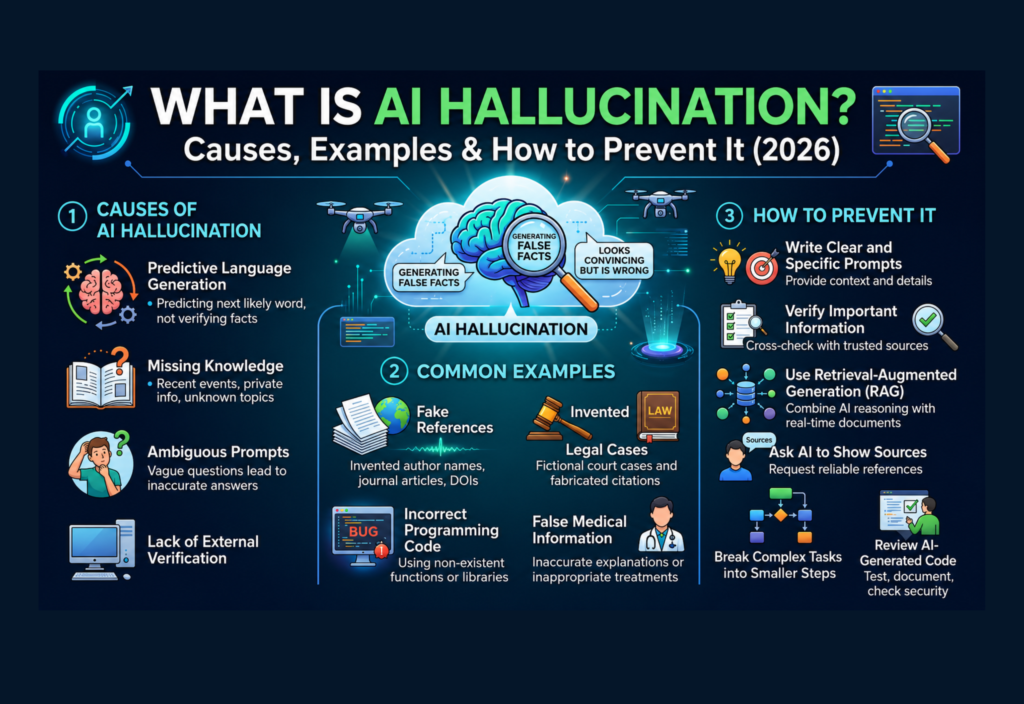
Why Do AI Hallucinations Happen?
AI hallucinations are not random mistakes. They usually result from the way large language models generate responses.
Several factors contribute to hallucinations.
1. Predictive Language Generation
Large Language Models (LLMs) predict the next most probable word rather than verifying facts against reality.
Instead of checking whether information is true, the model focuses on producing text that is statistically likely to follow the previous words.
As a result, it can generate statements that sound authoritative but are incorrect.
2. Missing Knowledge
AI models only know what they learned during training or what external tools provide.
If a question involves:
- Recent events
- Newly published research
- Breaking news
- Private company information
- Unknown topics
the model may guess instead of admitting uncertainty.
3. Ambiguous Prompts
Vague questions often lead to vague or inaccurate answers.
For example:
“Tell me about Apple.”
Does the user mean:
- Apple Inc.?
- Apples as fruit?
- Apple TV?
- Apple Intelligence?
Without enough context, AI may misunderstand the request.
4. Lack of External Verification
Some AI systems generate responses without consulting external databases or trusted sources.
When this happens, the model relies entirely on its internal knowledge, increasing the chance of hallucination.
This is one reason why Retrieval-Augmented Generation (RAG) systems often produce more reliable answers than standard language models.
5. Complex Reasoning Tasks
Very long calculations, multi-step reasoning, legal analysis, medical diagnosis, or advanced scientific questions increase the probability of errors.
The more complicated the task becomes, the greater the chance that AI may generate incorrect intermediate steps.
Common Examples of AI Hallucination
Hallucinations appear in many real-world situations.
Fake References
A student asks AI for research sources.
Instead of saying it cannot find enough references, the model invents:
- Author names
- Journal articles
- Publication years
- DOI numbers
The references look authentic but do not exist.
Incorrect Programming Code
A developer asks AI to use a software library.
The AI generates code using functions that were never part of that library.
Everything appears correct until the code is executed.
Invented Legal Cases
Lawyers using AI have occasionally discovered responses containing fictional court cases and fabricated legal citations.
Submitting these fake citations without verification can create serious professional consequences.
False Medical Information
Someone asks AI about symptoms.
Instead of encouraging consultation with a healthcare professional, the model may provide an inaccurate explanation or suggest an inappropriate treatment.
For this reason, AI should never replace qualified medical advice.
Incorrect Historical Facts
A user asks:
“Who invented a specific technology?”
The AI may confidently attribute the invention to the wrong person or provide incorrect dates that sound believable.
Industries Most Affected
AI hallucinations can affect almost every sector.
Healthcare
Doctors and medical researchers increasingly use AI for documentation, research assistance, and administrative work.
Incorrect medical information could influence important decisions if not carefully reviewed.
Education
Students often rely on AI for essays, homework, and research.
Fake citations and inaccurate explanations may reduce academic quality if sources are not verified.
Software Development
Developers use AI to generate code quickly.
However, hallucinated functions, outdated APIs, or insecure code can introduce bugs and security vulnerabilities.
Journalism
News organisations use AI to assist with drafting articles.
Publishing unverified AI-generated information could spread misinformation and damage credibility.
Finance
Financial professionals require accurate market data and regulations.
Hallucinated figures or incorrect investment information could lead to costly mistakes.
Legal Services
Law firms increasingly experiment with AI for legal research.
Because fabricated legal citations have already occurred in real cases, every AI-generated reference must be independently verified.
How to Prevent AI Hallucinations
Although AI hallucinations cannot be eliminated entirely, users can significantly reduce them by following a few best practices.
1. Write Clear and Specific Prompts
The quality of an AI response depends heavily on the prompt.
Instead of asking:
“Tell me about AI.”
Ask:
“Explain AI hallucinations with real-world examples and prevention methods for beginners.”
Providing context helps AI generate more accurate responses.
2. Verify Important Information
Never rely solely on AI for:
- Medical advice
- Legal guidance
- Financial decisions
- Academic research
- Scientific data
Always cross-check information using trusted sources before making important decisions.
3. Use Retrieval-Augmented Generation (RAG)
Many modern AI systems reduce hallucinations by retrieving information from trusted databases before generating responses.
Instead of depending only on trained knowledge, they combine AI reasoning with real-time documents, making answers more accurate and up to date.
4. Ask AI to Show Sources
When researching, request references.
For example:
“Provide reliable sources for this information.”
Although sources should still be verified, this encourages AI to generate more evidence-based responses.
5. Break Complex Tasks into Smaller Steps
Instead of asking AI to complete an entire project in one prompt, divide it into smaller tasks.
For example:
- Research the topic
- Create an outline
- Explain each section
- Review the final content
This approach reduces mistakes and improves accuracy.
6. Review AI-Generated Code
Developers should never copy AI-generated code directly into production.
Instead:
- Test the code
- Read the documentation
- Check security
- Verify API compatibility
Human review remains essential.
Can AI Hallucinations Be Completely Eliminated?
No.
Current AI models cannot guarantee 100% factual accuracy.
However, hallucinations continue to decrease because developers are improving AI through:
- Better training data
- Larger context windows
- Retrieval-Augmented Generation (RAG)
- Improved reasoning models
- Fact-checking systems
- External tool integration
- Human feedback during training
Future AI systems are expected to become significantly more reliable, but human verification will remain important for critical tasks.
AI Hallucination vs AI Bias
Many people confuse hallucinations with AI bias, but they are different problems.
AI Hallucination
- Meaning: Generates false information.
- Cause: Incorrect prediction.
- Result: Fake facts.
- Example: Invented research papers or fake citations.
- Solution: Better prompts, Retrieval-Augmented Generation (RAG), and fact-checking.
AI Bias
- Meaning: Produces unfair or biased outputs.
- Cause: Biased or unbalanced training data.
- Result: Unfair decisions or discrimination.
- Example: Hiring systems favoring certain groups over others.
- Solution: Fair datasets, ethical AI practices, and regular bias testing.
Understanding this difference helps users identify the correct solution.
Real-World Cases of AI Hallucination
Several well-known incidents have highlighted why AI hallucinations matter.
Legal Research
Lawyers using AI have submitted court documents containing fictional legal cases generated by an AI system. These citations appeared convincing but did not exist, leading to professional consequences.
Scientific Research
Researchers have reported AI-generated references that looked authentic but pointed to non-existent journals or fabricated papers.
Software Development
Developers occasionally receive code containing outdated functions or APIs that no longer exist, resulting in errors during testing.
Customer Support
AI chatbots sometimes provide incorrect company policies or inaccurate product details, requiring human review before responses are sent to customers.
These examples show why AI-generated content should always be checked before being used in professional environments.
Future of AI Hallucinations
Researchers are investing heavily in making AI more accurate.
Future improvements are likely to include:
- Stronger reasoning capabilities
- Better memory systems
- Improved real-time search
- More reliable citations
- Advanced fact-checking
- Lower hallucination rates
- Better integration with trusted knowledge bases
- Smarter AI agents capable of self-verification
Although hallucinations may never disappear completely, future AI systems are expected to produce far more dependable responses than today’s models.
Frequently Asked Questions
What is an AI hallucination?
An AI hallucination occurs when an AI model generates information that sounds believable but is inaccurate, misleading, or completely fabricated.
Why do AI models hallucinate?
Because language models predict the most likely words rather than verifying facts. Limited knowledge, unclear prompts, and missing external data can also contribute.
Can AI hallucinations be prevented?
They cannot be removed entirely, but they can be reduced by using clear prompts, verifying important information, and using AI systems that retrieve data from trusted sources.
Which AI models experience hallucinations?
All major AI models—including ChatGPT, Claude, Gemini, Copilot, and other large language models—can occasionally hallucinate, although the frequency varies by model and task.
Are AI hallucinations dangerous?
They can be, especially in healthcare, law, finance, research, and software development, where inaccurate information may lead to poor decisions if it is not verified.
Conclusion
AI Hallucination is one of the most important concepts to understand when working with modern artificial intelligence. While AI can generate impressive content, it may also produce information that is inaccurate or entirely fabricated. Recognising these limitations helps users apply AI more responsibly.
By writing clear prompts, verifying important facts, using trusted sources, and reviewing AI-generated content carefully, individuals and businesses can significantly reduce the risks associated with hallucinations. As AI technology continues to improve through better reasoning, retrieval systems, and fact-checking, future models are expected to become more reliable while still benefiting from responsible human oversight.