SLM vs LLM is one of the most important AI comparisons in 2026. As artificial intelligence continues to evolve, businesses, developers, students, and content creators use AI tools like ChatGPT, Claude, Gemini, and Microsoft Copilot every day. Although these tools rely on language models, not all models work the same way. Small Language Models (SLMs) focus on speed and efficiency, while Large Language Models (LLMs) deliver stronger reasoning and broader knowledge.
Choosing the right model depends on your goals rather than its size. For example, an SLM is ideal for mobile devices and offline AI, whereas an LLM performs better for coding, research, and enterprise applications. In this guide, you’ll learn the key differences between SLMs and LLMs, their pros, limitations, and real-world use cases to help you choose the right AI model.
What Is a Language Model?
A language model is an artificial intelligence system that understands and generates human language.
Instead of storing answers like a traditional database, it learns patterns from enormous amounts of text. As a result, it can predict the next word in a sentence and generate natural responses.
Modern language models power many AI applications, including:
- AI chatbots
- Writing assistants
- Coding assistants
- Search engines
- Customer support systems
- Translation tools
- Research assistants
- Business automation platforms
Although these systems share the same foundation, they are generally divided into two categories:
- Small Language Models (SLMs)
- Large Language Models (LLMs)
What Is an SLM (Small Language Model)?
A Small Language Model (SLM) is an AI model built with fewer parameters than a Large Language Model. Because of its smaller size, it requires less computing power, uses less memory, and generates responses more quickly.
Rather than solving every possible AI task, SLMs usually focus on specific jobs. Consequently, they perform well on devices with limited hardware, such as smartphones, laptops, embedded systems, and edge AI devices.
Some common characteristics of SLMs include:
- Small model size
- Fast response speed
- Lower hardware requirements
- Lower operating costs
- Better energy efficiency
- Easy local deployment
As a result, many businesses choose SLMs for applications where speed, privacy, and affordability matter more than advanced reasoning.
What Is an LLM (Large Language Model)?
A Large Language Model (LLM) is an AI model trained using billions or even trillions of parameters. These models learn from enormous datasets that include books, websites, research papers, documentation, and many other text sources.
Because they process far more information, LLMs can answer complex questions, write detailed content, generate software code, solve reasoning problems, and assist across many different subjects.
Popular examples include:
- ChatGPT
- Claude
- Gemini
- Llama
- DeepSeek
- Qwen
- Mistral Large
Although LLMs provide impressive capabilities, they also require powerful cloud servers and advanced GPUs. Therefore, running these models is generally more expensive than running smaller AI models.
How Do SLMs and LLMs Work?
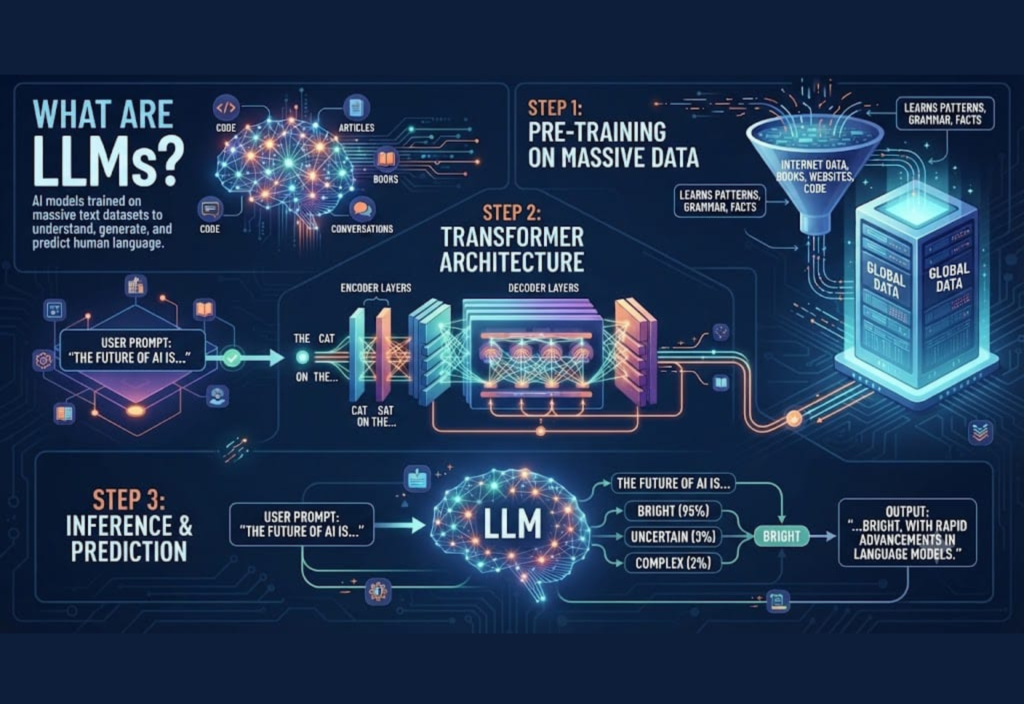
Both SLMs and LLMs use the same basic Transformer architecture. However, the scale of training and computing resources differs significantly.
The process usually follows these steps:
- Large text datasets are collected.
- The AI learns language patterns during training.
- A user enters a prompt.
- The model predicts the most likely next words.
- The complete response is generated.
Although both models follow this workflow, LLMs learn from much larger datasets and contain far more parameters. Consequently, they usually produce more detailed and accurate responses for complex tasks.
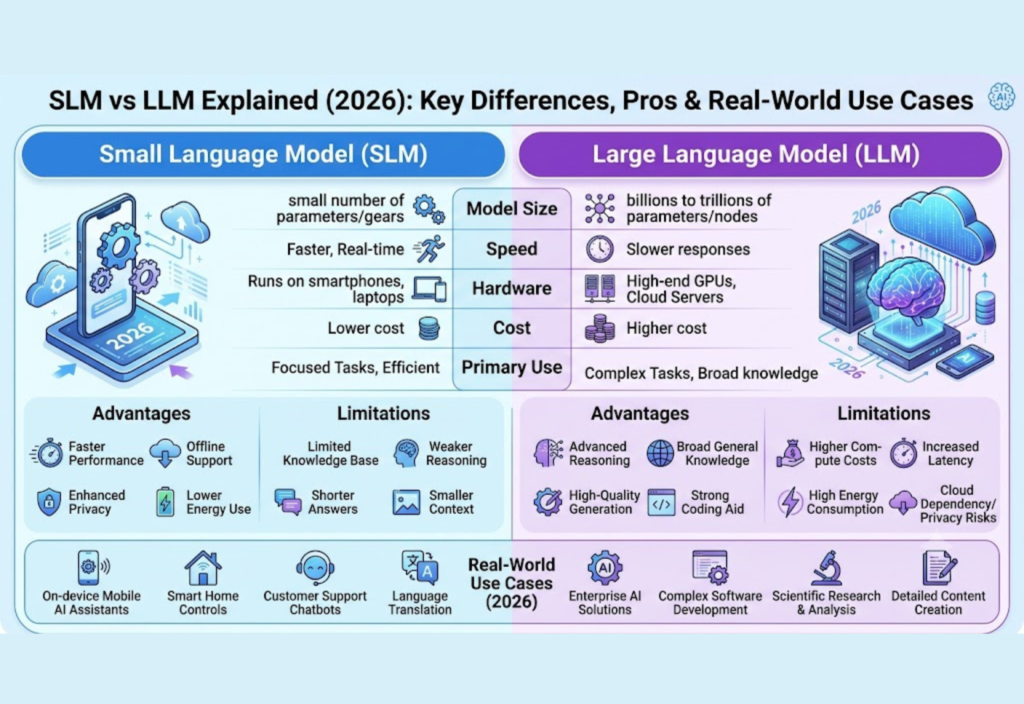
Key Differences Between SLM and LLM
SLM (Small Language Model)
- Model Size: Small
- Speed: Faster
- Hardware: Low requirements
- Cost: Lower
- Memory Usage: Low
- Offline Support: Excellent
- General Knowledge: Moderate
- Reasoning: Basic to moderate
- Mobile Devices: Excellent support
- Enterprise AI: Best for focused tasks
LLM (Large Language Model)
- Model Size: Very large
- Speed: Slower
- Hardware: High requirements
- Cost: Higher
- Memory Usage: High
- Offline Support: Limited
- General Knowledge: Extensive
- Reasoning: Advanced
- Mobile Devices: Limited support
- Enterprise AI: Best for complex workflows
Advantages of Small Language Models (SLMs)
Small Language Models offer several practical advantages.
Faster Performance
Because SLMs contain fewer parameters, they generate responses much faster. Therefore, they are ideal for real-time applications.
Lower Costs
SLMs require less computing power. As a result, businesses spend less on cloud infrastructure and hardware.
Better Privacy
Many SLMs can run directly on local devices. Consequently, sensitive data does not always need to leave the user’s system.
Lower Energy Consumption
Since smaller models require fewer resources, they consume less electricity. This makes them more environmentally friendly.
Easy Deployment
Developers can deploy SLMs on smartphones, laptops, IoT devices, and embedded systems without expensive hardware.
Advantages of Large Language Models (LLMs)
Large Language Models also provide significant benefits.
Better Reasoning
LLMs solve complex problems more effectively because they have learned from much larger datasets.
Broad Knowledge
They understand topics across technology, science, healthcare, finance, education, history, programming, and business.
Higher Quality Content
LLMs generate detailed articles, reports, documentation, marketing copy, and research summaries with greater depth and accuracy.
Strong Coding Assistance
Developers use LLMs for code generation, debugging, API integration, software architecture, and technical documentation.
Multi-Purpose AI
Unlike many smaller models, LLMs can perform writing, reasoning, translation, coding, planning, summarization, and conversational tasks within a single system.
Limitations of Small Language Models (SLMs)
Although SLMs are becoming more capable every year, they still have some limitations.
Limited Knowledge
SLMs learn from smaller datasets than LLMs. Therefore, they may struggle with highly technical or specialised topics.
Weaker Reasoning
Complex tasks often require deeper reasoning. As a result, SLMs may not perform as well when solving advanced mathematical, scientific, or legal problems.
Less Detailed Responses
SLMs usually generate shorter answers. While they are fast, they may not provide the same level of detail as larger models.
Smaller Context Window
Most SLMs process shorter conversations and documents. Consequently, they may lose important context during long discussions.
Limitations of Large Language Models (LLMs)
Large Language Models are powerful. However, they also have several disadvantages.
Higher Computing Costs
LLMs require expensive GPUs and cloud infrastructure. Therefore, running them costs significantly more than running SLMs.
Slower Responses
Because these models process billions of parameters, they usually respond more slowly than smaller models.
Higher Energy Consumption
Training and running LLMs consume large amounts of electricity. As a result, they are less energy efficient.
Privacy Concerns
Most LLMs run in the cloud. Therefore, users often send their data to external servers unless the model is deployed privately.
Real-World Use Cases of SLMs
Small Language Models are ideal when speed, efficiency, and privacy matter most.
Common applications include:
- AI assistants on smartphones
- Offline AI applications
- Smart home devices
- Customer support chatbots
- Email classification
- Document summarisation
- Translation tools
- Voice assistants
- Edge AI systems
- Industrial IoT devices
Because SLMs can often run locally, they are an excellent choice for mobile and embedded devices.
Real-World Use Cases of LLMs
Large Language Models perform best when tasks require advanced reasoning and broad knowledge.
Popular applications include:
- AI research assistants
- Software development
- AI coding assistants
- Enterprise automation
- Business analytics
- Content creation
- Marketing copywriting
- Legal research
- Healthcare support
- Educational tutoring
As businesses adopt AI, LLMs continue to power many advanced enterprise solutions.
SLM vs LLM: Which One Should You Choose?
The best choice depends on your project.
Choose an SLM if you need:
- Fast AI responses
- Offline functionality
- Lower operating costs
- Better privacy
- Mobile deployment
- Edge AI applications
Choose an LLM if you need:
- Advanced reasoning
- High-quality content generation
- Complex coding assistance
- Research support
- Long conversations
- Enterprise-scale AI
Many organisations now combine both models. For example, an SLM can handle simple requests, while an LLM solves more complex problems. This hybrid approach improves performance and reduces costs.
Future of SLMs and LLMs
AI is evolving rapidly, and both SLMs and LLMs will continue to improve.
Several trends are shaping the future:
- More powerful Small Language Models
- Better reasoning capabilities
- Longer context windows
- Faster AI inference
- Hybrid AI systems
- On-device AI
- Multimodal AI
- Smarter AI agents
Instead of replacing one another, SLMs and LLMs will likely work together. As a result, businesses will gain faster, more efficient, and more affordable AI solutions.
Frequently Asked Questions
What is the main difference between SLM and LLM?
An SLM is smaller, faster, and more efficient. In contrast, an LLM is larger, more knowledgeable, and better at solving complex tasks.
Are Small Language Models better than Large Language Models?
Not always. SLMs are ideal for lightweight applications, while LLMs perform better in advanced reasoning, coding, research, and content generation.
Can SLMs run offline?
Yes. Many Small Language Models can run on smartphones, laptops, and edge devices without requiring a constant internet connection.
Which industries use SLMs and LLMs?
Healthcare, education, finance, software development, manufacturing, retail, customer support, cybersecurity, and enterprise automation all use language models.
Will SLMs replace LLMs?
No. Both models have different strengths. SLMs focus on speed and efficiency, whereas LLMs handle complex reasoning and broader knowledge. Therefore, both will continue to play important roles in future AI systems.
Conclusion
SLM vs LLM is not about choosing one model over the other. Instead, each serves a different purpose. Small Language Models are ideal for fast, cost-effective, and privacy-focused tasks, while Large Language Models excel at advanced reasoning, coding, research, and content creation.
As AI continues to evolve, many businesses will use both models together to balance performance and cost. By understanding their strengths and limitations, you can choose the right AI model for your specific needs in 2026 and beyond.