AI Sales Agents are transforming how businesses sell products and engage with customers in 2026. Instead of relying on manual prospecting, cold emails, follow-ups, and CRM updates, companies now use AI to automate repetitive sales tasks and improve productivity. As a result, sales teams can focus on building relationships and closing more deals.
Unlike traditional automation tools, AI sales agents understand conversations, qualify leads, personalise communication, and schedule meetings. In this guide, you’ll learn how they work, their key benefits, challenges, and real-world use cases in 2026.
What Is an AI Sales Agent?
An AI Sales Agent is intelligent software that automates sales tasks using artificial intelligence. It can understand customer requests, analyse information, and generate relevant responses instead of relying only on fixed rules.
These systems work across websites, email, messaging apps, social media, and voice channels. They help businesses qualify leads, answer customer questions, recommend products, and support prospects throughout the sales journey.
Unlike traditional chatbots, they understand conversation context and provide more natural, personalised interactions.
How Do AI Sales Agents Work?
These intelligent systems automate sales workflows by understanding customer requests and responding in real time.
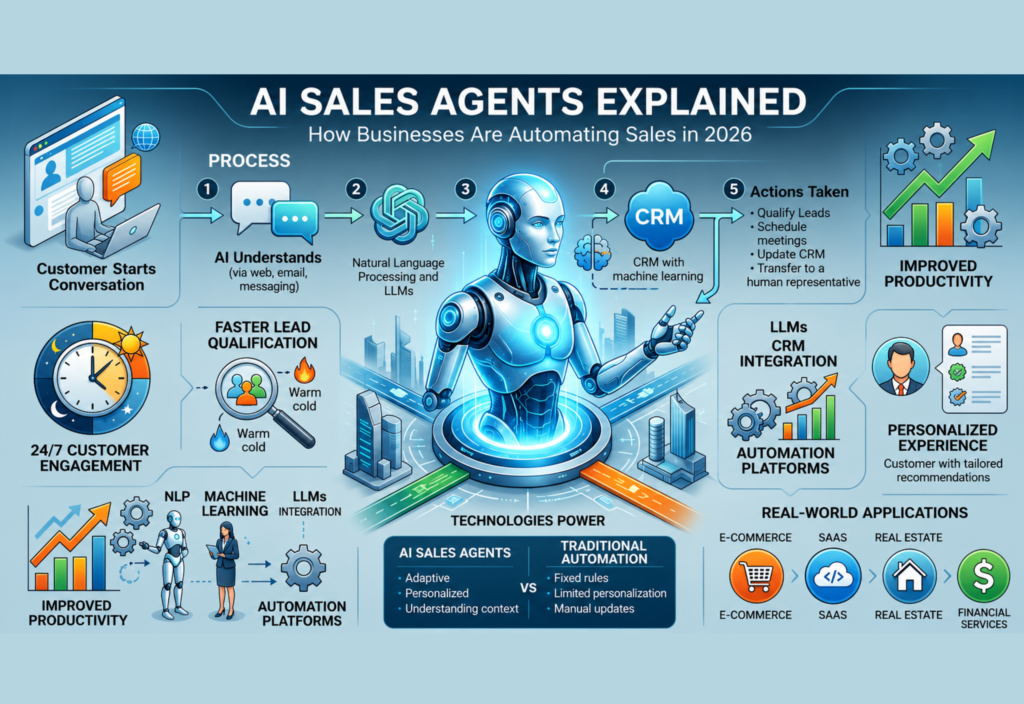
The process usually works like this:
- A customer starts a conversation.
- The AI understands the request.
- Customer data is retrieved from connected systems.
- The AI analyses the information.
- A personalised response is generated.
- If needed, the system schedules meetings, updates the CRM, or transfers the conversation to a sales representative.
This process takes only a few seconds, helping businesses respond faster and improve customer engagement.
Technologies Behind AI Sales Agents
AI sales agents combine several technologies to automate sales and improve customer interactions.
Natural Language Processing (NLP)
NLP helps AI understand written and spoken language, allowing it to answer customer questions naturally.
Machine Learning
Machine learning enables the system to learn from previous interactions and improve recommendations over time.
Large Language Models (LLMs)
LLMs help AI understand complex questions and generate accurate, personalised responses.
CRM Integration
CRM integration gives AI access to customer data and previous interactions, making responses more relevant.
Automation Platforms
Automation tools allow AI to update CRM records, assign leads, send emails, and trigger follow-up actions automatically.
Key Features of AI Sales Agents
Modern AI sales agents offer much more than basic customer support.
Common features include:
- Lead qualification
- Product recommendations
- Automated follow-ups
- Meeting scheduling
- CRM updates
- Customer support
- Sales forecasting
- Pipeline management
- Multilingual communication
- Personalised interactions
These features help businesses improve efficiency, save time, and deliver better customer experiences.
Benefits of AI Sales Agents
24/7 Customer Engagement
Unlike human teams, AI works around the clock. As a result, customers receive support anytime.
Faster Lead Qualification
AI quickly identifies qualified leads, allowing sales teams to focus on high-value opportunities.
Improved Productivity
AI automates repetitive tasks such as follow-ups and CRM updates. Therefore, sales representatives can spend more time building customer relationships.
Personalised Customer Experience
AI analyses customer data to deliver relevant recommendations and improve engagement.
Better Sales Performance
Fast responses and consistent follow-ups help businesses increase conversions and reduce missed opportunities.
Real-World Applications of AI Sales Agents
Businesses use this technology across many industries to automate sales and improve customer experiences.
E-commerce
- Product recommendations
- Cart recovery
- Order assistance
- Upselling
- Cross-selling
SaaS
- Demo booking
- Lead qualification
- Product onboarding
- Subscription management
Real Estate
- Property recommendations
- Appointment scheduling
- Buyer qualification
- Lead nurturing
Healthcare
- Appointment booking
- Patient enquiries
- Service recommendations
- Follow-up reminders
Financial Services
- Loan enquiries
- Product recommendations
- Customer support
- Investment guidance
This technology helps businesses automate repetitive tasks, improve customer engagement, and increase sales efficiency.
Challenges of AI Sales Agents
Although AI sales agents offer many advantages, businesses should also understand their limitations.
Limited Human Emotion
AI can understand language, but it cannot fully replace human empathy. Therefore, complex negotiations and relationship-building still require experienced sales professionals.
Data Quality Matters
AI performs best when it has access to accurate customer data. If the CRM contains outdated or incomplete information, the AI may generate poor recommendations.
Privacy and Compliance
Businesses must protect customer information when using AI. Following data privacy regulations and maintaining secure systems is essential for building customer trust.
Initial Setup
Deploying an AI sales agent requires planning, integration, and testing. However, once implemented correctly, it can save significant time and resources.
AI Sales Agents vs Traditional Sales Automation
Many people confuse AI sales agents with traditional automation tools. However, they are very different.
AI Sales Agents
- Understand customer conversations
- Learn from interactions
- Personalise responses
- Make intelligent recommendations
- Handle complex enquiries
- Adapt to changing situations
Traditional Automation
- Follow fixed rules
- Use predefined workflows
- Limited personalisation
- Require manual updates
- Cannot understand complex conversations
Because of these differences, AI sales agents provide a far more intelligent and flexible sales experience.
Best Use Cases for AI Sales Agents
AI sales agents can improve almost every stage of the sales process.
Popular use cases include:
- Website lead qualification
- Live chat support
- Outbound email campaigns
- Product recommendations
- Appointment scheduling
- Sales follow-ups
- CRM data management
- Customer onboarding
- Subscription renewals
- Upselling and cross-selling
As a result, businesses can automate routine work while keeping sales teams focused on high-value opportunities.
Industries Using AI Sales Agents
Many industries use AI sales agents to improve sales and customer engagement.
Common examples include:
- E-commerce
- SaaS
- Healthcare
- Real estate
- Banking
- Insurance
- Education
- Manufacturing
- Travel
- Telecommunications
Although each industry uses AI differently, the goal is the same: improve customer engagement and increase sales efficiency.
Popular AI Tools for Sales Automation
Businesses use a variety of AI-powered platforms to automate sales activities.
Some popular categories include:
- AI CRM platforms
- AI chatbots
- Email automation tools
- Meeting schedulers
- AI writing assistants
- Sales intelligence platforms
- Conversation analytics tools
- AI voice agents
Instead of replacing sales teams, these tools help employees work faster and make better decisions.
How to Implement AI Sales Agents
Businesses can follow these simple steps to implement AI successfully.
1. Identify Repetitive Tasks
Find time-consuming activities such as lead qualification, follow-ups, and appointment scheduling.
2. Choose the Right Platform
Select an AI solution that integrates with your CRM and existing sales tools.
3. Train the System
Provide product details, company information, pricing, and FAQs so it can generate accurate responses.
4. Test Before Launch
Run pilot tests to identify issues and improve performance.
5. Monitor Results
Track response time, lead conversions, and customer satisfaction to optimise performance over time.
Future of AI Sales Agents
AI sales agents are becoming smarter every year. Future developments are expected to include:
- Better reasoning capabilities
- More natural conversations
- Real-time multilingual communication
- Deeper CRM integration
- Autonomous sales workflows
- Predictive customer insights
- Voice-first AI agents
- Multi-agent collaboration
As AI technology advances, businesses will automate even more sales activities while maintaining personalised customer experiences.
Frequently Asked Questions
What is an AI Sales Agent?
An AI Sales Agent is intelligent software that automates tasks like lead qualification, customer communication, follow-ups, appointment scheduling, and CRM updates.
Can AI replace sales representatives?
No. AI handles repetitive work, while human sales professionals remain essential for negotiations, relationship building, and closing complex deals.
Which businesses benefit the most?
E-commerce, SaaS, healthcare, real estate, finance, education, and service-based businesses commonly use AI-powered sales automation.
Do these systems work 24/7?
Yes. They can answer customer questions, qualify leads, and provide support at any time.
Are they expensive?
Costs vary by platform and business size. However, many companies reduce expenses by automating repetitive sales tasks.
Conclusion
AI Sales Agents are helping businesses automate repetitive sales tasks and improve customer engagement. By handling lead qualification, follow-ups, scheduling, and CRM updates, they allow sales teams to focus on building stronger customer relationships and closing more deals.
As AI technology continues to improve, these intelligent assistants will become even more accurate, efficient, and personalised. Although human expertise remains essential, AI-powered sales tools can significantly boost productivity and support business growth. Companies that adopt this technology early will gain a competitive advantage in the digital marketplace.