Cybersecurity has become one of the biggest challenges of the digital age. Every day, businesses, governments, and individuals face cyber threats such as phishing attacks, ransomware, malware, identity theft, and data breaches. As cybercriminals continue to develop more sophisticated attack methods, traditional security systems often struggle to detect and stop threats quickly.
This is where Artificial Intelligence (AI) is transforming cybersecurity. Instead of relying only on predefined rules and manual monitoring, AI-powered security systems can analyse massive amounts of data, recognise unusual behaviour, detect cyber threats in real time, and respond much faster than conventional security tools.
In 2026, organisations around the world are investing heavily in AI-driven cybersecurity solutions to strengthen their digital defences. From financial institutions and healthcare providers to e-commerce businesses and government agencies, AI is helping security teams identify threats earlier, reduce response times, and protect sensitive information more effectively.
In this guide, you’ll learn what AI in cybersecurity is, how it works, its core technologies, major benefits, real-world applications, challenges, and why it has become an essential part of modern cyber defence.
What Is AI in Cybersecurity?
AI in Cybersecurity refers to the use of artificial intelligence and machine learning to detect, analyse, prevent, and respond to cyber threats automatically.
Unlike traditional security software that depends mainly on predefined rules or known attack signatures, AI continuously analyses network activity, user behaviour, system logs, and incoming data to identify suspicious patterns. It can detect both known and previously unseen threats, making security systems more adaptive and proactive.
Instead of replacing cybersecurity professionals, AI acts as an intelligent assistant that helps security teams monitor large environments, investigate incidents, and respond to attacks much faster.
How Does AI Improve Cybersecurity?
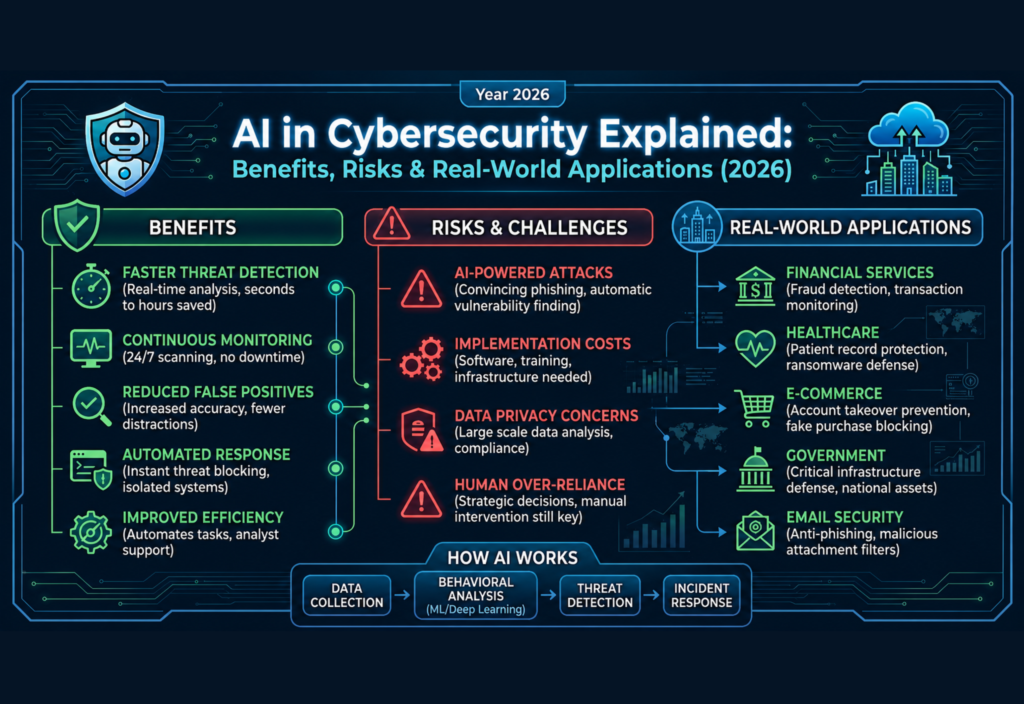
Modern AI security systems continuously collect and analyse information from multiple sources.
The process usually follows these steps:
- Collect data from networks, devices, applications, and users.
- Analyse behaviour using machine learning models.
- Detect unusual or suspicious activity.
- Assess the level of risk.
- Generate alerts or automatically respond to threats.
- Learn from new attacks to improve future detection.
Because this entire process happens in real time, organisations can reduce the impact of cyberattacks before they cause serious damage.
Technologies Behind AI in Cybersecurity
Several advanced technologies work together to improve digital security.
Machine Learning
Machine learning enables security systems to recognise attack patterns by analysing historical and real-time data. As new threats appear, the models continue learning and improving detection accuracy.
Natural Language Processing (NLP)
NLP helps security teams analyse emails, chat messages, and online content. It plays an important role in detecting phishing attempts, fraudulent messages, and social engineering attacks.
Behavioural Analytics
Instead of focusing only on known malware signatures, behavioural analytics monitors how users and devices normally operate. If unusual activity occurs, the system can flag it as suspicious.
Deep Learning
Deep learning processes extremely large datasets to identify hidden attack patterns that traditional security systems may miss.
Threat Intelligence
AI combines information from multiple security sources to identify emerging cyber threats, helping organisations stay ahead of attackers.
Benefits of AI in Cybersecurity
Faster Threat Detection
AI analyses millions of events within seconds, allowing organisations to identify threats much faster than manual monitoring.
Continuous Monitoring
Unlike human analysts, AI systems operate 24 hours a day without interruption. This provides constant protection against cyber threats.
Reduced False Positives
Traditional security software often generates unnecessary alerts. AI improves accuracy by identifying genuine threats more effectively.
Automated Incident Response
When suspicious activity is detected, AI can isolate infected devices, block malicious traffic, disable compromised accounts, and alert security teams automatically.
Improved Security Efficiency
By automating repetitive security tasks, AI allows cybersecurity professionals to focus on investigating complex attacks and improving overall security strategies.
Real-World Applications of AI in Cybersecurity
AI is already protecting organisations across many industries.
Financial Services
Banks use AI to detect fraudulent transactions, prevent identity theft, monitor online banking activity, and reduce financial fraud.
Healthcare
Hospitals use AI to protect patient records, detect ransomware attacks, secure connected medical devices, and monitor sensitive healthcare systems.
E-commerce
Online retailers use AI to identify fraudulent purchases, prevent account takeovers, detect payment fraud, and secure customer information.
Government
Government agencies rely on AI to defend critical infrastructure, detect cyber espionage, and protect national digital assets.
Enterprise Security
Large organisations use AI to monitor employee activity, secure cloud environments, detect insider threats, and strengthen network security.
Email Security
AI-powered email filters identify phishing emails, malicious attachments, fake websites, and business email compromise attacks before they reach users.
Challenges of AI in Cybersecurity
Although AI strengthens cybersecurity, it also has limitations that organisations must consider.
High Implementation Costs
Advanced AI security platforms can be expensive to deploy, especially for small businesses. Costs may include software, infrastructure, and employee training.
Data Privacy Concerns
AI systems process large amounts of sensitive information. Businesses must follow data protection regulations and maintain strong privacy controls.
AI-Powered Cyberattacks
Cybercriminals are also using AI to create more convincing phishing emails, automate attacks, and discover software vulnerabilities. As a result, defenders must continuously improve their AI security systems.
False Positives
Although AI improves detection accuracy, it can occasionally flag legitimate activities as suspicious, requiring human review.
Human Expertise Is Still Needed
AI cannot fully replace cybersecurity professionals. Human analysts remain essential for investigating complex incidents, making strategic decisions, and responding to advanced attacks.
AI vs Traditional Cybersecurity
Modern AI security offers several advantages over traditional security solutions.
AI-Powered Cybersecurity
- Learns from new threats
- Detects unusual behaviour
- Automates threat response
- Improves over time
- Analyses large volumes of data
Traditional Cybersecurity
- Uses predefined rules
- Detects known threats
- Requires more manual monitoring
- Limited adaptability
- Slower response to new attacks
AI complements traditional security rather than replacing it.
Common Cyber Threats AI Can Detect
AI helps organisations identify many types of cyber threats.
These include:
- Phishing attacks
- Malware
- Ransomware
- Identity theft
- Insider threats
- Account takeovers
- Network intrusions
- Distributed Denial-of-Service (DDoS) attacks
- Data breaches
- Fraudulent transactions
Early detection helps reduce damage and improve response times.
Popular AI Cybersecurity Tools
Many organisations use AI-powered security platforms to strengthen their defences.
Popular categories include:
- Endpoint detection and response (EDR)
- Extended detection and response (XDR)
- Security Information and Event Management (SIEM)
- Email security platforms
- Identity and access management tools
- Cloud security solutions
- Threat intelligence platforms
- Network monitoring systems
These tools automate threat detection while supporting security teams.
How Businesses Can Implement AI in Cybersecurity
Businesses should take a structured approach when adopting AI security.
1. Identify Security Risks
Assess existing systems and identify the most critical security challenges.
2. Select the Right Solution
Choose an AI platform that integrates with current security infrastructure.
3. Train Security Teams
Ensure employees understand how to use AI tools effectively.
4. Test Regularly
Perform security testing to verify detection accuracy and identify weaknesses.
5. Monitor Performance
Review alerts, incident reports, and detection rates to improve security over time.
Future of AI in Cybersecurity
AI will continue to play a larger role in digital security over the coming years.
Future developments may include:
- Smarter threat detection
- Predictive cyber defence
- Autonomous incident response
- Stronger cloud security
- AI-powered identity verification
- Improved fraud detection
- Better zero-day attack detection
- More intelligent security automation
As cyber threats become more advanced, AI will remain one of the most important technologies for protecting digital systems.
Frequently Asked Questions
What is AI in Cybersecurity?
AI in cybersecurity uses artificial intelligence and machine learning to detect, analyse, and respond to cyber threats automatically.
Can AI stop all cyberattacks?
No. AI significantly improves threat detection and response, but businesses still need skilled cybersecurity professionals and strong security practices.
Which industries benefit the most?
Banking, healthcare, government, retail, manufacturing, education, and technology companies widely use AI-powered cybersecurity solutions.
Is AI better than traditional cybersecurity?
AI is more effective at detecting new and evolving threats. However, it works best when combined with traditional security measures.
Is AI cybersecurity suitable for small businesses?
Yes. Many cloud-based AI security solutions are affordable and help small businesses improve protection without large security teams.
Conclusion
AI in Cybersecurity is transforming how organisations protect their digital assets against modern cyber threats. By analysing vast amounts of data, detecting suspicious behaviour, and automating incident response, AI helps businesses strengthen security while reducing response times.
Although challenges such as privacy concerns, implementation costs, and AI-powered attacks remain, the benefits outweigh the limitations for many organisations. Rather than replacing cybersecurity professionals, AI works alongside them to improve efficiency and detect threats more quickly.
As cyber risks continue to evolve, combining artificial intelligence with human expertise will become essential for building stronger, more resilient cybersecurity strategies in 2026 and beyond.