Artificial intelligence is transforming digital advertising faster than ever before. In 2026, businesses no longer rely solely on manual campaign management, keyword research, or audience targeting. Instead, AI-powered advertising platforms help marketers automate tasks, optimise budgets, improve targeting, and increase return on investment (ROI).
Both Google Ads and Facebook Ads (Meta Ads) have integrated advanced AI features that analyse millions of data points in real time. These intelligent systems automatically identify the right audience, determine the best bidding strategy, generate ad recommendations, and optimise campaigns based on performance. As a result, businesses can achieve better results while spending less time managing advertisements.
From small businesses to global brands, companies are using AI to create personalised advertising experiences, reduce wasted ad spend, and improve conversion rates. Whether you’re promoting an online store, generating leads, or building brand awareness, AI has become an essential part of modern advertising.
Understanding how AI works in Google Ads and Facebook Ads can help marketers stay competitive in today’s fast-changing digital landscape.
In this guide, you’ll learn what AI advertising is, how Google and Meta use artificial intelligence, its key benefits, practical applications, popular AI tools, best practices, challenges, and future trends shaping digital marketing in 2026.
What Is AI Advertising?
AI advertising refers to the use of artificial intelligence and machine learning to automate, optimise, and improve digital advertising campaigns.
Instead of manually adjusting bids, selecting audiences, analysing reports, or testing multiple ad variations, AI continuously analyses campaign data and makes intelligent decisions that improve overall performance.
Modern advertising platforms use AI to:
- Analyse customer behaviour
- Predict purchasing intent
- Identify high-value audiences
- Optimise bidding strategies
- Improve ad targeting
- Generate ad recommendations
- Increase conversions
- Reduce advertising costs
Unlike traditional advertising methods, AI learns from campaign performance over time. Therefore, advertising becomes more accurate and efficient as additional data becomes available.
Why AI Is Changing Digital Advertising
Online advertising has become far more competitive than it was only a few years ago.
Millions of businesses compete for customer attention across search engines and social media platforms. Consequently, managing campaigns manually has become increasingly difficult.
Artificial intelligence solves this challenge by analysing enormous amounts of data within seconds.
For example, AI can determine:
- Which users are most likely to click an advertisement
- Which audience is most likely to make a purchase
- Which creative performs better
- Which keywords generate the highest conversions
- Which budget allocation delivers the best return
Because these decisions happen automatically, marketers can focus more on business strategy rather than repetitive campaign management.
How AI Works in Google Ads
Google Ads uses artificial intelligence throughout nearly every stage of campaign management.
Instead of relying entirely on manual settings, Google’s AI analyses search behaviour, user intent, device type, location, browsing history, and hundreds of other signals before deciding when to display an advertisement.
The more data Google collects, the smarter its optimisation becomes.
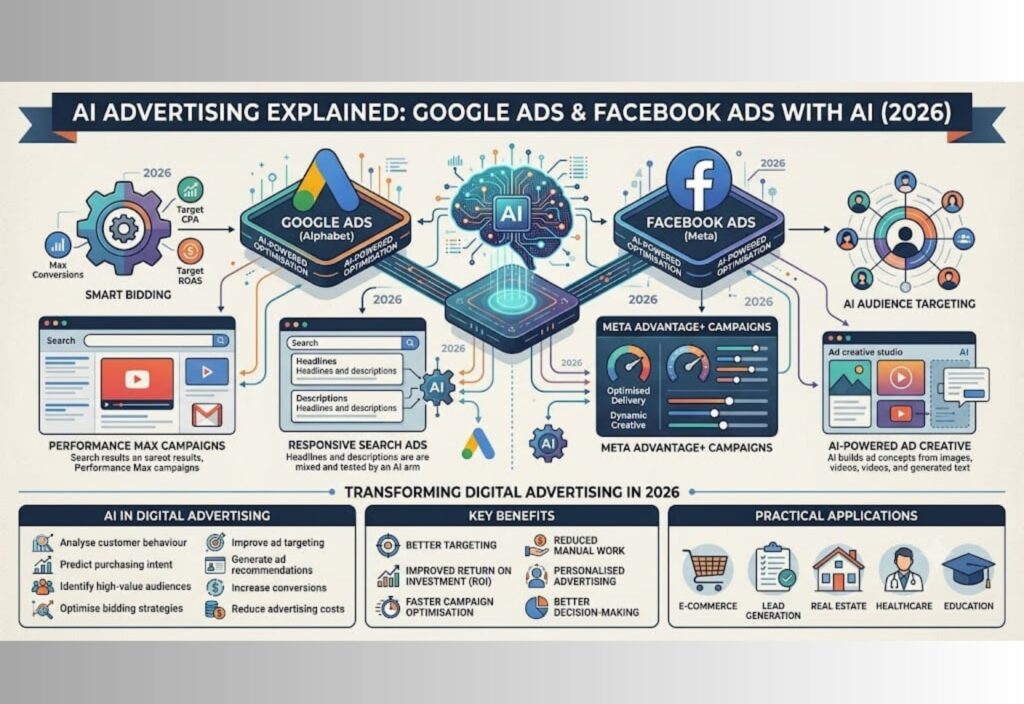
Smart Bidding
One of Google’s most powerful AI features is Smart Bidding.
Rather than manually setting bids for every keyword, Google’s machine learning automatically adjusts bids during each auction.
The system considers factors such as:
- User location
- Device type
- Search intent
- Time of day
- Previous browsing behaviour
- Historical conversion data
As a result, advertisers are more likely to reach customers who are ready to take action.
Popular Smart Bidding strategies include:
- Maximise Conversions
- Maximise Conversion Value
- Target CPA (Cost Per Acquisition)
- Target ROAS (Return on Ad Spend)
These automated strategies often outperform manual bidding because AI reacts instantly to changing market conditions.
Performance Max Campaigns
Performance Max is another major AI-powered feature introduced by Google.
Instead of creating separate campaigns for Search, Display, YouTube, Gmail, Discover, and Maps, advertisers provide campaign assets once.
Google’s AI then automatically decides:
- Where to show ads
- Which audience to target
- Which creative performs best
- How to distribute the advertising budget
This automation simplifies campaign management while maximising overall performance.
Responsive Search Ads
AI also improves ad creation through Responsive Search Ads (RSAs).
Advertisers write multiple headlines and descriptions, while Google’s machine learning tests different combinations automatically.
Over time, the system identifies the highest-performing combinations based on user engagement and conversion data.
Consequently, advertisers achieve better click-through rates without manually testing every variation.
Audience Targeting with AI
Google’s artificial intelligence continuously analyses user behaviour to identify audiences that are more likely to convert.
Instead of targeting only basic demographics, AI evaluates:
- Search history
- Website activity
- Shopping behaviour
- Interests
- Purchase intent
- Previous conversions
This allows businesses to reach customers at the right moment with highly relevant advertisements.
How AI Works in Facebook & Instagram Ads
Meta has integrated artificial intelligence across Facebook, Instagram, Messenger, and the Audience Network to help advertisers improve campaign performance.
Instead of relying only on manually selected audiences, Meta’s AI analyses billions of user interactions every day. Consequently, it identifies people who are most likely to engage with advertisements or complete desired actions.
The system continuously learns from user behaviour and adjusts campaigns automatically to improve results.
Meta Advantage+ Campaigns
One of Meta’s most powerful AI features is Advantage+ Campaigns.
Instead of manually selecting every campaign setting, advertisers provide:
- Marketing objective
- Creative assets
- Budget
- Landing page
- Business goals
Meta’s AI then automatically determines:
- The best audience
- Ad placements
- Budget distribution
- Creative combinations
- Delivery optimisation
As a result, businesses spend less time managing campaigns while improving overall performance.
AI Audience Targeting
Finding the right audience has always been one of the biggest challenges in digital advertising.
Artificial intelligence simplifies this process by analysing:
- User interests
- Browsing activity
- Shopping behaviour
- Engagement history
- Purchase intent
- Previous interactions
Instead of targeting broad audiences, AI identifies users who are most likely to become customers.
Therefore, businesses reduce wasted advertising spend.
AI-Powered Ad Creative
Creating effective advertisements requires multiple headlines, descriptions, and images.
AI now assists marketers by generating:
- Ad headlines
- Product descriptions
- Marketing copy
- Call-to-action buttons
- Image suggestions
- Video captions
Some AI tools can even create complete advertising campaigns within minutes.
However, marketers should still review AI-generated content before publishing.
AI Budget Optimisation
Budget allocation is another area where artificial intelligence provides significant improvements.
Instead of distributing budgets equally, AI continuously monitors campaign performance and automatically shifts spending toward better-performing advertisements.
For example:
If one audience generates more conversions than another, AI increases spending on the successful audience while reducing investment in weaker segments.
Consequently, advertisers achieve higher returns without manually adjusting campaign budgets.
Benefits of AI Advertising
Artificial intelligence offers several advantages for businesses of every size.
Better Targeting
AI analyses millions of behavioural signals to identify users who are most likely to convert.
Therefore, advertisements become more relevant.
Improved Return on Investment (ROI)
By reducing wasted impressions and optimising bids, AI helps advertisers generate more revenue from the same advertising budget.
Faster Campaign Optimisation
Instead of waiting days or weeks to evaluate campaign performance, AI analyses data continuously and makes improvements automatically.
As a result, campaigns adapt much faster.
Reduced Manual Work
Marketers no longer need to spend hours adjusting bids, testing creatives, or analysing reports manually.
Instead, AI performs many repetitive tasks automatically.
Personalised Advertising
Consumers expect personalised experiences.
AI analyses customer behaviour and displays advertisements that match individual interests, increasing engagement and conversions.
Better Decision-Making
AI processes enormous amounts of campaign data within seconds.
Therefore, businesses can make informed marketing decisions much faster.
Real-World Applications of AI Advertising
Businesses across many industries already use AI-powered advertising.
E-commerce
Online stores use AI to:
- Recommend products
- Optimise shopping campaigns
- Recover abandoned carts
- Improve product advertisements
Lead Generation
Service businesses automate:
- Audience targeting
- Landing page optimisation
- Lead qualification
- Customer acquisition
Real Estate
Property companies use AI to identify buyers interested in specific locations, price ranges, and property types.
Healthcare
Healthcare providers promote services using AI-powered audience segmentation while improving patient engagement.
Education
Educational institutions advertise online courses by targeting students based on learning interests and previous online behaviour.
Popular AI Advertising Tools
Several AI-powered tools help businesses improve digital advertising campaigns.
Popular options include:
- Google Ads AI
- Meta Advantage+
- ChatGPT
- Jasper AI
- Canva AI
- Adobe Firefly
- HubSpot AI
- Copy.ai
- Semrush AI
- Microsoft Copilot
These tools help marketers create content, optimise campaigns, analyse performance, and automate repetitive tasks.
Challenges of AI Advertising
Although AI offers many advantages, businesses should also understand its limitations.
Privacy Regulations
Data privacy laws continue evolving worldwide.
Therefore, advertisers must comply with regulations such as GDPR and other local privacy requirements.
Dependence on Data
AI performs best when sufficient high-quality data is available.
New businesses with limited conversion history may initially experience slower optimisation.
Reduced Manual Control
Because AI automates many campaign decisions, marketers have less direct control over bidding and targeting.
However, proper monitoring usually solves this concern.
AI Bias
Poor-quality or biased training data may occasionally affect targeting decisions.
Therefore, businesses should regularly review campaign performance.
Best Practices for AI Advertising
Artificial intelligence can significantly improve advertising performance. However, following the right strategies is essential to achieve the best results.
Set Clear Campaign Goals
Every campaign should begin with a clear objective.
Common goals include:
- Brand awareness
- Website traffic
- Lead generation
- Online sales
- App downloads
- Customer engagement
When objectives are clearly defined, AI can optimise campaigns more effectively.
Use High-Quality Creative Assets
Although AI can optimise advertisements, it still depends on quality inputs.
Businesses should use:
- Professional images
- High-quality videos
- Clear headlines
- Strong call-to-action buttons
- Optimised landing pages
Better creative assets usually lead to higher conversion rates.
Monitor Campaign Performance
AI automates optimisation, but marketers should continue monitoring important metrics such as:
- Click-through rate (CTR)
- Conversion rate
- Cost per click (CPC)
- Cost per acquisition (CPA)
- Return on ad spend (ROAS)
Regular reviews help identify new opportunities for improvement.
Combine AI with Human Creativity
Artificial intelligence is excellent at analysing data and automating repetitive tasks. However, human creativity remains essential for developing unique marketing strategies, storytelling, and brand messaging.
The most successful campaigns combine AI automation with human expertise.
Test Different Ad Variations
AI performs better when multiple creative options are available.
Advertisers should test different:
- Headlines
- Images
- Videos
- Descriptions
- Calls to action
Over time, AI automatically identifies the highest-performing combinations.
AI Advertising vs Traditional Advertising
Although both approaches aim to reach customers, their methods differ significantly.
Traditional Advertising
Traditional advertising relies heavily on manual campaign management.
Marketers usually:
- Choose audiences manually
- Set bids manually
- Analyse reports themselves
- Optimise campaigns periodically
While this approach offers greater control, it requires more time and effort.
AI Advertising
AI advertising automates many campaign decisions using machine learning.
It can:
- Identify high-converting audiences
- Optimise bids automatically
- Allocate budgets intelligently
- Improve ad delivery
- Learn continuously from campaign performance
As a result, businesses often achieve better performance with less manual work.
Future of AI Advertising
Artificial intelligence will continue transforming digital advertising over the next several years.
Future developments may include:
- Fully autonomous advertising campaigns
- More accurate predictive analytics
- Better audience personalisation
- Real-time creative generation
- Voice-based advertising
- AI-generated video advertisements
- Improved cross-platform optimisation
- Smarter customer journey analysis
Moreover, AI is expected to work more closely with customer relationship management (CRM) systems, allowing businesses to deliver highly personalised advertising experiences.
As machine learning models continue improving, advertisers will gain even greater efficiency while reducing advertising costs.
Frequently Asked Questions
What is AI advertising?
AI advertising uses artificial intelligence and machine learning to automate, optimise, and improve digital advertising campaigns across platforms such as Google Ads and Facebook Ads.
How does AI improve Google Ads?
AI helps Google Ads optimise bidding, audience targeting, keyword selection, budget allocation, and ad delivery based on real-time user behaviour.
Does Facebook use AI for advertising?
Yes. Meta uses artificial intelligence through features like Advantage+ to automate audience targeting, budget optimisation, creative testing, and campaign delivery.
Can small businesses benefit from AI advertising?
Absolutely. AI helps small businesses compete with larger brands by improving targeting, reducing advertising costs, and increasing return on investment without requiring large marketing teams.
Will AI replace digital marketers?
No. AI automates repetitive tasks and improves campaign optimisation, but marketers remain essential for strategy, creativity, branding, and business decision-making.
Conclusion
AI advertising is transforming the way businesses promote products and services online. By combining artificial intelligence with machine learning, platforms like Google Ads and Facebook Ads automatically optimise campaigns, improve audience targeting, manage budgets, and increase conversion rates with far less manual effort.
As AI continues to evolve in 2026, businesses of every size can use intelligent advertising tools to create more personalised customer experiences, reduce wasted ad spend, and improve marketing performance. Although challenges such as data privacy, platform dependence, and human oversight still exist, the advantages of AI-powered advertising far outweigh its limitations.
Understanding how AI advertising works today will help marketers, entrepreneurs, and business owners build smarter campaigns, make better marketing decisions, and stay competitive in the rapidly changing digital landscape.