Artificial intelligence is evolving rapidly, and one of its most exciting advancements is Multimodal AI. Unlike traditional AI systems that process only one type of information, this technology can understand and combine multiple forms of data, including text, images, audio, video, and documents. By analysing these inputs together, it delivers more accurate, context-aware, and human-like responses.
In the past, most AI tools specialised in a single task. One model could generate text, another recognised images, while a different system converted speech into text. Modern AI has changed this approach by bringing these capabilities together in a single model. As a result, users can interact more naturally without switching between multiple applications.
Leading technology companies such as OpenAI, Google, Anthropic, Microsoft, and Meta are developing advanced models capable of understanding several input types simultaneously. Consequently, businesses across healthcare, education, finance, manufacturing, customer support, and software development are adopting these systems to improve productivity and automate complex tasks.
Whether you’re a student, developer, business owner, or AI enthusiast, understanding this technology can help you stay ahead as artificial intelligence continues to reshape the digital landscape.
In this guide, you’ll learn what it is, why it matters, how it works, the technologies behind it, and the industries benefiting from its adoption.
Why Is Multimodal AI Important?
Traditional AI systems typically process only one type of information at a time. For example, a chatbot understands text, while an image recognition system analyses pictures. Although these tools perform well in their specialised areas, they often struggle when multiple sources of information are required to understand a situation.
Modern multimodal systems overcome this limitation by combining different types of data before generating a response. This enables them to understand context more effectively and provide more accurate results.
For example, imagine uploading a photo of a damaged laptop and asking:
“Why won’t this laptop turn on?”
Instead of relying only on your written question, the system can analyse the image, identify visible hardware damage, interpret your request, and provide a detailed explanation.
By connecting visual and textual information, these models deliver responses that are more useful and closer to human reasoning.
What Is Multimodal AI?
Multimodal AI is an artificial intelligence system designed to process, understand, and generate information using multiple types of data within a single model.
Rather than working with only text or only images, it combines several input formats to build a complete understanding before producing an output.
Common input types include:
- Text
- Images
- Audio
- Video
- Documents
- PDFs
- Charts
- Graphs
- Sensor data
By bringing these data sources together, the system gains richer context and makes better-informed decisions.
For example, a teacher can upload a student’s handwritten assignment and ask:
“Please check this work and explain the mistakes.”
The AI can:
- Read the handwriting
- Understand the content
- Detect grammar or mathematical errors
- Explain each mistake
- Suggest improvements
Similarly, a doctor may upload an X-ray alongside patient notes. The system analyses both the medical image and the written information before assisting with diagnosis.
These practical examples highlight why this technology is becoming increasingly valuable across a wide range of industries.
How Is It Different from Traditional AI?
The primary difference lies in the type of information each system can process.
Traditional AI usually focuses on a single data format. For example:
- A chatbot understands text.
- Speech recognition converts spoken words into text.
- Computer vision identifies objects in images.
Each system performs one specialised task.
Multimodal AI, on the other hand, combines these capabilities into a single intelligent model.
Instead of analysing only text or only images, it understands how different forms of information relate to one another. This allows it to solve more complex problems while producing more reliable and context-aware responses.
Because of this broader understanding, it is well suited for real-world applications that require reasoning across multiple types of data.
How Does Multimodal AI Work?
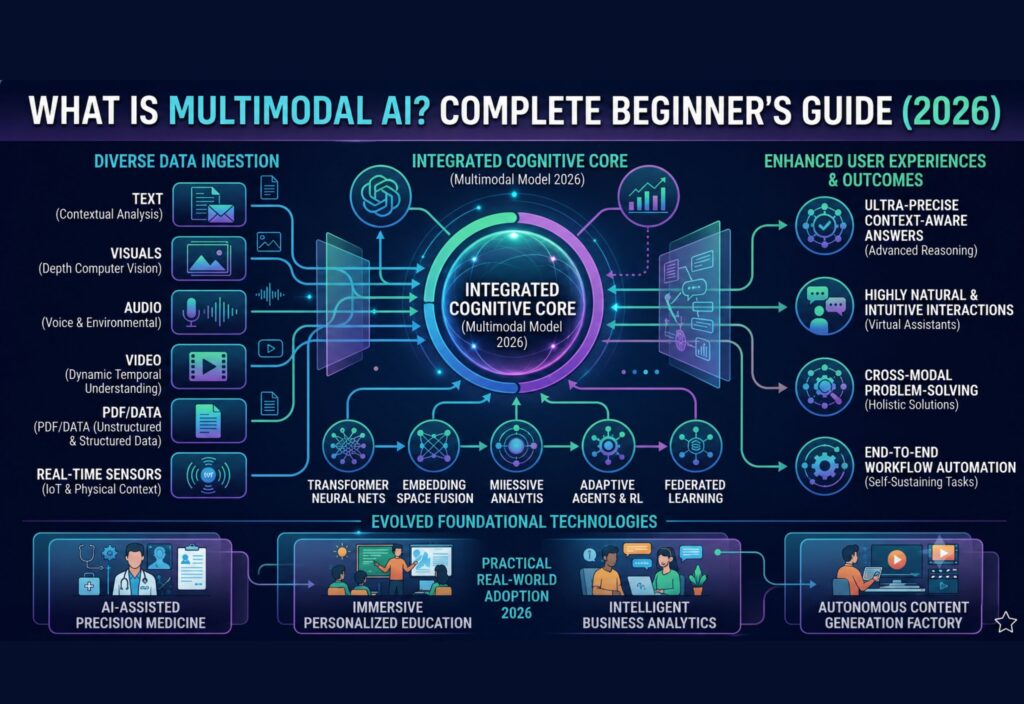
Although different companies use different architectures, most multimodal systems follow a similar workflow.
Step 1: Receive Multiple Inputs
The process begins when the AI receives one or more types of input.
Examples include:
- A written question
- An uploaded image
- A PDF document
- A voice recording
- A video clip
Unlike older AI systems, it can analyse several inputs simultaneously.
Step 2: Process Each Data Type
Next, specialised AI models process each input individually.
For example:
- Large Language Models (LLMs) understand text.
- Computer vision models analyse images.
- Speech recognition converts spoken language into text.
- Video models examine frames and identify important events.
Each model extracts useful information before sending it to the central AI system.
Step 3: Combine Information
After processing every input, the AI merges the extracted information into a unified understanding.
For example, if you upload a chart together with the question:
“Explain this sales report.”
The system analyses:
- The chart
- The numerical data
- The written question
- Previous conversation context
It then generates a complete explanation rather than interpreting only one piece of information.
This ability to combine multiple sources of data is what makes these systems more intelligent and accurate than traditional AI models.
Core Technologies Behind Multimodal AI
Several advanced AI technologies work together to make multimodal systems possible. Each plays a unique role in helping the model understand different forms of information.
Large Language Models (LLMs)
Large Language Models are responsible for understanding and generating human language.
They help AI:
- Understand written instructions
- Answer questions
- Generate articles
- Explain complex concepts
- Summarise documents
- Translate languages
Popular examples include GPT models, Claude, Gemini, and Llama.
Computer Vision
Computer vision enables AI to analyse and interpret visual information.
It can recognise:
- Objects
- People
- Animals
- Vehicles
- Charts
- Diagrams
- Handwritten notes
- Medical images
For example, it helps identify diseases from X-rays or recognise products in online shopping images.
Speech Recognition
Speech recognition converts spoken language into text that AI can understand.
This technology powers:
- Voice assistants
- Live transcription
- Voice search
- Meeting summaries
- Voice-controlled applications
As a result, users can communicate naturally without typing.
Natural Language Processing (NLP)
Natural Language Processing enables AI to understand grammar, context, user intent, and even emotions.
Rather than analysing words individually, NLP interprets the meaning of complete sentences, making conversations more accurate and natural.
Machine Learning
Machine learning allows AI systems to improve over time by learning from data and user interactions.
As more information becomes available, models become increasingly accurate and capable of handling more complex tasks.
Data Fusion
Data fusion is one of the key technologies behind multimodal systems.
Instead of processing each input separately, it combines information from different sources into a single understanding.
For example:
- A customer uploads a photo of a damaged product.
- They also describe the issue in text.
- The AI analyses both inputs together before generating a response.
By merging different types of information, the system delivers answers that are more accurate, relevant, and reliable than those produced by single-input AI models.
Benefits of Multimodal AI
This technology offers several advantages over traditional AI by combining multiple types of information into a single system. As a result, it delivers more accurate, efficient, and context-aware responses.
Better Context Understanding
By analysing text, images, documents, audio, and other inputs together, AI gains a deeper understanding of the user’s request.
For example, when a chart is uploaded along with a written question, the system can interpret both the visual data and the accompanying text to provide a more detailed explanation.
Improved Accuracy
Using multiple sources of information reduces misunderstandings and improves the quality of responses.
Instead of relying on a single input, the system cross-checks information across text, images, documents, or audio before generating an answer. This leads to more reliable results in many real-world situations.
More Natural Communication
People naturally communicate using a combination of speech, writing, images, and visual cues.
Modern AI supports these different interaction methods, allowing users to communicate in the way that feels most comfortable. This creates a smoother and more intuitive experience.
Increased Productivity
Businesses can automate more complex workflows because AI can process several types of information at the same time.
Employees spend less time switching between different tools, improving efficiency and helping teams focus on higher-value tasks.
Better Decision-Making
When text, visuals, documents, and numerical data are analysed together, organisations gain deeper insights for making informed decisions.
This capability is especially valuable in industries such as healthcare, finance, manufacturing, and business analytics.
Real-World Applications
Multimodal AI is already transforming the way organisations work across a wide range of industries.
Healthcare
Healthcare providers use these systems to:
- Analyse medical images
- Review patient records
- Summarise clinical notes
- Assist with diagnosis
- Support treatment planning
By combining medical images with patient information, healthcare professionals can make faster and more informed decisions.
Education
Educational platforms are using AI to provide:
- Interactive tutoring
- Language learning assistance
- Homework support
- Automatic grading
- Image-based explanations
Students can upload handwritten notes, diagrams, or documents and receive personalised guidance with detailed explanations.
Customer Support
Many businesses now allow customers to upload:
- Screenshots
- Product photos
- Documents
- Error messages
The AI analyses both the uploaded content and the customer’s question before suggesting solutions. This improves response quality while reducing support time.
Software Development
Developers use advanced AI tools to:
- Generate code
- Explain screenshots
- Debug applications
- Analyse system diagrams
- Create technical documentation
- Convert UI designs into code
These capabilities speed up development and help teams solve problems more efficiently.
Content Creation
Content creators rely on AI to:
- Write blog posts
- Generate images
- Create presentations
- Edit videos
- Produce captions
- Design marketing materials
Instead of using multiple applications, creators can complete many tasks within a single AI-powered workflow.
Finance
Financial institutions apply AI for:
- Document verification
- Fraud detection
- Customer support
- Financial reporting
- Risk analysis
By analysing different forms of information together, organisations improve security, reduce manual work, and make faster decisions.
E-commerce
Online retailers use AI to:
- Recommend products
- Identify products from photos
- Answer customer questions
- Analyse customer reviews
- Improve shopping experiences
These features help businesses increase customer satisfaction while driving more sales.
Popular Multimodal AI Models
Several leading AI models now support multimodal capabilities, allowing users to work with text, images, documents, audio, and other data types within a single system.
OpenAI GPT
OpenAI’s GPT models support text, images, documents, and voice interactions. They are widely used for writing, coding, document analysis, research, customer support, and business automation.
Google Gemini
Google Gemini is designed to understand text, images, audio, video, and code. It is commonly used for research, productivity, software development, and educational applications.
Claude
Claude is known for its strong document analysis, long-form writing, reasoning, and image understanding. It is frequently used for business tasks, research, and content creation.
Meta Llama
Meta’s Llama models are open-source and continue to expand their multimodal capabilities. They are widely adopted by developers and organisations building custom AI applications.
As AI technology continues to evolve, these models are becoming more capable, efficient, and accessible for both businesses and individual users.
Challenges of Multimodal AI
Although this technology offers many advantages, it also presents several challenges that organisations should consider before implementation.
High Computing Requirements
Processing text, images, audio, video, and documents together requires significantly more computing power than traditional AI systems. Organisations often need powerful GPUs, cloud infrastructure, and advanced hardware to run these models efficiently.
Data Privacy and Security
These systems frequently process sensitive information, including personal documents, medical records, voice recordings, and images. Protecting this data is essential, so businesses must implement strong security measures, encryption, and comply with relevant privacy regulations.
Accuracy Limitations
Despite continuous improvements, AI models are not always perfect. Poor-quality images, unclear audio, or incomplete documents can result in inaccurate interpretations. For high-risk decisions, human review remains important.
Development Costs
Building and maintaining advanced AI applications can be expensive. In addition to computing resources, organisations must invest in infrastructure, training data, software development, and regular model updates.
Ethical Considerations
Responsible AI development is essential. Developers should minimise bias, reduce misinformation, and improve transparency in AI-generated decisions. Clear governance and ethical guidelines help ensure the technology is used safely and fairly.
Best Practices for Using Multimodal AI
Following best practices helps organisations maximise the benefits of AI while reducing potential risks.
Use High-Quality Data
The quality of AI-generated results depends largely on the quality of the input data. Clear images, accurate documents, and well-structured datasets lead to better outcomes.
Protect Sensitive Information
Use encryption, secure storage, and proper access controls whenever handling confidential or personal data. Protecting user privacy should always be a priority.
Verify AI Responses
Although AI can automate many tasks, human oversight is still necessary for legal, financial, healthcare, and other high-stakes applications where accuracy is critical.
Combine AI with Human Expertise
The most effective approach combines automation with human knowledge. AI handles repetitive tasks efficiently, while people focus on creativity, strategic thinking, and complex decision-making.
Keep Models Updated
AI technology evolves rapidly. Regularly updating models helps improve performance, enhance security, and ensure access to the latest capabilities.
Future of Multimodal AI
The future of Multimodal AI is highly promising. As models become more advanced, they will better understand the relationships between text, images, audio, video, and real-world environments.
Future developments may include:
- More advanced reasoning capabilities
- Better long-term memory
- Real-time multilingual conversations
- Smarter personal AI assistants
- More capable autonomous AI agents
- Improved robotics
- Enterprise-wide business automation
- Enhanced healthcare diagnostics
- More personalised educational tools
In the coming years, AI is expected to interact naturally through speech, vision, gestures, and written language at the same time.
As the technology continues to mature, multimodal systems will become the foundation of next-generation AI applications across industries.
Multimodal AI vs Traditional AI
Although both technologies are designed to solve problems using artificial intelligence, they differ significantly in their capabilities.
Traditional AI
- Data Processing: Handles one type of input
- Context Awareness: Limited
- Primary Purpose: Task-specific
- Accuracy: Good for specialised tasks
- Automation: Basic workflow automation
- Computing Needs: Lower
- Real-World Applications: Limited to single tasks
Multimodal AI
- Data Processing: Handles multiple input types
- Context Awareness: More comprehensive
- Primary Purpose: Cross-modal reasoning
- Accuracy: Higher for complex scenarios
- Automation: Advanced workflow automation
- Computing Needs: Higher
- Real-World Applications: Suitable for complex business and consumer use cases
Overall, multimodal systems provide greater flexibility and a deeper understanding of information by combining multiple data sources into one intelligent model.
Frequently Asked Questions
What is Multimodal AI?
Multimodal AI is an artificial intelligence system that can understand and process multiple forms of information—including text, images, audio, video, and documents—within a single model.
How is it different from traditional AI?
Traditional AI typically works with one type of data at a time, while multimodal systems combine multiple data formats to improve understanding, reasoning, and response quality.
Where is this technology used?
It is widely used in healthcare, education, finance, customer support, software development, manufacturing, marketing, e-commerce, and content creation.
Which AI models support multimodal capabilities?
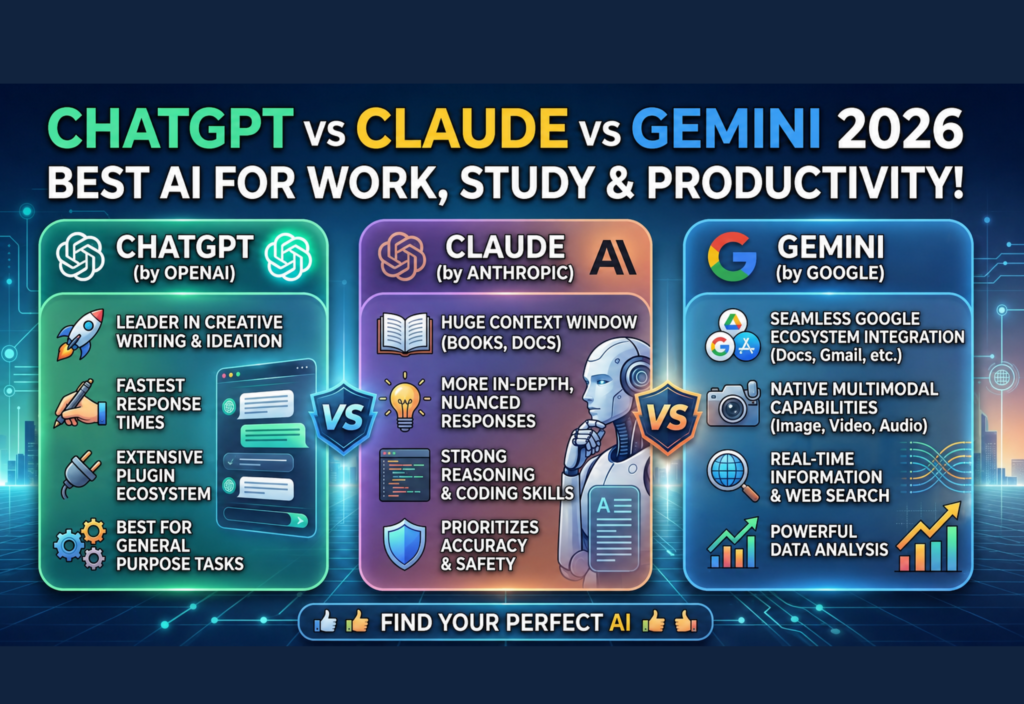
Some of the most popular models include OpenAI GPT, Google Gemini, Claude, and Meta Llama.
Is it better than text-only AI?
For many real-world applications, yes. By understanding multiple forms of information simultaneously, it provides richer context, improved accuracy, and a more natural user experience.
Conclusion
Multimodal AI is shaping the future of artificial intelligence by enabling systems to understand and combine text, images, audio, video, and documents within a single model. Unlike traditional AI, which typically processes only one type of input, these advanced systems deliver more accurate, context-aware, and intelligent responses.
Across industries, organisations are using this technology to improve customer experiences, automate workflows, support healthcare professionals, enhance education, accelerate software development, and streamline business operations. Although challenges such as privacy, infrastructure costs, and ethical concerns remain, the advantages of smarter automation, better decision-making, and richer human-computer interaction continue to drive widespread adoption.
As AI continues to evolve, understanding how multimodal systems work will help businesses, developers, and individuals prepare for the next generation of intelligent applications and unlock new opportunities in an increasingly AI-powered world.