Artificial intelligence is changing how businesses interact with customers, automate tasks, and improve productivity. AI Agents vs Chatbots is one of the most discussed topics in artificial intelligence because both technologies help businesses improve customer experiences and automate daily operations. Although these terms are often used interchangeably, they are not the same.
Traditional chatbots are designed to answer questions, provide information, and assist users through conversations. In contrast, AI agents can do much more than simply respond to prompts. They are capable of planning tasks, making decisions, using external tools, remembering previous interactions, and working toward specific goals with minimal human supervision.
As AI technology continues to advance in 2026, many organisations are replacing basic chatbots with intelligent AI agents that can automate entire workflows instead of handling only conversations.
Understanding the difference between AI Agents vs Chatbots is important for developers, businesses, marketers, and anyone interested in artificial intelligence. Choosing the right solution can improve customer experience, reduce operational costs, and increase efficiency.
In this guide, you’ll learn what AI agents and chatbots are, how they work, their major differences, advantages, limitations, and which technology is best for different use cases.
What Is a Chatbot?
A chatbot is a software application designed to simulate conversations with users through text or voice.
Its primary purpose is to answer questions, provide information, and assist users with simple tasks.
Early chatbots followed predefined rules, meaning they could only respond to questions that matched programmed patterns. Modern AI chatbots are far more advanced because they use Large Language Models (LLMs) to understand natural language and generate human-like responses.
Today’s AI chatbots can:
- Answer customer questions
- Provide technical support
- Explain products and services
- Translate languages
- Summarise documents
- Generate text
- Help with coding
- Offer recommendations
Despite these improvements, chatbots generally respond only after receiving user input. They usually do not make independent decisions or complete complex multi-step tasks on their own.
How Chatbots Work
Although chatbot technologies vary, most modern systems follow a similar process.
Step 1: Receive User Input
The chatbot first receives a question or command.
For example:
- What is Python?
- Reset my password.
- Recommend a laptop.
- Translate this paragraph.
Step 2: Understand the Request
Natural Language Processing (NLP) helps the chatbot understand what the user is asking.
Modern AI chatbots use LLMs to recognise context, intent, and language patterns.
Step 3: Generate a Response
The chatbot searches its knowledge or generates a response using its AI model.
It then returns the answer almost instantly.
Step 4: Continue the Conversation
If the user asks another question, the chatbot continues responding based on the ongoing conversation.
However, most chatbots focus mainly on conversation rather than completing independent tasks.
Common Uses of Chatbots
Businesses use chatbots for many everyday tasks.
Popular applications include:
- Customer support
- FAQ automation
- Online shopping assistance
- Appointment booking
- Banking support
- Education
- Healthcare information
- Travel assistance
- Food ordering
- Product recommendations
Because chatbots are relatively easy to deploy, they remain one of the most common AI solutions used by organisations.
What Is an AI Agent?
An AI agent is an intelligent software system that can work toward achieving specific objectives instead of simply answering questions.
Unlike chatbots, AI agents can:
- Plan tasks
- Make decisions
- Break large objectives into smaller steps
- Use external software tools
- Access databases
- Search the web
- Analyse information
- Correct mistakes
- Continue working until a task is completed
Rather than waiting for constant instructions, AI agents operate more independently and adapt when new information becomes available.
This higher level of autonomy makes AI agents suitable for complex business automation and productivity workflows.
How AI Agents Work
Most AI agents follow a goal-oriented workflow.
Step 1: Receive an Objective
Instead of a simple question, the agent receives a larger goal.
Examples include:
- Build a business report
- Research competitors
- Analyse customer feedback
- Create a marketing campaign
- Organise project documentation
Step 2: Create a Plan
The AI agent divides the objective into smaller tasks.
For example, researching competitors may involve:
- Searching company websites
- Collecting pricing information
- Comparing products
- Writing summaries
- Creating a final report
Planning allows AI agents to solve more complicated problems efficiently.
Step 3: Gather Information
The agent collects information from different sources, such as:
- Search engines
- APIs
- Business software
- Documents
- Databases
- Cloud storage
This information becomes the foundation for decision-making.
Step 4: Take Action
Instead of stopping after generating text, the AI agent performs actions such as:
- Sending emails
- Updating spreadsheets
- Scheduling meetings
- Creating reports
- Writing code
- Managing workflows
Some actions may still require user approval depending on security settings.
Step 5: Evaluate Results
After completing a task, the AI agent checks whether the objective has been achieved.
If necessary, it adjusts its strategy and continues working until satisfactory results are produced.
This continuous feedback process makes AI agents significantly more capable than traditional chatbots.
AI Agents vs Chatbots: Key Differences
Although both AI agents and chatbots use artificial intelligence, they are built for different purposes.
A chatbot is primarily designed to communicate with users by answering questions and providing information. An AI agent, however, is built to achieve goals by planning tasks, making decisions, using external tools, and completing multi-step workflows.
Below are the most important differences.
Purpose
Chatbots focus on conversations and user interactions.
AI agents focus on completing objectives and automating workflows.
Decision-Making
Most chatbots generate responses based on user input.
AI agents analyse situations, evaluate different options, and decide which action should be taken next.
Planning
Chatbots generally answer one question at a time.
AI agents divide large objectives into multiple smaller tasks and complete them step by step.
Tool Integration
Traditional chatbots have limited access to external software.
AI agents can connect with:
- Email platforms
- Calendars
- CRM systems
- APIs
- Databases
- Cloud storage
- Business applications
Memory
Many chatbots remember only the current conversation.
AI agents often maintain long-term memory, allowing them to remember previous tasks, user preferences, and project history.
Autonomy
Chatbots require continuous user interaction.
AI agents can continue working independently after receiving an objective.
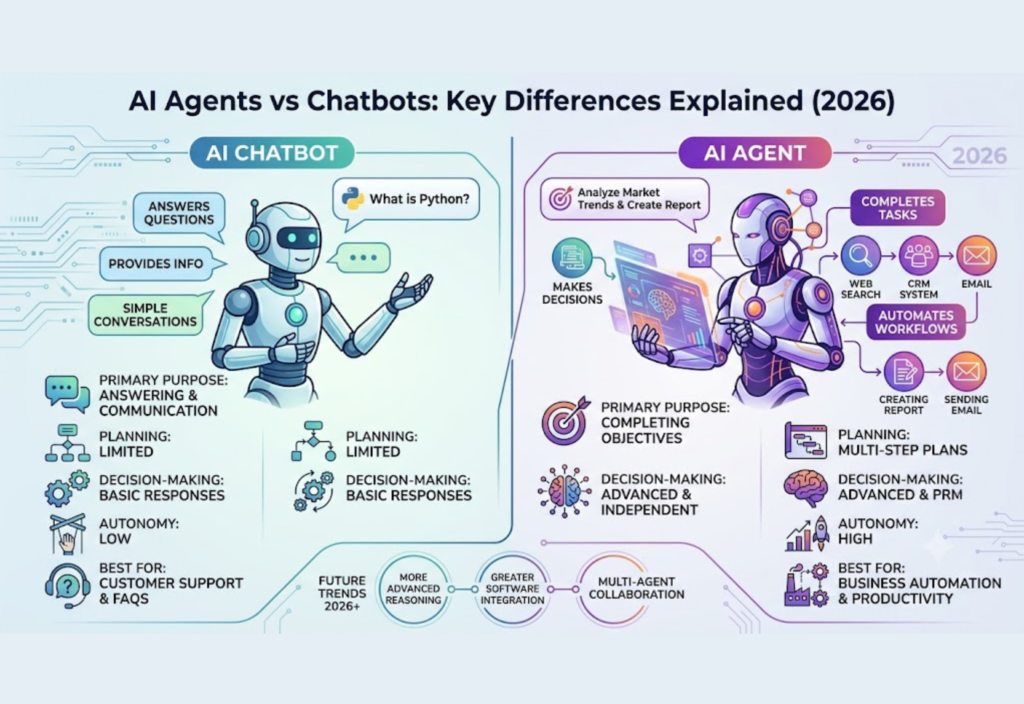
AI Agents vs Chatbots Comparison
Chatbots
- Primary purpose: Answer questions
- Planning ability: Limited
- Decision-making: Basic
- External tools: Limited
- Memory: Usually short-term
- Autonomy: Low
- Workflow: Single conversation
- Best for: Customer support and FAQs
AI Agents
- Primary purpose: Complete objectives
- Planning ability: Multi-step planning
- Decision-making: Advanced
- External tools: Extensive integration
- Memory: Long-term
- Autonomy: High
- Workflow: Connected tasks and automation
- Best for: Business automation and productivity
Advantages of Chatbots
Despite being less advanced, chatbots remain valuable for many businesses.
Easy Deployment
Most chatbots can be implemented quickly without major infrastructure changes.
Lower Cost
Basic chatbot solutions are generally less expensive than autonomous AI agents.
Fast Customer Support
Chatbots instantly answer frequently asked questions, reducing support workload.
Available 24/7
Customers receive assistance at any time without waiting for human agents.
Consistent Responses
Chatbots provide standardised answers, reducing inconsistencies across customer interactions.
Limitations of Chatbots
Chatbots also have several limitations.
Limited Understanding
They may struggle with complicated or ambiguous requests.
No Independent Planning
Most chatbots cannot create long-term plans or complete complex workflows.
Minimal Decision-Making
Chatbots usually wait for user instructions instead of acting independently.
Limited Software Integration
Many chatbot platforms only perform simple conversational tasks.
Advantages of AI Agents
AI agents provide capabilities that go far beyond traditional chatbots.
Higher Productivity
AI agents automate repetitive work, allowing employees to focus on strategic activities.
Multi-Step Task Automation
They can complete complex workflows without requiring continuous user input.
Better Decision-Making
AI agents analyse large amounts of information before selecting the best action.
Tool Integration
They interact with business software to automate real-world operations.
Continuous Learning
Many AI agents improve through user feedback and updated knowledge.
Increased Business Efficiency
Companies reduce manual work while improving speed and accuracy.
Limitations of AI Agents
Although powerful, AI agents are not perfect.
More Complex Setup
Deploying AI agents often requires additional planning, infrastructure, and integrations.
Higher Computing Requirements
Advanced AI agents usually consume more computing resources than chatbots.
Security Concerns
Since AI agents interact with business systems, strong authentication and monitoring are essential.
Human Oversight
Critical business decisions should still be reviewed by humans to ensure accuracy and compliance.
Real-World Use Cases of Chatbots
Chatbots are widely used for simple customer interactions.
Common examples include:
- Customer support
- Frequently asked questions
- Online shopping assistance
- Appointment scheduling
- Banking enquiries
- Hotel bookings
- Food ordering
- Educational support
These tasks mainly involve answering questions rather than completing independent workflows.
Real-World Use Cases of AI Agents
AI agents handle much more advanced business processes.
Examples include:
Software Development
AI agents can:
- Generate code
- Fix bugs
- Review pull requests
- Create documentation
- Run automated testing
Marketing
AI agents assist with:
- Content planning
- Keyword research
- Social media management
- Email marketing
- Campaign optimisation
Customer Service
Instead of simply answering questions, AI agents can:
- Investigate issues
- Access customer accounts
- Update support tickets
- Escalate complex cases
- Follow up automatically
Business Operations
Companies use AI agents to:
- Analyse reports
- Manage projects
- Organise documents
- Generate presentations
- Automate workflows
Healthcare
Medical organisations use AI agents for:
- Appointment scheduling
- Patient record management
- Clinical note summarisation
- Administrative automation
Which Should You Choose?
The right choice depends on your project requirements, budget, and business goals.
Choose a chatbot if your primary objective is to answer customer questions, provide product information, automate FAQs, or offer basic support. Chatbots are easier to deploy, require fewer resources, and work well for simple conversational tasks.
On the other hand, choose an AI agent if your application needs to automate complex workflows, connect with multiple business tools, analyse information, make decisions, and complete tasks independently. AI agents are ideal for organisations looking to improve productivity through intelligent automation.
In many cases, businesses use both technologies together. A chatbot handles customer conversations, while an AI agent performs the background tasks needed to resolve requests efficiently.
Future of AI Agents and Chatbots
Artificial intelligence is evolving rapidly, and both chatbots and AI agents are becoming more capable every year.
Future developments are expected to include:
- More advanced reasoning capabilities
- Better long-term memory
- Improved decision-making
- Greater integration with business software
- Multi-agent collaboration
- Personal AI assistants
- Enterprise-wide automation
- More secure and reliable AI systems
While chatbots will continue to play an important role in customer communication, AI agents are expected to become the preferred solution for handling complex business operations.
Challenges and Considerations
Before adopting either technology, organisations should evaluate several important factors.
Security
AI systems often process sensitive information, making strong authentication and data protection essential.
Privacy
Businesses must ensure compliance with privacy regulations when handling customer data.
Cost
Chatbots are generally more affordable, whereas AI agents may require greater investment in infrastructure and implementation.
Human Oversight
Although AI agents can operate independently, human review remains important for high-risk decisions and sensitive business processes.
Scalability
Organisations should choose a solution that can grow alongside future business requirements.
Frequently Asked Questions
What is the main difference between AI agents and chatbots?
Chatbots are designed to answer questions and assist users through conversations. AI agents go further by planning tasks, making decisions, using external tools, and completing multi-step objectives with minimal human supervision.
Can AI agents replace chatbots?
Not completely. Chatbots remain an excellent choice for customer support and frequently asked questions, while AI agents are better suited for workflow automation and complex business tasks.
Which is better for customer service?
For simple enquiries and FAQs, chatbots are usually sufficient. However, AI agents provide a better experience for complex support requests because they can investigate issues, access business systems, and automate follow-up actions.
Are AI agents more expensive?
Yes. AI agents generally require more computing resources, software integrations, and implementation effort than standard chatbots. However, they often deliver greater long-term value by automating complex processes.
Can businesses use both together?
Yes. Many organisations combine chatbots and AI agents. The chatbot interacts with customers, while the AI agent performs background tasks such as updating records, generating reports, or completing business workflows.
Conclusion
Understanding the difference between AI agents vs chatbots is essential for choosing the right AI solution. Chatbots are designed to answer questions, assist users, and automate simple conversations, making them ideal for customer support and frequently asked questions. AI agents, however, go far beyond conversation by planning tasks, making decisions, using external tools, and completing complex objectives with minimal human intervention.
As artificial intelligence continues to advance in 2026, more businesses are adopting AI agents to automate workflows, improve productivity, and streamline operations. Nevertheless, chatbots remain valuable for handling customer interactions quickly and efficiently. Instead of replacing one another, these technologies often work together to deliver smarter, faster, and more scalable AI-powered experiences.
By understanding their strengths, limitations, and real-world applications, developers and organisations can confidently choose the solution that best fits their needs today while preparing for the future of intelligent automation.