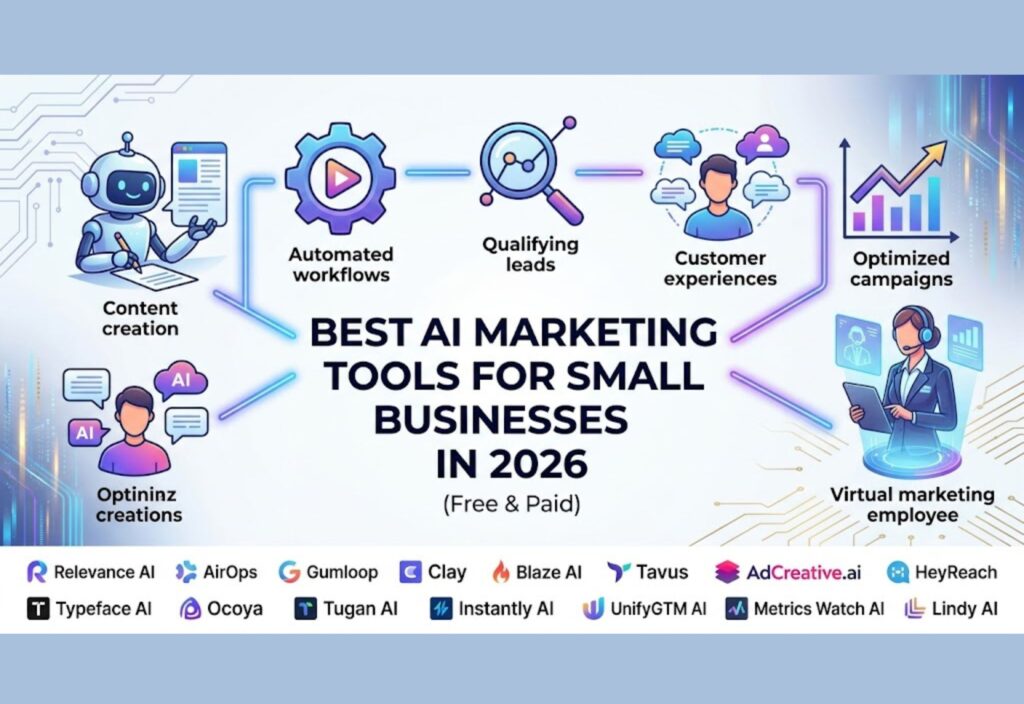
Artificial intelligence is no longer just about writing blog posts or creating social media captions. In 2026, AI has evolved into a complete marketing partner that can automate workflows, qualify leads, personalize customer experiences, optimize campaigns, and even act like a virtual marketing employee.
While most websites continue recommending the same popular tools, many newer AI platforms are helping small businesses achieve better results with less manual work. These tools are designed to automate repetitive marketing tasks, improve decision-making, and reduce costs—without requiring a large team.
If you’re a freelancer, startup founder, eCommerce seller, agency owner, or local business owner, this guide introduces hidden AI marketing tools that deserve your attention.
Why Traditional AI Marketing Tools Are No Longer Enough
Many businesses rely on AI tools only for writing articles or generating images. While those features are useful, modern marketing requires much more than content creation.
Today’s small businesses need AI that can:
- Build complete marketing workflows
- Research competitors automatically
- Qualify leads
- Personalize customer outreach
- Monitor campaign performance
- Create SEO content at scale
- Analyze customer behavior
- Connect multiple marketing platforms
Instead of using five or six separate applications, newer AI platforms combine multiple tasks into one intelligent workflow.
What Makes These AI Tools Different?
Unlike general AI assistants, these platforms focus on solving real marketing problems.
They help businesses:
- Save hours every week through automation
- Improve lead conversion rates
- Create consistent brand messaging
- Reduce manual marketing tasks
- Scale content production
- Improve campaign accuracy
- Deliver personalized customer experiences
Most importantly, many of these tools offer free plans or affordable pricing, making them suitable for small businesses.
1. Relevance AI
Best For
Building AI employees that automate marketing operations.
Relevance AI is one of the most innovative platforms available in 2026. Instead of giving you a chatbot, it allows you to create AI-powered team members that can perform marketing tasks independently.
For example, you can create an AI marketing assistant that:
- Researches competitors
- Writes campaign briefs
- Organizes customer data
- Summarizes marketing reports
- Qualifies incoming leads
- Generates outreach ideas
Key Features
- AI agents for marketing
- No-code workflow builder
- CRM integrations
- Lead qualification
- Knowledge base support
- Marketing automation
Free Plan
Yes
Best For
- Small agencies
- SaaS startups
- Marketing consultants
- Growing businesses
Pros
- Saves significant manual work
- Easy to build AI workflows
- Excellent automation features
Cons
- Advanced workflows require some learning.
2. AirOps
Best For
SEO content operations and AI-powered content workflows.
Creating one article with AI is easy. Managing hundreds of SEO pages consistently is much harder.
AirOps is designed to solve this challenge.
It helps businesses create repeatable SEO workflows that combine AI with structured prompts and human review.
Instead of writing content one page at a time, you can build systems that generate optimized drafts for product pages, blog articles, landing pages, and location pages.
Features
- AI SEO workflows
- Content templates
- Keyword clustering
- Prompt management
- Content scaling
- Team collaboration
Ideal For
- SEO agencies
- Affiliate websites
- Content teams
- eCommerce stores
Why It Stands Out
AirOps focuses on maintaining content quality while producing large volumes of SEO-friendly content.
3. Gumloop
Best For
No-code AI marketing automation.
Most businesses waste time copying data between different applications.
Gumloop removes this problem by allowing you to build AI workflows visually.
For example:
- New lead → AI qualifies lead → CRM updated → Welcome email sent
- Blog published → AI creates social media posts → Posts scheduled automatically
- Customer review received → AI summarizes feedback → Team notified
Everything happens automatically.
Features
- Drag-and-drop workflow builder
- AI automation
- Marketing integrations
- Web scraping
- Lead enrichment
- Data processing
Free Version
Available
Pros
- Beginner-friendly
- No coding required
- Saves hours every week
Cons
Some advanced integrations may require paid plans.
4. Clay
Best For
AI-powered lead generation and personalized outreach.
Finding high-quality leads is often the biggest challenge for small businesses.
Clay combines public data sources with AI to help businesses identify potential customers and personalize outreach at scale.
Instead of sending generic emails, Clay enriches lead information and helps you create messages tailored to each prospect.
Key Features
- Lead enrichment
- AI personalization
- Company research
- CRM integration
- Data automation
- Email preparation
Best For
- B2B businesses
- Sales teams
- Marketing agencies
- Freelancers
Why Small Businesses Love It
Personalized outreach typically performs better than mass email campaigns, and Clay makes that process much faster.
5. Blaze AI
Best For
Maintaining a consistent brand voice across all marketing content.
One common problem with AI-generated content is inconsistency. Different prompts often produce different writing styles.
Blaze AI addresses this by learning your brand’s tone, messaging, and style guidelines.
Whether you’re writing blog posts, newsletters, landing pages, or social media updates, Blaze AI helps keep your content aligned with your brand identity.
Features
- Brand voice training
- AI writing
- Social media content
- Marketing campaigns
- Content calendar
- Team collaboration
Free Plan
Available
Ideal Users
- Small businesses
- Personal brands
- Agencies
- Content creators
6. Tavus
Best For
Personalized AI video marketing.
Video marketing continues to grow, but recording a separate video for every customer isn’t practical.
Tavus uses AI to create personalized videos from a single recording. Businesses can customize names, company information, or other details without filming multiple versions.
Practical Use Cases
- Sales outreach
- Customer onboarding
- Product demonstrations
- Personalized follow-ups
- Client appreciation messages
Features
- AI video personalization
- Custom variables
- CRM integration
- Marketing automation
- Scalable video campaigns
Benefits
Personalized videos often receive higher engagement than generic marketing videos.
7. AdCreative.ai
Best For
Creating high-converting advertising creatives.
Designing effective advertisements requires testing multiple headlines, layouts, and visuals.
AdCreative.ai uses AI to generate advertising creatives optimized for platforms such as Google Ads, Facebook Ads, Instagram, and LinkedIn.
Instead of starting from scratch, marketers receive multiple creative variations that can be tested and refined.
Features
- AI ad creatives
- Banner generation
- Product ads
- Performance scoring
- Brand customization
- Marketing analytics
Ideal For
- Online stores
- Digital marketers
- Small agencies
- Local businesses running paid campaigns
Advantages
- Faster creative production
- Multiple ad variations
- Consistent branding
Why These Tools Matter in 2026
The marketing landscape is shifting from simple AI assistants to AI systems that can automate complete workflows.
Small businesses no longer need large marketing teams to:
- Generate qualified leads
- Produce consistent content
- Build advertising campaigns
- Personalize customer communication
- Automate repetitive marketing tasks
By adopting the right AI platforms, businesses can compete more effectively while keeping operational costs under control.
8. HeyReach
Best For
AI-powered LinkedIn outreach and lead generation.
LinkedIn remains one of the best platforms for B2B marketing, but manually connecting with prospects and sending follow-up messages takes time.
HeyReach automates LinkedIn outreach safely by managing multiple sender accounts, scheduling campaigns, and tracking responses. When combined with AI-written personalized messages, it becomes a powerful lead-generation system.
Key Features
- Automated LinkedIn outreach
- Multi-account management
- Smart campaign scheduling
- AI-powered personalization
- Performance tracking
- CRM integrations
Best For
- Marketing agencies
- B2B startups
- SaaS companies
- Consultants
Pros
- Saves hours of manual outreach
- Improves lead generation
- Easy campaign management
Cons
- Best suited for LinkedIn-based businesses.
9. Typeface AI
Best For
Brand-safe AI content creation for marketing teams.
Many businesses struggle to keep their marketing content consistent across blogs, emails, ads, and social media.
Typeface AI helps create content that follows your company’s branding, tone of voice, colors, and messaging guidelines. It is especially useful for businesses with multiple team members producing content.
Key Features
- Brand-aware AI writing
- AI image generation
- Marketing templates
- Campaign creation
- Team collaboration
- Content approval workflows
Free Plan
Limited trial
Ideal Users
- Growing startups
- eCommerce brands
- Marketing teams
- Digital agencies
10. Ocoya
Best For
All-in-one AI social media management.
Instead of using separate tools for writing captions, designing graphics, and scheduling posts, Ocoya combines these tasks into one platform.
It can generate social media content, suggest hashtags, schedule posts, and analyze engagement across multiple platforms.
Features
- AI caption generator
- Content scheduling
- AI copywriting
- Social media calendar
- Analytics dashboard
- Canva integration
Supported Platforms
- X
- TikTok
Why Small Businesses Like It
It simplifies social media management without requiring multiple subscriptions.
11. Tugan AI
Best For
Turning existing content into persuasive marketing copy.
Unlike traditional AI writers, Tugan AI allows you to input a website URL, YouTube video, or existing article. It then generates fresh marketing content inspired by the information without simply copying it.
This makes it useful for creating:
- Sales emails
- Landing pages
- Product descriptions
- Social media posts
- Newsletter content
- Marketing hooks
Features
- URL-to-content generation
- AI copywriting
- Email campaigns
- Sales page creation
- Marketing frameworks
Best For
- Affiliate marketers
- Coaches
- Digital product creators
- Online businesses
12. Instantly AI
Best For
Cold email marketing at scale.
Email marketing remains one of the highest ROI channels, but sending cold emails manually is inefficient.
Instantly AI helps businesses:
- Warm up email accounts
- Manage multiple inboxes
- Personalize campaigns
- Track replies
- Improve deliverability
Key Features
- AI email personalization
- Inbox management
- Campaign analytics
- Email warm-up
- Lead tracking
Perfect For
- Agencies
- Freelancers
- B2B businesses
- SaaS companies
13. UnifyGTM AI
Best For
Go-to-market planning and campaign execution.
Launching a new product often involves market research, audience analysis, messaging, and campaign planning.
UnifyGTM AI helps organize these activities into a single AI-assisted workflow.
Features
- Market analysis
- Audience segmentation
- Campaign planning
- AI strategy suggestions
- Performance tracking
Why It Matters
Small businesses can launch products with a more structured marketing plan instead of relying on guesswork.
14. Metrics Watch AI
Best For
Automated marketing reports.
Marketing data is often scattered across Google Analytics, Search Console, advertising platforms, and social media.
Metrics Watch AI automatically collects performance data and generates easy-to-read reports.
Features
- Automated dashboards
- AI summaries
- Scheduled reports
- Marketing KPIs
- Client reporting
Ideal Users
- Marketing agencies
- Freelancers
- Business owners
15. Lindy AI
Best For
AI executive assistant for marketing teams.
Lindy AI acts like a digital employee that can coordinate multiple business tasks.
Instead of simply answering questions, Lindy AI can perform actions such as:
- Scheduling meetings
- Following up with leads
- Managing emails
- Updating CRM records
- Researching competitors
- Preparing marketing reports
Features
- AI assistants
- Workflow automation
- Email management
- CRM integrations
- Meeting summaries
Why It’s Different
Rather than replacing one marketing task, Lindy AI helps coordinate many business activities from one interface.
Comparison Table
Relevance AI
Primary Use: AI Employees
Free Plan: ✅ Yes
Best For: Marketing Automation
AirOps
Primary Use: SEO Workflows
Free Plan: Limited
Best For: Content Teams
Gumloop
Primary Use: AI Automation
Free Plan: ✅ Yes
Best For: Workflow Automation
Clay
Primary Use: Lead Generation
Free Plan: Limited
Best For: B2B Sales
Blaze AI
Primary Use: Brand Content
Free Plan: ✅ Yes
Best For: Content Marketing
Tavus
Primary Use: Personalized Videos
Free Plan: Trial
Best For: Video Marketing
AdCreative.ai
Primary Use: AI Ad Creation
Free Plan: Trial
Best For: Paid Advertising
HeyReach
Primary Use: LinkedIn Outreach
Free Plan: Trial
Best For: B2B Marketing
Typeface AI
Primary Use: Brand AI Content
Free Plan: Trial
Best For: Marketing Teams
Ocoya
Primary Use: Social Media Management
Free Plan: Trial
Best For: Social Media Marketing
Tugan AI
Primary Use: AI Sales Copywriting
Free Plan: Trial
Best For: Copywriting & Sales Pages
Instantly AI
Primary Use: Cold Email Outreach
Free Plan: Trial
Best For: Email Marketing
UnifyGTM AI
Primary Use: Go-to-Market Strategy
Free Plan: Beta
Best For: Product Launches
Metrics Watch AI
Primary Use: Marketing Reports & Analytics
Free Plan: Paid Only
Best For: Agencies & Analytics
Lindy AI
Primary Use: AI Business Assistant
Free Plan: Limited
Best For: Business Automation
Free vs Paid AI Marketing Tools
Free AI Tools Are Best For
- Freelancers
- New startups
- Bloggers
- Small local businesses
Paid AI Tools Are Better If You Need
- Advanced automation
- Team collaboration
- CRM integrations
- Large-scale campaigns
- Detailed analytics
- Higher usage limits
A common approach is to start with free plans and upgrade only when your business grows.
AI Marketing Trends in 2026
The AI marketing landscape continues to evolve rapidly. Key trends include:
AI Employees
Businesses are adopting AI agents that handle recurring marketing tasks with minimal supervision.
Hyper-Personalization
AI tailors emails, ads, and website experiences based on customer behavior and preferences.
Workflow Automation
Instead of isolated tools, businesses are building connected AI workflows that manage multiple marketing tasks from one trigger.
AI Video Marketing
Personalized videos are becoming a standard method for sales outreach and customer engagement.
Predictive Marketing
AI can analyze customer data to forecast buying behavior and recommend the best time to launch campaigns.
How to Choose the Right AI Marketing Tool
Before subscribing to any platform, ask yourself:
- What marketing task consumes the most time?
- Does the tool integrate with your existing software?
- Is there a free plan or trial?
- Can your team learn it quickly?
- Will it scale as your business grows?
Choosing tools that solve real business problems is more effective than subscribing to many platforms with overlapping features.
Frequently Asked Questions (FAQs)
What is the best hidden AI marketing tool in 2026?
Relevance AI is one of the strongest choices for businesses that want AI-powered marketing automation through customizable AI agents.
Which AI tool is best for SEO?
AirOps is an excellent option for managing AI-assisted SEO content workflows at scale.
Which AI tool is best for social media?
Ocoya combines AI copywriting, scheduling, analytics, and content planning in one platform.
Can small businesses use these AI tools for free?
Many of these tools offer free plans, limited trials, or beta access, making them suitable for startups and small businesses.
Are AI marketing tools difficult to use?
Most modern platforms are designed with no-code interfaces and beginner-friendly dashboards, allowing users to automate tasks without programming knowledge.
Final Thoughts
The future of marketing is shifting from single-purpose AI assistants to intelligent platforms that automate complete business workflows. Small businesses that adopt these modern AI tools can save time, improve customer engagement, and compete more effectively without hiring large marketing teams.
Instead of relying only on well-known AI tools, consider experimenting with platforms like Relevance AI, AirOps, Gumloop, Clay, Blaze AI, and Lindy AI. These newer solutions focus on automation, personalization, and efficiency—areas that are becoming increasingly important in 2026.
The most successful strategy isn’t to use every AI tool available. It’s to choose a small set of tools that fit your goals, integrate well with your existing processes, and help you consistently deliver better marketing results.