Artificial intelligence is changing the way businesses communicate with customers, manage inquiries, generate leads, and provide support. One of the most practical applications of this technology is the AI chatbot. Businesses of all sizes are using chatbots to answer common questions, qualify leads, automate repetitive conversations, and provide faster customer service.
This growing demand has also created opportunities for freelancers, agencies, consultants, and online entrepreneurs.
You do not necessarily need to build a chatbot platform from scratch to earn money. In many cases, businesses need someone who can select the right AI tools, create useful conversation flows, connect a chatbot with existing systems, and maintain it over time.
If you have basic technical knowledge, communication skills, marketing experience, or an interest in AI tools, chatbot services can become a practical online income stream.
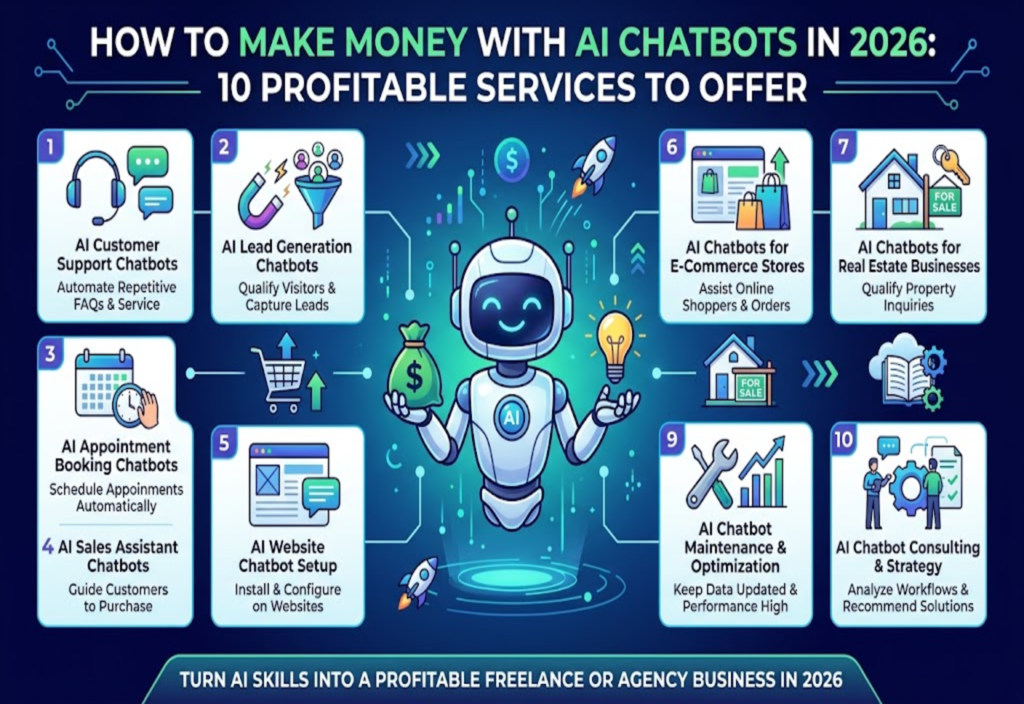
In this guide, we will explore 10 profitable AI chatbot services you can offer in 2026, how each service works, who needs it, and how you can turn chatbot skills into a business.
Why AI Chatbot Services Are in Demand in 2026
Businesses receive thousands of repetitive questions every day. Customers want quick answers about products, prices, opening hours, appointments, shipping, returns, and services.
Hiring employees to handle every repetitive question can be expensive and inefficient. AI chatbots can handle many of these interactions automatically while allowing human employees to focus on more complicated customer requests.
Modern AI chatbots can do much more than display predefined answers. Depending on the tools and integrations being used, they can understand natural language, access business information, collect customer details, schedule appointments, recommend products, and transfer conversations to human staff.
This creates an opportunity for people who can help businesses implement these systems.
The important point is that businesses generally do not pay simply because someone knows how to use an AI tool. They pay for a business result.
For example, a company may want to:
Reduce repetitive customer-support questions
Capture more leads
Book more appointments
Respond to customers outside business hours
Improve website engagement
Automate basic sales conversations
Qualify potential customers
Reduce manual administrative work
If your chatbot service helps solve one of these problems, it becomes much easier to create a valuable offer.
What Skills Do You Need to Start an AI Chatbot Business?
You do not necessarily need advanced programming skills to begin.
Many modern chatbot platforms provide visual builders, integrations, templates, and automation features. However, you still need to understand how businesses work and how customers interact with them.
Useful skills include:
Basic AI and chatbot knowledge
Prompt writing
Conversation design
Customer-service principles
Basic automation
Website integration
Lead-generation concepts
Copywriting
Testing and troubleshooting
Basic analytics
Learning these skills can help you provide better services and avoid creating chatbots that sound impressive but fail to solve real customer problems.
1. AI Customer Support Chatbots
One of the most straightforward chatbot services is creating AI-powered customer-support assistants.
Businesses receive repetitive questions about products, services, pricing, delivery, refunds, policies, and operating hours. A properly configured chatbot can answer many of these questions automatically.
For example, an online store could have a chatbot that helps customers understand:
Product specifications
Shipping information
Return policies
Order-related questions
Payment options
Frequently asked questions
The chatbot can provide instant answers while directing complicated issues to a human support representative.
Your service could include chatbot setup, business knowledge integration, conversation design, testing, and ongoing maintenance.
This can also become a recurring service because business information changes regularly.
2. AI Lead Generation Chatbots
A chatbot does not have to focus only on customer support. It can also help businesses generate and qualify leads.
Imagine a visitor arrives on a website and starts a conversation. Instead of simply displaying a contact form, the chatbot can ask relevant questions about the visitor’s needs.
For example:
What service are you interested in?
What type of project do you need?
What is your approximate budget?
When would you like to start?
How can we contact you?
The chatbot can then organize the information and send qualified leads to the business.
This service can be particularly useful for agencies, consultants, real-estate businesses, service companies, education providers, and other businesses that depend on inquiries.
The value proposition is simple: you are not just installing a chatbot; you are helping the business turn website visitors into potential customers.
3. AI Appointment Booking Chatbots
Many businesses spend significant time answering appointment-related questions.
Customers may ask about available services, appointment times, pricing, locations, cancellation policies, and availability.
An AI appointment chatbot can automate much of this process.
Depending on the business and available integrations, the chatbot can:
Explain available services
Collect customer information
Answer common questions
Help customers select an appointment
Connect with a scheduling system
Send confirmation information
Provide reminders through supported systems
This service can work particularly well for consultants, salons, clinics, fitness businesses, tutoring services, repair companies, and professional service providers.
Instead of selling a generic chatbot, position the service around automating appointment management.
4. AI Sales Assistant Chatbots
AI chatbots can also assist businesses during the sales process.
A sales-focused chatbot can answer questions about products and services, compare options, explain features, and guide customers toward an appropriate choice.
For example, an online electronics store could use a chatbot to ask a customer what type of device they need, their preferred features, and their budget. The chatbot can then provide relevant product information.
A service business could use a similar system to explain packages and identify which service is most appropriate for a potential customer.
As a freelancer, you can create chatbot conversation flows that support different stages of the customer journey.
The key is to make the conversation useful rather than aggressively promotional.
5. AI Website Chatbot Setup
Some businesses already know they need a chatbot but do not know how to implement one.
This creates an opportunity to offer a complete AI chatbot setup service.
You could help a client:
Choose a suitable chatbot platform.
Prepare the business information.
Create the chatbot’s instructions.
Design common conversation flows.
Add the chatbot to the website.
Test different customer questions.
Improve responses.
Monitor performance after launch.
This is particularly suitable for beginners because you can start by learning one or two chatbot platforms thoroughly rather than trying to master every AI tool available.
Once you become comfortable with the process, you can create standardized packages for different types of businesses.
6. AI Chatbots for E-Commerce Stores
Online stores are another potential market for chatbot services.
E-commerce businesses often have large numbers of repetitive customer questions. Visitors may want to know which product is suitable for them, how much shipping costs, whether an item is available, or how returns work.
An AI chatbot can help guide visitors through these questions.
For example, a clothing store could use a chatbot to help shoppers find products based on:
Size
Style
Budget
Color
Product type
Intended use
A chatbot can also help customers find information about shipping, returns, payment methods, and other store policies.
You can offer e-commerce chatbot setup as a specialized service instead of targeting every type of business.
Specialization can make your marketing clearer because potential clients immediately understand what you provide.
7. AI Chatbots for Real Estate Businesses
Real estate businesses deal with a large number of inquiries.
Potential buyers and renters may ask about properties, locations, prices, availability, property features, and viewing appointments.
A chatbot can act as an initial assistant by collecting information from visitors and directing them toward relevant properties or next steps.
For example, it could ask:
What type of property are you looking for?
Which area interests you?
What is your approximate budget?
Are you buying or renting?
How many bedrooms do you need?
The answers can help the business understand what the potential customer wants.
You can offer real-estate chatbot services that focus on lead capture, property inquiries, qualification, and appointment requests.
8. AI Chatbot Content and Knowledge-Base Setup
An AI chatbot is only as useful as the information it has access to.
A common problem is that businesses have information scattered across websites, documents, FAQs, product pages, and internal resources.
You can offer a service that organizes this information into a structured knowledge base for the chatbot.
This may involve:
Collecting existing business information
Organizing FAQs
Cleaning outdated content
Creating structured answers
Identifying missing information
Writing chatbot-friendly responses
Testing questions against the knowledge base
This service is valuable because businesses often need help preparing their information before an AI assistant can work effectively.
It also creates an opportunity to combine AI chatbot setup with content organization.
9. AI Chatbot Maintenance and Optimization
Launching a chatbot is not the end of the project.
Customer questions change. Products change. Prices change. Business policies change. New services are introduced.
A chatbot that worked well six months ago may provide outdated or incomplete answers today.
This creates an opportunity for recurring chatbot maintenance.
Your monthly service could include:
Reviewing conversations
Finding unanswered questions
Updating business information
Improving chatbot instructions
Adding new FAQs
Testing problematic conversations
Monitoring response quality
Updating automation workflows
Instead of earning only from one-time chatbot projects, maintenance allows you to build ongoing client relationships.
For freelancers and agencies, recurring services can be especially useful because they create a more predictable business model.
10. AI Chatbot Consulting and Strategy
If you gain enough experience, you can move beyond chatbot implementation and offer consulting.
Some businesses do not know whether they need a chatbot, what tasks they should automate, or which platform fits their workflow.
An AI chatbot consultant can analyze the business process and recommend practical solutions.
A consulting project might include:
Business workflow analysis
Customer-support analysis
Chatbot opportunity research
Platform recommendations
Automation planning
Conversation-flow design
Implementation roadmap
AI chatbot improvement strategy
You do not necessarily need to build every system yourself. You can provide the strategy and work with other specialists when technical implementation is required.
This model can be particularly useful once you have experience with several chatbot projects and understand the problems businesses commonly face.
How Much Can You Charge for AI Chatbot Services?
There is no single price for chatbot services.
Pricing depends on factors such as:
Business size
Number of chatbot conversations
Complexity of the workflow
Required integrations
Number of pages or documents
Customization
Maintenance requirements
Ongoing support
Your experience
A beginner might start with smaller projects to build a portfolio. More complex implementations involving multiple systems, advanced automation, or ongoing optimization can command higher project fees.
Instead of competing only on price, focus on defining exactly what the client receives.
For example, a service package could include chatbot setup, FAQ creation, website installation, testing, and 30 days of basic optimization.
Clear packages make it easier for potential customers to understand the value of your service.
How to Find Your First AI Chatbot Clients
Finding clients is often more difficult than learning the technology.
Start by choosing a specific type of business instead of trying to sell to everyone.
For example, you could focus on:
E-commerce stores
Real estate companies
Marketing agencies
Local service businesses
Consultants
Education businesses
Professional service providers
Once you choose a niche, study its common customer questions and create a sample chatbot.
You can then demonstrate how the chatbot could solve a specific problem.
Potential client sources include freelance marketplaces, professional networking platforms, business directories, direct outreach, local businesses, and your own website.
Your outreach should focus on the business problem rather than simply saying that you build AI chatbots.
For example, instead of writing, “I offer AI chatbot services,” explain how you could help reduce repetitive customer inquiries or capture website leads automatically.
Create a Demo Before Selling
A working demo can make your service much easier to sell.
Choose one business category and build a simple demonstration chatbot.
For example, create a fictional online store chatbot that can:
Answer product questions
Explain shipping
Handle returns
Recommend products
Collect customer information
Record a short demonstration showing how it works.
You can use the demo on your website, portfolio, social media profiles, and freelance proposals.
The purpose is to show potential clients what you can actually build rather than relying entirely on descriptions.
How to Turn Chatbot Skills into Recurring Income
One-time projects can generate income, but recurring services can create a more sustainable business model.
After building a chatbot, you can offer monthly services such as:
Chatbot monitoring
Knowledge-base updates
Conversation analysis
New workflow creation
Performance optimization
FAQ updates
Integration maintenance
Customer-support improvements
You can also create different service tiers.
For example, a basic package might cover maintenance, while a higher package could include regular optimization and new automation workflows.
This approach allows you to continue providing value after the initial chatbot launch.
Common Mistakes to Avoid
Not every chatbot project will succeed. Many problems come from poor planning rather than the AI technology itself.
One common mistake is trying to automate everything.
Some conversations require human judgment, especially when customers have complaints, unusual requests, sensitive situations, or complex problems.
Another mistake is providing too much information at once. Customers generally want clear and useful answers rather than long AI-generated paragraphs.
You should also test the chatbot extensively before launch.
Ask different versions of the same question, use misspellings, try unexpected requests, and test whether the chatbot knows when to transfer a conversation to a human.
Finally, keep business information updated. An AI assistant that gives outdated pricing or incorrect policies can create more problems than it solves.
Is Making Money with AI Chatbots Worth It in 2026?
AI chatbots are becoming part of the broader shift toward business automation. The opportunity is not simply in creating another chatbot; it is in helping businesses use conversational AI to solve specific operational and customer-facing problems.
For beginners, the easiest entry point may be a narrow service such as website chatbot setup, FAQ automation, lead generation, or appointment booking.
As your experience grows, you can expand into integrations, optimization, consulting, and complete AI automation systems.
The most important skill is not simply knowing how to use an AI chatbot platform. It is understanding where a chatbot can save time, improve customer experience, or support business growth.
Final Thoughts
Learning how to make money with AI chatbots in 2026 can open several paths for freelancers, consultants, agencies, and online entrepreneurs.
You can start with a simple service, such as setting up a website chatbot, and gradually move toward more advanced solutions like lead qualification, sales automation, appointment systems, and chatbot consulting.
The best approach is to choose a specific niche, learn the tools required for that niche, build a working demo, and focus your offer on a real business problem.
AI technology will continue to evolve, but businesses will still need people who can turn that technology into practical solutions. If you can combine AI chatbot skills with business understanding and good customer communication, you can build a service around that demand rather than simply selling access to an AI tool.