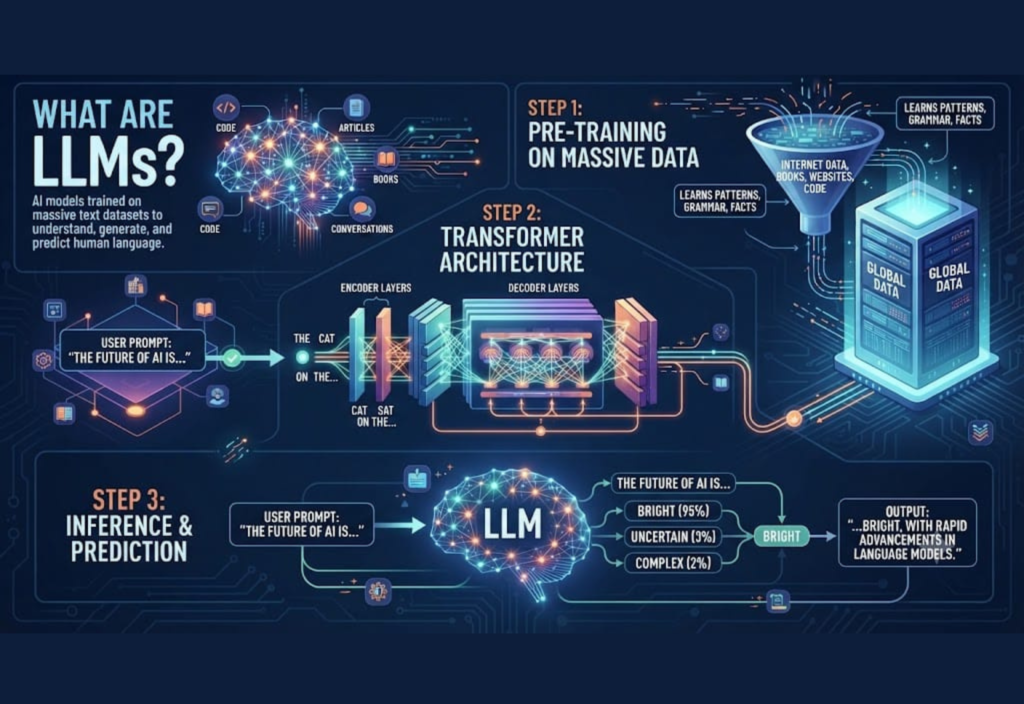
Large Language Models (LLMs) are becoming an important part of modern artificial intelligence. People use them for writing, coding, research, customer support, document analysis, automation, and many other tasks.
One important concept to understand when working with an LLM is context. An AI model does not always process only the latest question. Depending on the application, it may also process previous messages, instructions, documents, code, tool results, and other information.
As the amount of information increases, the number of tokens processed by the model also increases. This can affect the model’s usage, processing requirements, response time, and potentially the overall cost.
Some modern AI models support context windows containing hundreds of thousands of tokens. This allows users to work with large documents, long conversations, extensive codebases, and large collections of information.
However, having a large context window does not mean that every request automatically costs more. The actual usage depends on how much information is processed, which model is being used, how the provider calculates tokens, and whether special pricing or caching rules apply.
This guide explains LLM context costs, token usage, and pricing beyond 200K tokens in simple terms.
What Is an LLM Context Window?
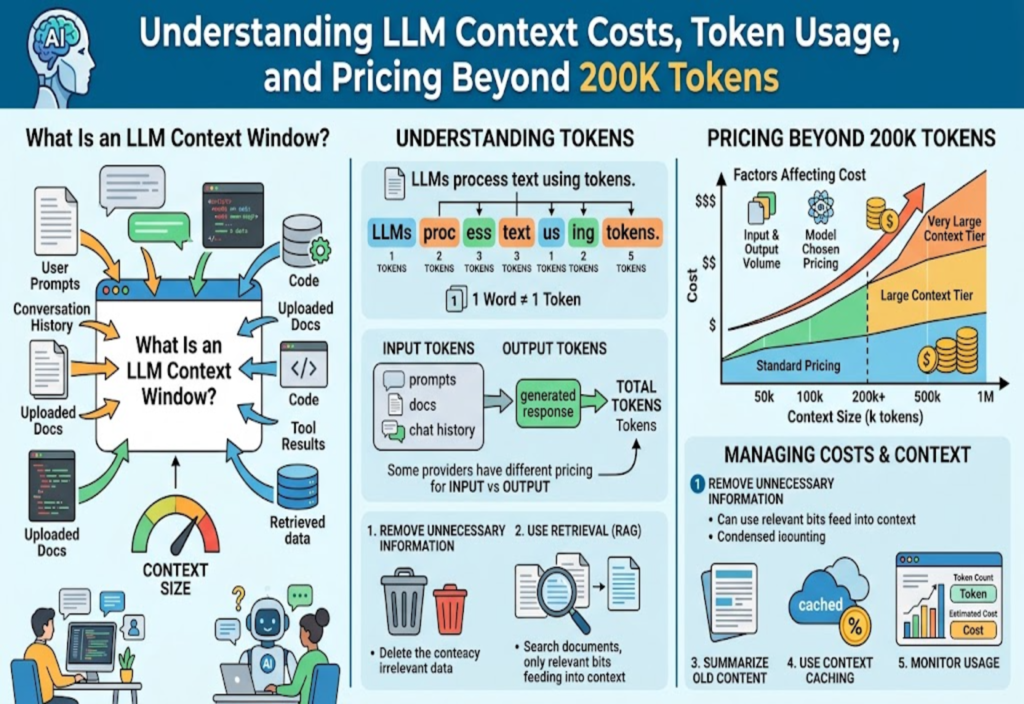
An LLM context window is the amount of information that a model can consider during an interaction.
You can think of the context window as the model’s temporary working space. The larger the context window, the more information the model can potentially process at one time.
What Can Be Included in the Context?
Depending on the AI application, context can contain:
The user’s current question
Previous conversation messages
System instructions
Uploaded documents
Code
Tool results
Retrieved information
Previous AI responses
Structured data
For example, if you ask an AI model to summarize a short article, the context may be relatively small. If you ask it to analyze hundreds of pages of documentation, the context can become much larger.
Why Context Size Matters
A larger context window can be useful for tasks that require the model to understand relationships between many pieces of information.
For example, a developer could provide several source-code files and ask the model to identify a problem that involves multiple files.
Similarly, a researcher could provide several long documents and ask the model to compare their findings.
However, larger context is not always necessary. For simple tasks, a smaller amount of relevant information may be more efficient.
What Are Tokens in an LLM?
LLMs generally process text using units called tokens.
A token can represent a complete word, part of a word, punctuation, a number, a symbol, or another piece of text.
Are Tokens the Same as Words?
No.
One word is not always equal to one token.
For example, a short and common word may be represented by a single token, while a longer or less common word may be divided into multiple tokens.
The exact token count depends on the tokenizer used by the particular model.
This is why estimating AI usage based only on the number of words can sometimes be inaccurate.
Why Tokens Are Important
Tokens are important because many AI providers calculate usage based on the number of tokens processed.
A request can contain:
Input tokens
Output tokens
The combination of these can determine the total amount of model usage.
What Are Input Tokens?
Input tokens are the tokens sent to the AI model.
Examples of Input Tokens
Input can include:
User prompts
Conversation history
Documents
Instructions
Code
Search results
Tool outputs
Retrieved information
For example, if you upload a large PDF and ask the AI to analyze it, the text processed from that document may contribute to the input token count.
Why Large Inputs Matter
A large input can contain tens or hundreds of thousands of tokens.
When the model processes that information, the amount of computational work can increase.
This is one reason some AI providers use different pricing levels for larger requests.
What Are Output Tokens?
Output tokens are the tokens generated by the AI model in its response.
Example of Output Usage
Imagine you provide an AI model with a large research report and ask:
“Summarize the main findings in 1,000 words.”
The report may contain a large number of input tokens, while the generated summary contains a much smaller number of output tokens.
Therefore, a request can have a large input but a relatively small output.
Why Output Pricing Can Be Different
Some AI providers charge different rates for input and output tokens.
This means developers should consider both types of usage when estimating costs.
The exact pricing depends on the model and provider.
What Does 200K Tokens Mean?
The term 200K tokens means approximately 200,000 tokens.
Understanding Token Measurements
Common token measurements include:
1K = 1,000 tokens
10K = 10,000 tokens
100K = 100,000 tokens
200K = 200,000 tokens
500K = 500,000 tokens
1M = 1,000,000 tokens
A 200K-token context can contain a very large amount of information.
Is 200K Tokens the Same as 200K Words?
No.
Tokens and words are different measurements.
The number of words represented by 200K tokens depends on the language, tokenizer, and type of content.
Code, numbers, punctuation, and different languages can produce different token counts.
What Happens Beyond 200K Tokens?
When a model supports a context window larger than 200K tokens, users can potentially process more information in a single interaction.
However, the provider may apply different pricing or processing rules when the context becomes very large.
Tiered Pricing
Some AI providers use tiered pricing.
A simplified example could look like:
Smaller context: standard rate
Medium context: another rate
Very large context: higher rate
These are only examples. Actual pricing differs between providers and models.
Why Large Contexts May Cost More
Processing large contexts can require additional computational resources.
A large request may require:
More memory
More processing
More server resources
More time
Greater infrastructure capacity
For this reason, some providers may charge more when requests exceed certain context thresholds.
Does a Large Context Window Mean Higher Costs?
Not necessarily.
A model may support a context window of hundreds of thousands or even millions of tokens, but you may use only a small portion of that capacity.
Maximum Capacity vs Actual Usage
Consider this example:
Model context capacity: 1,000,000 tokens
Actual request: 20,000 tokens
You should not automatically assume that the provider charges you for 1,000,000 tokens.
The actual calculation depends on the provider’s pricing rules.
This distinction is important when comparing AI models.
How LLM Context Pricing Works
LLM pricing can contain several different components.
Input Token Pricing
The provider may charge according to the number of input tokens processed.
Output Token Pricing
The provider may use a separate rate for generated output tokens.
Large-Context Pricing
Some providers may apply different rates when a request exceeds a particular context threshold.
Cached Input Pricing
If a provider supports prompt or context caching, repeated information may be priced differently.
Developers should check the current documentation of the specific model rather than relying on a general pricing assumption.
A Simple Token Cost Example
Imagine a fictional AI provider charges:
$2 per million input tokens
$8 per million output tokens
Suppose an application processes:
150,000 input tokens
and generates:
5,000 output tokens
The input calculation would be:
150,000 ÷ 1,000,000 × $2 = $0.30
The output calculation would be:
5,000 ÷ 1,000,000 × $8 = $0.04
The estimated total would therefore be:
$0.34
These prices are only an example for understanding the calculation. They do not represent the current pricing of a specific AI provider.
Why Long Conversations Can Increase Token Usage
AI chat applications can accumulate a large amount of context over time.
Conversation History
Suppose a user has a conversation containing:
100 messages
Several long documents
Multiple code examples
Previous instructions
AI-generated responses
If the application continues including relevant history in future requests, the input context can become increasingly large.
Managing Long Conversations
Developers can manage long conversations by using:
Summaries
Relevant-message selection
Retrieval
Context compression
Memory systems
Removing unnecessary information
The goal is to keep useful information while avoiding unnecessary context.
What Is Context Compression?
Context compression is the process of reducing a large amount of information into a smaller representation while preserving the most important details.
Example of Context Compression
Imagine a conversation contains 50 previous messages.
Instead of sending all 50 messages every time, an application could create a summary containing the important information.
The model might then receive:
Conversation summary + recent messages
This can reduce the amount of context that needs to be processed.
Limitations of Compression
Compression needs to be handled carefully.
If too much information is removed, the model may lose important details.
Therefore, a good compression system should preserve information that is important for the current task.
What Is Retrieval-Augmented Generation?
Retrieval-Augmented Generation, commonly called RAG, is a technique that allows an AI application to retrieve relevant information before asking an LLM to generate an answer.
How RAG Works
A simplified RAG workflow looks like this:
The user asks a question.
The system searches a knowledge source.
Relevant information is retrieved.
The information is added to the model’s context.
The LLM generates an answer.
This approach can be more efficient than sending an entire database to the model.
Why RAG Helps With Large Knowledge Bases
Imagine a company has thousands of documents.
Sending every document to an AI model for every question would create unnecessary processing.
Instead, a retrieval system can search the knowledge base and provide only the most relevant sections.
This can help reduce context size and improve efficiency.
How Context Caching Can Affect Costs
Context caching is another important concept in LLM applications.
What Is Context Caching?
Caching allows frequently reused information to be handled more efficiently.
For example, an application may repeatedly use the same long system instructions or reference material.
If the AI provider supports caching, repeated information may receive different pricing or processing treatment.
Why Caching Can Be Useful
Caching can potentially:
Reduce repeated processing
Improve response performance
Reduce certain usage costs
Make large-context applications more efficient
However, caching policies differ between AI providers, so developers should review the specific model’s documentation.
Large Context for AI Coding
Large-context models can be useful for software development.
Working With Multiple Files
A developer may need to analyze:
Source-code files
Configuration files
Documentation
Error logs
Test results
Project requirements
A large context window can help an AI model understand relationships between different parts of a project.
Avoiding Unnecessary Code
Even when a model supports a large context, developers should not automatically send an entire codebase.
If only five files are relevant to a problem, sending hundreds of unrelated files may add unnecessary context.
Relevant context is usually more useful than maximum context.
Large Context for Research
Researchers can use large-context AI systems to work with substantial amounts of information.
Common Research Tasks
These can include:
Comparing reports
Summarizing documents
Finding common themes
Extracting information
Organizing research notes
Reviewing technical documentation
Why Human Verification Still Matters
AI-generated research should be checked against the original sources.
An AI model can misunderstand information, make an incorrect connection, or produce an unsupported statement.
Large context improves the amount of information the model can consider, but it does not guarantee perfect accuracy.
Large Context for Business Applications
Businesses can use LLMs for many document-heavy tasks.
Common Business Uses
Examples include:
Customer support
Internal knowledge search
Document analysis
Report creation
Technical support
Workflow automation
Software development
Business research
Choosing the Appropriate Context
Not every business task requires hundreds of thousands of tokens.
A short customer question may need only a small amount of context.
A detailed analysis of multiple business documents may require much more.
The context size should match the actual requirements of the task.
Large Context in AI Agents
AI agents can make context management even more important.
Why Agents May Use More Tokens
An AI agent can perform several actions during one task.
For example:
Understand the request.
Search for information.
Review the search results.
Use a tool.
Analyze the tool output.
Perform another action.
Produce the final response.
Each stage can potentially add information to the overall workflow.
Managing Agent Context
Developers can improve efficiency by:
Limiting tool results
Summarizing intermediate steps
Removing irrelevant information
Using retrieval
Selecting appropriate models
Monitoring token usage
This can prevent unnecessary context growth.
How to Reduce LLM Context Costs
There are several practical strategies for managing large-context usage.
Remove Unnecessary Information
Only send information that is relevant to the task.
Use Retrieval
Retrieve specific information instead of sending an entire knowledge base.
Summarize Older Content
Summarize old conversation history when the full details are no longer required.
Use Caching
If supported by the provider, caching can help with repeatedly used context.
Control Tool Output
AI tools can sometimes return large amounts of information. Developers should limit the information passed back to the model when possible.
Monitor Usage
Track input tokens, output tokens, requests, and overall costs.
Select the Right Model
A simple task may not require a highly capable large-context model.
Using an appropriate model can improve efficiency.
Why More Context Does Not Always Mean Better Answers
It is easy to assume that giving an AI model more information will always produce a better answer.
That is not necessarily true.
Irrelevant Information Can Create Noise
Suppose you ask an AI model to analyze a particular product page but provide hundreds of unrelated documents.
The additional information may not improve the answer.
Instead, it can make the context more complicated.
Relevant Context Is More Valuable
A useful principle is:
Give the model enough information to complete the task, but avoid unnecessary information.
This approach can improve both efficiency and clarity.
Common Mistakes When Managing LLM Context
Developers and users can make several common mistakes.
Mistake 1: Confusing Context Capacity With Actual Usage
A model supporting 1 million tokens does not mean every request uses 1 million tokens.
Mistake 2: Sending Entire Documents Unnecessarily
If only a few sections are relevant, retrieving those sections may be more efficient.
Mistake 3: Ignoring Output Tokens
Generated responses can also contribute to usage.
Mistake 4: Repeating Large Instructions
Repeatedly sending the same large context can increase usage when caching or another strategy might be available.
Mistake 5: Using Outdated Pricing Information
AI pricing can change.
An old pricing example may no longer represent the current cost.
Always check the official provider documentation before making production cost calculations.
How to Choose an LLM for Large-Context Tasks
Before choosing an AI model, developers should evaluate several factors.
Context Window
How much information can the model process?
Input Cost
What is the cost of processing input tokens?
Output Cost
What is the cost of generated tokens?
Large-Context Pricing
Does the provider apply different pricing above a certain threshold?
Caching Support
Does the model support caching for repeated context?
Output Limit
How much text can the model generate in one response?
Performance
How efficiently can the model process large requests?
Reliability
Does the model consistently perform well for the specific task?
A good model choice should consider all these factors instead of focusing only on the maximum context size.
Ethical and Responsible Use of AI
Understanding AI costs is also part of responsible technology use.
Be Transparent About AI Costs
Businesses using AI-powered services should clearly explain relevant usage charges to their customers.
Protect User Information
Large-context AI systems may process documents, conversations, and business information.
Developers should therefore use appropriate security and privacy practices.
Use AI for Beneficial Purposes
AI technology should be used responsibly and should not be used to deceive people, commit fraud, exploit users, or cause unnecessary harm.
Responsible AI development focuses on useful, honest, secure, and beneficial applications.
The Future of Large-Context AI
AI models are continuing to improve their ability to process large amounts of information.
Larger Context Windows
Future models may support increasingly large context windows.
This could make AI systems more useful for:
Large codebases
Long research projects
Business documentation
Complex AI agents
Technical analysis
Large knowledge bases
Better Context Management
The future is not only about making context windows larger.
AI systems will also need better methods for:
Selecting relevant information
Summarizing content
Retrieving knowledge
Managing conversations
Caching repeated context
Protecting private information
The combination of larger context and smarter information management could make AI applications more efficient.
Final Thoughts
Understanding LLM context costs, token usage, and pricing beyond 200K tokens is becoming increasingly important as AI models handle larger and more complex tasks.
A context window represents the amount of information an AI model can potentially process during an interaction. Tokens are the smaller units used to represent text and other information for the model.
When the amount of context increases, token usage can also increase. Depending on the AI provider, larger requests may have different pricing structures. Input and output tokens may also have separate rates, while caching can affect how repeated information is handled.
However, using the largest possible context is not always the best approach. Efficient AI applications focus on relevant information rather than simply using more information.
Techniques such as RAG, context compression, summarization, caching, and careful token monitoring can help developers build more efficient AI systems.
For anyone working with LLMs, understanding these concepts can make it easier to choose the right model, estimate potential usage, control unnecessary context, and design responsible AI applications.
As AI technology continues to develop, the most useful systems will not simply be those with the largest context windows. They will be systems that balance accuracy, capability, efficiency, privacy, cost, and responsible use.