Have you ever wondered how your smartphone understands voice commands, how Google Translate converts one language into another, or how chatbots respond to your questions? These features are powered by a technology known as Natural Language Processing (NLP).
Natural Language Processing is an important branch of Artificial Intelligence (AI). It helps computers process, analyze, and work with human language. People communicate through different languages, including English, Urdu, Arabic, Spanish, and many others. NLP makes it possible for computer systems to work with this language in useful ways.
Today, NLP is used in search engines, translation applications, virtual assistants, customer support systems, email filters, and AI-powered writing tools.
As digital communication continues to grow, the amount of text and speech produced every day is increasing. Manually processing all this information can take a lot of time. NLP helps businesses and individuals handle language-related tasks more efficiently.
In this beginner-friendly guide, you will learn what Natural Language Processing is, how it works, its main techniques, real-world applications, benefits, limitations, and future developments.
What Is Natural Language Processing (NLP)?
Natural Language Processing (NLP) is a field of Artificial Intelligence that focuses on helping computers understand, analyze, interpret, and generate human language.
In simple words, NLP allows computer systems to work with the words and sentences people use in everyday communication.
For example, when you type a question into a search engine, the system needs to process your words to identify what information you are looking for. Similarly, when you use a translation application, NLP techniques help analyze the original text and produce a translated version.
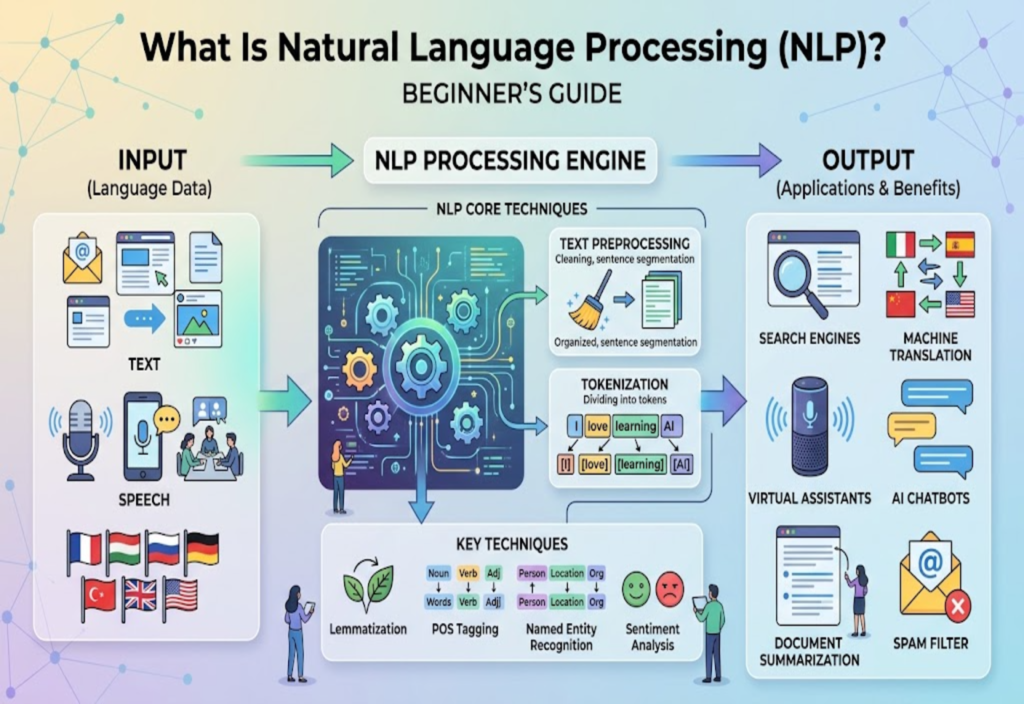
NLP works with two main forms of human communication:
1. Text: Written language found in emails, documents, websites, social media posts, messages, and online searches.
2. Speech: Spoken language that can be converted into text and processed by computer systems.
NLP combines different technologies, including machine learning, linguistics, statistics, and deep learning. These techniques help systems identify language patterns and perform specific language-related tasks.
However, NLP does not mean that a computer understands language exactly as a human does. It processes information using algorithms, statistical patterns, and learned relationships between words.
How Does Natural Language Processing Work?
Natural Language Processing uses several steps to process human language. The exact process depends on the application, but most NLP systems follow a series of operations to analyze input and produce useful results.
Let’s understand the basic process.
1. Collecting Language Data
The first step is collecting language data. This information may come from websites, books, documents, emails, conversations, or other text sources.
For speech-based applications, audio recordings may also be collected.
The quality and variety of this data can affect how well an NLP system performs.
2. Text Preprocessing
Before analyzing text, an NLP system may need to clean and organize the information.
This process is called text preprocessing.
It can include:
Removing unnecessary spaces and symbols.
Converting text into a consistent format.
Identifying sentences.
Separating text into individual words.
Removing certain common words when appropriate.
Preparing text for further analysis.
For example, a sentence such as:
“Natural Language Processing is useful for AI applications.”
Can be separated into individual words for further processing.
Preprocessing makes text easier for algorithms to analyze.
3. Tokenization
Tokenization is the process of dividing text into smaller units called tokens.
A token can be a word, part of a word, punctuation mark, or another meaningful text unit.
For example:
“AI makes language processing easier.”
A simple word-level tokenizer may divide it into:
AI
makes
language
processing
easier
Tokenization helps NLP systems work with text in smaller, organized parts.
4. Understanding Language Structure
Human language has grammar, sentence structure, and relationships between words.
NLP systems use different techniques to analyze these structures.
For example, a system may identify:
Nouns
Verbs
Adjectives
Pronouns
Sentence boundaries
Relationships between words
This information helps the system understand how different parts of a sentence are connected.
5. Analyzing Meaning and Context
Understanding the meaning of words is one of the more challenging parts of NLP.
Some words have different meanings depending on how they are used.
For example:
“I went to the bank to deposit money.”
“The boat reached the river bank.”
The word “bank” has a different meaning in each sentence.
NLP systems use surrounding words and contextual information to identify the most likely meaning.
6. Producing an Output
After processing the input, an NLP system produces an output based on its task.
The output may include:
A translated sentence.
A summary of a long document.
A response to a customer question.
A classification of an email.
A list of important keywords.
A speech-to-text transcription.
The result depends on the model, the available information, and the task being performed.
Main Techniques Used in Natural Language Processing
NLP includes several techniques that help computers process different aspects of human language.
Understanding these techniques makes it easier to learn how modern language applications work.
1. Tokenization
Tokenization divides text into smaller units called tokens.
These units help computer systems organize and process written language.
For example, an application that analyzes customer reviews may first divide each review into individual words or subword units.
Tokenization is commonly used in search engines, chatbots, text classification, and language models.
2. Stemming
Stemming reduces words to their basic root-like form by removing common endings.
For example:
Playing → Play
Played → Play
Playing → Play
The result may not always be a complete dictionary word, but stemming can help identify related word forms.
3. Lemmatization
Lemmatization converts words into their dictionary base form, known as a lemma.
For example:
Running → Run
Better → Good
Cars → Car
Unlike basic stemming, lemmatization considers grammatical information and vocabulary rules.
It can produce more meaningful results when analyzing language.
4. Part-of-Speech Tagging
Part-of-speech tagging identifies the grammatical role of each word in a sentence.
It can identify whether a word is:
A noun
A verb
An adjective
An adverb
A pronoun
A preposition
For example, in the sentence “The computer processes information,” the system can identify “computer” and “information” as nouns and “processes” as a verb.
This technique helps NLP systems analyze sentence structure.
5. Named Entity Recognition (NER)
Named Entity Recognition is a technique used to identify important names and entities in text.
These may include:
People
Cities
Countries
Organizations
Dates
Locations
Product names
For example:
“Microsoft opened a new office in London in 2026.”
An NER system may identify Microsoft as an organization, London as a location, and 2026 as a date.
This technique is useful for extracting information from large documents.
6. Sentiment Analysis
Sentiment analysis identifies the emotional tone or opinion expressed in written text.
It is commonly used to classify customer feedback into categories such as:
Positive
Negative
Neutral
For example:
“I really enjoyed using this application.”
An NLP system may classify this review as positive.
However, sentiment analysis is not always accurate. Sarcasm, cultural differences, and complex expressions can make it difficult to identify the correct meaning.
7. Text Classification
Text classification organizes written information into predefined categories.
For example, an email system may classify messages as:
Important
Promotional
Spam
Customer inquiry
Order request
Businesses use this technique to organize customer messages and reduce repetitive manual work.
8. Machine Translation
Machine translation converts text from one language into another.
For example, it can translate an English sentence into Urdu, Arabic, French, or another supported language.
Modern translation systems often use neural networks and deep learning to analyze the meaning and context of sentences.
However, translations may still contain mistakes, particularly when dealing with idioms, technical terminology, or cultural expressions.
9. Speech Recognition
Speech recognition converts spoken words into written text.
For example, when you use a voice typing feature on your smartphone, the application processes your speech and converts it into text.
Speech recognition is commonly used in:
Voice typing.
Meeting transcription.
Voice-controlled applications.
Customer service systems.
Accessibility tools.
10. Text Generation
Text generation allows computer systems to produce written language based on an input or instruction.
It is used in AI writing assistants, chatbots, content summarization, and conversational applications.
Modern language models use advanced NLP techniques to generate text that follows patterns learned during training.
Natural Language Processing vs. Natural Language Understanding
These two terms are closely related, but they have different meanings.
Natural Language Processing (NLP) is the broader field that includes different methods for working with human language.
Natural Language Understanding (NLU) focuses on interpreting the meaning, context, and intention behind language.
For example, when someone writes:
“Can you help me find a good laptop?”
An NLP system processes the sentence, while an NLU component may identify that the user wants product recommendations.
NLU is one important part of modern NLP applications.
AWS+1
What Is Natural Language Generation (NLG)?
Natural Language Generation (NLG) is another important area related to NLP.
It focuses on producing written or spoken language from information provided to a computer system.
For example, an application may receive information about a product and generate a short product description.
NLG is used in:
AI writing assistants.
Automatic report generation.
Chatbots.
Text summarization.
Conversational applications.
In simple terms:
NLP processes human language.
NLU focuses on interpreting language.
NLG focuses on generating language.
Together, these technologies support many modern language-based applications.
Real-World Applications of Natural Language Processing
NLP is already part of many digital services people use every day. It helps individuals and organizations manage language-related tasks more efficiently.
Here are some important applications.
1. Search Engines
Search engines use language-processing techniques to analyze search queries and identify relevant information.
For example, when someone searches for:
“Best free AI tools for students”
The search engine analyzes the words and attempts to identify the user’s search intent.
This helps it provide relevant webpages, articles, and other information.
NLP-related techniques can also help search systems identify relationships between words and understand different ways of expressing similar questions.
2. AI Chatbots
AI chatbots use NLP to process user messages and generate relevant responses.
They are commonly used on websites, online stores, educational platforms, and customer support pages.
For example, a customer may ask:
“Where is my order?”
A chatbot can analyze the request and connect it with an order-tracking system.
Modern AI chatbots may also use large language models to handle more detailed conversations.
3. Language Translation
Translation applications use NLP and machine learning to convert information between different languages.
For example, someone who receives an English email but understands Urdu can use a translation application to understand its content.
Modern translation systems consider sentence structure and surrounding context instead of simply replacing individual words.
However, important documents should still be reviewed because automated translations can contain errors.
4. Email Spam Detection
Email services use text classification and other machine learning techniques to identify unwanted messages.
An email filtering system may examine:
Words and phrases.
Sender information.
Message structure.
Links and attachments.
Previously identified spam patterns.
Based on this information, the system may classify an email as spam or place it in the inbox.
5. Voice Assistants
Voice assistants use speech recognition and language-processing technologies to respond to spoken commands.
For example, a person may ask a smartphone to set an alarm or provide information about the weather.
The system processes the spoken request and identifies the action that needs to be performed.
Speech recognition and NLP often work together in these applications.
6. Customer Support Automation
Businesses receive thousands of customer messages through emails, websites, and social media platforms.
Reading and organizing every message manually can be time-consuming.
NLP can help businesses:
Categorize customer inquiries.
Identify common complaints.
Extract important details.
Suggest responses.
Route messages to the correct department.
This helps customer support teams organize their work and respond more efficiently.
7. Social Media Monitoring
Companies often receive feedback about their products and services through social media.
NLP-based sentiment analysis can help analyze these comments and identify general customer opinions.
For example:
“This product is excellent.”
“This service is disappointing.”
A sentiment analysis system may classify the first comment as positive and the second as negative.
Businesses can use these insights to identify common concerns and improve their services.
8. Document Summarization
Long documents can contain hundreds or thousands of words.
NLP-powered summarization tools help create shorter versions that highlight important information.
These tools can be useful for:
Research papers.
Business reports.
Meeting notes.
Educational material.
News articles.
However, users should review summaries when accuracy is important because important details may sometimes be missed.
9. Healthcare Documentation
NLP can help healthcare organizations process large amounts of written information.
For example, language-processing systems may assist with extracting relevant details from clinical documents, organizing medical records, and supporting research.
These tools can reduce some repetitive documentation work.
However, NLP systems should not replace qualified medical professionals or independently determine a patient’s treatment.
10. AI Writing Tools
Many AI writing applications use NLP techniques to process instructions and generate written content.
They can help users:
Improve grammar.
Rewrite sentences.
Summarize information.
Generate content outlines.
Suggest alternative wording.
Organize written material.
The generated content should always be reviewed for accuracy, originality, and suitability before publication.
Google Cloud+3
What Is the Difference Between NLP and Large Language Models (LLMs)?
Natural Language Processing and Large Language Models are closely connected, but they are not the same thing.
NLP is a broad field that includes different techniques for processing and generating human language.
Large Language Models (LLMs) are advanced AI models trained on large amounts of text data to perform language-related tasks.
Examples include:
ChatGPT.
Google Gemini.
Claude.
These models can generate text, answer questions, summarize documents, and assist with language-based tasks.
Traditional NLP systems may perform a specific task, such as identifying names in a document or classifying emails.
LLMs can perform several language-related tasks through a single model, depending on their capabilities.
An important point is that LLMs are part of the wider development of NLP rather than a completely separate field.
GitHub+1
Benefits of Natural Language Processing
NLP provides several advantages for businesses, developers, researchers, and everyday users.
1. Saves Time
NLP can automate repetitive language-related tasks such as email classification, document processing, and text extraction.
This allows people to spend more time on tasks that require human judgment.
2. Processes Large Amounts of Text
Organizations produce and receive large amounts of written information.
NLP helps analyze this information more efficiently than manually reviewing every document.
3. Improves Customer Support
Chatbots and automated message classification can help businesses organize customer inquiries and provide faster responses.
4. Supports Multiple Languages
Machine translation and multilingual NLP applications help people communicate across language barriers.
However, language support and accuracy can vary between applications.
5. Helps Extract Useful Information
NLP can identify names, dates, locations, keywords, and other important details from unstructured documents.
This makes information easier to organize and search.
6. Improves Accessibility
Speech-to-text and text-to-speech technologies can make digital information more accessible to people with different communication needs.
Challenges and Limitations of NLP
Although NLP has improved significantly, it still faces several challenges.
Understanding these limitations is important because language is complex and does not always follow predictable patterns.
1. Language Ambiguity
A single word can have multiple meanings.
For example, the word “light” may refer to brightness or something that is not heavy.
An NLP system needs context to identify the intended meaning.
2. Different Languages and Dialects
People communicate using different languages, accents, dialects, and writing styles.
Some languages have more digital training data available than others.
As a result, NLP applications may perform better in certain languages than in less-supported languages.
3. Sarcasm and Cultural Expressions
People often use jokes, sarcasm, idioms, and indirect expressions.
For example:
“That was a great idea!” can express genuine appreciation or sarcasm, depending on the situation.
Identifying the intended meaning can be difficult for automated systems.
4. Data Quality Problems
NLP systems depend on the quality of the information used for training and processing.
Incorrect, incomplete, or biased data can affect results.
Businesses need to review their datasets and use suitable quality-control methods.
5. Privacy Concerns
Language-processing applications may handle personal messages, emails, customer information, and business documents.
Organizations should protect sensitive information and follow applicable privacy requirements.
Users should also be careful when entering confidential information into online AI tools.
6. Incorrect or Misleading Results
NLP systems can produce incorrect classifications, translations, summaries, or generated responses.
Even advanced language models can make mistakes.
Human review remains important, especially for legal, financial, medical, religious, and other sensitive information.
Popular NLP Tools and Libraries for Developers
Developers can use different programming libraries and platforms to build NLP applications.
Some tools are designed for beginners, while others support advanced machine learning projects.
1. NLTK
NLTK is a Python library used for learning and experimenting with natural language processing.
It provides tools for:
Tokenization.
Stemming.
Lemmatization.
Text classification.
Part-of-speech tagging.
Language analysis.
It is a useful starting point for students and beginners who want to understand basic NLP concepts.
Website: NLTK Official Website
2. spaCy
spaCy is a Python-based NLP library designed for practical language-processing applications.
It supports:
Named Entity Recognition.
Tokenization.
Part-of-speech tagging.
Dependency parsing.
Linguistic analysis.
Developers often use spaCy to build efficient NLP pipelines.
Website: spaCy Official Website
3. Hugging Face Transformers
Hugging Face Transformers provides access to many pretrained language models.
Developers can use these models for:
Text classification.
Translation.
Question answering.
Text generation.
Summarization.
Sentiment analysis.
It is particularly useful for developers who want to experiment with modern transformer-based models.
Website: Transformers Documentation
4. Stanford CoreNLP
Stanford CoreNLP is a language-processing toolkit developed for analyzing written text.
It supports several NLP tasks, including:
Tokenization.
Sentence segmentation.
Part-of-speech tagging.
Named Entity Recognition.
Dependency parsing.
It can be useful for research and language-analysis projects.
Website: Stanford CoreNLP Documentation
5. Google Cloud Natural Language
Google Cloud Natural Language provides language-analysis capabilities through cloud-based services.
It can help developers analyze text, identify entities, classify content, and perform sentiment analysis.
It is useful for applications that need language-processing features without building every component from the beginning.
Website: Google Cloud Natural Language
How to Start Learning Natural Language Processing
If you are interested in learning NLP, you do not need to begin with complicated AI models.
A step-by-step approach can help you understand the basic concepts before moving toward advanced applications.
Step 1: Learn Python Programming
Python is widely used in NLP development.
Start by learning:
Variables.
Data types.
Lists and dictionaries.
Loops.
Functions.
String operations.
These programming concepts will help you work with text data.
Step 2: Understand Basic NLP Concepts
Learn the fundamental techniques before moving to advanced models.
Start with:
Tokenization.
Stemming.
Lemmatization.
Part-of-speech tagging.
Named Entity Recognition.
Sentiment Analysis.
Understanding these concepts will make more advanced topics easier.
Step 3: Practice With NLP Libraries
Install beginner-friendly libraries such as NLTK and spaCy.
Try small projects to understand how these libraries process written information.
For example, you can create a program that separates sentences into words or identifies names in a paragraph.
Step 4: Work on Small Projects
Practical projects help turn theoretical knowledge into useful skills.
Some beginner project ideas include:
Email spam classifier.
Customer review analyzer.
Text summarizer.
Keyword extraction tool.
Basic language translator.
News category classifier.
Start with simple projects and gradually increase their complexity.
Step 5: Explore Machine Learning and Deep Learning
After learning the basics, explore machine learning and neural networks.
You can then study transformer models and pretrained language models.
This will help you understand how modern NLP applications handle complex language tasks.
The Future of Natural Language Processing
Natural Language Processing continues to develop as machine learning and AI technologies improve.
Modern NLP systems are becoming more capable of processing different types of language information, including text, speech, and multilingual content.
Several developments are shaping the future of this field.
1. Better Multilingual Communication
Future NLP systems may improve language support for communities that use less widely represented languages.
This could make translation and digital communication more accessible.
2. More Advanced AI Assistants
AI assistants are becoming more capable of processing longer instructions, summarizing information, and helping users complete language-based tasks.
Their usefulness will depend on accuracy, appropriate access to information, and reliable system design.
3. Improved Voice Recognition
Speech recognition technology continues to develop.
Future systems may become better at handling different accents, speaking styles, and background noise.
4. More Accurate Information Extraction
Organizations need to process large amounts of documents and business information.
NLP systems may become more effective at extracting relevant details and organizing unstructured data.
5. Integration With Other AI Technologies
NLP is increasingly combined with computer vision, speech processing, machine learning, and other AI technologies.
This supports applications that can process different forms of information together.
However, future improvements will still need to address privacy, reliability, fairness, and data-quality concerns.
Frequently Asked Questions About NLP
1. What does NLP stand for?
NLP stands for Natural Language Processing. It is a field of Artificial Intelligence that focuses on processing, analyzing, and generating human language.
2. Is NLP a part of Artificial Intelligence?
Yes. NLP is a branch of Artificial Intelligence and computer science that focuses on working with human language.
3. What are common examples of NLP?
Common examples include language translation, email spam detection, chatbots, sentiment analysis, voice recognition, text summarization, and AI writing applications.
4. Is NLP used in ChatGPT?
Yes. ChatGPT uses advanced language models and NLP-related technologies to process user instructions and generate responses.
5. Which programming language is best for NLP?
Python is one of the most popular programming languages for NLP because it offers many useful libraries, including NLTK, spaCy, and Hugging Face Transformers.
6. What is the difference between NLP and NLU?
NLP is the broader field of language processing. NLU is a part of NLP that focuses on interpreting the meaning, context, and intention behind language.
7. Can NLP understand Urdu?
Yes. NLP systems can process Urdu text and speech. However, their accuracy depends on the model, available training data, language support, and the complexity of the text.
8. Is NLP used in SEO?
Yes. NLP-related techniques are used in search systems to process queries, analyze content, identify entities, and understand relationships between words.
SEO professionals can use NLP concepts to create clear, relevant, and useful content that addresses users’ search needs.
9. Do I need mathematics to learn NLP?
Basic mathematics is helpful, especially when learning machine learning and deep learning. Beginners can start with Python and fundamental NLP concepts before studying more advanced mathematics.
10. What is the difference between traditional NLP and modern NLP?
Traditional NLP often relies on predefined rules, statistical methods, and specialized models for individual tasks. Modern NLP increasingly uses deep learning and transformer-based models to handle more complex language-processing tasks.
Conclusion
Natural Language Processing is an important part of modern Artificial Intelligence. It allows computer systems to process written and spoken language and perform useful tasks such as translation, text classification, sentiment analysis, and document summarization.
From search engines and email filters to AI chatbots and writing assistants, NLP supports many applications used in everyday digital life.
For beginners, learning NLP can be a valuable step toward understanding how modern AI applications work. Starting with Python, basic language-processing techniques, and practical projects can provide a strong foundation.
As this technology develops, NLP will continue to play an important role in communication, information processing, and digital services. However, its results should be checked carefully because automated systems can still misunderstand language or produce inaccurate information.