Best Open Source Databases in 2026 are essential for building fast, secure, and scalable applications. Every modern application depends on a reliable database, whether you’re creating a WordPress website, a mobile app, an AI-powered platform, or enterprise software. The right database determines how efficiently your application stores, retrieves, and manages data. Therefore, choosing the right database is one of the most important technical decisions you will make.
In 2026, open source databases continue to dominate the technology industry because they combine flexibility, reliability, and cost efficiency. Instead of paying expensive licensing fees, businesses can use powerful community-driven database systems that receive regular updates and security improvements. As a result, startups, enterprises, universities, and independent developers continue to adopt open source solutions for projects of every size.
Furthermore, the rapid growth of cloud computing, artificial intelligence, big data, and SaaS applications has increased the demand for databases that can process massive amounts of information while maintaining excellent performance. Fortunately, several mature open source databases are capable of meeting these modern requirements.
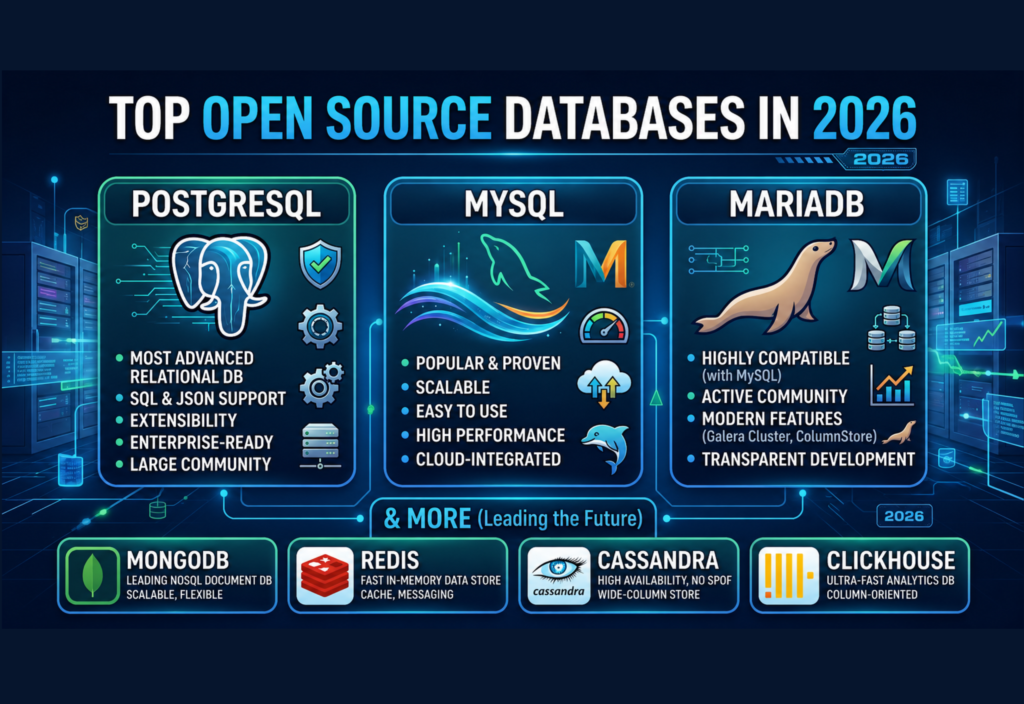
In this guide, you’ll explore the Best Open Source Databases in 2026, including PostgreSQL, MySQL, MariaDB, SQLite, and MongoDB. You’ll learn their key features, advantages, use cases, and differences so you can confidently choose the right database for your next project.
What Is an Open Source Database?
A database is software that stores, organizes, and retrieves information. An open source database goes one step further by making its source code publicly available. Developers can inspect the code, improve it, customize it, and contribute new features according to the project’s open source license.
Unlike proprietary databases that require expensive licenses, open source databases are usually free to use. Moreover, they benefit from active developer communities that regularly improve security, performance, and stability.
Today, many of the world’s largest websites and business platforms rely on open source databases because they provide enterprise-level capabilities without locking organizations into a single vendor.
Benefits of Open Source Databases
Businesses continue to adopt open source databases because they offer numerous advantages.
- Lower software costs
- Active global communities
- Frequent security updates
- Excellent scalability
- Flexible customization
- Cloud compatibility
- Cross-platform support
- Strong developer documentation
- Large ecosystem of development tools
Additionally, most modern programming languages integrate seamlessly with popular open source databases, making development much easier.
Why Open Source Databases Matter in 2026
Software development has evolved rapidly over the last few years. Applications now serve millions of users, analyze real-time information, and integrate AI into everyday workflows. Consequently, databases must deliver high performance while remaining secure and scalable.
Artificial Intelligence
AI applications generate enormous amounts of structured and unstructured data. Therefore, developers require databases that can efficiently process and organize this information.
Cloud Computing
Most modern applications now run in the cloud. As a result, developers need databases that support distributed systems, automated backups, and easy scaling.
Lower Development Costs
Businesses always look for ways to reduce infrastructure expenses. Open source databases eliminate licensing fees while still providing enterprise-grade capabilities.
Community Innovation
Thousands of developers contribute improvements every year. Consequently, new features arrive faster than ever before.
Better Performance
Modern database engines continue to improve indexing, replication, caching, and query optimization. Therefore, today’s open source databases can handle workloads that were once limited to commercial database systems.
PostgreSQL
PostgreSQL is widely recognized as one of the most advanced open source relational databases available today. Since its first release, it has earned a reputation for stability, security, and exceptional SQL compliance.
Unlike many traditional database systems, PostgreSQL supports both structured relational data and modern JSON documents. Because of this flexibility, developers can build everything from financial software to AI-powered applications using a single database engine.
Large technology companies, research organizations, healthcare providers, and government institutions trust PostgreSQL because it handles complex workloads while maintaining excellent reliability.
Key Features of PostgreSQL
- ACID-compliant transactions
- Advanced indexing techniques
- JSON and JSONB support
- Full-text search
- Table partitioning
- High availability
- Strong security controls
- Powerful extensions such as PostGIS
Moreover, PostgreSQL allows developers to extend its functionality through custom extensions, making it one of the most flexible relational databases available.
Advantages of PostgreSQL
- Outstanding reliability
- Enterprise-grade security
- Excellent SQL compliance
- High scalability
- Advanced query optimization
- Large open source community
- Frequent feature updates
Furthermore, PostgreSQL performs extremely well when applications require complex joins, reporting, analytics, or transactional consistency.
Best Use Cases
- Enterprise software
- Banking applications
- Healthcare systems
- AI platforms
- SaaS products
- Geographic Information Systems (GIS)
- Business analytics
- Government applications
Organizations handling mission-critical data often choose PostgreSQL because of its reliability and long-term stability.
MySQL
MySQL has remained one of the world’s most popular relational databases for decades. Although newer technologies continue to appear, millions of websites still depend on MySQL every day.
Its popularity comes from its simplicity, excellent performance, and broad compatibility with web technologies. For example, WordPress, WooCommerce, and many popular content management systems use MySQL as their default database.
Because MySQL is beginner-friendly, many developers learn it as their first database before moving on to more advanced systems.
Key Features of MySQL
- Fast query execution
- Reliable replication
- Multiple storage engines
- Strong security
- Easy installation
- Comprehensive documentation
- Excellent backup support
Additionally, MySQL integrates smoothly with PHP, Python, Java, JavaScript, Node.js, and many other programming languages.
Advantages of MySQL
- Easy to learn
- Excellent performance
- Large global community
- Extensive learning resources
- Wide hosting support
- Reliable backup solutions
- Stable production environment
Consequently, MySQL remains one of the best databases for beginners and small-to-medium business applications.
Best Use Cases
- WordPress websites
- WooCommerce stores
- Blogs
- Business websites
- Customer portals
- Educational projects
- Small business software
- eCommerce applications
In addition, most shared hosting companies include MySQL support, making deployment simple and affordable.
PostgreSQL vs MySQL: Quick Comparison
PostgreSQL
- Performance: ⭐⭐⭐⭐⭐
- Security: ⭐⭐⭐⭐⭐
- Scalability: ⭐⭐⭐⭐⭐
- JSON Support: Advanced
- Best For: Enterprise applications, AI platforms, and analytics
MySQL
- Performance: ⭐⭐⭐⭐⭐
- Security: ⭐⭐⭐⭐☆
- Scalability: ⭐⭐⭐⭐⭐
- JSON Support: Good
- Best For: WordPress websites, blogs, and eCommerce
Both databases are excellent choices. However, PostgreSQL is often preferred for enterprise applications and advanced analytics, whereas MySQL remains one of the best options for websites, blogs, and content management systems.
MariaDB
MariaDB is one of the fastest-growing open source relational databases in the world. It was created by the original developers of MySQL with the goal of keeping the database fully open source while continuing to improve its performance and features.
Although MariaDB is highly compatible with MySQL, it introduces several enhancements that make it attractive for businesses and developers. Consequently, many organizations migrate from MySQL to MariaDB without making significant changes to their applications.
Moreover, MariaDB focuses on transparency, community-driven development, and long-term innovation. These qualities have helped it become a trusted database for modern web applications and enterprise software.
Key Features
- MySQL compatibility
- Multiple storage engines
- Improved query optimization
- Advanced replication
- Enhanced security features
- High-performance indexing
- Regular community updates
Because MariaDB continues to evolve, developers receive new improvements and security updates on a regular basis.
Advantages
- Completely open source
- Excellent performance
- Easy migration from MySQL
- Active global community
- Flexible storage engines
- Reliable security
Additionally, many cloud providers support MariaDB, making deployment simple for businesses of every size.
Best Use Cases
- Business applications
- eCommerce platforms
- SaaS products
- Cloud-native applications
- Enterprise software
- Web hosting environments
If your project already uses MySQL but requires greater flexibility, MariaDB is worth considering.
SQLite
SQLite is different from traditional database servers because it does not require installation or configuration. Instead, the entire database is stored inside a single file. As a result, developers can quickly build lightweight applications without managing a separate database server.
Many people use SQLite every day without realizing it. In fact, Android devices, web browsers, desktop software, and IoT systems often rely on SQLite behind the scenes.
Its simplicity makes it one of the most widely deployed database engines in the world.
Key Features
- Zero configuration
- Single database file
- Lightweight architecture
- Cross-platform compatibility
- High-speed local storage
- Reliable performance
Furthermore, SQLite requires very little system memory, making it ideal for portable devices.
Advantages
- Easy to install
- Extremely lightweight
- Highly portable
- Reliable
- Free to use
Additionally, SQLite simplifies testing because developers can create databases instantly without additional setup.
Best Use Cases
- Mobile applications
- Desktop software
- Embedded systems
- IoT devices
- Offline applications
- Local development
However, applications with thousands of concurrent users usually benefit from server-based databases such as PostgreSQL or MySQL.
MongoDB
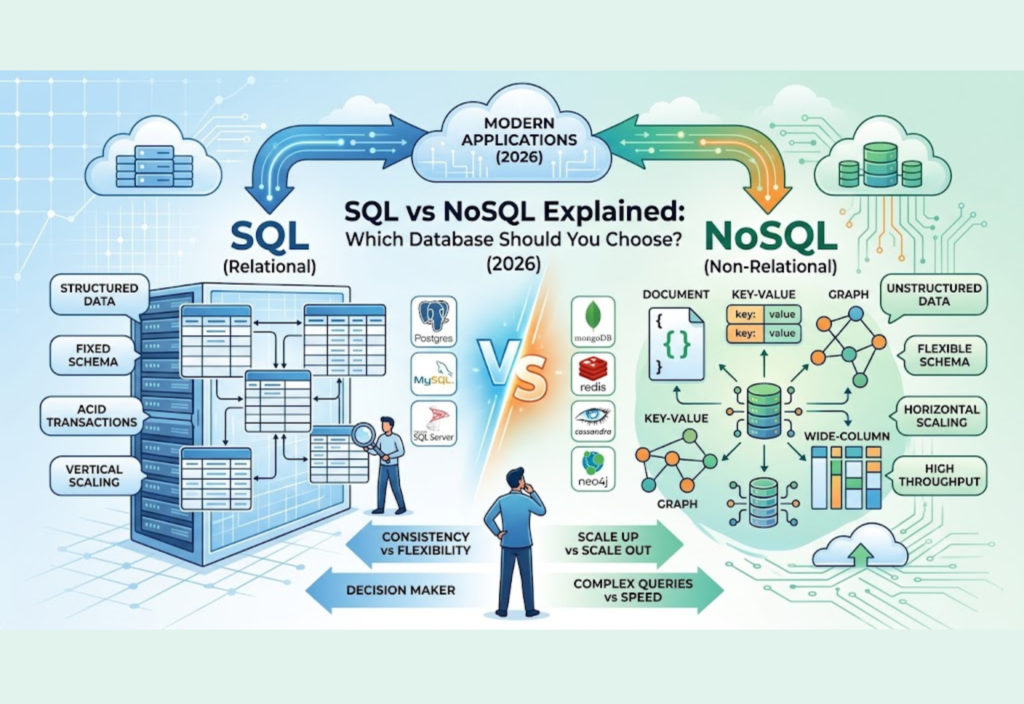
MongoDB is one of the most popular NoSQL databases available today. Unlike relational databases that organize information into tables, MongoDB stores data in flexible JSON-like documents. Therefore, developers can easily modify their data structure as application requirements change.
Modern software often handles user-generated content, API responses, and rapidly changing datasets. Because of this flexibility, MongoDB has become a preferred choice for cloud applications, AI systems, and real-time platforms.
Key Features
- Document-oriented storage
- Flexible schema
- Horizontal scaling
- Built-in replication
- Powerful indexing
- High availability
- Cloud integration
Moreover, MongoDB performs exceptionally well when applications need to process large volumes of unstructured data.
Advantages
- Flexible data model
- Excellent scalability
- Fast application development
- Easy cloud deployment
- Strong developer community
As businesses continue adopting cloud-native architectures, MongoDB remains one of the leading NoSQL solutions.
Best Use Cases
- AI applications
- Content management systems
- Real-time analytics
- Social media platforms
- Gaming applications
- Large-scale APIs
- Big data projects
Although MongoDB is highly flexible, relational databases still provide stronger transactional consistency for financial and enterprise systems.
Comparison of the Best Open Source Databases
PostgreSQL
- Type: Relational Database
- Best For: Enterprise applications, AI, and Analytics
- Difficulty: Intermediate
MySQL
- Type: Relational Database
- Best For: Websites, WordPress, and eCommerce
- Difficulty: Beginner
MariaDB
- Type: Relational Database
- Best For: Business Software and Cloud Applications
- Difficulty: Beginner
SQLite
- Type: Embedded Database
- Best For: Mobile and Desktop Applications
- Difficulty: Beginner
MongoDB
- Type: NoSQL Database
- Best For: AI applications, APIs, and Real-Time Platforms
- Difficulty: Intermediate
How to Choose the Right Database
Choosing the best database depends on your project’s goals rather than current trends. Before making a decision, consider the following questions.
- How much data will your application store?
- Will thousands of users access the database simultaneously?
- Do you require strict transactional consistency?
- Will the application run in the cloud?
- Does your project need horizontal scalability?
- Which programming language are you using?
If your project requires advanced SQL features and enterprise reliability, PostgreSQL is an excellent option. On the other hand, MySQL is perfect for websites, blogs, and content management systems.
Meanwhile, MariaDB provides a community-driven alternative with strong compatibility. SQLite works best for lightweight applications, whereas MongoDB is ideal for flexible document-based data.
Future Trends in Open Source Databases
Open source databases continue to evolve as software development becomes more advanced. Several important trends are shaping the future.
AI Integration
Many modern databases now support AI-powered search, vector indexing, and intelligent data processing.
Cloud-Native Development
Managed database services continue to simplify deployment, scaling, and maintenance.
Improved Security
Developers are placing greater emphasis on encryption, authentication, and automated security updates.
Better Performance
Database engines continue improving indexing, replication, and query optimization for faster applications.
Developer Productivity
New monitoring tools, automated backups, and performance dashboards help teams manage databases more efficiently.
These innovations ensure that open source databases remain competitive for years to come.
Final Thoughts
Open source databases continue to power modern software development across countless industries. Whether you’re building a simple website or a large enterprise platform, selecting the right database can improve performance, reduce costs, and simplify future growth.
PostgreSQL remains the strongest option for enterprise applications, analytics, and AI workloads. MySQL continues to dominate traditional web development because of its simplicity and reliability. MariaDB offers an excellent open source alternative with additional flexibility. SQLite is perfect for lightweight local applications, while MongoDB excels in document-based and cloud-native environments.
Instead of choosing a database based only on popularity, evaluate your project’s requirements carefully. By matching the database to your application’s needs, you can build software that performs well today and scales successfully in the future.