High-Paying AI Careers are becoming some of the most valuable opportunities in the modern technology world. In 2026, Artificial Intelligence is changing how companies operate, how businesses solve problems, and how professionals build their careers.
From healthcare and finance to education, cybersecurity, manufacturing, and e-commerce, AI technology is being used in almost every industry. As a result, companies need skilled professionals who can develop AI systems, manage data, and create practical solutions.
The demand for artificial intelligence experts is growing because organizations want to automate repetitive tasks, improve decision-making, and provide better customer experiences. Therefore, people with AI knowledge can find excellent career opportunities with strong growth potential.
The good news is that you do not need to become an AI researcher immediately. Instead, you can start by learning basic programming, understanding machine learning concepts, and building practical projects step by step.
In this guide, you will discover the top High-Paying AI Careers in 2026, the skills required for each role, and how beginners can start building a successful future in artificial intelligence.
Why Are High-Paying AI Careers Growing in 2026?
Artificial Intelligence has moved beyond research laboratories and large technology companies. Today, businesses of all sizes are adopting AI tools to improve productivity and create better services.
Moreover, the rapid growth of generative AI, automation, and data-driven technologies has increased the need for professionals who understand artificial intelligence.
Some major reasons behind the growth of AI careers include:
- Increasing demand for automation
- Higher adoption of AI tools by businesses
- Growth of machine learning applications
- Expansion of cloud computing
- Need for better data analysis
- Development of AI-powered products
In addition, many AI professionals enjoy flexible work opportunities, including remote jobs and freelance projects.
As AI continues to evolve, professionals who keep improving their skills can build stable and rewarding careers.
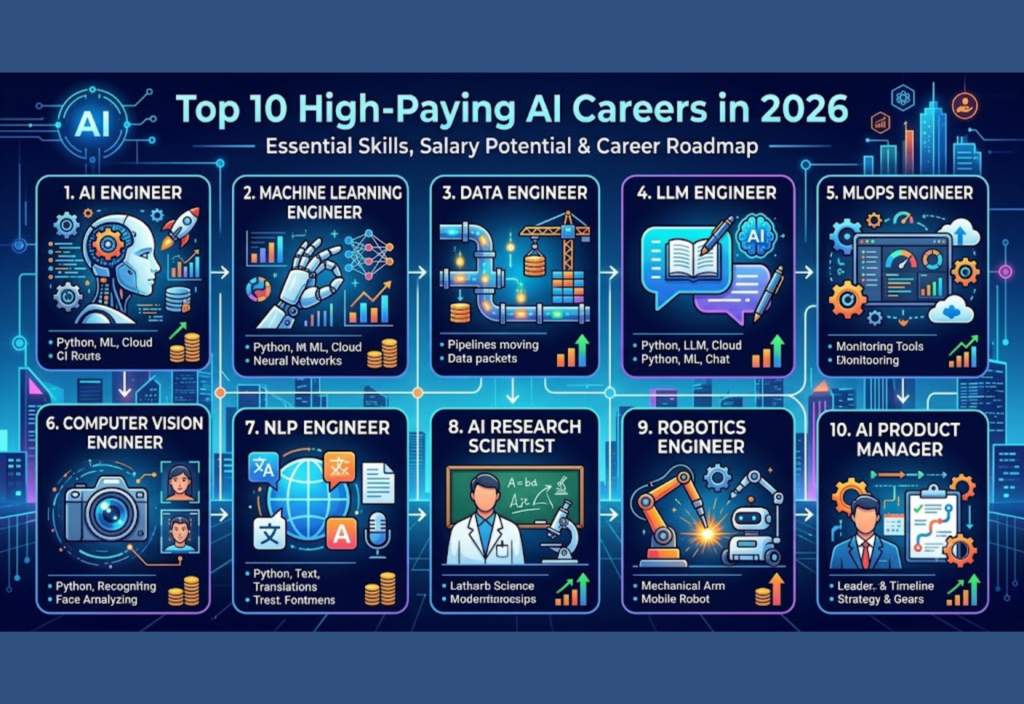
1. AI Engineer
An AI Engineer develops intelligent systems that allow computers to perform tasks that normally require human intelligence.
For example, AI Engineers create applications that can understand language, recognize images, analyze information, and make predictions.
Their work combines programming, machine learning, and software development.
Responsibilities of AI Engineers
AI Engineers usually work on:
- Developing AI-powered applications
- Creating intelligent chatbots
- Building recommendation systems
- Connecting AI models with software
- Testing and improving AI performance
Furthermore, they work closely with data scientists and software developers to create useful AI solutions.
Skills Required for AI Engineers
Important skills include:
- Python programming
- Machine learning basics
- Deep learning
- AI APIs
- Cloud platforms
- Problem-solving skills
Because almost every industry is adopting AI solutions, AI Engineers are among the most in-demand technology professionals.
2. Machine Learning Engineer
Machine Learning Engineers create systems that learn from data and improve automatically.
Unlike traditional software, machine learning models can identify patterns and make better predictions as they receive more information.
For instance, recommendation systems on shopping websites and fraud detection systems in banking use machine learning technology.
Responsibilities of Machine Learning Engineers
Their common tasks include:
- Training machine learning models
- Preparing data for AI systems
- Testing model accuracy
- Improving prediction results
- Deploying machine learning solutions
Skills Required for Machine Learning Engineers
To succeed in this field, professionals need:
- Python
- Statistics
- Machine learning algorithms
- Data analysis
- TensorFlow
- PyTorch
Moreover, strong problem-solving skills help engineers create better AI solutions for real-world challenges.
3. Data Engineer
Data plays a major role in artificial intelligence. Without clean and organized information, AI systems cannot produce accurate results.
Therefore, Data Engineers build the systems that collect, store, and process large amounts of data.
They make sure that AI models receive reliable information.
Responsibilities of Data Engineers
Their work includes:
- Creating data pipelines
- Managing databases
- Organizing large datasets
- Improving data quality
- Building data storage systems
Skills Required for Data Engineers
Important skills include:
- SQL
- Python
- Database management
- Data warehousing
- ETL processes
- Cloud technologies
As businesses continue generating massive amounts of data, the demand for skilled Data Engineers is increasing worldwide.
4. LLM Engineer
Large Language Models (LLMs) have become one of the biggest developments in artificial intelligence.
LLM Engineers create applications that use advanced language models to understand and generate human-like responses.
For example, they build AI assistants, business chatbots, and document analysis systems.
Responsibilities of LLM Engineers
They work on:
- AI chatbot development
- AI search systems
- Document summarization tools
- Business automation solutions
- Language-based applications
Skills Required for LLM Engineers
Key skills include:
- Python
- Prompt Engineering
- AI APIs
- Retrieval-Augmented Generation (RAG)
- Vector databases
- API integration
Furthermore, as more companies adopt generative AI, LLM Engineers are becoming one of the fastest-growing AI professionals.
5. MLOps Engineer
MLOps Engineers help companies deploy and manage artificial intelligence systems in real-world environments. Building an AI model is only the first step. After that, organizations need professionals who can maintain, monitor, and improve these systems.
Therefore, MLOps has become an important part of modern AI development.
Responsibilities of MLOps Engineers
MLOps Engineers usually handle tasks such as:
- Deploying machine learning models
- Monitoring AI system performance
- Automating model updates
- Improving system reliability
- Managing AI infrastructure
In addition, they make sure AI applications continue working smoothly after deployment.
Skills Required for MLOps Engineers
Important skills include:
- Docker
- Kubernetes
- Cloud computing
- CI/CD pipelines
- Machine learning basics
- Monitoring tools
Because businesses depend on reliable AI systems, experienced MLOps Engineers are becoming highly valuable in the technology industry.
6. Computer Vision Engineer
Computer Vision Engineers create AI systems that allow computers to understand and analyze images and videos.
This technology helps machines identify objects, recognize patterns, and understand visual information.
For example, computer vision is used in healthcare scanning, self-driving vehicles, security systems, and manufacturing inspections.
Responsibilities of Computer Vision Engineers
Their work includes:
- Developing image recognition systems
- Building video analysis tools
- Improving object detection accuracy
- Creating visual AI applications
Skills Required for Computer Vision Engineers
Professionals need knowledge of:
- Python
- OpenCV
- Deep learning
- Neural networks
- Image processing
- TensorFlow or PyTorch
Moreover, as industries continue adopting automation, computer vision experts will have more career opportunities in the coming years.
7. NLP Engineer
Natural Language Processing (NLP) Engineers focus on helping computers understand, process, and generate human language.
NLP technology is behind many tools people use every day, including AI assistants, translation services, voice applications, and search systems.
Responsibilities of NLP Engineers
They develop:
- AI chatbots
- Voice assistants
- Translation systems
- Text analysis tools
- Sentiment analysis applications
Furthermore, NLP Engineers improve how machines communicate with humans naturally.
Skills Required for NLP Engineers
Important skills include:
- Python
- Natural Language Processing
- Machine learning
- Large Language Models
- Text analytics
- Data processing
As businesses increase their use of conversational AI, NLP remains one of the important areas within artificial intelligence.
8. AI Research Scientist
AI Research Scientists work on creating new artificial intelligence methods and improving existing technologies.
Unlike many engineering roles, this career focuses more on experimentation, research, and innovation.
They often work in universities, research laboratories, and advanced technology companies.
Responsibilities of AI Research Scientists
Their responsibilities include:
- Developing new AI algorithms
- Testing experimental models
- Improving AI performance
- Publishing research papers
- Studying new AI techniques
Skills Required for AI Research Scientists
A strong foundation in the following areas is important:
- Mathematics
- Statistics
- Deep learning
- Python programming
- Research methods
- Scientific writing
Although this career usually requires advanced knowledge, it offers opportunities to work on technologies that shape the future of AI.
9. Robotics Engineer
Robotics Engineers combine artificial intelligence with mechanical systems to create smart machines.
Today, AI-powered robots are helping industries improve productivity and complete difficult tasks.
For example, robots are used in factories, warehouses, healthcare facilities, and agriculture.
Responsibilities of Robotics Engineers
They work on:
- Designing intelligent robots
- Programming robotic systems
- Improving automation processes
- Integrating AI with hardware
- Testing robotic performance
Skills Required for Robotics Engineers
Key skills include:
- Robotics
- Python
- Computer vision
- Sensors
- Embedded systems
- ROS (Robot Operating System)
Moreover, as automation continues expanding, robotics experts will play an important role in future industries.
10. AI Product Manager
AI Product Managers connect business goals with artificial intelligence solutions.
They do not always create AI models themselves. Instead, they manage teams and make sure AI products solve real customer problems.
This role is ideal for professionals who enjoy technology, planning, and leadership.
Responsibilities of AI Product Managers
Their tasks include:
- Planning AI products
- Understanding customer needs
- Managing development teams
- Creating product strategies
- Measuring product success
Skills Required for AI Product Managers
Important skills include:
- Product management
- Communication
- AI fundamentals
- Business strategy
- Project management
Because companies need people who can connect technology with business goals, AI Product Managers are becoming increasingly important.
Essential Skills Needed for High-Paying AI Careers
Although each AI role requires different expertise, some skills are useful across almost all artificial intelligence careers.
Technical Skills
Professionals should learn:
- Python programming
- SQL databases
- Machine learning basics
- Data analysis
- Cloud computing
- Git and GitHub
AI-Specific Skills
In addition, learning these areas can improve career opportunities:
- Prompt Engineering
- Large Language Models
- AI automation
- Deep learning concepts
- AI tools and APIs
Soft Skills
Technical knowledge is important; however, communication and problem-solving skills are equally valuable.
Successful AI professionals should develop:
- Critical thinking
- Communication skills
- Creativity
- Adaptability
How to Start a Career in Artificial Intelligence
Starting an AI career may look difficult at first. However, following a clear learning plan can make the process easier.
A practical roadmap includes:
Step 1: Learn Programming Basics
Start with Python because it is widely used in artificial intelligence and machine learning.
Step 2: Understand Data and Machine Learning
Learn how data works and understand basic machine learning concepts.
Step 3: Build Practical Projects
Create small projects such as:
- AI chatbots
- Data analysis tools
- Image recognition apps
- Automation workflows
Step 4: Create a Portfolio
A strong portfolio helps demonstrate your skills to employers and clients.
You can share projects on:
- GitHub
- Personal websites
Step 5: Apply for Opportunities
After building skills, you can apply for:
- Internships
- Freelance projects
- Entry-level AI jobs
- Remote positions
Consistency and practical experience are more valuable than learning everything quickly.
Salary Potential of High-Paying AI Careers
AI salaries depend on several factors, including:
- Experience level
- Location
- Industry
- Technical skills
- Company size
Professionals with strong AI knowledge and practical experience usually have access to better opportunities.
Moreover, specialists in areas like machine learning, LLM development, and AI automation often receive higher compensation because their skills are in strong demand.
Instead of focusing only on salary, beginners should focus on building valuable skills and gaining real-world experience.
Is Artificial Intelligence a Good Career in 2026?
Yes, Artificial Intelligence is one of the fastest-growing career fields in 2026.
Companies across different industries need professionals who can:
- Build intelligent applications
- Analyze business data
- Automate processes
- Improve customer experiences
However, AI is constantly changing. Therefore, continuous learning is important for long-term success.
People who stay updated with new AI tools and technologies will have better opportunities in the future.
Frequently Asked Questions About High-Paying AI Careers
Which AI career has the highest salary?
AI Engineers, Machine Learning Engineers, LLM Engineers, and AI Research Scientists are considered some of the highest-paying AI careers. However, salaries depend on experience, location, and technical expertise.
Can beginners start an AI career?
Yes. Beginners can start by learning Python, data analysis, machine learning basics, and building small AI projects.
Do all AI careers require programming?
No. Many AI careers require programming, but some roles, such as AI Product Manager, AI Consultant, and AI Trainer, focus more on business skills and communication.
Which programming language is best for AI?
Python is the most popular programming language for artificial intelligence because it is simple, flexible, and supported by many AI libraries.
Final Thoughts
High-Paying AI Careers are creating new opportunities for students, developers, professionals, and technology enthusiasts in 2026.
From AI Engineering and Machine Learning to LLM development, robotics, and AI product management, there are many career paths available for people with different interests and skills.
The key to success is building a strong foundation, practicing with real projects, and continuously improving your knowledge.
Although artificial intelligence is changing quickly, professionals who stay curious and keep learning can build successful and rewarding careers in this growing technology field.