Artificial intelligence is becoming an important part of modern technology. From customer support chatbots and content classification systems to programming assistants and business automation, AI models are being used to perform many different tasks. However, a general-purpose AI model may not always produce the exact type of output a business or developer needs.
This is where AI fine-tuning becomes useful. It allows developers to adapt an already trained AI model to a particular task, writing style, industry, or expected output format. Instead of building a model from scratch, they can start with an existing model and continue training it with carefully prepared examples.
For example, a business might want an AI assistant that categorizes customer emails, a developer might need a model that generates structured product descriptions, or a support team might want more consistent responses to common questions. Fine-tuning can help improve performance on these specialized tasks when the training data matches the intended use.
In this guide, you will learn what AI fine-tuning is, how it works, which types of fine-tuning are available, how to prepare training data, and how to evaluate a customized model. You will also discover common mistakes, practical examples, and important considerations for using fine-tuning responsibly in 2026.
What Is AI Fine-Tuning?
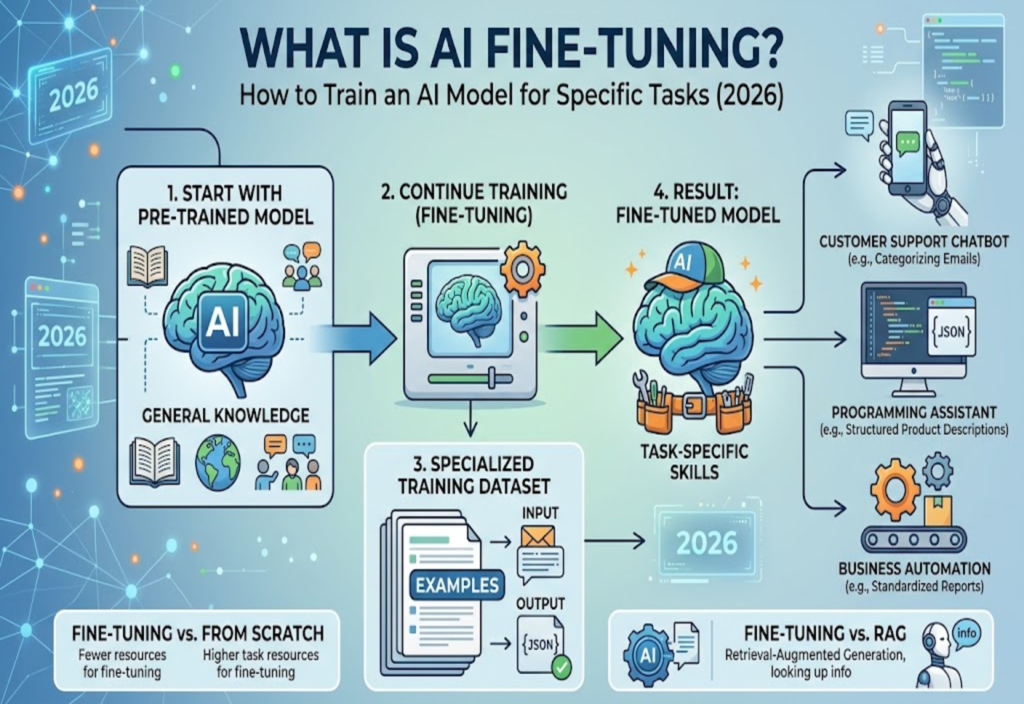
AI fine-tuning is the process of taking a model that has already been trained and continuing its training on a more specific dataset. The goal is to help the model perform a particular task more consistently or follow certain instructions more effectively.
A pre-trained model has already learned patterns from its original training process. Fine-tuning builds on that foundation by exposing the model to examples that represent the task it needs to perform.
For instance, a general language model can answer questions, summarize text, and write different types of content. However, a company may need the model to classify every incoming email into one of three categories: order, product inquiry, or complaint. Fine-tuning may help the model learn the company’s preferred classification format from representative examples.
The process does not necessarily require training an entirely new AI system. Instead, it modifies an existing model through an additional training process, depending on the model and fine-tuning method being used.
According to the National Institute of Standards and Technology (NIST), fine-tuning involves adapting a pre-trained model to perform specialized tasks or operate within a particular domain.
How Does AI Fine-Tuning Work?
Fine-tuning works by using examples to guide a model toward the desired behavior. During training, the model processes examples and adjusts certain parameters, commonly called weights, to reduce the difference between its predicted output and the target output.
The exact process depends on the architecture, training method, and tools used. However, a typical workflow contains several main stages.
1. Start With a Pre-Trained Model
The first step is choosing an existing model that is suitable for your task.
Pre-trained models have already learned useful patterns from their original training data. Some models specialize in language, while others handle images, audio, or multiple data types.
For example, a developer building a customer support assistant might choose a language model capable of understanding customer messages and generating appropriate responses.
The selected model should support the required task, language, data format, and fine-tuning method.
2. Prepare a Specialized Dataset
The next step is collecting examples that demonstrate the desired behavior.
A training dataset usually contains input information and the correct or preferred output. The examples should reflect the kinds of requests the model will encounter after deployment.
For an email classification model, the dataset might include messages about purchases, questions about products, and complaints. Each message should have an accurate category label.
Poor-quality examples can teach the wrong behavior, so data preparation is one of the most important parts of fine-tuning.
3. Train the Model on the Examples
Once the dataset is ready, the training process begins.
The model processes the examples and updates its trainable parameters according to the selected training method. Over multiple training steps, it learns to produce outputs that better match the examples.
Developers can configure training options such as the number of training epochs and learning rate when the chosen platform supports those settings.
An epoch represents one complete pass through the training dataset. More epochs do not automatically mean better results. Excessive training can cause a model to memorize examples instead of learning patterns that generalize to new situations.
4. Evaluate the Fine-Tuned Model
After training, developers test the customized model on examples that were not used during training.
This helps determine whether the model has learned useful patterns or simply memorized the training data.
For example, if an email classifier performs well on familiar training messages but incorrectly classifies new customer emails, its performance may not be good enough for real-world use.
Evaluation should measure task-specific results, such as classification accuracy, consistency, response quality, formatting, and the rate of serious errors.
5. Deploy and Monitor the Model
If evaluation shows meaningful improvement, the model can be integrated into an application, website, or business workflow.
However, the work does not end after deployment. Developers should monitor its performance, review unexpected outputs, and update their evaluation process when requirements change.
A model that performs well on today’s examples may need additional training or other adjustments when products, customer behavior, or business processes evolve.
AI Fine-Tuning vs. Training an AI Model From Scratch
Fine-tuning and training from scratch are different approaches to developing AI systems.
Training from scratch involves learning model parameters from an initial state using a large training process. Depending on the model’s size and objective, this can require substantial datasets, computing resources, engineering expertise, and time.
Fine-tuning starts with an existing model and adapts it to a more specific objective. Because the original model already contains learned representations, the additional training can be considerably more manageable.
Here are the main differences:
Training an AI model from scratch
Starts without the learned parameters of an existing pre-trained model.
Can require extensive training data and computing resources.
Offers greater control over the initial training process and model design.
Is generally more complex and expensive for large-scale models.
Fine-tuning an existing AI model
Starts with a pre-trained model.
Uses task-specific examples to adapt its behavior.
Can require fewer resources than training a comparable model from scratch.
Depends on the quality, capabilities, and limitations of the original model.
For many developers and businesses, fine-tuning is a practical option when an existing model already performs the basic task but needs more consistent specialized behavior.
Types of AI Fine-Tuning
There are several ways to adapt an AI model. The right method depends on the task, available data, computing resources, and how much of the model needs to be updated.
1. Supervised Fine-Tuning (SFT)
Supervised fine-tuning is a common method in which a model is trained using examples that contain inputs and desired outputs.
For example:
Input: “I purchased a laptop yesterday, but it arrived damaged.”
Desired output: “Complaint”
The model receives many examples like this and learns to map similar inputs to the expected outputs.
Supervised fine-tuning is useful for:
Text classification.
Instruction following.
Structured response generation.
Specialized writing formats.
Translation and text transformation.
Customer support workflows.
The quality and diversity of the examples strongly influence the outcome. The dataset should include realistic variations rather than repeating nearly identical examples.
2. Instruction Fine-Tuning
Instruction fine-tuning teaches a model to respond to different instructions more effectively. It commonly uses examples of instructions paired with appropriate responses.
For example, a model might receive instructions such as:
Summarize this report in five bullet points.
Rewrite this paragraph in simple English.
Extract the product name and price from this description.
Convert this information into valid JSON.
The training examples demonstrate the expected response to each instruction.
Instruction fine-tuning is especially useful when a model needs to follow a consistent set of task requirements across different inputs.
3. Domain-Specific Fine-Tuning
Domain-specific fine-tuning adapts a model to the language, terminology, or tasks associated with a particular field.
Possible applications include technical documentation, customer service, manufacturing, software development, and specialized business operations.
For example, a software company might fine-tune a model to categorize bug reports using its own issue labels and preferred reporting format.
However, domain-specific training does not automatically guarantee factual accuracy or professional expertise. Outputs still require appropriate evaluation and, where necessary, review by qualified people.
4. Parameter-Efficient Fine-Tuning (PEFT)
Parameter-efficient fine-tuning refers to methods that adapt a model while training only a relatively small subset of parameters or adding a smaller number of trainable parameters.
One well-known approach is Low-Rank Adaptation, commonly called LoRA.
Instead of updating every parameter in a large model, LoRA introduces trainable low-rank matrices into selected parts of the model. This can reduce the memory and computing requirements associated with fine-tuning.
PEFT methods are particularly useful when developers have limited hardware resources or want to maintain separate task-specific adaptations.
The exact savings depend on the model architecture, implementation, hardware, and training configuration.
5. Reinforcement Fine-Tuning
Reinforcement fine-tuning uses a reward or grading process to encourage the model to produce outputs that score well against a defined objective.
For example, a training system may evaluate candidate responses according to whether they satisfy specific rules, solve a problem correctly, or follow a required output structure.
The model is then optimized using the feedback provided by the training process.
This approach can be helpful when a task has a measurable success criterion. However, the reward function must be designed carefully. If it rewards the wrong behavior, the model may learn to maximize the score without producing genuinely useful results.
Not every fine-tuning project requires reinforcement-based training. For many clearly defined tasks, supervised fine-tuning may be sufficient.
When Should You Use AI Fine-Tuning?
Fine-tuning is most useful when a model needs to perform a well-defined task more reliably than it does with ordinary instructions alone.
Consider it when:
You need consistent output formatting across many requests.
You have examples of correct responses for a specialized task.
Your application uses a fixed set of classification labels.
A model repeatedly fails to follow important instructions.
You need a particular tone or response structure.
You have evaluated simpler solutions and identified a clear performance gap.
For example, a business that processes thousands of customer emails may benefit from a model trained to recognize its own categories and produce standardized results.
Fine-tuning is not always necessary. If a task can be completed reliably with a clear prompt, a few examples in the prompt, or access to an external knowledge source, those approaches may be easier to maintain.
A sensible approach is to identify the problem first, establish a measurable baseline, and fine-tune only when testing shows that it is likely to provide a meaningful improvement.
Fine-Tuning vs. Prompt Engineering
Prompt engineering and fine-tuning both help developers guide AI behavior, but they work differently.
Prompt engineering involves writing instructions and providing context when a model is used. Fine-tuning involves an additional training process that adapts a model using a dataset.
Prompt engineering is generally quicker to test and easier to update. Fine-tuning can be useful when a task requires consistent behavior across many requests or when a carefully designed prompt does not provide sufficient improvement.
For example, a prompt may instruct an AI model to return a product description in a particular format. If the model follows that instruction reliably, additional training may not be necessary.
However, if an application repeatedly requires a specialized output structure across a large number of inputs, fine-tuning may be worth evaluating.
The best choice depends on measurable performance, development effort, and operating costs rather than on the assumption that a more customized model is always better.
Fine-Tuning vs. Retrieval-Augmented Generation (RAG)
Retrieval-Augmented Generation, commonly called RAG, connects a language model to an external information source. The system retrieves relevant information and provides it to the model when answering a question.
Fine-tuning changes a model’s learned behavior through additional training. RAG supplies relevant information at the time of the request.
Imagine a company that wants an AI assistant to answer questions about its latest product prices and return policies.
A RAG system can retrieve current information from company documents or a product database. Fine-tuning may help the model follow the company’s preferred response format or handle common support requests more consistently.
These methods can also be used together.
As a general guideline, consider RAG when the main challenge is access to changing or reference-specific information. Consider fine-tuning when the main challenge is consistent task behavior, response format, or specialized patterns.
Neither method guarantees correct answers, so the complete application should be tested for reliability.
How to Fine-Tune an AI Model Step by Step
The following workflow provides a practical starting point for a small project.
Step 1: Define a Clear Objective
Before collecting data, decide exactly what you want the model to do.
Avoid broad goals such as “make the AI smarter.” Instead, define a measurable outcome.
For example:
“Classify each incoming customer email as Order, Inquiry, or Complaint, and return the result in a consistent JSON structure.”
This objective gives you a clear way to prepare examples and measure success.
Step 2: Choose a Suitable Base Model
Select a model that already supports the general task.
Check its language capabilities, context limits, licensing terms, supported fine-tuning methods, hardware requirements, and deployment options.
Hosted platforms can simplify infrastructure management, while open-weight models may provide greater control over deployment and training. The appropriate choice depends on your budget, technical skills, data requirements, and intended application.
Do not assume that every model supports fine-tuning or that every provider offers the same training features.
Step 3: Collect and Clean Training Data
Prepare examples that represent real inputs and the desired outputs.
Remove duplicate, irrelevant, contradictory, or incorrectly labeled examples. Check spelling, formatting, and consistency.
If your dataset contains private customer information, assess whether you have permission to use it and whether it needs to be anonymized or removed.
The goal is not simply to collect as much data as possible. The goal is to build a reliable dataset that accurately represents the intended task.
Step 4: Divide the Dataset
Separate your examples into appropriate groups:
Training data: Used to update the model.
Validation data: Used during development to monitor performance and compare configurations.
Test data: Reserved for an independent assessment of the final model.
Keep the test set separate from training. If test examples are repeatedly used to guide training decisions, the final evaluation may become less representative of performance on genuinely new data.
For small datasets, choose the split carefully so that each group contains enough meaningful examples.
Step 5: Format the Training Examples
Many fine-tuning platforms require a particular data format. For conversational models, JSON Lines (JSONL) is commonly supported by some providers.
In JSONL, each line contains a separate JSON object. A simple example for an email classification task is shown below.
{"messages":[{"role":"user","content":"I would like to order two keyboards."},{"role":"assistant","content":"Order"}]}
{"messages":[{"role":"user","content":"Does this laptop support Wi-Fi 6?"},{"role":"assistant","content":"Inquiry"}]}
{"messages":[{"role":"user","content":"My package arrived damaged."},{"role":"assistant","content":"Complaint"}]}
These are illustrative examples of the input-output structure, not a complete training dataset. The required schema varies by platform and model.
Create enough diverse examples to represent normal requests, unusual phrasing, spelling variations, and ambiguous cases. Make sure each example’s target output follows the same rules.
Step 6: Run the Fine-Tuning Job
Use the training interface or API supported by your selected provider.
Typically, you will need to specify the base model, training dataset, and supported training configuration. Some platforms also allow you to provide a validation dataset and configure parameters such as training epochs.
Start with a small, controlled experiment when practical. Keep records of the dataset version, configuration, and evaluation results so you can compare different runs.
Before starting, check the provider’s current documentation because supported models, pricing, and training interfaces can change.
Step 7: Evaluate the Results
Compare the fine-tuned model with the original model using the same test cases.
For classification, calculate accuracy and inspect the types of mistakes. For text generation, assess whether outputs meet the required format, contain correct information, and follow the intended instructions.
A model may achieve a high overall accuracy while still performing poorly on an important category. Review results by category rather than relying on a single score.
Also test unfamiliar inputs, ambiguous requests, and examples that could trigger unsafe or inappropriate behavior.
Step 8: Deploy Carefully
If the model demonstrates meaningful improvements, integrate it into your application.
Start with a limited deployment where possible. Monitor performance, latency, operating costs, and user feedback. Provide a fallback or human review process for important decisions.
Keep a record of failures and use them to improve your evaluation dataset. Retraining should be based on evidence that the model needs improvement, not simply on the passage of time.
Practical Example: Fine-Tuning an AI Email Classifier
Suppose an online store receives hundreds of emails every day. Staff members currently read each message and decide whether it concerns a new order, a product question, or a complaint.
An AI classifier could automate the initial sorting process.
The project would begin by collecting representative emails and assigning each one a correct category. The examples would then be checked for consistency and divided into training, validation, and test sets.
A suitable model could be fine-tuned using the training examples. After training, the team would evaluate it on unseen messages and measure how often it assigns the correct category.
The resulting model could be integrated into an email automation workflow. Messages classified as orders could be sent to the order-handling process, while inquiries could be routed to the customer support team.
However, the system should not automatically make important decisions based only on an unverified AI prediction. Low-confidence or ambiguous cases should be reviewed, and the system should be tested against unusual messages before being used at scale.
This example illustrates a practical advantage of fine-tuning: it can help an AI system follow a specific set of task requirements more consistently when the data and evaluation process are well designed.
How Much Data Do You Need for Fine-Tuning?
There is no universal dataset size that guarantees successful fine-tuning.
The amount of data required depends on the complexity of the task, the capabilities of the base model, the diversity of inputs, the quality of the labels, and the training method.
A narrow classification task may be easier to learn than a complex task requiring detailed reasoning across many subjects.
For some supervised fine-tuning workflows, developers can begin experimenting with dozens of carefully prepared examples. More complex projects may need hundreds or thousands of examples, or substantially more.
The important distinction is between quantity and quality. A large dataset containing inaccurate labels can produce worse results than a smaller dataset containing clear, representative examples.
A useful starting strategy is to build a small high-quality dataset, establish baseline performance, and increase the dataset size only when evaluation identifies a reason to do so.
Common AI Fine-Tuning Mistakes
Fine-tuning can improve a specialized AI workflow, but several mistakes can limit its effectiveness.
Using Poor-Quality Training Data
Incorrect labels, contradictory responses, and inconsistent formats can teach the model undesirable patterns.
Review the examples before training and establish clear labeling rules. When the task requires specialist knowledge, have appropriate reviewers check the target outputs.
Training on Too Few Types of Examples
A dataset may contain many examples but still lack variety.
If every training message uses almost identical wording, the model may struggle with different phrasing or unfamiliar inputs.
Include realistic variations while maintaining the same underlying task requirements.
Ignoring Overfitting
Overfitting occurs when a model learns the training examples too closely and performs poorly on new data.
Monitor validation results and test the model on independent examples. If performance improves on training data but deteriorates on unseen cases, reconsider the dataset and training configuration.
Fine-Tuning When Prompting Is Enough
Additional training introduces development work and may add costs.
Before fine-tuning, test whether better instructions, examples in the prompt, structured outputs, or retrieval from an external data source can solve the problem.
Use fine-tuning when the expected benefit justifies the additional effort.
Failing to Evaluate Safety and Accuracy
A model can follow the desired format while still producing incorrect or inappropriate content.
Evaluate factual reliability, privacy risks, harmful outputs, and performance on edge cases. The checks should match the model’s intended use and the consequences of its mistakes.
Forgetting to Monitor the Deployed Model
Real-world inputs can change over time. A model that performs well during initial testing may encounter new products, new terminology, or unfamiliar requests later.
Monitor results and maintain a process for reviewing errors and updating the system when necessary.
Benefits of AI Fine-Tuning
Fine-tuning can offer several advantages when applied to a suitable task.
More consistent outputs: Training examples can help a model follow a preferred response style, structure, or classification scheme.
Specialized task performance: A model can be adapted to a particular workflow rather than relying entirely on general-purpose behavior.
Improved instruction following: Carefully designed examples can teach the model how to respond to specific kinds of requests.
Potentially simpler workflows: A well-adapted model may require less complicated prompting for repeated tasks.
Flexible integration: Fine-tuned models can be used in supported applications, APIs, and automation systems.
These benefits are not automatic. Results depend on the model, training data, evaluation methods, and the complexity of the intended task.
Limitations of AI Fine-Tuning
Fine-tuning also has important limitations.
First, it does not guarantee that a model will always produce correct answers. The model may still misunderstand a question, make factual errors, or generate unexpected outputs.
Second, fine-tuning is not a substitute for up-to-date information. If a model needs access to current prices, changing policies, or newly published documents, an external data source or retrieval system may be more appropriate.
Third, training can require technical knowledge, computing resources, and ongoing evaluation. Hosted services may reduce infrastructure requirements, but their features and costs vary.
Finally, a model can inherit undesirable patterns from its training examples. Poorly designed data may make its behavior less reliable rather than more reliable.
For these reasons, fine-tuning should be treated as one component of a broader AI development process rather than a complete solution to every AI problem.
Is AI Fine-Tuning Useful for Small Businesses?
Yes, it can be useful for small businesses when they have a repetitive, clearly defined task and enough suitable examples to evaluate the results.
Potential applications include:
Categorizing customer support emails.
Standardizing product descriptions.
Extracting fields from business documents.
Formatting reports.
Routing incoming requests.
Converting unstructured text into structured data.
For a small business, the first step should be identifying a task that consumes time and has a clear definition of success.
For example, a business may want to convert product notes into descriptions that follow a consistent template. It can begin by testing a general model with detailed instructions. If that approach remains inconsistent, the business can investigate whether fine-tuning would improve the output.
It is also important to compare the total cost of development, training, testing, and maintenance with the time or effort saved. A customized model is valuable when it provides a practical benefit, not simply because it uses a more advanced technique.
Responsible and Ethical Considerations
AI fine-tuning is a technical process, but the way it is used also matters.
Training data should be obtained and used responsibly. Developers should respect applicable laws, licenses, privacy requirements, and the rights of people who created the source material.
Sensitive information should not be included in a dataset without an appropriate legal basis and necessary safeguards. Removing direct identifiers may help reduce risk, but it does not always make data completely anonymous.
Developers should also consider whether their intended application could facilitate deception, fraud, exploitation, harassment, or other harmful activities. Systems that affect people’s opportunities, finances, privacy, or access to important services deserve especially careful testing and oversight.
From an Islamic point of view, the technical process of fine-tuning an AI model is not, by itself, enough to determine the ruling on every possible use. The purpose of the system, the data used, the rights of others, and the consequences of its use are relevant considerations.
Using AI to support legitimate work, improve accessibility, organize information, or automate ordinary business tasks is different from deliberately using it to deceive people or violate their rights. Specific religious rulings about a particular application should be referred to a qualified scholar who understands the relevant details.
This approach avoids making blanket claims about every AI tool or every possible use of fine-tuning.
The Future of AI Fine-Tuning in 2026
AI development continues to offer new ways to adapt models to specialized tasks. Fine-tuning methods, including parameter-efficient approaches, are making customization more accessible for some use cases.
At the same time, improvements in prompting, retrieval systems, model capabilities, and structured output tools mean that fine-tuning is not always the first or best solution.
Developers increasingly need to compare different approaches based on measurable results. A smaller adapted model may be appropriate for a narrow task, while a general-purpose model connected to reliable external information may be more suitable for another.
The most useful development strategy is to start with a clear problem, choose a suitable baseline, test possible solutions, and adopt the simplest approach that meets the requirements.
As AI systems become more integrated into business software and automation, data quality, evaluation, security, and responsible deployment will remain essential parts of building useful applications.
Conclusion
AI fine-tuning is a method of adapting an existing AI model to a specific task by continuing its training with carefully prepared examples. It can help improve consistency, specialized task performance, and adherence to desired output formats.
The process typically involves selecting a base model, preparing a dataset, training the model, evaluating its results, and monitoring its performance after deployment. Methods such as supervised fine-tuning, instruction fine-tuning, and parameter-efficient fine-tuning serve different purposes and have different requirements.
However, fine-tuning is not necessary for every AI application. Prompt engineering or retrieval-augmented generation may provide a simpler solution, depending on the problem.
For developers and businesses, the best approach is to define a measurable goal, use reliable data, test the results carefully, and deploy the model responsibly. When these principles are followed, AI fine-tuning can become a practical tool for building more specialized and useful AI-powered applications.