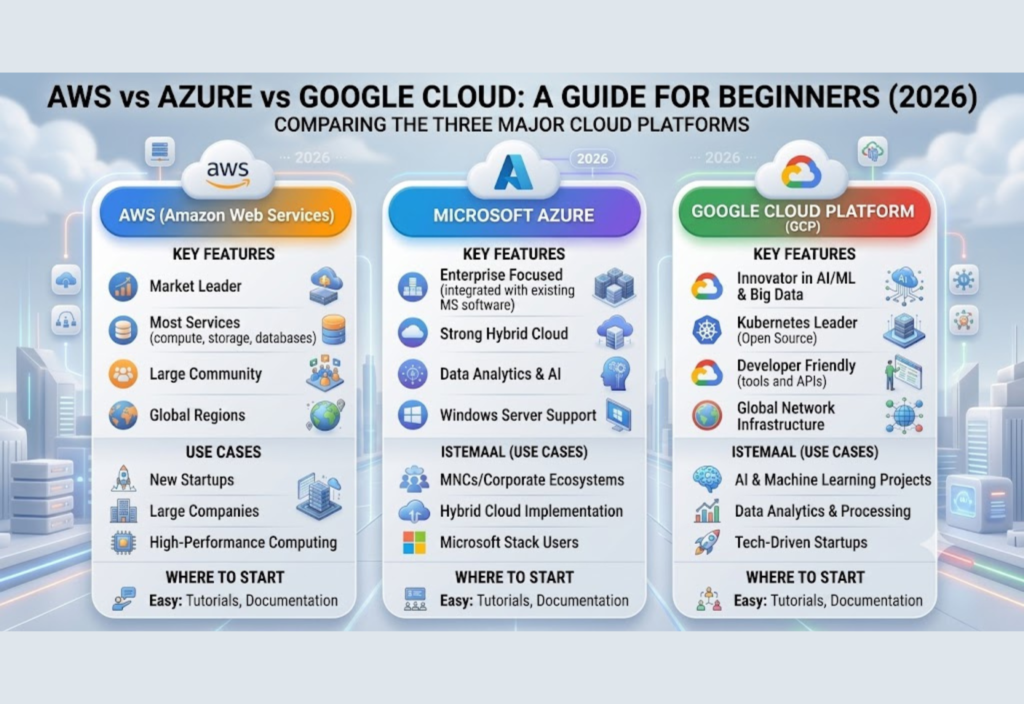
AWS vs Azure vs Google Cloud Explained for Beginners is one of the most searched cloud computing topics in 2026 because businesses of every size are moving their applications, data, and services to the cloud. Understanding the differences between Amazon Web Services (AWS), Microsoft Azure, and Google Cloud Platform (GCP) helps beginners choose the right platform for learning, certifications, and career growth. As cloud computing continues to expand, selecting the best provider has become an important decision for developers, IT professionals, students, and businesses alike.
Cloud computing has changed the way organizations build, manage, and scale digital services. Instead of purchasing expensive physical servers, companies can rent computing resources over the internet whenever they need them. As a result, businesses reduce costs, improve performance, and scale applications much more efficiently.
In this beginner-friendly guide, you’ll learn the differences between AWS, Azure, and Google Cloud, compare their features, understand pricing models, explore AI capabilities, and discover which cloud platform is the best choice for beginners in 2026.
What Is Cloud Computing?
Cloud computing is the delivery of computing services over the internet instead of using physical hardware. Rather than purchasing and maintaining expensive servers, businesses rent computing resources from cloud providers whenever they need them.
Cloud computing services include:
- Virtual machines
- Cloud storage
- Databases
- Networking
- Artificial intelligence
- Machine learning
- Security services
- Analytics tools
Because everything is available online, organizations can launch applications more quickly and scale resources whenever demand increases. In addition, cloud providers handle maintenance, updates, and hardware management, allowing businesses to focus on growth instead of infrastructure.
Why Is Cloud Computing Important?
Cloud computing has become one of the most valuable technologies in modern business. Organizations of every size use cloud services to improve flexibility, reduce operating costs, and deliver better customer experiences.
Some of the biggest advantages include:
- Lower infrastructure costs
- Faster application deployment
- Automatic scalability
- Improved reliability
- Global availability
- Strong security features
- Easy collaboration across teams
Furthermore, cloud platforms allow startups to launch products without making huge investments in hardware. As businesses grow, they can simply increase their cloud resources without replacing physical equipment.
What Is AWS (Amazon Web Services)?
Amazon Web Services, commonly known as AWS, is the world’s largest cloud computing platform. It was launched by Amazon in 2006 and has grown into the most widely used cloud service provider worldwide.
Today, AWS offers more than 250 cloud services that support businesses of every size. Whether you’re building a small website or a large enterprise application, AWS provides tools to develop, deploy, secure, and manage your projects efficiently.
Its massive global infrastructure allows businesses to deliver applications with excellent speed and reliability across multiple regions.
Key AWS Services
Some of the most popular AWS services include:
- Amazon EC2 for virtual servers
- Amazon S3 for cloud storage
- Amazon RDS for managed databases
- AWS Lambda for serverless computing
- Amazon CloudFront for content delivery
- Amazon VPC for networking
- Amazon DynamoDB for NoSQL databases
These services help developers create scalable applications while reducing infrastructure management.
Advantages of AWS
AWS remains the leading cloud provider because of several important benefits.
- Largest cloud ecosystem
- Most cloud services available
- Global data centers
- Excellent scalability
- Strong developer community
- Wide range of certifications
- High reliability and availability
Moreover, AWS is trusted by startups, multinational companies, educational institutions, and government agencies around the world.
Disadvantages of AWS
Despite its popularity, AWS has a few challenges for beginners.
- Large number of services can feel overwhelming.
- Pricing may become confusing without proper planning.
- Learning advanced services takes time.
However, once users understand the platform, AWS becomes much easier to navigate.
What Is Microsoft Azure?
Microsoft Azure is Microsoft’s cloud computing platform designed for developers, businesses, and enterprise organizations. It provides a complete collection of cloud services for hosting applications, managing databases, storing files, and running artificial intelligence workloads.
Azure is especially popular among companies that already use Microsoft technologies such as Windows Server, Microsoft 365, SQL Server, and Active Directory.
Because of its seamless integration with Microsoft’s software ecosystem, many enterprises choose Azure for their digital transformation projects.
Key Azure Services
Azure includes hundreds of cloud services. Some of the most widely used are:
- Azure Virtual Machines
- Azure Blob Storage
- Azure SQL Database
- Azure Active Directory
- Azure Kubernetes Service
- Azure AI Services
- Azure Functions
These services enable organizations to build secure, scalable, and highly available applications.
Advantages of Azure
Azure offers several important benefits for businesses.
- Excellent integration with Microsoft products
- Strong hybrid cloud capabilities
- Enterprise-grade security
- Reliable compliance features
- Global cloud infrastructure
- Powerful identity management
In addition, Azure supports organizations that want to combine on-premises infrastructure with cloud services, making migration much easier.
Disadvantages of Azure
Although Azure is highly capable, beginners may experience a learning curve.
- Dashboard contains many advanced features.
- Some services require Microsoft ecosystem knowledge.
- Pricing structure can appear complicated initially.
Nevertheless, businesses already using Microsoft software usually find Azure easier to adopt.
What Is Google Cloud Platform (GCP)?
Google Cloud Platform, often called GCP, is Google’s cloud computing platform. It uses the same powerful infrastructure that supports services like Google Search, YouTube, and Gmail.
Google Cloud has become especially popular for artificial intelligence, machine learning, big data analytics, and Kubernetes deployments.
Unlike some competitors, Google Cloud offers a clean and user-friendly interface, making it attractive for beginners.
Key Google Cloud Services
Some of the most popular Google Cloud services include:
- Compute Engine
- Cloud Storage
- BigQuery
- Google Kubernetes Engine (GKE)
- Vertex AI
- Cloud Run
- Cloud Functions
These services help developers build scalable cloud-native applications with minimal infrastructure management.
Advantages of Google Cloud
Google Cloud continues to grow because it offers several unique strengths.
- Excellent AI and machine learning tools
- Beginner-friendly interface
- Powerful data analytics
- Industry-leading Kubernetes support
- High-performance networking
- Competitive pricing
Additionally, Google Cloud is widely recognized for innovation in artificial intelligence and data science.
Disadvantages of Google Cloud
Although Google Cloud is improving rapidly, there are still a few limitations.
- Smaller market share than AWS and Azure.
- Fewer enterprise customers.
- Smaller ecosystem of third-party services.
Even so, Google Cloud remains one of the fastest-growing cloud platforms worldwide.
AWS vs Azure vs Google Cloud: Basic Comparison
All three cloud providers deliver secure, scalable, and reliable cloud infrastructure. However, each platform focuses on different strengths.
AWS is the largest cloud provider and offers the widest range of cloud services.
Microsoft Azure is the preferred choice for businesses using Microsoft technologies and enterprise environments.
Google Cloud is well known for artificial intelligence, machine learning, data analytics, and Kubernetes.
Although their interfaces and services differ, the core cloud concepts remain very similar. Therefore, learning one platform makes it easier to understand the others later.
Pricing Comparison
Pricing is one of the most important factors when selecting a cloud provider. Fortunately, all three platforms allow users to pay only for the resources they consume.
AWS follows a flexible pay-as-you-go pricing model. Consequently, businesses only pay for the computing power, storage, and services they actually use. However, costs can rise quickly if resources are not monitored carefully.
Microsoft Azure also uses pay-as-you-go billing. In addition, Microsoft offers attractive discounts for organizations already using Windows Server, Microsoft 365, and other Microsoft products. As a result, Azure is often the most economical option for enterprise customers.
Google Cloud is known for its transparent pricing structure. Furthermore, it automatically applies discounts for long-running workloads without requiring manual configuration. Because of this, many startups and small businesses find Google Cloud cost-effective.
Overall, the best pricing depends on your workload, business size, and usage patterns rather than a single provider being the cheapest.
AI and Machine Learning Capabilities
Artificial intelligence has become one of the biggest reasons businesses choose cloud platforms. Today, AWS, Microsoft Azure, and Google Cloud all provide advanced AI services that help developers build intelligent applications without creating machine learning models from scratch.
AWS offers services such as Amazon SageMaker, Amazon Bedrock, Amazon Rekognition, and Amazon Textract. These tools simplify model training, image recognition, document processing, and generative AI development. As a result, developers can build AI-powered applications more efficiently.
Microsoft Azure also provides a powerful collection of AI services. Azure AI Services, Azure OpenAI Service, and Azure Machine Learning allow organizations to develop chatbots, automate workflows, and analyze large datasets. Moreover, businesses already using Microsoft products can integrate these services with minimal effort.
Google Cloud is widely recognized for its leadership in artificial intelligence and data analytics. Vertex AI, BigQuery, AutoML, and TensorFlow integration help developers create advanced AI applications with less complexity. Consequently, Google Cloud is often the preferred choice for data scientists and AI researchers.
Although every provider supports AI development, the best option depends on your project requirements, existing infrastructure, and long-term goals.
Security and Compliance
Security is one of the most important factors when choosing a cloud platform. Since businesses store valuable information online, cloud providers invest heavily in protecting customer data.
AWS includes advanced security services such as Identity and Access Management (IAM), encryption, firewall protection, threat detection, and continuous monitoring. Therefore, organizations can secure applications while meeting industry standards.
Azure also offers enterprise-grade security with Microsoft Defender for Cloud, Azure Active Directory, and built-in compliance tools. Furthermore, Azure is widely trusted by government agencies and large corporations because of its strong regulatory compliance.
Google Cloud protects customer data through encryption, identity management, and continuous security monitoring. In addition, Google’s global infrastructure provides multiple layers of protection against cyber threats.
No matter which platform you choose, following security best practices remains essential for protecting cloud resources.
Career Opportunities in Cloud Computing
Cloud computing has become one of the fastest-growing technology fields. As more companies migrate to cloud infrastructure, the demand for skilled cloud professionals continues to increase.
Some of the most popular cloud careers include:
- Cloud Engineer
- DevOps Engineer
- Solutions Architect
- Cloud Security Engineer
- Data Engineer
- Machine Learning Engineer
- Cloud Administrator
- Site Reliability Engineer (SRE)
These roles are available across industries, including finance, healthcare, education, e-commerce, and software development.
In addition, cloud certifications can significantly improve your resume and increase job opportunities.
Popular certifications include:
AWS Certifications
- AWS Certified Cloud Practitioner
- AWS Solutions Architect – Associate
- AWS Developer – Associate
Microsoft Azure Certifications
- Azure Fundamentals (AZ-900)
- Azure Administrator Associate
- Azure Solutions Architect Expert
Google Cloud Certifications
- Associate Cloud Engineer
- Professional Cloud Architect
- Professional Data Engineer
Earning one or more of these certifications demonstrates practical cloud knowledge and helps professionals stand out in a competitive job market.
Which Cloud Platform Is Best for Beginners?
Choosing the right cloud platform depends on your learning goals and career plans.
If you want the largest cloud ecosystem, AWS is an excellent starting point. Because it dominates the cloud market, learning AWS can open many career opportunities.
On the other hand, Azure is ideal for people planning to work in corporate IT environments. Since many enterprises already use Microsoft technologies, Azure skills remain highly valuable.
Meanwhile, Google Cloud offers one of the simplest learning experiences. Its clean interface and strong AI services make it especially attractive for students, developers, and data professionals.
Rather than learning all three platforms at once, focus on mastering one cloud provider first. After building a solid foundation, expanding to the other platforms becomes much easier.
Tips for Learning Cloud Computing
Learning cloud computing becomes much easier when you follow a structured approach.
Here are some practical tips:
- Learn the basic concepts before exploring advanced services.
- Create a free cloud account for hands-on practice.
- Build simple projects to gain practical experience.
- Understand Linux and networking fundamentals.
- Study cloud security best practices.
- Practice using storage, databases, and virtual machines.
- Prepare for beginner certification exams.
- Continue building real-world applications.
Consistent practice is far more valuable than simply watching tutorials.
Common Mistakes Beginners Should Avoid
Many beginners make similar mistakes while learning cloud computing. Avoiding these problems will help you progress faster.
Common mistakes include:
- Trying to learn every cloud platform at the same time.
- Ignoring networking and security basics.
- Skipping practical projects.
- Forgetting to monitor cloud spending.
- Relying only on theory instead of practice.
- Expecting to master cloud computing within a few weeks.
Learning one concept at a time leads to better long-term results.
AWS vs Azure vs Google Cloud: Final Comparison
Each cloud platform offers unique strengths that suit different users.
AWS remains the largest cloud provider with the widest selection of services and the biggest developer community.
Microsoft Azure continues to lead enterprise cloud computing thanks to its excellent Microsoft integration and hybrid cloud capabilities.
Google Cloud stands out for artificial intelligence, machine learning, big data analytics, and Kubernetes.
Instead of searching for a single “best” platform, choose the one that aligns with your goals, current skills, and future career plans.
Frequently Asked Questions
Which cloud platform is easiest to learn?
Google Cloud offers one of the simplest interfaces for beginners. However, AWS provides the largest collection of tutorials, certifications, and community resources.
Is AWS better than Azure?
AWS has the largest market share and service portfolio. Nevertheless, Azure is often the preferred choice for organizations already using Microsoft technologies.
Which cloud platform is best for AI?
Google Cloud is widely recognized for its powerful AI and machine learning services. Even so, AWS and Azure also provide excellent AI development tools.
Should I learn all three cloud platforms?
Learning one platform first is usually the smartest approach. Once you understand cloud fundamentals, moving to another provider becomes much easier.
Final Conclusion
Understanding AWS vs Azure vs Google Cloud Explained for Beginners is an excellent first step toward building a successful cloud computing career in 2026.
AWS remains the global leader with the largest ecosystem, extensive documentation, and the broadest range of cloud services. At the same time, Microsoft Azure continues to dominate enterprise environments because of its seamless integration with Microsoft products and strong hybrid cloud capabilities. Meanwhile, Google Cloud has earned a strong reputation for artificial intelligence, machine learning, and data analytics through innovative services such as Vertex AI and BigQuery.
Ultimately, there is no single cloud platform that is perfect for everyone. Instead, the right choice depends on your career goals, technical interests, and project requirements. Start by mastering one platform, build practical projects, earn industry-recognized certifications, and continue expanding your cloud knowledge over time. By following this approach, you will develop valuable cloud computing skills that can open the door to exciting career opportunities in today’s rapidly growing technology industry.