Artificial Intelligence (AI) has advanced rapidly over the past few years, and Large Language Models (LLMs) have become one of the biggest breakthroughs in modern AI. Large Language Models power today’s most popular AI tools, helping people write content, generate code, answer questions, translate languages, summarize documents, and complete many other tasks. From AI chatbots and virtual assistants to business applications and research tools, Large Language Models are transforming the way people work, learn, and communicate.
Whether you’re a student, developer, business owner, marketer, or content creator, you’ve likely used an LLM without even realizing it.
If you’re interested in turning these skills into income, read our How to Earn with LLM Skills in 2026 (Beginner’s Guide) to discover practical ways to make money using Large Language Models.
Popular AI platforms like ChatGPT, Claude, Gemini, and Microsoft Copilot all rely on Large Language Models to understand user requests and generate human-like responses.
Unlike traditional software that simply retrieves information from a database, Large Language Models generate original content by learning language patterns from enormous amounts of text. As a result, they can answer questions, summarize documents, write articles, translate languages, create computer code, and assist with complex problem-solving.
In this guide, you’ll learn what Large Language Models are, how Large Language Models work, how they are trained, their key benefits and limitations, and why they are becoming one of the most important technologies in artificial intelligence.
What Is a Large Language Model (LLM)?
A Large Language Model (LLM) is an advanced artificial intelligence system that has been trained on massive collections of text from books, websites, research papers, articles, documentation, and other publicly available or licensed sources.
During training, the model learns how human language works. Instead of memorizing exact answers, it recognizes patterns between words, sentences, grammar, and context. This allows the model to generate new text that sounds natural and meaningful.
The word “Large” refers to two important factors:
- The enormous amount of training data used to teach the model.
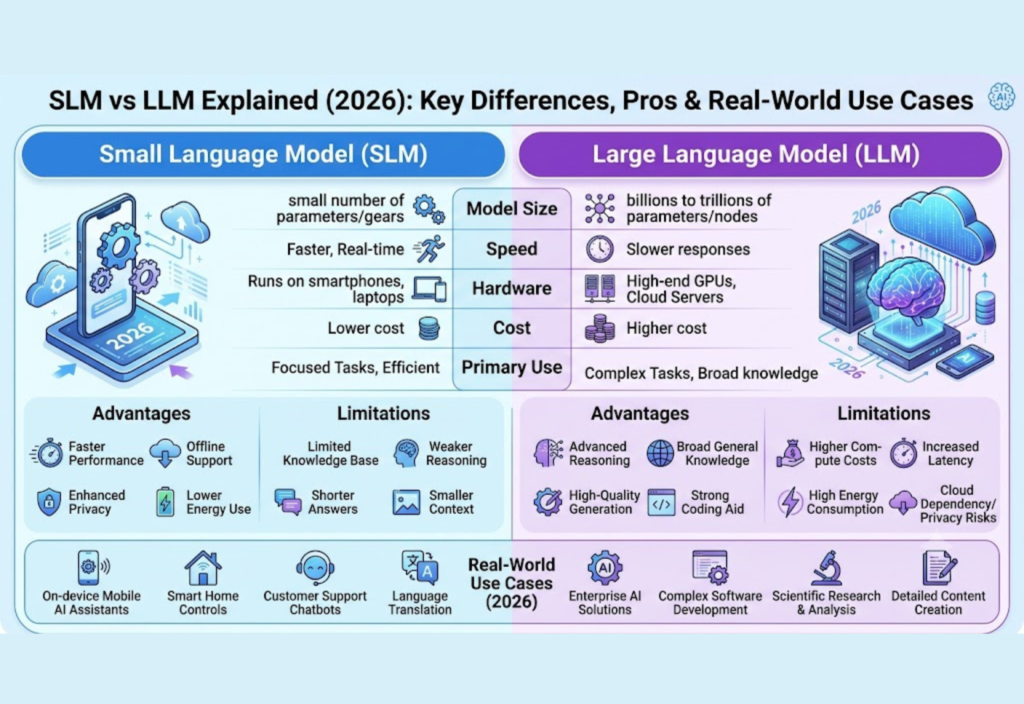
- The billions (or even trillions) of parameters that help the model understand language.
Parameters are mathematical values that allow the AI model to recognize relationships between words and predict the most appropriate response.
Because of this training, Large Language Models can perform many language-related tasks with impressive accuracy.
Some common tasks include:
- Writing blog posts and articles
- Answering questions
- Summarizing long documents
- Translating different languages
- Writing and explaining computer code
- Creating emails and reports
- Brainstorming ideas
- Assisting with research
- Generating creative stories
- Improving grammar and writing
Instead of being programmed separately for each task, one LLM can perform all of these functions using the same underlying model.
How Do Large Language Models Work?
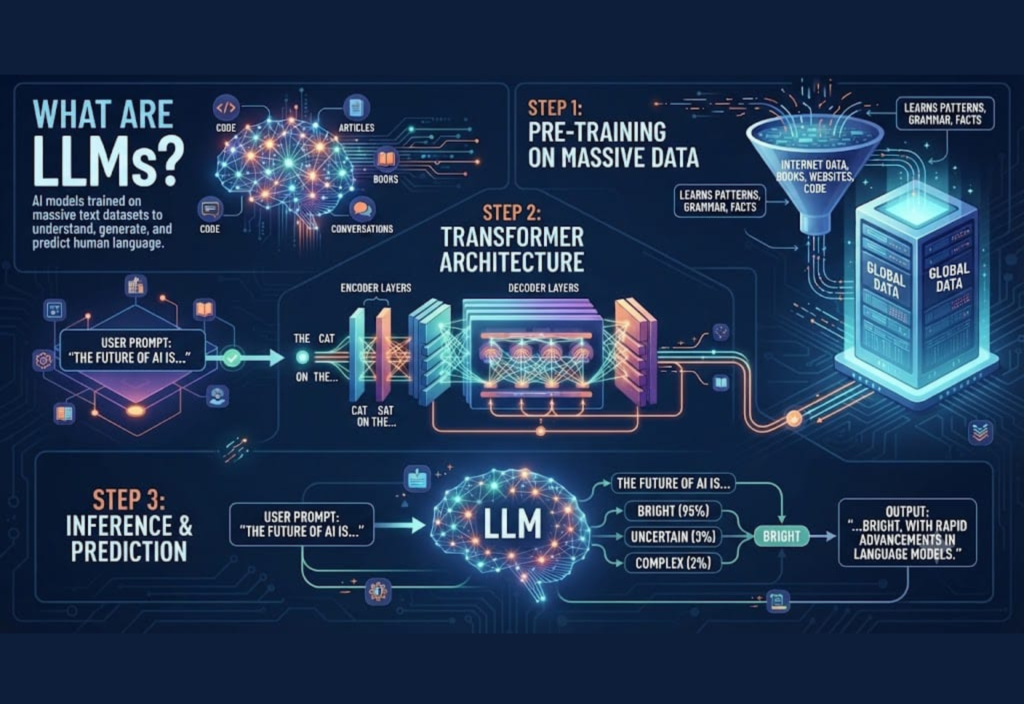
Although LLMs appear to “understand” language like humans, they actually work by predicting the most likely next word (or token) based on the context provided.
This process happens incredibly fast and involves several important steps.
User Input
Everything begins with a prompt.
For example:
“Explain how solar panels generate electricity.”
Once the prompt is entered, the AI starts analyzing the text before generating a response.
Tokenization
Rather than reading complete sentences, the model breaks text into smaller units called tokens.
A token might be:
- A complete word
- Part of a word
- A number
- A punctuation mark
Breaking text into tokens allows the model to process language more efficiently.
Understanding Context
After tokenization, the model analyzes how all the tokens relate to one another.
Instead of looking at individual words separately, the AI examines the entire sentence to understand its meaning.
For example, the word “bank” could refer to a financial institution or the side of a river.
The surrounding words help the model determine the correct meaning.
Because of this contextual understanding, LLMs produce much more natural responses than traditional keyword-based systems.
Transformer Architecture
Modern Large Language Models are built using a deep learning architecture known as the Transformer.
The Transformer introduced a powerful concept called the Attention Mechanism.
Instead of treating every word equally, attention helps the model determine which words are most important when interpreting a sentence.
For example, in a long paragraph, the model can connect words that are far apart while still understanding their relationship.
This capability significantly improves language understanding and response quality.
Today, nearly all modern LLMs rely on Transformer architecture because it delivers better performance than previous neural network designs.
Response Generation
Once the model understands the prompt, it begins generating the response.
Rather than creating the entire answer at once, the model predicts one token at a time.
Each newly generated token becomes part of the context for predicting the next one.
This process continues within milliseconds until a complete response is produced.
Although it feels like the AI is thinking, it is actually making highly accurate probability predictions based on patterns learned during training.
Key Components of Large Language Models
Several important technologies work together to make Large Language Models effective.
Massive Training Data
LLMs learn from enormous datasets containing books, websites, articles, documentation, academic papers, and other text sources.
The larger and higher-quality the dataset, the better the model usually performs.
Parameters
Parameters are the mathematical values learned during training.
Modern LLMs often contain billions or even trillions of parameters.
More parameters generally allow the model to recognize more complex language patterns, although model design also plays an important role.
Neural Networks
Large Language Models use deep neural networks that mimic certain aspects of how the human brain processes information.
These networks identify relationships between words and continuously improve during training.
Attention Mechanism
The attention mechanism allows the model to focus on the most relevant parts of the input instead of processing every word equally.
As a result, responses become more accurate and context-aware.
Context Window
The context window determines how much information the model can remember during a conversation or document.
A larger context window allows the AI to understand longer discussions, lengthy documents, and complex instructions more effectively.
How Are Large Language Models Trained?
Training an LLM is a complex process that requires advanced hardware, enormous datasets, and significant computing power.
Although the exact process differs between AI companies, most Large Language Models follow several common stages.
Collecting Data
Engineers first gather massive amounts of high-quality text from books, research papers, websites, documentation, and other trusted sources.
The goal is to expose the model to many different writing styles and subjects.
Cleaning the Data
Not all collected data is useful.
Before training begins, engineers remove duplicate content, spam, harmful material, formatting errors, and low-quality text.
This improves the overall quality of the model.
Initial Training
The cleaned dataset is then used to train the model.
During this stage, the AI repeatedly predicts missing words and gradually learns grammar, vocabulary, sentence structure, reasoning patterns, and contextual relationships.
Training often takes several weeks or even months using thousands of powerful GPUs.
Fine-Tuning
After the initial training is complete, developers fine-tune the model for specific tasks.
For example, one version may specialize in coding, while another focuses on customer support or scientific research.
Fine-tuning improves performance in targeted applications.
Human Feedback
Finally, many modern LLMs are improved using human feedback.
Experts review AI-generated responses and provide corrections or rankings.
The model then learns which responses are more accurate, helpful, and natural.
This final step greatly improves conversation quality and user experience.
Common Applications of Large Language Models
Today, Large Language Models are used across many industries because they can understand and generate natural language. As AI technology continues to improve, new applications are appearing almost every day. Consequently, businesses, educational institutions, and individual users rely on LLMs to complete tasks faster and more efficiently.
Some of the most common applications include:
AI chatbots and virtual assistants
Customer support automation
Content writing and copywriting
Programming and code generation
Educational tutoring
Language translation
Medical research assistance
Business documentation
Data analysis and reporting
Marketing content creation
Email drafting and summarization
Research and knowledge discovery
Because one LLM can perform multiple language-related tasks, organizations no longer need separate software for every activity. This versatility makes Large Language Models valuable across many industries.
Benefits of Large Language Models
Large Language Models offer several advantages that make them useful for both individuals and businesses. Moreover, ongoing research continues to improve their accuracy and capabilities.
Natural Communication
LLMs generate responses that sound natural and conversational. Therefore, users can interact with AI using everyday language instead of complicated commands.
Higher Productivity
Writing articles, emails, reports, summaries, and documentation takes much less time with AI assistance. As a result, professionals can focus on more strategic work.
Multilingual Support
Many modern LLMs understand and generate content in multiple languages. Consequently, businesses can communicate with global audiences more effectively.
Versatility
Unlike traditional software, one Large Language Model can perform many different tasks. For example, it can write content, explain concepts, generate code, translate languages, and summarize documents within the same conversation.
Continuous Improvement
AI research is advancing rapidly. Therefore, each new generation of Large Language Models becomes more accurate, faster, and more efficient than previous versions.
Better User Experience
Since LLMs understand context, they can provide more relevant and personalized responses. This capability improves customer support, learning experiences, and overall user satisfaction.
Limitations of Large Language Models
Although LLMs are highly capable, they are not perfect. Understanding their limitations helps users apply AI responsibly and make better decisions.
Incorrect Information
Sometimes an LLM may generate information that sounds convincing but is inaccurate or outdated. For this reason, users should verify important facts from reliable sources.
Sensitive to Prompt Quality
The quality of the response depends heavily on the prompt provided by the user. Clear and detailed instructions usually produce better results.
High Computing Requirements
Training and running Large Language Models require powerful hardware, significant memory, and advanced computing infrastructure. Consequently, developing large models can be expensive.
Limited Real-Time Knowledge
Some LLMs only know information available up to their training period unless they are connected to live internet resources.
Human Review Is Still Necessary
For critical fields such as healthcare, law, finance, or public safety, AI-generated content should always be reviewed by qualified professionals before decisions are made.
Popular Examples of Large Language Models
Several technology companies have developed powerful Large Language Models for different purposes. Some of the best-known examples include:
ChatGPT by OpenAI
Gemini by Google
Claude by Anthropic
Llama by Meta
Mistral AI models
DeepSeek LLM
Each model has its own strengths, features, and specialized use cases. However, they all rely on similar Large Language Model technology.
The Future of Large Language Models
The future of Large Language Models looks extremely promising. Researchers continue to improve reasoning, efficiency, multilingual capabilities, and overall performance. As a result, future models are expected to become even more useful in everyday life.
In the coming years, LLMs will likely:
Understand longer conversations more accurately
Deliver more reliable answers
Support more languages
Work with text, images, audio, and video together
Require fewer computing resources
Provide stronger reasoning abilities
Improve business automation and decision-making
Furthermore, Large Language Models will play a major role in education, healthcare, scientific research, software development, customer service, and many other industries.
Rather than replacing humans, these systems will increasingly work alongside people to improve productivity and solve complex problems.
Frequently Asked Questions (FAQs)
What does LLM stand for?
LLM stands for Large Language Model, an artificial intelligence system trained on massive amounts of text to understand and generate human language.
How do Large Language Models generate answers?
LLMs predict the most likely next word based on the context of the conversation. They generate responses one token at a time until a complete answer is produced.
Are Large Language Models the same as ChatGPT?
No. A Large Language Model is the underlying AI technology, while ChatGPT is a chatbot application built using an LLM.
Can LLMs write computer code?
Yes. Many modern Large Language Models can generate, explain, debug, and improve programming code in multiple languages.
Are Large Language Models always accurate?
No. Although they are highly capable, they can sometimes produce incorrect or outdated information. Therefore, important information should always be verified.
Conclusion
Large Language Models have transformed the way people interact with artificial intelligence. Instead of simply retrieving information, they understand language patterns and generate meaningful, human-like responses. As a result, they can assist with writing, coding, translation, research, customer support, education, and countless other tasks.
Although LLMs have certain limitations, their advantages far outweigh their challenges. They continue to improve through better training methods, larger datasets, and ongoing AI research. Consequently, they are becoming more reliable, efficient, and capable every year.
As artificial intelligence continues to evolve, understanding Large Language Models will become an increasingly valuable skill for students, professionals, developers, marketers, and business owners alike. Whether you want to improve productivity, build AI-powered applications, or simply learn how modern AI works, LLMs are at the center of this technological revolution.
In short, Large Language Models are not just powering today’s AI tools—they are shaping the future of human-computer interaction.