Artificial intelligence and robotics are transforming the way people live and work. Every year, new innovations make machines smarter, faster, and more capable of performing complex tasks. Among these advancements, humanoid robots have gained worldwide attention because they are designed to look, move, and interact like humans. Today, technology companies and research organizations are developing these intelligent machines to assist in healthcare, education, manufacturing, customer service, logistics, and scientific research.
Many people wonder what these machines are and why they are becoming increasingly important. Simply put, humanoid robots are intelligent systems built with a human-like body structure and powered by artificial intelligence (AI). Unlike traditional industrial robots that perform one repetitive task, these advanced machines can understand voice commands, recognize objects, communicate with people, and adapt to different environments.
As artificial intelligence continues to improve, these robotic systems are becoming more practical for everyday use. They are no longer limited to research laboratories. Instead, they are beginning to work alongside people in hospitals, schools, offices, airports, factories, and even homes. Consequently, experts believe this technology will play a major role in the future of work.
In this guide, you’ll learn what these robots are, how they work, their different types, the technologies behind them, and why they are transforming industries around the world.
Understanding Human-Like Robots
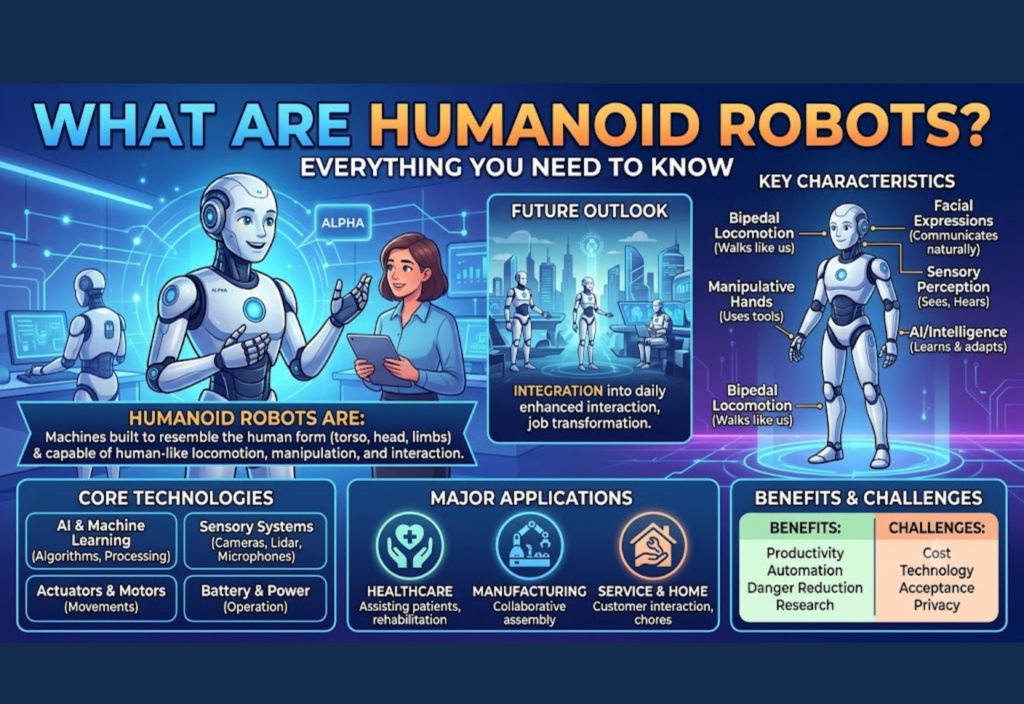
A humanoid robot is a robot designed to resemble the human body. Most humanoid robots include a head, torso, two arms, and two legs, allowing them to operate in environments built for people. Because of their human-like appearance, they can interact naturally with humans and perform tasks using familiar tools and equipment.
Unlike traditional factory robots that repeat the same movement continuously, humanoid robots are built for flexibility. They combine artificial intelligence, machine learning, computer vision, sensors, and advanced mechanical systems to perform different tasks depending on their surroundings.
For example, a humanoid robot can recognize a person’s face, understand spoken instructions, avoid obstacles, carry objects, and answer simple questions. Moreover, advanced models can learn from previous experiences and improve their performance over time.
Another reason these robots are becoming popular is their ability to communicate naturally. Instead of requiring complex programming for every task, they can respond to voice commands and adapt to changing situations. As a result, businesses across various industries are exploring new ways to use humanoid robots.
Different Types of Advanced Robots
Not all humanoid robots are designed for the same purpose. Some focus on research, while others are developed for customer service, education, or industrial work. Therefore, understanding the different types helps explain how these robots are used in the real world.
Fully Autonomous Robots
Fully autonomous robots can perform tasks without continuous human control. They rely on artificial intelligence, cameras, sensors, and machine learning to understand their surroundings and make decisions independently.
These robots can:
- Walk without assistance
- Avoid obstacles
- Recognize people
- Respond to voice commands
- Complete assigned tasks
Because of their independence, they are becoming valuable in healthcare, logistics, and customer service.
Semi-Autonomous Systems
Semi-autonomous robots combine AI with human supervision. While they can perform many routine tasks independently, they still require human guidance for complex situations.
For instance, hospitals may use semi-autonomous robots to transport medicines or guide visitors while medical staff oversee their operation.
Research and Experimental Robots
Research organizations and universities develop humanoid robots to study artificial intelligence, robotics, and human-robot interaction.
These robots help scientists:
- Test AI algorithms
- Improve robotic movement
- Study machine learning
- Develop safer automation
- Explore future technologies
Consequently, many innovations in commercial robotics begin in research laboratories.
Service Robots
Service robots are designed to interact directly with people. They assist customers, answer questions, provide directions, and improve visitor experiences.
Today, service robots can be found in:
- Hotels
- Airports
- Shopping malls
- Museums
- Banks
- Hospitals
As businesses continue investing in automation, service robots are becoming increasingly common.
How These Intelligent Machines Work
Humanoid robots combine several advanced technologies that work together to help them understand their environment, make decisions, and perform physical tasks. Instead of relying on one system, they integrate artificial intelligence, computer vision, sensors, machine learning, motors, and cloud computing into a single intelligent platform.
Each technology performs a specific function while working together to create smooth and efficient robotic behavior.
Artificial Intelligence (AI)
Artificial intelligence serves as the robot’s brain. It processes information from cameras and sensors, analyzes situations, and determines the best response.
AI enables humanoid robots to:
- Understand spoken language
- Answer questions
- Recognize faces
- Make decisions
- Solve simple problems
- Learn from interactions
Furthermore, modern AI models continue improving, making humanoid robots smarter and more capable every year.
Sensors
Sensors allow robots to understand what is happening around them. They constantly collect data about the environment and send it to the AI system for analysis.
Common sensors measure:
- Distance
- Motion
- Pressure
- Temperature
- Speed
- Balance
As a result, robots can move safely, avoid obstacles, and maintain stability while walking or carrying objects.
Computer Vision
Computer vision allows humanoid robots to “see” the world. High-resolution cameras capture images, while AI software analyzes visual information in real time.
This technology helps robots:
- Recognize people
- Identify objects
- Read signs
- Detect obstacles
- Navigate unfamiliar environments
Consequently, humanoid robots can operate effectively in hospitals, offices, warehouses, airports, and public spaces.
Motors and Actuators
Motors and actuators convert electrical energy into movement. They control every physical action performed by the robot.
These systems enable robots to:
- Walk naturally
- Lift objects
- Turn smoothly
- Move their hands
- Climb stairs
- Maintain body balance
Because of precise motor control, humanoid robots can perform complex movements with impressive accuracy.
Machine Learning
Machine learning allows robots to improve through experience. Instead of repeating identical actions forever, they analyze previous interactions and adjust their behavior accordingly.
For example, if a robot encounters a new obstacle, it can learn a better route for future tasks. Similarly, speech recognition becomes more accurate after processing more conversations.
Therefore, machine learning makes humanoid robots more adaptive and efficient over time.
Cloud Computing and Edge AI
Many modern humanoid robots also rely on cloud computing and edge AI to process large amounts of information quickly.
Cloud computing provides:
- Powerful processing
- Data storage
- Continuous software updates
Meanwhile, edge AI allows robots to make decisions instantly without depending entirely on an internet connection.
As a result, robots become faster, more reliable, and capable of responding to changing situations in real time.
Key Features of Modern Humanoid Robots
Modern humanoid robots are becoming more advanced because of continuous improvements in artificial intelligence, robotics, and computer engineering. Unlike older machines that could only perform limited tasks, today’s humanoid robots can understand their surroundings, communicate with people, and complete different activities.
Furthermore, these robots are designed to work in human environments without requiring major changes to buildings, tools, or workplaces. As a result, companies are exploring humanoid robots for many real-world applications.
Human-Like Movement
One of the most important features of humanoid robots is their ability to move like humans. Advanced balance systems, sensors, and motion-control technology allow robots to walk, turn, bend, and carry objects.
Moreover, some modern robots can climb stairs, maintain balance on uneven surfaces, and perform complex movements. This ability makes them useful in places that were originally designed for humans.
For example, a humanoid robot can move through offices, hospitals, factories, and homes without needing special equipment or modified environments.
Natural Voice Communication
Another important feature of humanoid robots is natural communication. Using speech recognition and natural language processing, these robots can understand human instructions and respond with useful information.
Additionally, voice communication makes interaction easier because users do not need technical knowledge to operate the robot.
Humanoid robots can:
- Answer common questions
- Provide instructions
- Translate languages
- Assist customers
- Communicate with patients
Therefore, voice technology plays a major role in making robots more user-friendly.
Smart Object Recognition
Humanoid robots use advanced cameras and computer vision systems to identify objects around them. This ability allows them to understand their environment and perform tasks more accurately.
For instance, a robot working in a warehouse can identify packages, while a healthcare robot can recognize medical equipment.
Furthermore, object recognition helps robots make better decisions because they can understand what objects are and how they should interact with them.
Autonomous Navigation
Modern humanoid robots are capable of moving independently through different environments. They use sensors, cameras, and AI algorithms to create maps and choose safe routes.
Because of autonomous navigation, robots can:
- Avoid obstacles
- Detect changes in surroundings
- Move safely around people
- Reach specific locations
- Adjust their path when necessary
As a result, they can operate effectively in busy environments such as airports, hospitals, and shopping centers.
Human Interaction
A major goal of humanoid robotics is creating machines that can interact naturally with people. Many advanced robots can recognize faces, understand gestures, and respond to conversations.
Moreover, some robots are designed with facial expressions and body movements to make communication feel more natural.
Although robots cannot experience human emotions, these features help create better interactions between humans and machines.
Learning and Adaptation
Machine learning allows humanoid robots to improve their abilities over time. Instead of depending only on fixed programming, they can analyze information and adjust their actions.
For example, a robot can learn the best way to complete a task after repeated attempts. Similarly, it can improve speech recognition and movement accuracy through experience.
Consequently, learning capabilities make humanoid robots more flexible and useful.
Why Businesses Are Investing in Humanoid Robots
Businesses around the world are investing in humanoid robots because they offer new opportunities to improve efficiency, reduce costs, and increase workplace safety. As artificial intelligence becomes more powerful, companies are discovering new ways to integrate robotic systems into daily operations.
Furthermore, many industries are facing challenges such as labor shortages and increasing demand for faster services. Therefore, humanoid robots are becoming an attractive solution.
Reducing Repetitive Work
Many jobs require employees to perform the same tasks repeatedly. Over time, this can reduce productivity and increase physical stress.
Humanoid robots can handle repetitive activities such as:
- Sorting products
- Moving materials
- Checking equipment
- Organizing inventory
- Performing basic customer support
As a result, employees can focus on more creative and important responsibilities.
Improving Workplace Safety
Safety is another major reason companies are adopting humanoid robots. Some industries require workers to operate in dangerous conditions, including factories, construction sites, and hazardous environments.
Humanoid robots can perform risky tasks while protecting human workers from potential injuries.
For example, they can handle heavy materials, inspect dangerous areas, and perform tasks in unsafe locations.
Therefore, robotic technology helps create safer workplaces.
Increasing Productivity
Unlike humans, robots can operate for long periods without becoming tired. They can maintain consistent performance and complete tasks with high accuracy.
Moreover, AI-powered robots can analyze information quickly and make decisions faster than traditional machines.
Consequently, businesses can improve productivity while maintaining better quality standards.
Supporting Employees
Many experts believe humanoid robots will not completely replace human workers. Instead, they will work alongside employees and provide support.
For example, a factory worker can focus on quality control while a robot handles heavy lifting. Similarly, healthcare workers can spend more time with patients while robots complete routine tasks.
This collaboration between humans and robots can create more efficient workplaces.
Applications of Humanoid Robots
Humanoid robots are becoming useful in many industries because of their ability to move, communicate, and perform different tasks. As technology improves, their applications continue expanding.
Healthcare
Healthcare is one of the most promising areas for humanoid robots. Hospitals and care facilities are exploring robotic assistants to support medical professionals and patients.
These robots can:
- Deliver medicines
- Transport equipment
- Guide visitors
- Remind patients about schedules
- Assist elderly people
Furthermore, they can help reduce the workload of healthcare workers by handling routine activities.
As a result, doctors and nurses can spend more time focusing on patient care.
Manufacturing
Manufacturing companies have used robots for many years, but humanoid robots provide more flexibility than traditional machines.
They can perform tasks such as:
- Product assembly
- Quality inspection
- Material transportation
- Equipment monitoring
- Packaging
Because humanoid robots can work in human-designed spaces, companies do not always need to redesign their factories.
Therefore, they offer a practical automation solution.
Education
Schools and universities are using humanoid robots to make learning more interactive. These robots help students understand programming, artificial intelligence, and engineering concepts.
Moreover, they provide practical demonstrations that make difficult subjects easier to understand.
Students can learn:
- Robotics development
- Coding skills
- AI concepts
- Problem-solving techniques
Consequently, humanoid robots are helping prepare students for future technology careers.
Customer Service
Many businesses are testing humanoid robots for customer support. Hotels, airports, banks, and shopping centers use them to improve visitor experiences.
These robots can:
- Welcome guests
- Answer questions
- Provide directions
- Offer information in multiple languages
Furthermore, they can provide support throughout the day without needing breaks.
Scientific Research
Research organizations continue developing humanoid robots to understand artificial intelligence and human-machine interaction.
Scientists use these robots to test:
- New AI models
- Robotic movements
- Machine learning systems
- Human interaction methods
As a result, research improvements continue making humanoid robots smarter and more capable.
Benefits of Humanoid Robots
Humanoid robots provide many advantages across different industries. As artificial intelligence and robotics continue to improve, these machines are becoming more useful, reliable, and efficient. Furthermore, businesses and organizations are adopting humanoid robots because they can support employees, improve safety, and increase productivity.
Higher Productivity
One of the biggest benefits of humanoid robots is their ability to perform tasks continuously without getting tired. Unlike humans, robots can work for long periods while maintaining consistent performance.
For example, they can complete repetitive activities such as assembling products, moving materials, checking equipment, and organizing inventory. As a result, businesses can complete operations faster and reduce delays.
Moreover, robots can perform tasks with high accuracy, which helps companies maintain better quality standards.
Improved Workplace Safety
Many industries involve dangerous working conditions. Workers in factories, construction sites, and industrial environments may face risks from heavy machinery, chemicals, or unsafe locations.
Humanoid robots can handle these dangerous tasks instead of humans. Therefore, companies can reduce workplace accidents and create safer environments.
For example, robots can inspect hazardous areas, carry heavy objects, or operate in conditions that may be unsafe for people.
Consequently, robotic technology helps protect employees while improving business efficiency.
Better Customer Support
AI-powered humanoid robots can improve customer experiences by providing quick and accurate assistance. They can answer questions, provide directions, and communicate with visitors in different languages.
Furthermore, robots can operate continuously, which allows businesses to provide support throughout the day.
Hotels, airports, banks, and shopping centers are using humanoid robots to:
- Welcome visitors
- Provide information
- Guide customers
- Reduce waiting times
As a result, organizations can improve customer satisfaction while managing daily operations more effectively.
Support for an Aging Population
Many countries are experiencing an increase in elderly populations. Because of this, the demand for healthcare support and personal assistance is growing.
Humanoid robots can help older adults with simple daily activities, including:
- Medication reminders
- Carrying lightweight objects
- Providing basic assistance
- Offering communication support
Although robots cannot replace human caregivers, they can reduce workload and provide additional support.
Therefore, humanoid robots may become valuable tools for improving elderly care in the future.
Continuous Improvement Through AI
Another important advantage of humanoid robots is their ability to learn and improve. Through machine learning, robots can analyze previous experiences and become better at completing tasks.
For example, a robot can learn how to move more efficiently, recognize objects more accurately, or respond better to human instructions.
Moreover, continuous learning allows robots to adapt to changing environments. As a result, they become more useful over time.
Challenges and Limitations of Humanoid Robots
Although humanoid robots offer many benefits, they still face several challenges. Researchers and engineers are working to solve these problems so robots can become more practical and accessible.
High Development Costs
Building advanced humanoid robots requires expensive hardware, powerful processors, advanced software, and years of research.
Because of these requirements, many humanoid robots are currently costly to develop and purchase.
Furthermore, maintenance, software updates, and repairs can increase the overall expenses for businesses.
However, as technology improves and production increases, the cost of humanoid robots is expected to decrease.
Limited Battery Life
Battery performance is another major challenge for humanoid robots. These machines require energy to operate motors, cameras, sensors, and artificial intelligence systems.
Although battery technology is improving, many robots still need frequent charging during long operations.
Therefore, researchers are developing better energy systems that can provide longer working hours.
Understanding Human Emotions
Modern humanoid robots can recognize faces, speech, and some human behaviors. However, they still struggle to understand complex emotions and social situations.
For example, robots may have difficulty understanding:
- Humor
- Sarcasm
- Emotional reactions
- Cultural differences
Because human communication involves many emotional factors, human supervision remains important.
Privacy and Security Concerns
Humanoid robots collect information through cameras, microphones, and sensors. This creates concerns about privacy and data protection.
For example, robots working in homes, hospitals, or public places may collect sensitive information about people.
Therefore, developers must create strong security systems to protect user data and ensure responsible robot usage.
Ethical Concerns
As humanoid robots become smarter, society must consider important ethical questions.
These include:
- How should robots make decisions?
- Who is responsible if a robot makes a mistake?
- How will automation affect jobs?
- What rules should control AI-powered machines?
Consequently, governments and technology companies need clear guidelines to ensure the safe development of humanoid robots.
The Future of Humanoid Robotics
The future of humanoid robots looks highly promising. With rapid progress in artificial intelligence, machine learning, computer vision, and robotics, these machines are becoming smarter and more capable every year.
In the coming years, humanoid robots are expected to become more common in workplaces and daily life. They may assist doctors in hospitals, support teachers in classrooms, help engineers in factories, and provide services in public areas.
Furthermore, improvements in AI will allow robots to communicate more naturally, understand environments better, and complete more complex tasks.
Future humanoid robots may include:
- Longer battery life
- Better movement systems
- More advanced AI models
- Improved human interaction
- Greater independence
As a result, these robots could become valuable partners in many areas of society.
However, most experts believe humanoid robots will not completely replace humans. Instead, they will work alongside people and handle repetitive, dangerous, and physically demanding tasks.
Therefore, humans will be able to focus more on creativity, innovation, decision-making, and problem-solving.
Frequently Asked Questions
What is a humanoid robot?
A humanoid robot is an intelligent machine designed with a human-like body structure. It uses artificial intelligence, sensors, cameras, and software to perform tasks and interact with people.
Can AI robots think like humans?
No. Humanoid robots can process information, recognize patterns, and make limited decisions. However, they do not have human consciousness, emotions, or independent thoughts.
Where are these robots used?
Humanoid robots are used in healthcare, manufacturing, education, customer service, logistics, hospitality, and scientific research.
Where are these robots used?
Most experts believe humanoid robots will support human workers instead of completely replacing them. They are mainly useful for repetitive, dangerous, and physically demanding tasks.
What technologies power intelligent robots?
Humanoid robots use artificial intelligence, machine learning, computer vision, sensors, cameras, motors, actuators, and advanced software systems.
What are the biggest challenges of humanoid robots?
The biggest challenges include high costs, limited battery life, privacy concerns, security risks, and difficulty understanding human emotions.
Conclusion
Humanoid robots represent one of the most exciting developments in artificial intelligence and robotics. By combining AI, machine learning, sensors, computer vision, and human-like movement, these advanced machines are changing the way industries operate.
Today, these intelligent systems are already helping in healthcare, manufacturing, education, customer service, and research. Furthermore, continuous improvements in technology are making them smarter, safer, and more affordable.
Although challenges such as cost, battery limitations, and ethical concerns remain, the future of this technology is extremely promising. Instead of replacing humans, these machines are expected to become powerful assistants that help people work more efficiently.
As technology continues to advance, these robotic systems will likely become important partners in building a safer, smarter, and more innovative future.