
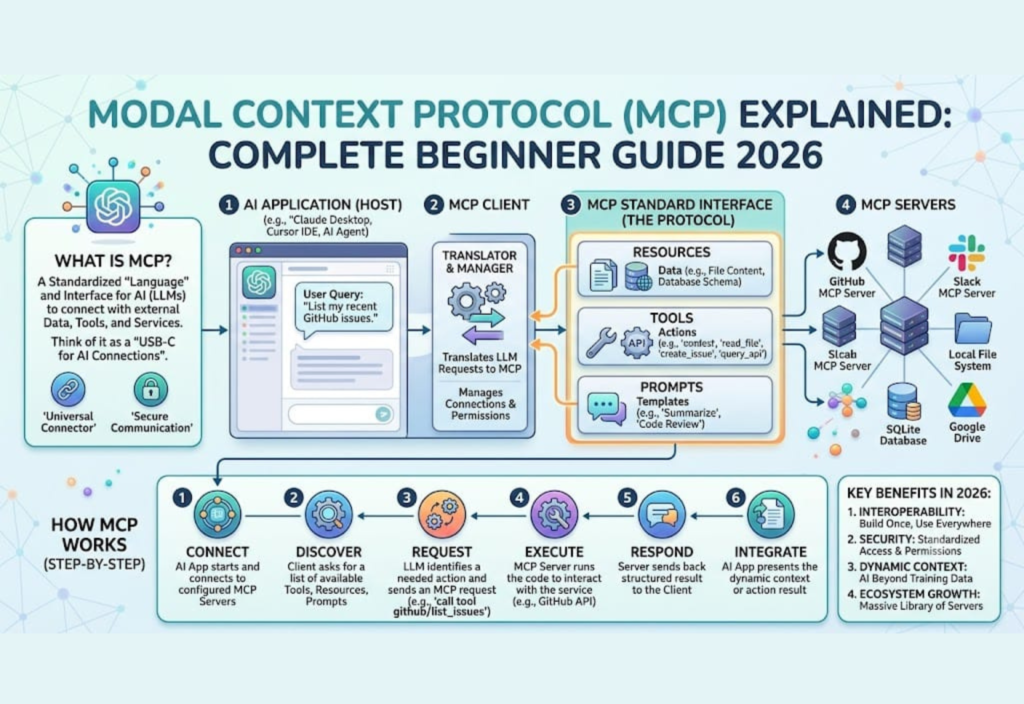
Artificial Intelligence is rapidly moving beyond simple chatbots. Today’s AI assistants can search documents, interact with business software, access cloud storage, retrieve live information, and automate complex workflows. To make these capabilities possible, AI systems need a secure and standardized method for communicating with external tools and data sources. This is where Model Context Protocol (MCP) comes in.
Model Context Protocol is an open standard that enables AI models to connect with external applications, databases, APIs, and business systems through a common interface. Instead of building a separate integration for every AI model and every software tool, developers can create one MCP-compatible connection that works across multiple AI platforms. This approach simplifies development, improves security, and makes AI applications more flexible.
As AI agents become increasingly popular in 2026, understanding Model Context Protocol is becoming an essential skill for developers, businesses, and anyone interested in modern AI technologies. This beginner’s guide explains what MCP is, why it matters, and how it works.
What Is Model Context Protocol?
Model Context Protocol (MCP) is an open communication standard that allows AI models to securely interact with external tools, applications, and data sources.
Traditional Large Language Models (LLMs) generate responses using the information they learned during training. However, they cannot automatically access live company data, private documents, or external software without additional integrations.
Model Context Protocol solves this problem by creating a standardized communication layer between AI models and external resources. Instead of relying only on stored knowledge, AI assistants can request current information, retrieve documents, perform actions, and return more accurate responses.
Think of MCP as a universal connector that enables AI to work with different systems using one common protocol rather than many separate integrations.
Why Was Model Context Protocol Created?
Before MCP, connecting AI to external software was often a complicated process. Every application required its own custom integration, which increased development time and maintenance costs.
For example, if an AI assistant needed access to multiple services such as Google Drive, GitHub, Slack, Notion, and a company database, developers usually had to create individual integrations for each service.
This traditional approach introduced several challenges:
- Time-consuming development
- High maintenance costs
- Security risks
- Compatibility issues
- Duplicate engineering work
Model Context Protocol was introduced to eliminate these problems by providing a single, standardized method for AI systems to communicate with external tools.
How Does Model Context Protocol Work?
Although MCP is built on advanced technology, its workflow is easy to understand.
Step 1: The User Makes a Request
A user asks an AI assistant to perform a task.
For example:
“Summarize the latest sales report stored in our company database.”
Instead of generating an answer immediately, the AI recognizes that it needs information from an external source.
Step 2: The AI Sends a Request
The AI communicates with an MCP server responsible for managing connections with external resources.
The server understands which tools are available and how to access them securely.
Step 3: The Server Retrieves Information
The MCP server collects the required information from connected systems such as:
- Company databases
- Cloud storage
- APIs
- Knowledge bases
- PDFs
- Business documents
- Internal applications
Only the information needed for the user’s request is retrieved.
Step 4: The AI Generates a Response
The retrieved information is sent back to the AI model. Using this fresh context, the AI generates an accurate, detailed, and relevant response instead of relying only on previously trained knowledge.
This process helps reduce incorrect answers and ensures responses are based on current information.
Core Components of Model Context Protocol
Every MCP implementation includes several essential components that work together.
MCP Client
The MCP client is the AI application that communicates with external systems.
Examples include:
- AI assistants
- Coding tools
- Enterprise chatbots
- Productivity applications
- Customer support platforms
The client sends requests whenever additional information or external actions are required.
MCP Server
The MCP server acts as the bridge between the AI model and external resources.
Its responsibilities include:
- Receiving requests
- Authenticating users
- Managing permissions
- Retrieving information
- Executing supported tools
- Returning results securely
Because the server handles communication, developers can connect multiple services without changing the AI model itself.
Resources
Resources are the information sources available through MCP.
These resources may include:
- Documents
- PDFs
- Databases
- Websites
- Cloud storage
- Knowledge bases
- Company files
- Spreadsheets
By accessing these resources, AI assistants can answer questions using up-to-date information rather than outdated training data.
Tools
In addition to reading information, MCP allows AI systems to perform actions using external tools.
Examples include:
- Searching documents
- Sending emails
- Running database queries
- Creating calendar events
- Managing cloud services
- Executing scripts
- Updating business records
This transforms AI assistants from simple conversational systems into intelligent digital assistants capable of completing real-world tasks.
Benefits of Model Context Protocol
Organizations are adopting MCP because it offers several important advantages:
- Simplifies AI integrations
- Reduces development time
- Improves security through standardized access
- Supports real-time information retrieval
- Works with multiple AI platforms
- Makes enterprise AI applications easier to maintain
- Scales efficiently as businesses grow
These benefits make MCP one of the most significant technologies for building next-generation AI applications.
Real-World Applications of Model Context Protocol
Model Context Protocol is already being used across many industries to build intelligent AI assistants that can work with real business data instead of relying only on pre-trained knowledge. As more organizations adopt AI agents, MCP is becoming an important foundation for secure and scalable AI applications.
1. AI Customer Support
Companies can connect AI assistants to internal knowledge bases, FAQs, product manuals, and support documentation. When a customer asks a question, the AI retrieves the latest information before generating a response.
This results in:
- Faster customer support
- More accurate answers
- Reduced workload for support teams
2. Enterprise AI Assistants
Businesses use MCP to connect AI with internal systems such as HR platforms, project management tools, company documents, and databases.
Employees can ask questions like:
- “Show this month’s sales report.”
- “Summarize today’s project updates.”
- “Find the latest employee handbook.”
The AI retrieves the required information instantly.
3. Software Development
Developers are using MCP to build coding assistants that can access Git repositories, documentation, issue trackers, and development tools.
Instead of manually searching through multiple platforms, developers can ask AI to:
- Explain source code
- Review pull requests
- Find bugs
- Generate documentation
- Suggest improvements
4. Research and Education
Researchers often work with thousands of research papers and documents.
Using MCP, AI assistants can search trusted sources, summarize findings, compare information, and answer research questions using the latest available data.
Students can also benefit from AI tutors connected to textbooks, lecture notes, and academic resources.
5. Healthcare
Hospitals and healthcare organizations can connect AI systems to medical guidelines, patient documentation, and clinical knowledge bases while maintaining strict access controls.
Doctors and healthcare professionals can retrieve relevant information much faster without manually searching through large document collections.
Model Context Protocol vs Traditional APIs
Many beginners confuse MCP with APIs because both allow software systems to communicate. However, they solve different problems.
Model Context Protocol (MCP)
Purpose: Standardized communication for AI models and AI agents.
AI-Friendly: Yes, specifically designed for AI applications.
External Tools: Connects AI to tools, databases, and services through a common protocol.
Scalability: Highly scalable as new tools and systems are added.
Context Sharing: Supports context sharing for more accurate AI responses.
Traditional API
Purpose: Enables communication between software applications.
AI-Friendly: Not specifically designed for AI integration.
External Tools: Requires separate custom integrations for each service.
Scalability: Depends on implementation and integration design.
Context Sharing: Limited support for AI context management.
Traditional APIs remain important, but MCP simplifies how AI assistants interact with multiple external systems.
Advantages of Model Context Protocol
Model Context Protocol provides several important benefits for developers and businesses.
Standardized Integration
Instead of creating multiple custom integrations, developers can build one MCP-compatible connection.
Better Scalability
As businesses add more tools and services, MCP makes expansion much easier.
Improved Security
Authentication and permissions can be managed consistently across connected systems.
More Accurate AI Responses
Since AI retrieves live information, responses are based on current data instead of outdated training knowledge.
Faster Development
Developers spend less time writing integration code and more time building useful AI features.
Limitations of MCP
Although MCP offers many advantages, it also has a few limitations.
- Adoption is still growing.
- Some tools may not yet support MCP.
- Proper security configuration is essential.
- Developers need to understand MCP architecture before implementation.
- Performance depends on the connected systems and network quality.
Despite these challenges, MCP continues to gain popularity because of its flexibility and long-term benefits.
The Future of Model Context Protocol
As AI agents become more capable, standardized communication between AI and software systems will become increasingly important.
In the coming years, MCP is expected to support:
- More enterprise software integrations
- Advanced AI agents
- Smarter workflow automation
- Secure cloud applications
- Improved developer tools
- Better interoperability between AI platforms
Many technology companies are already exploring MCP-compatible solutions, making it one of the most promising standards in modern AI development.
Frequently Asked Questions (FAQs)
What is Model Context Protocol?
Model Context Protocol (MCP) is an open standard that enables AI models to securely connect with external tools, databases, documents, and applications.
Why is MCP important?
It allows AI assistants to access real-time information, perform actions using external tools, and generate more accurate responses.
Is MCP only for developers?
No. While developers implement MCP, businesses, researchers, and organizations also benefit from AI systems powered by this protocol.
Does MCP replace APIs?
No. MCP works alongside APIs. It provides a standardized way for AI models to use APIs and external services more efficiently.
Can MCP improve AI agents?
Yes. MCP gives AI agents access to live information and external tools, allowing them to complete complex tasks beyond simple conversations.
Conclusion
Model Context Protocol is changing how AI systems interact with the digital world. Instead of limiting AI to pre-trained knowledge, MCP allows models to securely retrieve information, use external tools, and complete real-world tasks through a standardized communication framework.
For developers, MCP reduces integration complexity and speeds up AI application development. For businesses, it enables smarter AI assistants that can work with company data while maintaining security and scalability.
As AI agents continue to evolve in 2026 and beyond, understanding Model Context Protocol will become increasingly valuable for anyone involved in artificial intelligence, software development, or digital transformation.