Artificial Intelligence (AI) has become a part of everyday life. Millions of people now use AI assistants to write articles, generate code, summarize documents, answer questions, and brainstorm ideas. However, one important concept determines how well these AI tools perform: the context window.
If you’ve ever wondered why ChatGPT sometimes forgets earlier parts of a conversation or why Claude can analyze very large documents, the answer usually lies in the size of the model’s context window.
In this guide, you’ll learn what is context window in AI, how it works, why it matters, and how you can use this knowledge to get better results from ChatGPT, Claude, Gemini, and other modern AI models.
What Is a Context Window in AI?
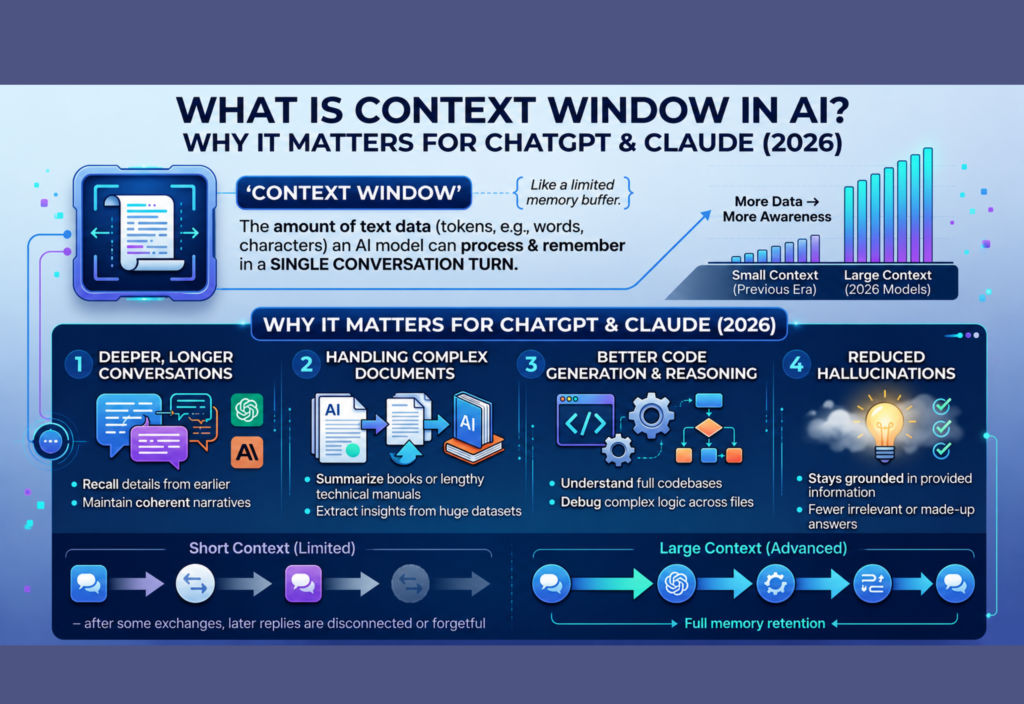
A context window is the maximum amount of information an AI model can process at one time while generating a response.
Think of it as the AI’s temporary working memory. It includes:
- Your latest prompt
- Previous chat history
- Uploaded documents
- Instructions
- The AI’s previous responses
Everything inside this window helps the AI understand your request. If the conversation becomes too long, older information may no longer fit within the available context. As a result, the AI may appear to “forget” earlier details.
Imagine It Like Reading a Book
Suppose you’re reading a 500-page novel, but you’re only allowed to remember the last 30 pages.
You can easily answer questions about recent chapters. However, recalling events from the beginning becomes difficult.
AI models work in a similar way. They can only consider the information currently inside their context window.
What Are Tokens?
AI models don’t count words. Instead, they process tokens.
A token may be:
- A whole word
- Part of a word
- A punctuation mark
- A number
- A symbol
For example:
Artificial Intelligence is transforming businesses.
This sentence is divided into several tokens before the AI processes it.
Because context windows are measured in tokens, the exact number of words that fit varies depending on the language and writing style.
How Does a Context Window Work?
Whenever you interact with an AI chatbot, several pieces of information are combined:
- Your current prompt
- Previous conversation
- Uploaded documents
- System instructions
- AI-generated responses
The model processes all of this information together before producing its next answer.
The larger the context window, the more information the AI can consider at the same time.
Why Does Context Window Matter?
The context window directly affects the quality of AI responses.
A larger context window allows AI to:
- Understand longer conversations
- Analyze lengthy documents
- Remember previous instructions
- Produce more consistent answers
- Reduce unnecessary repetition
- Connect ideas from different parts of a document
On the other hand, smaller context windows may cause the AI to lose important details as conversations become longer.
Example: Writing a Long Blog Post
Imagine you’re writing a 5,000-word article.
If the AI has a small context window, it may:
- Forget your introduction
- Repeat ideas
- Change writing style
- Miss important SEO keywords
With a larger context window, the AI can keep track of your headings, writing style, and instructions throughout the article, resulting in a more consistent and polished final draft.
Context Window in ChatGPT
ChatGPT uses its context window to understand your prompts, conversation history, and uploaded files.
When working on long projects such as:
- Blog writing
- Programming
- Research
- Business reports
it’s helpful to organize your prompts clearly and summarize previous discussions when necessary. This ensures the model continues to produce relevant responses even during extended conversations.
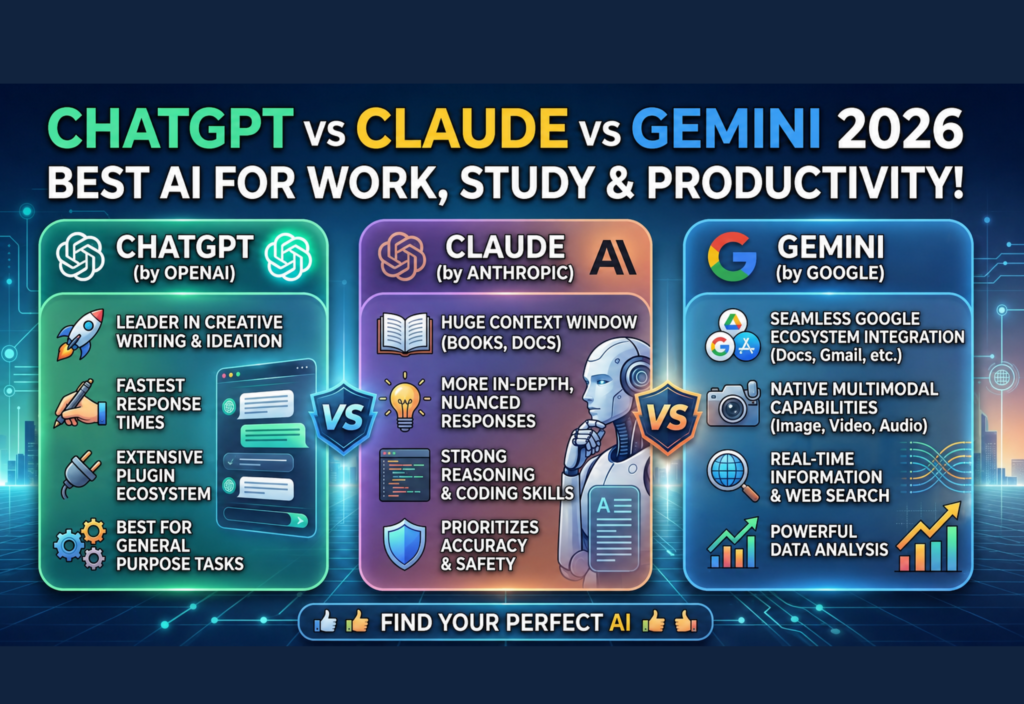
Context Window in Claude
Claude is widely recognized for its ability to handle long documents and complex conversations.
This makes it especially useful for:
- Research papers
- Legal documents
- Technical manuals
- Large codebases
- Business reports
A larger context window enables Claude to analyze more information in a single session, reducing the need to split documents into smaller sections.
Context Window vs Memory
Many users think these terms mean the same thing, but they are different.
| Context Window | Memory |
|---|---|
| Temporary | Can persist across conversations (if enabled) |
| Limited by tokens | Stores selected user information |
| Used while generating responses | Used for personalization |
| Changes during a conversation | Remains available for future chats |
Understanding this difference helps explain why an AI may remember your instructions within one conversation but not necessarily across all future chats.
Benefits of Larger Context Windows
A larger context window provides several advantages.
Better Consistency
The AI remembers earlier instructions, producing responses with a consistent tone and structure.
Improved Document Analysis
Long reports, books, and PDFs can often be analyzed without dividing them into multiple sections.
Better Coding Assistance
Developers can share multiple files, making it easier for AI to understand relationships between different parts of a project.
Enhanced Research
Researchers can compare information from multiple sources within the same conversation, improving the quality of summaries and insights.
Limitations
Despite their advantages, larger context windows have some limitations.
For example:
- Processing more information may require additional computing power.
- Very large conversations can still become difficult to manage if prompts are poorly organized.
- A larger context window does not automatically make an AI model smarter; it simply allows the model to consider more information at once.
Best Practices
To get better results from AI:
- Write clear prompts.
- Avoid unnecessary information.
- Organize documents using headings.
- Summarize long conversations.
- Repeat important instructions if needed.
- Keep related information together.
These habits improve response quality regardless of which AI model you use.
The Future of Context Windows
AI companies continue to expand context windows while making models more efficient.
In the coming years, larger context windows are expected to improve:
- Long-form writing
- Software development
- Academic research
- Business analysis
- Multimodal AI involving text, images, audio, and video
As these improvements continue, AI assistants will become even more capable of handling complex real-world tasks.
Conclusion
Understanding what is context window in AI is essential for anyone using modern AI tools. A context window determines how much information an AI can process at one time, making it one of the biggest factors affecting response quality.
Whether you’re writing articles with ChatGPT, reviewing legal documents in Claude, or conducting research with another AI assistant, knowing how context windows work will help you create better prompts, improve consistency, and get more accurate results.
Frequently Asked Questions
What is a context window in AI?
A context window is the maximum amount of information an AI model can process at one time while generating a response.
Why is the context window important?
It helps AI understand previous messages, instructions, and uploaded documents, resulting in more accurate and consistent responses.
Does ChatGPT remember everything?
No. ChatGPT can only use information that fits within its current context window, along with any separate memory features that may be enabled.
What are AI tokens?
Tokens are small units of text that AI models process instead of counting words directly.
Is a larger context window always better?
A larger context window is beneficial for long conversations and document analysis, but well-written prompts remain essential for the best results.