Artificial Intelligence is evolving at an incredible pace. While traditional AI systems can answer questions, generate content, and assist with coding, a new generation of intelligent systems is changing how AI works. These autonomous systems can plan tasks, make decisions, use external tools, and complete complex objectives with minimal human intervention.
Unlike conventional AI models that simply respond to prompts, Agentic AI behaves more like a digital assistant capable of working toward specific goals. Instead of answering one question at a time, it can plan multiple steps, remember previous interactions, and adapt its actions as new information becomes available.
In 2026, this technology is becoming one of the most important developments in artificial intelligence. Businesses, software developers, and technology companies are adopting autonomous AI agents to automate workflows, improve productivity, and reduce manual work across many industries.
In this guide, you’ll learn what Agentic AI is, how autonomous AI agents work, the technologies behind them, their benefits, limitations, real-world applications, and why they represent the next major step in AI development.
What Is Agentic AI?
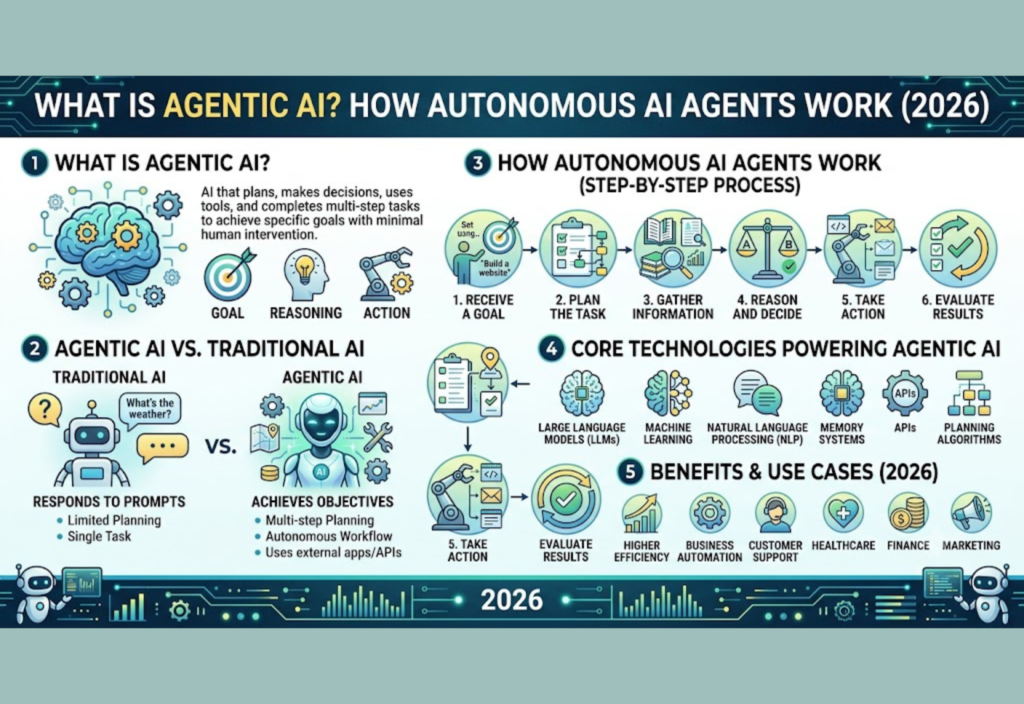
Agentic AI refers to artificial intelligence systems that can independently plan, make decisions, use available resources, and complete tasks to achieve specific objectives.
Unlike traditional AI models that generate responses only after receiving prompts, these systems continuously work toward a goal by analysing information, selecting the best actions, and adapting when circumstances change.
For example, instead of simply answering, “How do I book a flight?”, an AI agent could:
- Search available flights
- Compare ticket prices
- Recommend the best option
- Book the ticket after approval
- Add it to your calendar
- Send confirmation emails
This level of autonomy makes autonomous AI agents fundamentally different from standard AI assistants.
What Makes Agentic AI Different?
Traditional AI mainly focuses on responding to user input.
Agentic AI focuses on achieving objectives.
Instead of waiting for every instruction, autonomous AI agents can:
- Break large tasks into smaller steps
- Plan workflows
- Use software tools
- Access databases
- Search the web
- Analyse information
- Correct mistakes
- Continue working until the task is completed
This makes AI far more useful for real-world business automation.
How Does Agentic AI Work?
Although implementations differ, most autonomous AI agents follow a similar workflow.
Step 1: Receive a Goal
Everything begins with an objective.
Examples include:
- Write a research report
- Build a website
- Analyse customer feedback
- Generate marketing content
- Plan a business trip
Instead of solving only one request, the AI understands the overall objective.
Step 2: Plan the Task
The agent breaks the objective into smaller tasks.
For example, creating a research report may involve:
- Searching information
- Collecting sources
- Summarising findings
- Writing sections
- Reviewing accuracy
- Producing the final document
Planning allows the AI to solve complex problems more efficiently.
Step 3: Gather Information
The AI retrieves relevant information from available resources.
It may use:
- Search engines
- Documents
- Databases
- APIs
- Business software
- Knowledge bases
The collected information becomes the foundation for decision-making.
Step 4: Reason and Decide
Instead of blindly following instructions, the AI evaluates different options before selecting the best action.
Reasoning enables the agent to:
- Compare alternatives
- Solve problems
- Prioritise tasks
- Handle unexpected situations
This capability distinguishes Agentic AI from traditional automation.
Step 5: Take Action
Once a decision has been made, the AI performs the required action.
Examples include:
- Sending emails
- Updating databases
- Scheduling meetings
- Creating reports
- Writing code
- Ordering products
- Generating documents
Some actions may still require human approval depending on the application.
Step 6: Evaluate Results
After completing a task, the AI checks whether the objective has been achieved.
If necessary, it adjusts its plan and continues working until satisfactory results are produced.
This feedback loop enables continuous improvement.
Technologies Behind Agentic AI
Modern autonomous AI agents combine several advanced technologies.
Large Language Models (LLMs)
LLMs provide language understanding, reasoning, and content generation capabilities.
They help AI:
- Understand instructions
- Generate responses
- Explain decisions
- Communicate naturally
Machine Learning
Machine learning enables AI systems to improve based on previous interactions and new information.
Over time, performance becomes more accurate and efficient.
Natural Language Processing (NLP)
NLP allows AI agents to understand written and spoken language.
This enables natural conversations with users.
Memory Systems
Unlike basic chatbots, many AI agents remember previous conversations and completed tasks.
Memory helps maintain long-term context.
APIs
Application Programming Interfaces allow AI agents to interact with external software.
Examples include:
- Email platforms
- Calendars
- CRM systems
- Databases
- Cloud storage
- Business applications
Planning Algorithms
Planning systems enable agents to:
- Prioritise actions
- Optimise workflows
- Solve multi-step problems
- Adapt when conditions change
Characteristics of Autonomous AI Agents
Most Agentic AI systems share several important characteristics.
Goal-Oriented
Every action supports achieving a defined objective.
Autonomous
Agents perform many tasks independently without constant human instructions.
Adaptive
They adjust strategies when new information becomes available.
Tool Usage
AI agents interact with external applications and services to complete work.
Continuous Learning
Many systems improve through experience, user feedback, and additional training.
Benefits of Agentic AI
Agentic AI offers several advantages over traditional AI systems.
Higher Productivity
Autonomous agents handle repetitive and time-consuming work, allowing employees to focus on higher-value activities.
Faster Decision-Making
AI analyses large amounts of information within seconds, improving response times.
Business Automation
Entire workflows can be automated, reducing manual effort and operational costs.
Improved Accuracy
By analysing multiple data sources, AI agents can reduce human error in repetitive tasks.
Better Customer Experience
Autonomous AI provides faster responses, personalised recommendations, and continuous availability.
Real-World Applications
Agentic AI is transforming many industries by automating complex tasks and improving efficiency.
Common applications include:
- Customer support
- Software development
- Healthcare
- Finance
- Education
- Marketing
- Research
- Cybersecurity
- E-commerce
- Supply chain management
As adoption grows, autonomous AI agents are expected to become standard tools for businesses of all sizes.
Popular Agentic AI Frameworks
Developers use specialised frameworks to build autonomous AI agents more efficiently.
Popular frameworks include:
- LangChain
- LangGraph
- CrewAI
- AutoGen
- OpenAI Agents SDK
- Semantic Kernel
- Haystack
- LlamaIndex
These frameworks help AI agents plan tasks, use tools, access memory, and collaborate with other agents.
Agentic AI vs Traditional AI
Although both technologies use artificial intelligence, their capabilities differ significantly.
Traditional AI
Traditional AI mainly responds to user prompts. However, it has limited planning capabilities. As a result, it usually performs one task at a time.
| Feature | Details |
|---|---|
| Goal | Answer prompts |
| Planning | Limited |
| Decision Making | Basic |
| Tool Usage | Limited |
| Memory | Short-term |
| Autonomy | Low |
| Workflow | Single task |
Agentic AI
In contrast, Agentic AI focuses on completing objectives instead of simply answering prompts. Moreover, it can plan multiple steps, use external tools, and make independent decisions. Therefore, it is better suited for complex workflows.
| Feature | Details |
|---|---|
| Goal | Complete objectives |
| Planning | Multi-step planning |
| Decision Making | Advanced |
| Tool Usage | Extensive |
| Memory | Long-term |
| Autonomy | High |
| Workflow | Multiple connected tasks |
Agentic AI vs AI Agents
Many people use these terms interchangeably, but they are not identical.
AI Agent
An AI agent is a software program that performs specific tasks.
Agentic AI
Agentic AI is the broader concept that enables AI agents to reason, plan, make decisions, and complete complex objectives with greater autonomy.
In simple terms, AI agents are applications, while Agentic AI describes the intelligence powering them.
Business Applications of Agentic AI
Businesses across many industries are already adopting autonomous AI agents.
Customer Support
AI agents answer customer questions, resolve issues, and escalate complex requests when necessary.
Marketing
Businesses automate:
- Content creation
- Campaign planning
- Audience research
- Email marketing
- Social media management
Software Development
Developers use AI agents for:
- Writing code
- Fixing bugs
- Testing software
- Generating documentation
- Reviewing pull requests
Healthcare
Medical organisations use AI agents to:
- Schedule appointments
- Organise patient records
- Summarise clinical notes
- Assist healthcare professionals
Finance
Financial institutions automate:
- Risk analysis
- Fraud detection
- Customer support
- Financial reporting
Research
Researchers use AI agents to:
- Collect information
- Analyse documents
- Compare sources
- Generate summaries
Advantages of Agentic AI
Higher Efficiency
AI agents complete complex workflows much faster than manual processes.
Reduced Manual Work
Routine tasks are automated, allowing employees to focus on strategic activities.
Better Decision-Making
AI evaluates large amounts of information before selecting the most appropriate action.
Continuous Availability
Unlike human workers, AI agents can operate 24/7 without breaks.
Improved Scalability
Businesses can manage increasing workloads without hiring large teams.
Personalised Experiences
AI agents analyse user behaviour and provide recommendations tailored to individual needs.
Challenges of Agentic AI
Despite its advantages, Agentic AI also presents several challenges.
Accuracy
Poor-quality data may lead to incorrect decisions.
Security
AI agents often access business systems and sensitive information, making strong security essential.
Privacy
Organisations must comply with data protection regulations when handling customer information.
Human Oversight
High-risk decisions should still involve human review to ensure accuracy and accountability.
Infrastructure Costs
Large-scale autonomous AI systems may require significant computing resources.
Risks of Agentic AI
Businesses should also understand the potential risks.
Common concerns include:
- Incorrect decisions
- Hallucinated information
- Unauthorised actions
- Security vulnerabilities
- Bias in training data
- Compliance issues
Responsible AI governance helps minimise these risks.
Best Practices for Using Agentic AI
To deploy Agentic AI successfully:
- Define clear objectives.
- Use high-quality data.
- Keep humans involved in critical decisions.
- Monitor AI performance regularly.
- Secure APIs and connected systems.
- Update AI models frequently.
- Test workflows before production deployment.
- Follow ethical AI guidelines.
These practices improve reliability and build user trust.
Future of Agentic AI
Agentic AI is expected to become one of the most important technologies of the coming years.
Future developments may include:
- More advanced reasoning
- Better long-term memory
- Autonomous business operations
- Multi-agent collaboration
- Improved decision-making
- Smarter robotics
- Personal AI assistants
- Enterprise-wide AI automation
As technology continues to evolve, autonomous AI agents will become increasingly capable of handling complex tasks across many industries.
Frequently Asked Questions
What is Agentic AI?
Agentic AI is artificial intelligence that can plan, make decisions, use tools, and complete multi-step tasks with minimal human supervision.
How is it different from traditional AI?
Traditional AI mainly responds to prompts, while autonomous AI systems work toward achieving goals through planning, reasoning, and independent actions.
Can it replace humans?
No. These systems automate repetitive tasks, but human expertise remains essential for creativity, ethics, strategic planning, and complex decision-making.
Which industries benefit the most?
Healthcare, finance, software development, marketing, education, customer service, cybersecurity, manufacturing, and e-commerce are among the leading adopters.
Is it safe?
When implemented with proper security, monitoring, and human oversight, autonomous AI systems can be highly beneficial. However, organisations should carefully manage privacy, accuracy, and compliance risks.
Conclusion
Agentic AI represents the next evolution of artificial intelligence. Unlike traditional AI systems that simply respond to prompts, autonomous AI agents can plan, reason, make decisions, and complete complex tasks with minimal human intervention. By combining Large Language Models, memory, planning, and external tools, they automate workflows and improve productivity across industries.
As businesses continue adopting AI in 2026, Agentic AI is expected to play a central role in software development, customer service, healthcare, finance, marketing, and enterprise automation. Although challenges such as security, privacy, and human oversight remain important, the technology offers enormous potential for improving efficiency and innovation. Understanding how Agentic AI works today will help individuals and organisations prepare for the future of intelligent automation.