Python Object-Oriented Programming (OOP) is one of the most valuable programming concepts every Python developer should learn. Whether you’re building websites, desktop applications, automation scripts, APIs, artificial intelligence solutions, or enterprise software, understanding Python OOP helps you write cleaner, more organised, and reusable code.
Instead of writing everything as separate functions, Object-Oriented Programming organises code into classes and objects. Each object combines data and behaviour into a single unit, making programs easier to understand and maintain. This approach is especially useful when working on large projects where multiple developers collaborate.
Python is considered one of the best programming languages for learning OOP because its syntax is simple while still supporting advanced object-oriented concepts. In 2026, most professional Python frameworks—including Django, Flask, FastAPI, TensorFlow, and many automation libraries—make extensive use of OOP principles.
In this guide, you’ll learn what Python OOP is, why it matters, how classes and objects work, constructors, methods, variables, and the core building blocks that every beginner should understand before moving to advanced concepts.
What Is Object-Oriented Programming (OOP)?
Object-Oriented Programming (OOP) is a programming paradigm that organises software around objects instead of individual functions.
An object combines:
- Data (Attributes)
- Behaviour (Methods)
Rather than treating data and functions separately, OOP groups them into one reusable structure.
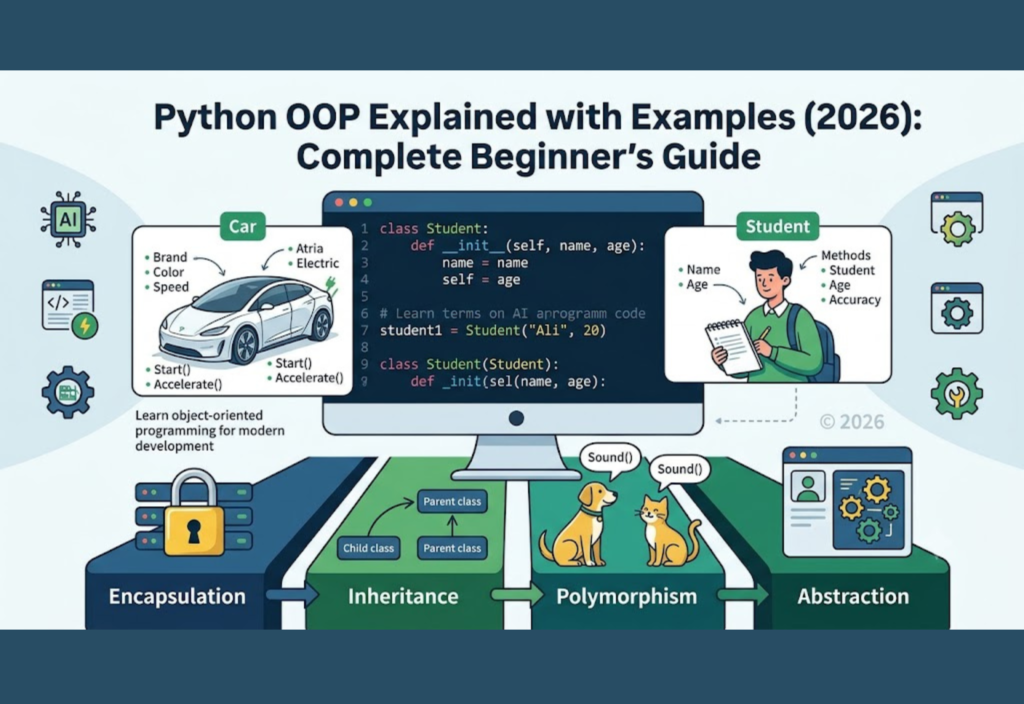
For example, imagine a Car.
A car has several characteristics.
Attributes
- Brand
- Colour
- Speed
- Model
It can also perform different actions.
Methods
- Start()
- Stop()
- Accelerate()
- Brake()
Instead of creating separate functions for every car, OOP allows you to define one Car class and create multiple car objects from it.
This closely mirrors real-world objects, making software easier to design and maintain.
Why Learn Python OOP?
Learning Object-Oriented Programming offers several advantages, especially as your projects become larger and more complex.
Some major benefits include:
- Better code organisation
- Code reusability
- Easier maintenance
- Reduced duplication
- Improved scalability
- Better teamwork
- Simplified debugging
- Real-world modelling
Because of these advantages, most professional Python applications rely heavily on OOP.
Understanding Classes and Objects
Before learning advanced OOP concepts, it’s important to understand two fundamental building blocks.
What Is a Class?
A class is a blueprint used to create objects.
It defines:
- Attributes
- Methods
Think of a class as the architectural design of a house.
The blueprint describes the structure, but it is not the actual house.
Similarly, a class describes what an object will contain without creating the object itself.
Creating Your First Class
A simple Python class looks like this:
class Student:
    pass
The pass keyword simply tells Python that the class currently has no content.
Although this class does nothing yet, it serves as a template for creating objects.
What Is an Object?
An object is an actual instance created from a class.
If Car is a class, then the following are objects:
- BMW
- Tesla
- Toyota
- Honda
Each object shares the same structure while storing different information.
Creating an Object
Once a class exists, creating an object is simple.
class Student:
    pass

student1 = Student()
student2 = Student()
Here, both student1 and student2 are separate objects created from the same class.
Each object can store different data independently.
Understanding Attributes
Attributes are variables that belong to an object.
They store information about that object.
For example, a Student object might have:
- Name
- Age
- Grade
- Roll Number
A Car object may have:
- Brand
- Model
- Colour
- Engine Size
Every object can have different attribute values while sharing the same structure.
Understanding Methods
Methods are functions defined inside a class.
They describe what an object can do.
Examples include:
- Login()
- Register()
- CalculateSalary()
- SendEmail()
- PrintInvoice()
Methods allow objects to perform actions.
Constructors in Python (init)
When a new object is created, Python can automatically initialise its data using a special method called the constructor.
The constructor is written using:
__init__()Example:
class Student:

    def __init__(self, name, age):
        self.name = name
        self.age = age

student = Student("Ali", 20)

print(student.name)
print(student.age)
Output:
Ali
20
Whenever a Student object is created, Python automatically runs the constructor and stores the provided values.
Understanding the self Keyword
One of the most confusing topics for beginners is the self keyword.
The self keyword refers to the current object.
Example:
class Car:

    def __init__(self, brand):
        self.brand = brand
Here,
self.brandstores the brand for the current object only.
If another object is created, it will have its own value.
Without self, Python would not know which object’s data should be accessed.
Instance Variables
Instance variables belong to individual objects.
Each object stores its own copy.
Example:
class Employee:

    def __init__(self, name):
        self.name = name

employee1 = Employee("Sara")
employee2 = Employee("Ahmed")
Here:
- employee1 stores “Sara”
- employee2 stores “Ahmed”
Both objects use the same class but contain different data.
Instance Methods
Instance methods work with object data.
Example:
class Student:

    def __init__(self, name):
        self.name = name

    def greet(self):
        print("Hello", self.name)

student = Student("Fatima")

student.greet()
Output:
Hello FatimaThe greet() method accesses the object’s own data using self.
Class Variables
Unlike instance variables, class variables are shared by every object.
Example:
class Employee:

    company = "ABC Technologies"

employee1 = Employee()
employee2 = Employee()

print(employee1.company)
print(employee2.company)
Output:
ABC Technologies
ABC Technologies
Every object shares the same company name.
If the class variable changes, all objects see the updated value.
Static Methods
Sometimes a method does not need access to object data.
In that case, Python provides static methods.
Example:
class Calculator:

    @staticmethod
    def add(a, b):
        return a + b

print(Calculator.add(10, 5))
Output:
15Static methods are useful for utility functions that don’t depend on object attributes.
Difference Between Class Variables and Instance Variables
Understanding the difference between these two types of variables is important.
Instance Variables
- Belong to individual objects
- Each object has its own copy
- Store object-specific information
Class Variables
- Shared by every object
- Defined directly inside the class
- Store common information
Using both correctly helps create flexible and reusable applications.
The Four Pillars of Object-Oriented Programming
Object-Oriented Programming is built around four fundamental principles that make software easier to develop, maintain, and scale. These principles allow developers to create modular, reusable, and organised applications.
The four pillars of Python OOP are:
- Encapsulation
- Inheritance
- Polymorphism
- Abstraction
Understanding these concepts is essential for writing professional Python applications.
1. Encapsulation
Encapsulation is the process of keeping data and the methods that operate on that data inside the same class while restricting direct access to sensitive information.
Instead of allowing users to modify important data directly, encapsulation provides controlled access through methods.
For example, consider a bank account. Customers should not be able to change their account balance directly. Instead, they should deposit or withdraw money through authorised methods.
Example:
class BankAccount:

    def __init__(self, balance):
        self.__balance = balance

    def deposit(self, amount):
        self.__balance += amount

    def withdraw(self, amount):
        if amount <= self.__balance:
            self.__balance -= amount

    def get_balance(self):
        return self.__balance

account = BankAccount(1000)

account.deposit(500)

print(account.get_balance())
Output
1500The double underscore (__) makes the variable private, preventing direct access from outside the class.
Benefits of Encapsulation
- Protects sensitive data
- Prevents accidental modifications
- Improves security
- Makes code easier to maintain
2. Inheritance
Inheritance allows one class to inherit attributes and methods from another class.
Instead of rewriting the same code, developers can reuse existing functionality by creating child classes from parent classes.
Example:
class Animal:

    def speak(self):
        print("Animal speaks")

class Dog(Animal):

    def bark(self):
        print("Bark")

dog = Dog()

dog.speak()
dog.bark()
Output
Animal speaks
Bark
The Dog class inherits the speak() method from the Animal class while adding its own functionality.
Advantages of Inheritance
- Code reusability
- Less duplication
- Easier maintenance
- Better scalability
Types of Inheritance in Python
Python supports multiple inheritance types.
Single Inheritance
One child inherits from one parent.
Multiple Inheritance
One child inherits from multiple parent classes.
Multilevel Inheritance
A child inherits from another child class.
Hierarchical Inheritance
Multiple child classes inherit from one parent.
Hybrid Inheritance
A combination of different inheritance types.
These inheritance models provide flexibility for designing complex applications.
3. Polymorphism
Polymorphism allows different classes to use the same method name while producing different results.
The word polymorphism means “many forms.”
Example:
class Dog:

    def sound(self):
        print("Bark")

class Cat:

    def sound(self):
        print("Meow")

class Cow:

    def sound(self):
        print("Moo")

animals = [Dog(), Cat(), Cow()]

for animal in animals:
    animal.sound()
Output
Bark
Meow
Moo
Although every class uses the sound() method, each produces a different result.
Benefits of Polymorphism
- Cleaner code
- Easier extension
- Greater flexibility
- Better code reuse
Method Overriding
Method overriding occurs when a child class replaces a method inherited from the parent class.
Example:
class Animal:

    def sound(self):
        print("Animal Sound")

class Dog(Animal):

    def sound(self):
        print("Bark")

dog = Dog()

dog.sound()
Output
BarkThe child class overrides the parent’s implementation.
4. Abstraction
Abstraction hides unnecessary implementation details while exposing only the required functionality.
Users interact with simple interfaces without needing to understand the internal logic.
Python provides abstraction using the abc module.
Example:
from abc import ABC, abstractmethod

class Vehicle(ABC):

    @abstractmethod
    def start(self):
        pass

class Car(Vehicle):

    def start(self):
        print("Car Started")

car = Car()

car.start()
Output
Car StartedUsers only call start() without knowing how it works internally.
Benefits of Abstraction
- Simplifies complex applications
- Improves security
- Reduces unnecessary complexity
- Makes software easier to use
Composition vs Inheritance
Although inheritance is useful, composition is often considered a better design approach.
Inheritance
Inheritance creates an “is-a” relationship.
Examples:
- Dog is an Animal
- Car is a Vehicle
Composition
Composition creates a “has-a” relationship.
Examples:
- Car has an Engine
- Laptop has a Keyboard
- Smartphone has a Camera
Modern Python applications often prefer composition because it provides greater flexibility and reduces dependency between classes.
Real-World Applications of Python OOP
Object-Oriented Programming is used in almost every modern Python application.
Common examples include:
- Web applications
- AI and Machine Learning
- Desktop software
- Mobile applications
- Banking systems
- Hospital management systems
- E-commerce platforms
- Inventory management software
- Customer Relationship Management (CRM)
- Automation tools
- Game development
- Enterprise software
Because OOP models real-world objects naturally, it is suitable for both small and large projects.
Advantages of Python OOP
Using Object-Oriented Programming provides several important advantages.
Some of the biggest benefits include:
- Better code organisation
- Reusable code
- Easier debugging
- Improved scalability
- Reduced duplication
- Better collaboration
- Faster development
- Improved security through encapsulation
- Simplified maintenance
- Modular application design
These benefits make OOP one of the most widely used programming approaches.
OOP vs Procedural Programming
Although both programming approaches solve problems, they organise code differently.
Procedural Programming focuses on functions and step-by-step instructions. It works well for small programs but becomes harder to maintain as projects grow.
Object-Oriented Programming, on the other hand, organises code into classes and objects. As a result, applications become more modular, reusable, and easier to scale.
Procedural Programming
- Structure: Functions
- Code Reusability: Limited
- Maintenance: Difficult for large projects
- Data Security: Lower
- Scalability: Limited
- Best For: Small programs
Object-Oriented Programming (OOP)
- Structure: Classes and Objects
- Code Reusability: High
- Maintenance: Easier
- Data Security: Better through encapsulation
- Scalability: Excellent
- Best For: Medium and large applications
For modern Python development, OOP is generally the preferred approach because it simplifies large-scale software development.
Real-World Python OOP Projects
Once you understand OOP concepts, you can build many practical applications.
Some beginner-friendly projects include:
- Student Management System
- Library Management System
- Banking Application
- Hospital Management System
- Employee Management System
- Inventory Management System
- Hotel Booking System
- Online Shopping Cart
- Vehicle Rental System
- School Management Software
More advanced Python frameworks like Django and FastAPI also rely heavily on Object-Oriented Programming. Learning OOP therefore prepares you for real-world software development.
When Should You Use OOP?
Object-Oriented Programming is ideal whenever your application contains multiple related objects or is expected to grow over time.
Common situations include:
- Web development
- Desktop applications
- AI and Machine Learning projects
- Automation tools
- REST APIs
- Enterprise software
- Financial systems
- Healthcare applications
- E-commerce platforms
- Large team projects
For very small scripts, procedural programming may be sufficient. However, as applications become more complex, OOP usually becomes the better choice because it improves organisation and maintainability.
Best Practices for Python OOP
Following best practices makes your code easier to understand and maintain.
Consider these recommendations:
- Keep each class focused on a single responsibility.
- Use meaningful class and method names.
- Prefer composition when inheritance is unnecessary.
- Keep methods short and easy to read.
- Protect sensitive data with encapsulation.
- Avoid duplicate code whenever possible.
- Write reusable methods.
- Organise related classes into separate modules.
- Follow Python’s PEP 8 coding style.
- Add comments and documentation where appropriate.
These practices improve code quality and make collaboration easier.
Common OOP Mistakes
Many beginners make similar mistakes while learning Object-Oriented Programming.
Common examples include:
- Creating classes that handle too many responsibilities.
- Using inheritance when composition would be better.
- Ignoring encapsulation.
- Writing duplicate methods.
- Using global variables unnecessarily.
- Making classes unnecessarily complex.
- Choosing unclear class names.
- Forgetting to initialise object attributes properly.
Avoiding these mistakes will help you write cleaner and more professional Python code.
Python OOP Interview Questions
If you’re preparing for interviews, you should understand these common questions.
What is a class?
A class is a blueprint used to create objects.
What is an object?
An object is an instance of a class that contains its own attributes and methods.
What are the four pillars of OOP?
The four pillars are:
- Encapsulation
- Inheritance
- Polymorphism
- Abstraction
What is inheritance?
Inheritance allows one class to reuse the properties and methods of another class.
What is polymorphism?
Polymorphism allows different classes to use the same method name while producing different behaviour.
Why is encapsulation important?
Encapsulation protects sensitive data and improves software security.
What is abstraction?
Abstraction hides implementation details while exposing only the necessary functionality.
These questions frequently appear in Python interviews for beginners and intermediate developers.
Frequently Asked Questions
What is Python OOP?
Python OOP (Object-Oriented Programming) is a programming approach that organises code into classes and objects, making applications more modular, reusable, and easier to maintain.
Is Python completely object-oriented?
Python is a multi-paradigm language. It fully supports Object-Oriented Programming while also allowing procedural and functional programming styles.
Why should beginners learn OOP?
Learning OOP helps beginners write organised code, understand professional software development, and prepare for frameworks such as Django, Flask, and FastAPI.
What are the four pillars of OOP?
The four pillars are Encapsulation, Inheritance, Polymorphism, and Abstraction.
Is OOP required for AI and Machine Learning?
Yes. Many popular AI libraries, including TensorFlow, PyTorch, Scikit-learn, and LangChain, use Object-Oriented Programming extensively.
Which Python frameworks use OOP?
Many popular frameworks rely on OOP, including:
- Django
- Flask
- FastAPI
- TensorFlow
- PyTorch
- Kivy
- Pygame
Conclusion
Python Object-Oriented Programming is one of the most important skills every developer should master. By understanding classes, objects, constructors, methods, inheritance, encapsulation, polymorphism, and abstraction, you can write cleaner, more reusable, and easier-to-maintain code.
As Python continues to power web development, artificial intelligence, automation, data science, and enterprise software in 2026, strong OOP knowledge has become an essential requirement for modern developers. Although procedural programming is suitable for small scripts, Object-Oriented Programming provides the flexibility and scalability needed for larger applications.
Whether you plan to build websites, APIs, automation tools, desktop software, or AI-powered applications, mastering Python OOP will give you a solid foundation for professional software development and help you create efficient, scalable, and maintainable programs.