AI agents are becoming a major part of modern software development. Unlike a simple chatbot, an AI agent can use tools, access data, follow steps, and complete tasks.
However, building an AI agent from scratch can be difficult. Developers may need to connect an AI model with APIs, databases, tools, memory, and business logic. That is where AI agent frameworks can help. LangChain, CrewAI, and AutoGen are three popular frameworks for building AI-powered applications. Each one has a different approach. Therefore, choosing the right framework depends on what you want to build.
In this guide, we will compare LangChain vs CrewAI vs AutoGen in 2026. You will learn how each framework works, what makes it different, and which one may fit your project best.
What Are AI Agent Frameworks?
An AI agent framework is a software tool that helps developers build applications that can perform tasks with the help of AI models.
A simple AI application may work like this:
User → AI Model → Answer
An AI agent can follow a longer process:
User → AI Agent → Tool → Data → Action → Result
For example, imagine a research agent. A user gives it a topic. The agent can collect information, analyze it, and prepare a report.
Building such a system without a framework can take a lot of time. Frameworks provide ready-made components that make this work easier.
Depending on the framework, developers can add:
AI models
Tools
APIs
Databases
Memory
Retrieval
Workflows
Multiple agents
Human approval
As a result, developers can spend more time solving the actual problem.
Why Are AI Agent Frameworks Important in 2026?
AI agents are being used in many areas. Businesses can use them for automation, research, customer support, data work, and software development.
For example, an AI system may need to:
Read documents
Search information
Call an API
Analyze data
Write a report
Review code
Answer customer questions
Complete a business task
A language model alone may not be enough for these jobs.
Instead, the model needs access to tools and clear instructions. It may also need memory and a way to control each step.
That is why agent frameworks are useful. They provide a structure for connecting these different parts.
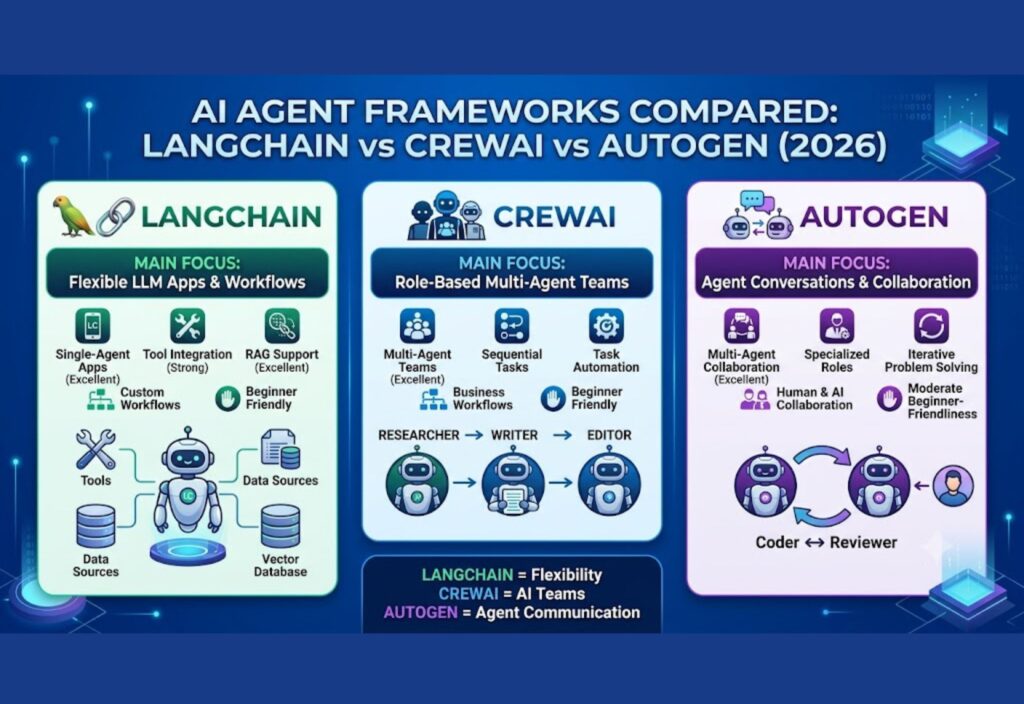
LangChain vs CrewAI vs AutoGen at a Glance
The three frameworks can be used for AI agent development. However, their main strengths are different.
LangChain
| Feature | Details |
|---|---|
| Main Focus | LLM Apps & Workflows |
| Beginner Friendly | Yes |
| Single-Agent Apps | Excellent |
| Multi-Agent Apps | Good |
| Tool Support | Strong |
| RAG Support | Excellent |
| Best Use | Flexible AI Apps |
| Python | Yes |
CrewAI
| Feature | Details |
|---|---|
| Main Focus | Multi-Agent Teams |
| Beginner Friendly | Yes |
| Single-Agent Apps | Good |
| Multi-Agent Apps | Excellent |
| Tool Support | Strong |
| RAG Support | Good |
| Best Use | AI Task Teams |
| Python | Yes |
AutoGen
| Feature | Details |
|---|---|
| Main Focus | Agent Collaboration |
| Beginner Friendly | Moderate |
| Single-Agent Apps | Good |
| Multi-Agent Apps | Excellent |
| Tool Support | Strong |
| RAG Support | Good |
| Best Use | Agent Conversations |
| Python | Yes |
This table gives a quick overview. Still, you should understand each framework before making a final choice.
What Is LangChain?
LangChain is a framework for building applications that use large language models.
It helps developers connect AI models with tools, data, APIs, retrieval systems, and application workflows.
For example, a LangChain application can connect an AI model with:
A database
A search tool
A calculator
A document store
An API
A vector database
This makes LangChain useful for many different AI projects.
It can also be used to build AI agents that choose tools based on the task.
How Does LangChain Work?
A simple LangChain application can follow this structure:
User → Application → AI Model → Response
An agent can use a more advanced flow:
User → Agent → Decide → Tool → Result → Final Answer
For example, a user may ask:
What is the current price of a product?
The agent can decide that it needs an external tool. It can then call an API, receive the result, and provide the answer.
This approach allows an AI model to do more than generate text.
Main Features of LangChain
AI Model Support
LangChain can be used with different AI models. This gives developers more flexibility when choosing a model provider.
Therefore, you can build an application without tying the entire design to one model.
Tool Calling
Agents can use external tools to perform actions.
For example, a tool may allow an agent to:
Search data
Call an API
Query a database
Perform calculations
Read files
Retrieval
LangChain is useful for retrieval-based AI applications.
For example, a business can connect its internal documents to an AI assistant. Users can then ask questions about those documents.
Agent Workflows
Developers can build agents that decide which tool or action is needed.
This is useful for tasks that do not always follow the same path.
Workflow Control
Not every AI application needs full agent freedom. Sometimes a fixed workflow is better.
LangChain can also support structured application flows. Therefore, developers can choose between flexible agents and controlled steps.
Advantages of LangChain
LangChain has a broad ecosystem.
It can support many types of AI applications. In addition, it works well with tools, retrieval, databases, and model providers.
Another advantage is flexibility.
Developers can start with a small application and later add more features.
For example, a simple AI assistant can later gain:
Tool use
Document search
Memory
APIs
Structured outputs
As a result, LangChain can grow with the project.
Limitations of LangChain
The large ecosystem can also be a challenge.
Beginners may see many concepts and components at once. This can make the framework feel harder than a simple AI API.
Large applications also require careful design.
Developers need to think about:
State
Errors
Tools
Data
Workflow
Security
Agent behavior
Therefore, beginners should start with a small project.
What Is CrewAI?
CrewAI is a framework designed for AI agents that work together as a team.
The main idea is easy to understand.
Instead of asking one agent to do everything, you can create several agents with different roles.
For example:
Researcher → Writer → Editor
The researcher collects information. Next, the writer creates the content. Finally, the editor checks the result.
This makes CrewAI useful for task-based multi-agent workflows.
How Does CrewAI Work?
CrewAI mainly works around agents, tasks, and crews.
An agent is an AI worker with a specific role.
A task is a job that needs to be completed.
A crew brings the agents and tasks together.
For example:
Research Agent → Analysis Agent → Writing Agent
The first agent collects information. After that, the second agent analyzes it. Finally, the third agent creates the output.
This structure is easy to understand.
Main Features of CrewAI
Role-Based Agents
Each agent can have a specific role.
Examples include:
Researcher
Writer
Developer
Analyst
Reviewer
Support Agent
Giving agents clear roles can make complex workflows easier to manage.
Task-Based Workflows
Developers can define tasks for each agent.
A task can include instructions and a desired result.
Consequently, each agent knows what it is expected to do.
Multi-Agent Collaboration
Several agents can work on the same larger goal.
For example:
Research → Analysis → Writing → Review
Each step can have a different agent.
Sequential Tasks
Tasks can run in a specific order.
This is useful when one task needs the result of an earlier task.
Advantages of CrewAI
CrewAI is easy to understand.
The idea of giving an AI agent a role is simple. Therefore, beginners can often understand the basic concept quickly.
It is also useful for business automation.
For example, a company could build a workflow with:
Lead Researcher → Sales Analyst → Report Writer
Each agent has one main job.
This can make a large process easier to organize.
Limitations of CrewAI
Multi-agent systems can become expensive.
If five agents are used for one task, the application may need several AI model calls.
That can increase:
Cost
Response time
Complexity
Also, not every project needs multiple agents.
If one agent can complete the task, adding several more may not provide enough value.
What Is AutoGen?
AutoGen is a framework for creating AI applications where agents can communicate and work together.
Its main idea is agent collaboration.
For example, a project can use:
Planner Agent ↔ Developer Agent ↔ Reviewer Agent
The planner creates a plan. The developer works on the task. Then, the reviewer checks the result.
The agents can exchange information during the process.
This makes AutoGen useful for collaborative AI workflows.
How Does AutoGen Work?
AutoGen applications can contain different agents.
Each agent can have a specific purpose.
For example:
User → Planner → Developer → Tester → Final Result
The planner decides what needs to happen. Then, the developer works on the solution. Afterward, the tester checks the result.
Depending on the workflow, agents can communicate several times.
This can be helpful when a task needs discussion or repeated review.
Main Features of AutoGen
Agent Conversations
Agent communication is a major part of AutoGen.
Multiple agents can exchange information while working toward a common goal.
Specialized Agents
Developers can create different agents for different jobs.
For example:
Planner
Coder
Tester
Researcher
Reviewer
This makes it possible to divide a difficult task into smaller parts.
Tool Use
Agents can also work with external tools.
For example, a coding agent may use development tools while a research agent may use data sources.
Human Input
Some workflows can include human approval.
This is useful when an AI system should not make important decisions without review.
Advantages of AutoGen
AutoGen is useful for multi-agent collaboration.
It can model situations where agents need to communicate, review work, and improve a result.
For example, a coding system could include one agent for planning, another for coding, and another for testing.
As a result, difficult tasks can be divided between different AI roles.
Limitations of AutoGen
Agent conversations can become complex.
More conversations can also mean more AI model calls.
Therefore, the application may become:
More expensive
Slower
Harder to debug
A good design should limit unnecessary conversations.
LangChain vs CrewAI vs AutoGen: Main Difference
The easiest way to understand the three frameworks is to look at their main ideas.
LangChain focuses on flexible LLM applications and workflows.
CrewAI focuses on teams of AI agents working on tasks.
AutoGen focuses on communication and collaboration between agents.
All three can build AI agents. However, their design styles are different.
LangChain vs CrewAI vs AutoGen for Beginners
Beginners often want a framework that is simple to understand.
CrewAI can be a good starting point for people who want to learn multi-agent systems. Its agent and task concepts are clear.
LangChain is also useful for beginners, especially when learning how AI models connect with tools and data.
AutoGen may require more understanding when building advanced agent conversations.
Therefore, your first project should be small.
For example, build a simple research agent before creating a system with ten agents.
Which Framework Is Best for Single AI Agents?
For a single AI agent, LangChain is a strong option.
It provides tools for connecting a model with APIs, databases, retrieval systems, and other services.
For example, you can create an AI research assistant that:
Receives a question.
Finds useful information.
Retrieves relevant data.
Processes the information.
Creates a final answer.
CrewAI can also be used for agent applications. However, its multi-agent approach becomes more useful when several roles are needed.
AutoGen can also support single-agent setups, but collaboration is one of its main strengths.
Which Framework Is Best for Multi-Agent Systems?
All three frameworks can be used for multi-agent systems.
However, CrewAI and AutoGen are strong choices when multiple agents need to work together.
CrewAI is useful for role-based tasks.
For example:
Researcher → Writer → Editor
AutoGen is useful when agents need to communicate.
For example:
Planner ↔ Developer ↔ Reviewer
LangChain can also handle multi-agent workflows when developers need more control over the application architecture.
Which Framework Is Best for RAG?
RAG stands for Retrieval-Augmented Generation.
It allows an AI model to retrieve information before generating an answer.
For example, a company can connect its private documents to an AI assistant.
A user can then ask:
What is our refund policy?
The system retrieves the relevant document and uses it to create the response.
LangChain is a strong choice for RAG because it provides tools for working with documents, retrieval, embeddings, and vector databases.
CrewAI and AutoGen can also be part of RAG systems. However, LangChain is often a natural choice when retrieval is a major part of the application.
Which Framework Is Best for AI Automation?
AI automation usually needs tools, APIs, workflows, and decision-making.
LangChain is useful when an agent needs access to many external tools.
CrewAI is useful when an automation process can be divided into different roles.
AutoGen can work well when agents need to discuss tasks before completing them.
For example, a business automation system could use:
Research Agent → Analysis Agent → Report Agent
This approach can divide a large process into smaller jobs.
Which Framework Is Best for Coding Agents?
Coding agents can read instructions, work with code, use tools, and review results.
All three frameworks can be used for coding workflows.
A LangChain application could connect an AI model with development tools.
CrewAI could divide the work into:
Planner → Developer → Tester
AutoGen could create a conversation between:
Coding Agent ↔ Review Agent
The best choice depends on the project.
If you need a flexible tool-based system, LangChain can be a strong option. For role-based coding teams, CrewAI can work well. When agent communication is important, AutoGen may be useful.
Which Framework Is Best for Business Automation?
Business automation can include many repetitive tasks.
Examples include:
Customer support
Lead research
Data analysis
Document processing
Report creation
Email handling
Market research
CrewAI can be useful when these jobs can be divided into roles.
For example:
Research Agent → Sales Agent → Report Agent
LangChain may be better when the workflow needs many tools or data sources.
Meanwhile, AutoGen can help when agents need to discuss and review a task.
Cost and Performance
Framework choice can affect cost and speed.
A single-agent system may use one or two AI calls. A multi-agent system may use many.
For example:
User → Researcher → Analyst → Writer → Reviewer
Each step may require an AI model call.
Therefore, the total cost can increase.
To reduce costs, consider these steps:
Use smaller models for simple jobs.
Avoid unnecessary agents.
Limit repeated tool calls.
Keep prompts focused.
Cache reusable information.
Set limits on agent conversations.
Monitor token usage.
A simple workflow can often be faster than a large autonomous system.
Security for AI Agents
AI agents can sometimes access external systems.
For that reason, security should be planned early.
An agent that can send emails or change database records should not have unlimited access.
Important security practices include:
Protect API keys.
Limit tool permissions.
Validate inputs.
Use authentication.
Log important actions.
Protect private data.
Add human approval for sensitive tasks.
Give agents only the access they need.
In particular, high-risk actions should have additional checks.
Common AI Agent Mistakes
Building an AI agent is exciting. Still, beginners often make the system more complex than necessary.
Using Too Many Agents
More agents do not always mean better results.
If one agent can complete a task, keep the system simple.
Giving Too Many Tools
An agent with many tools may have trouble choosing the correct one.
Instead, provide only the tools that are needed.
Ignoring Errors
AI output can sometimes be wrong.
Therefore, important actions should have validation and error handling.
Skipping Testing
An agent may work during a simple test but fail with real users.
Create different test cases before launching the application.
Giving Too Much Access
An AI agent should not have unnecessary permissions.
Use the minimum access required for the task.
How to Choose the Right AI Agent Framework
Start by defining your project.
Ask these questions:
Is it a single-agent application?
Does it need several agents?
Does it require RAG?
Does it need many tools?
Do agents need to communicate?
Does the workflow need fixed steps?
What is the expected budget?
How important is security?
After answering these questions, the choice becomes easier.
Choose LangChain If
You need:
Flexible AI applications
Tool integration
RAG
LLM workflows
Custom agent logic
Data connections
Choose CrewAI If
You need:
Role-based agents
Multi-agent teams
Task automation
Business workflows
Sequential agent tasks
Choose AutoGen If
You need:
Agent conversations
Multi-agent collaboration
Iterative problem solving
Specialized AI roles
Human and AI collaboration
Comparison by Use Case
| Use Case | Best Starting Choice |
|---|---|
| RAG chatbot | LangChain |
| AI research assistant | LangChain |
| Tool-based AI agent | LangChain |
| Multi-agent business workflow | CrewAI |
| AI research team | CrewAI |
| Task-based automation | CrewAI |
| Agent conversations | AutoGen |
| Collaborative coding | AutoGen |
| Experimental multi-agent system | AutoGen |
These are general recommendations.
Your project may still benefit from another framework depending on its requirements.
Can You Use Multiple Frameworks?
It is possible to use more than one framework in a larger system.
For example, one framework may handle agent logic while another library handles a specific data or retrieval task.
However, there is a trade-off.
Every additional framework adds another layer to maintain.
That can make the system harder to understand and debug.
Therefore, start with one framework. Add another only when there is a clear reason.
How to Start Learning AI Agents
If you are new to AI agents, do not begin with a large multi-agent project.
Instead, follow a simple learning path.
Step 1: Learn LLM Basics
Understand:
Prompts
Tokens
Context windows
APIs
Structured output
Step 2: Build a Simple AI App
Connect an application to an AI model.
Step 3: Add One Tool
Give the application access to a calculator, database, API, or search tool.
Step 4: Create an Agent
Let the AI decide when it should use the tool.
Step 5: Add Retrieval
Connect documents or a knowledge base if your project needs external information.
Step 6: Try Multiple Agents
Only after learning single-agent systems should you build multi-agent workflows.
This path makes learning easier.
Future of AI Agent Frameworks
AI agent development is still changing quickly.
Frameworks will likely continue improving areas such as:
Agent reliability
Tool use
Workflow control
Memory
State management
Multi-agent collaboration
Evaluation
Monitoring
Security
At the same time, simpler workflows will remain useful.
Not every problem needs a fully autonomous AI agent.
In many cases, a controlled workflow can provide better results.
Therefore, developers should choose autonomy carefully.
LangChain vs CrewAI vs AutoGen: Final Verdict
There is no universal winner.
The best framework depends on what you want to build.
LangChain is a strong choice for flexible LLM applications, RAG systems, tool-based agents, and custom workflows.
CrewAI is a strong choice for role-based multi-agent systems and task automation.
AutoGen is a strong choice for applications where agents need to communicate, collaborate, and review each other’s work.
A simple way to remember the difference is:
LangChain = Flexible AI applications
CrewAI = AI teams and task workflows
AutoGen = Agent communication and collaboration
Before choosing a framework, define the problem first. Then design the simplest workflow that can solve it.
Final Thoughts
AI agent frameworks are making advanced AI development easier.
LangChain, CrewAI, and AutoGen each provide useful tools for building AI-powered systems. However, they solve problems in slightly different ways.
LangChain is flexible and works well with tools, data, retrieval, and workflows. CrewAI focuses on teams of specialized agents. AutoGen focuses on communication between agents.
As AI agents become more common in 2026, learning these frameworks can help developers build useful automation and intelligent applications.
The most important lesson is simple:
Do not build a complex agent system just because you can. Build the simplest system that solves the problem well.
Start with one agent. Add tools when needed. Introduce multiple agents only when they provide a real benefit.
That approach can reduce cost, improve speed, and make your AI application easier to test and maintain.