Artificial intelligence has become a major part of modern technology. Today, you may often hear terms such as 7B, 13B, and 70B when people talk about AI models and Large Language Models (LLMs).
But what do these numbers actually mean?
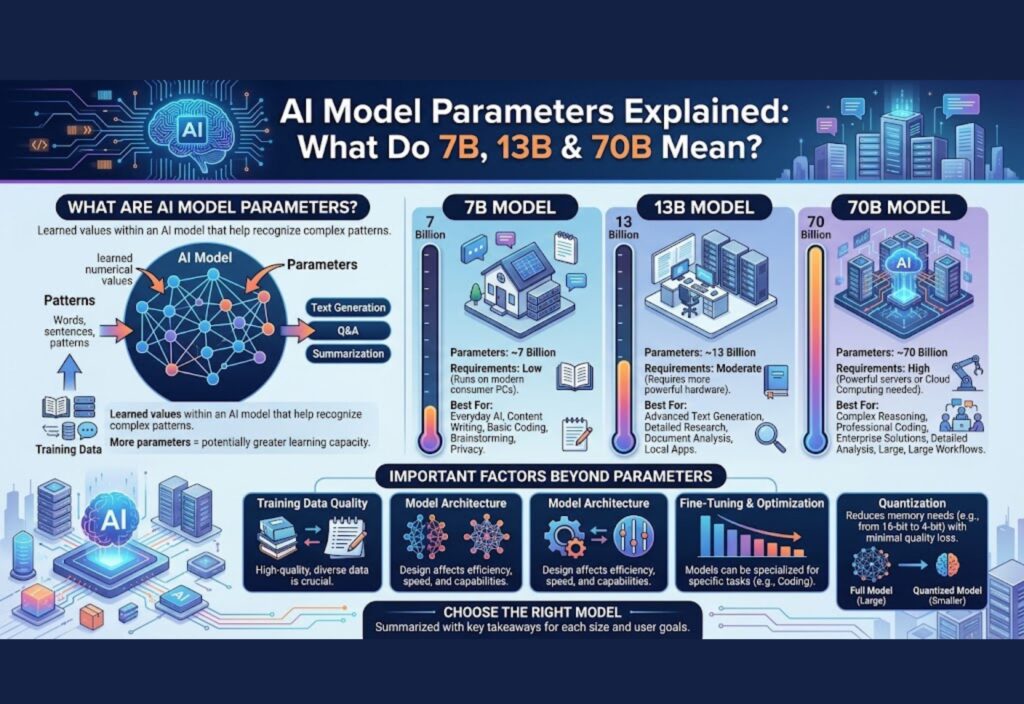
In simple terms, 7B, 13B, and 70B refer to the approximate number of parameters in an AI model. The letter B means billion. Therefore, a 7B model has around 7 billion parameters, while a 70B model has around 70 billion parameters.
However, parameter count is not the only thing that determines how good an AI model is. Training data, model architecture, training methods, optimization, context length, and other factors can also affect performance.
This guide explains AI model parameters in simple language. It also explains the differences between 7B, 13B, and 70B models, their hardware needs, their benefits, their limitations, and how to choose the right model.
What Are AI Model Parameters?
AI model parameters are numerical values that an artificial intelligence system learns during training.
You can think of parameters as internal values that help the model recognize patterns. During training, the AI processes large amounts of information and adjusts these values to improve its results.
For language models, parameters help the system learn patterns related to:
Words
Sentences
Grammar
Language patterns
Context
Programming
Questions and answers
Text generation
Relationships between concepts
As a result, a model with billions of parameters can learn very complex patterns from its training data.
For example, when you see a model described as 7B, it means the model contains approximately 7 billion learned parameters.
Likewise, 13B means approximately 13 billion parameters, while 70B means approximately 70 billion parameters.
What Does 7B Mean?
A 7B AI model contains approximately 7 billion parameters.
Generally, models in this range require fewer resources than larger models. Therefore, they are popular among people who want to experiment with AI on their own computers.
A 7B model can be useful for:
General questions
Content writing
Summarization
Basic coding
Translation
Brainstorming
Simple AI assistants
Local AI experiments
Moreover, many 7B models can be used with quantization. This can reduce their memory requirements and make them easier to run on consumer hardware.
However, a 7B model may not perform as well as a much larger model on very difficult reasoning or complex coding tasks.
What Does 13B Mean?
A 13B model contains approximately 13 billion parameters.
Because it has more parameters than a 7B model, it may have more capacity to learn complex patterns. Nevertheless, this does not mean that every 13B model will automatically be better than every 7B model.
The quality of training is also very important.
A 13B model can be useful for:
Advanced text generation
Coding assistance
Research tasks
Document analysis
Question answering
Summarization
Local AI applications
More complex instructions
In addition, a 13B model can provide a middle ground between smaller models and very large models.
What Does 70B Mean?
A 70B model contains approximately 70 billion parameters.
That is ten times the parameter count of a 7B model. However, this does not mean that it is automatically ten times better.
A large model can have more capacity for learning complex patterns. Because of this, some 70B models can perform very well on difficult reasoning, coding, analysis, and language tasks.
For example, a 70B model may be used for:
Advanced reasoning
Complex coding
Research
Detailed analysis
Professional AI applications
Large AI workflows
Advanced language tasks
On the other hand, these models normally require much more computing power.
Why Are Parameters Important?
Parameters are important because they provide the model with capacity to learn patterns.
Imagine an AI model as a large collection of adjustable values. During training, these values are changed so that the model can make better predictions.
As the number of parameters increases, the model can potentially represent more complex relationships.
However, there is an important point to remember.
More parameters do not always mean better performance.
For example, a smaller model with better training can sometimes perform better than a larger model with poor training.
Therefore, parameter count should be considered together with other model features.
7B vs 13B vs 70B in Simple Terms
7B Model
Parameters: Approximately 7 billion
Hardware: Lower requirements
Best for: Everyday AI and local experimentation
A 7B model is often a practical starting point for people who want to run AI locally.
13B Model
Parameters: Approximately 13 billion
Hardware: Moderate requirements
Best for: More demanding AI tasks
A 13B model can be a useful choice when you want more capability but do not want the resource requirements of a very large model.
70B Model
Parameters: Approximately 70 billion
Hardware: High requirements
Best for: Advanced reasoning and professional workloads
A 70B model can be useful when stronger performance is more important than low hardware requirements.
Does More Parameters Mean More Intelligence?
Not always.
It is easy to assume that a model with more parameters must be smarter. However, AI performance depends on many different factors.
For instance, training data can have a major effect on performance. Similarly, the model architecture and training process can also make a large difference.
Other important factors include:
Data quality
Training methods
Fine-tuning
Model architecture
Context length
Optimization
Inference methods
Tool use
Therefore, parameter count should not be treated as a direct measurement of intelligence.
Why Training Data Matters
Training data plays an important role in AI model performance.
A model learns patterns from the data used during training. If the training data is high quality, diverse, and useful, the resulting model may perform better.
On the other hand, poor or limited data can reduce the usefulness of a model.
For this reason, two models with similar parameter counts can have very different performance.
A well-trained 7B model may perform better than a poorly trained 13B model on certain tasks.
Why Model Architecture Matters
Model architecture describes how the AI system is designed.
Different architectures can process information in different ways. As a result, two models with the same number of parameters may not have the same capabilities.
Architecture can affect:
Speed
Memory usage
Reasoning
Context handling
Training efficiency
Inference performance
Therefore, you should look at architecture as well as parameter count when comparing AI models.
What Is Quantization?
Quantization is a technique used to reduce the amount of memory needed to run an AI model.
Normally, model parameters can be stored using different numerical precisions. Quantization reduces the precision of these values.
For example, a model may be available in:
16-bit format
8-bit format
4-bit format
A lower-bit version usually requires less storage and memory.
As a result, quantization can make larger AI models easier to run on local computers.
However, reducing precision can sometimes cause a small decrease in model quality. The actual effect depends on the model and the quantization method.
How Much Memory Does a 7B Model Need?
The exact memory requirement depends on the model format and other factors.
For example, if 7 billion parameters are stored using approximately 16 bits per parameter, the raw parameter storage would be around 14 GB.
At 8-bit precision, the raw storage would be around 7 GB.
At 4-bit precision, it would be around 3.5 GB.
These numbers are only rough estimates.
In practice, running the model also requires memory for the software, context, temporary calculations, and other system processes.
Therefore, you should not assume that a 7B model will always work on a computer with exactly the same amount of available memory.
How Much Memory Does a 13B Model Need?
A 13B model naturally requires more memory than a 7B model.
At approximately 16-bit precision, the raw parameter storage can be around 26 GB.
At 8-bit precision, it can be around 13 GB.
At 4-bit precision, it can be around 6.5 GB.
Again, these are approximate figures rather than exact system requirements.
The actual memory requirement can be higher because the AI software needs additional memory during operation.
How Much Memory Does a 70B Model Need?
A 70B model requires much more memory.
At approximately 16-bit precision, the raw parameter storage can be around 140 GB.
At 8-bit precision, it can be around 70 GB.
At 4-bit precision, it can be around 35 GB.
Consequently, running a 70B model locally can be difficult for users with ordinary computers.
However, quantization can reduce the memory requirement considerably.
Does a 70B Model Always Need 70 GB of RAM?
No.
The term 70B describes the number of parameters. It does not mean that the model always needs exactly 70 GB of RAM.
Memory requirements depend on:
Model precision
Quantization
Context size
Architecture
Software
Hardware
Runtime settings
For example, a quantized 70B model can require much less memory than a full-precision version.
Even so, users should keep extra memory available for the operating system and AI software.
What Are Tokens?
Tokens are another important concept in AI.
A token is a piece of text that a language model processes.
Depending on the tokenizer, one token can represent:
A complete word
Part of a word
Punctuation
A number
A small piece of text
For example, a long sentence may be divided into many tokens before the AI processes it.
Tokens and parameters are completely different concepts.
Parameters are learned values inside the model, while tokens are pieces of text processed by the model.
Parameters vs Context Length
Parameters should also not be confused with context length.
Parameters are learned values inside the model.
Context length describes how much text and information the model can process within a particular interaction.
For example, a model can have billions of parameters and also support a large context window.
A larger context window does not automatically mean that the model has more parameters.
What Are Active Parameters?
Active parameters are especially important when discussing modern AI architectures.
Some AI models use a Mixture-of-Experts (MoE) design. In these models, not every parameter needs to be used for every input.
Instead, the system can select certain parts of the model for a particular task.
Therefore, a model may have a large total parameter count while using only a smaller number of parameters for each token.
This can help improve efficiency.
What Is a Mixture-of-Experts Model?
A Mixture-of-Experts model divides parts of the neural network into different expert sections.
When a user sends a request, the model can choose the most useful experts for that request.
This means the total parameter count can be very large, while the number of active parameters can be much smaller.
As a result, comparing an MoE model with a dense model only by total parameters may not give a complete picture.
Why Are 7B Models Popular for Local AI?
7B models are popular because they can provide a good balance between capability and hardware requirements.
Many users want to run AI locally instead of relying completely on cloud services.
A smaller model can be useful for:
Private AI assistants
Offline experiments
Local chatbots
Coding help
Document processing
AI learning
Personal automation
Furthermore, quantization can make these models even easier to run.
For beginners, a 7B model can therefore be a practical introduction to local AI.
Why Choose a 13B Model?
A 13B model can be useful when a 7B model does not provide enough performance.
At the same time, a 13B model may be easier to manage than a much larger model.
For example, developers may use a 13B model for:
Coding assistance
Research
Document analysis
Content generation
Local assistants
AI experiments
However, the best choice still depends on the exact model and the user’s computer.
Why Choose a 70B Model?
A 70B model can be useful for users who need stronger performance on difficult tasks.
For example, professional users may use larger models for:
Complex coding
Advanced reasoning
Research
Detailed analysis
AI agents
Enterprise applications
However, these models can require powerful hardware or cloud computing.
Therefore, using a 70B model is not always the most practical option.
Which Model Size Is Best for Beginners?
For beginners, a 7B model can often be a good starting point.
It generally requires fewer resources and can be easier to experiment with.
Once you understand local AI, you can explore larger models such as 13B or 70B models.
However, the best starting model depends on your computer and the tasks you want to perform.
Which Model Is Best for Coding?
There is no single answer.
A larger model can sometimes provide better results on complex programming problems. However, a smaller model that has been specifically trained or tuned for coding can also perform very well.
Therefore, when choosing a coding model, look at:
Coding benchmarks
Model quality
Context length
Speed
Hardware requirements
License
Programming language support
Parameter count should be only one part of the decision.
Which Model Is Best for Content Writing?
For basic writing tasks, a smaller model can often be enough.
A 7B model may handle:
Blog outlines
Simple articles
Summaries
Rewriting
Brainstorming
For more complex research and detailed writing, a larger model may provide better results.
Still, writing quality depends heavily on training and instruction following.
Which Model Is Best for AI Agents?
AI agents often need more than simple text generation.
An AI agent may need to:
Understand instructions
Plan tasks
Use tools
Read information
Make decisions
Produce structured results
For simple agents, smaller models may be sufficient.
For more complex agents, a larger model can sometimes provide stronger reasoning and instruction following.
Nevertheless, the best choice depends on the agent’s workflow.
Advantages of Smaller AI Models
Smaller models offer several benefits.
First, they generally require less memory.
Second, they can often respond faster.
Third, they may be cheaper to operate.
In addition, smaller models can be easier to run locally.
They can therefore be a good choice for users who value speed, privacy, and lower hardware requirements.
Advantages of Larger AI Models
Larger models can also provide important benefits.
They may have greater capacity for complex patterns. Furthermore, they can perform strongly on demanding tasks when properly trained.
Larger models may be useful for:
Complex reasoning
Advanced coding
Research
Detailed analysis
Professional workflows
However, these benefits often come with higher computing costs.
Disadvantages of Smaller Models
Smaller models can have limitations.
For example, they may struggle with:
Very complex reasoning
Long instructions
Difficult programming tasks
Specialized knowledge
Complicated multi-step workflows
Even so, these limitations vary from one model to another.
Disadvantages of Larger Models
Large models can also create challenges.
They may require:
More RAM
More VRAM
More storage
More processing power
More electricity
Higher cloud costs
Moreover, larger models can sometimes be slower.
Therefore, using the largest model available is not always the best strategy.
How to Choose Between 7B, 13B, and 70B
The right choice depends on your goals.
Choose 7B If:
You have limited hardware.
You want faster responses.
You are learning about local AI.
You need everyday AI assistance.
You want lower memory usage.
You are experimenting with AI applications.
Choose 13B If:
You have moderate hardware.
You need more capability than a small model.
You perform more demanding tasks.
You want a balance between performance and resources.
Choose 70B If:
You have powerful hardware.
You need advanced performance.
You work with complex reasoning tasks.
You are building professional AI systems.
You can use cloud computing when necessary.
Important Factors Besides Parameter Count
Before choosing an AI model, consider several other factors.
Model Quality
Check how well the model performs on the tasks you actually need.
Context Length
A larger context window can be useful when working with long documents or complex conversations.
Inference Speed
If you need quick answers, response speed can be more important than model size.
Hardware Requirements
Always check the memory and processing requirements before installing a local model.
Cost
Cloud models may charge based on usage, while local models may require more hardware investment.
Privacy
For sensitive documents, local AI may provide more control over where your information is processed.
License
Always check the model’s license before using it commercially.
Common Myths About 7B, 13B, and 70B Models
Myth 1: 70B Is Ten Times Smarter Than 7B
Not necessarily.
70B means the model has approximately ten times as many parameters. It does not mean that its intelligence is exactly ten times higher.
Myth 2: 7B Models Are Always Poor
No.
A well-trained 7B model can be highly useful for many everyday tasks.
Myth 3: 13B Is Always Better Than 7B
Not always.
Training quality, architecture, and optimization can make a major difference.
Myth 4: 70B Always Requires 70 GB of RAM
No.
Memory requirements depend on precision, quantization, and other technical factors.
Myth 5: Parameters Are Tokens
No.
Parameters are learned values, while tokens are pieces of text processed by the model.
Frequently Asked Questions
What does 7B mean in AI?
7B means that an AI model has approximately 7 billion parameters.
What does 13B mean in AI?
13B means that an AI model has approximately 13 billion parameters.
What does 70B mean in AI?
70B means that an AI model has approximately 70 billion parameters.
Is a 70B model better than a 7B model?
A 70B model may perform better on some complex tasks, but it is not automatically better in every situation.
Can I run a 7B model on a normal computer?
Depending on the model and its quantization, many 7B models can be run on consumer computers.
Why do larger models need more memory?
Larger models contain more parameters, so storing and processing those parameters generally requires more memory and computing power.
What is quantization?
Quantization reduces the numerical precision used to store model parameters. As a result, the model can require less memory and storage.
Are parameters the same as model knowledge?
No. Parameters are learned numerical values that help the model represent patterns. They should not be viewed as a simple count of facts stored inside the model.
Final Thoughts
The terms 7B, 13B, and 70B describe the approximate number of parameters in an AI model.
A 7B model contains around 7 billion parameters. Similarly, a 13B model contains around 13 billion, while a 70B model contains around 70 billion.
Generally, larger models can provide greater capacity for complex tasks. However, parameter count alone does not determine model quality.
Training data, architecture, fine-tuning, context length, optimization, and inference methods all matter.
For local AI users, a 7B model can be an excellent starting point because it usually requires fewer resources. Meanwhile, a 13B model can provide a useful balance between capability and hardware requirements. Finally, a 70B model can be suitable for demanding professional workloads when enough computing power is available.
Ultimately, the best AI model is not simply the one with the highest parameter count. Instead, choose the model that gives you the right combination of quality, speed, cost, privacy, hardware requirements, and performance for your specific task.