Artificial intelligence has changed rapidly over the last few years. One of the biggest reasons behind this progress is the development of the Transformer architecture.
Transformers are a type of neural network architecture that changed how AI systems process language and other types of information. They are the foundation of many modern Large Language Models (LLMs) and have played an important role in the development of advanced generative AI systems.
If you use ChatGPT, AI writing tools, coding assistants, translation systems, or other modern AI applications, there is a good chance that Transformer-based technology is involved somewhere in the system.
But what exactly is a Transformer?
How does it understand relationships between words?
Why is the Transformer architecture so important for ChatGPT and other LLMs?
This guide explains the Transformer architecture in simple language. You will learn how Transformers work, what attention means, how self-attention helps AI understand context, and why Transformers became so important for modern artificial intelligence.
What Is Transformer Architecture in AI?
The Transformer architecture is a neural network design created to process sequences of information efficiently.
It was introduced in a 2017 research paper titled “Attention Is All You Need.” The architecture introduced a strong focus on attention mechanisms instead of relying mainly on older sequence-processing methods.
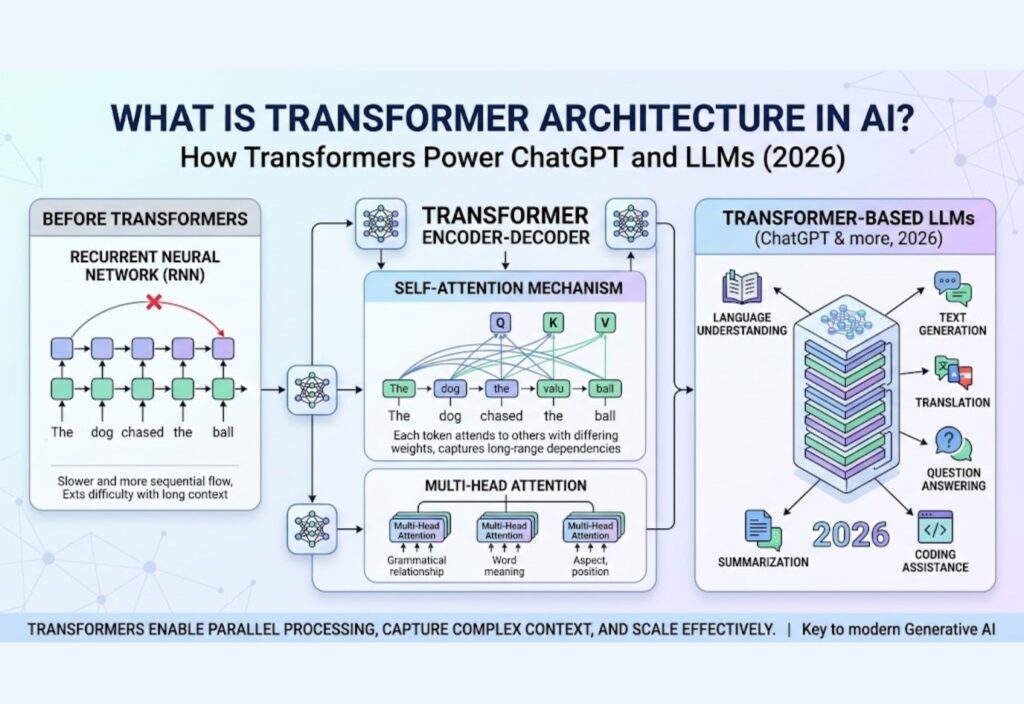
Before Transformers became popular, many language systems relied on architectures such as Recurrent Neural Networks (RNNs) and Long Short-Term Memory networks (LSTMs).
These older approaches processed information step by step. Transformers introduced a different approach by allowing the model to examine relationships between different parts of an input more effectively.
As a result, Transformers became highly useful for language understanding, text generation, translation, and many other AI tasks.
Why Were Transformers Created?
Before the Transformer architecture, processing long sequences could be difficult for AI systems.
For example, consider a sentence with many words.
An AI system needs to understand how words relate to one another. A word near the end of a sentence may depend on information from much earlier in the sentence.
Older sequence models could struggle with these long-range relationships.
Transformers addressed this challenge by using attention mechanisms.
Instead of processing every word only in a strict sequence, the model can examine relationships between different tokens and determine which parts of the input are more important for the current task.
This approach made language processing more efficient and scalable.
What Is Attention in AI?
Attention is one of the most important ideas behind Transformer models.
In simple terms, attention helps an AI model decide which parts of the input are important when processing a particular token.
Imagine the following sentence:
“The dog chased the ball because it was excited.”
To understand the word “it,” the model needs to consider other words in the sentence.
Attention allows the model to examine relationships between tokens and assign different levels of importance to them.
Therefore, instead of treating every word as equally important, the model can focus more strongly on relevant information.
What Is Self-Attention?
Self-attention is a mechanism that allows tokens within the same input to interact with one another.
Suppose a sentence contains many words.
When processing one token, the Transformer can compare it with other tokens in the sequence. It then calculates how strongly they should influence one another.
This helps the model understand:
Context
Relationships
Word meaning
Sentence structure
Long-range dependencies
Consequently, self-attention is one of the key reasons Transformers can handle complex language patterns.
How Does Self-Attention Work?
Self-attention may sound complicated, but the basic idea can be explained simply.
For each input token, the Transformer creates three important representations:
Query
Key
Value
These are commonly called Q, K, and V.
The query represents what the current token is looking for.
The key represents information that can be matched against that query.
The value contains the information that can be passed forward after the attention scores are calculated.
The model compares queries with keys to determine which tokens are more relevant.
After that, it uses the values to create a new representation containing information from the important tokens.
This process allows the model to build a richer understanding of the input.
What Are Queries, Keys, and Values?
The easiest way to understand Q, K, and V is through a simple analogy.
Imagine you are searching for information in a library.
The query represents what you are looking for.
The key represents labels or descriptions that help you find relevant information.
The value represents the actual information you receive.
In a Transformer, these three representations work together to calculate attention.
As a result, the model can determine which parts of the input deserve more focus.
Why Is Self-Attention Important?
Self-attention allows a model to connect information from different parts of a sequence.
For example, a sentence may contain a word at the beginning that strongly affects the meaning of a word near the end.
With self-attention, the model can directly consider that relationship.
This is especially useful for:
Long sentences
Documents
Conversations
Code
Questions and answers
Translation
Summarization
Therefore, self-attention became a major building block for modern language models.
What Is Multi-Head Attention?
Transformers do not normally rely on just one attention calculation.
Instead, they can use multiple attention heads.
This is called multi-head attention.
Each attention head can focus on different relationships within the input.
For example, one head may focus more on grammatical relationships, while another may capture relationships between distant words.
Another head may focus on a different type of pattern.
The outputs from these attention heads are then combined.
As a result, the model can examine the same input from multiple perspectives.
What Is a Transformer Encoder?
The original Transformer architecture included an encoder and a decoder.
The encoder processes the input and creates useful representations.
For example, if the input is a sentence, the encoder can transform the sentence into internal representations that capture its meaning and relationships.
Encoder-based architectures became especially useful for tasks such as:
Text classification
Language understanding
Search
Sentence analysis
Information extraction
Models such as BERT are well-known examples of Transformer-based encoder architectures.
What Is a Transformer Decoder?
The decoder is designed to generate or transform output based on available information.
It can process previously generated tokens and use them to predict the next token.
This makes decoder-based Transformers particularly useful for text generation.
Many modern generative AI systems use decoder-style Transformer architectures.
For example, GPT-style models are based on the decoder side of the Transformer concept.
Encoder vs Decoder
The difference can be explained simply.
Encoder: Mainly focuses on understanding and representing input information.
Decoder: Mainly focuses on generating output based on previous information.
However, modern AI architectures are not limited to the exact structure of the original Transformer.
Different models use different variations depending on their goals.
What Is an Encoder-Decoder Transformer?
Some Transformer models use both components.
The encoder processes the input, while the decoder generates the output.
This design can be useful for tasks where the system needs to transform one sequence into another.
Examples include:
Machine translation
Text transformation
Summarization
Question answering
Sequence-to-sequence tasks
The original Transformer architecture was designed around this encoder-decoder structure.
How Do Transformers Process Text?
Before a Transformer can process text, the text is usually divided into smaller units called tokens.
A token can represent a complete word, part of a word, punctuation, or another piece of text.
The tokens are then converted into numerical representations.
These representations are passed through the Transformer layers.
During processing, the model uses attention and other neural network operations to create richer representations of the input.
Finally, the model can use these representations to predict or generate output.
What Are Embeddings?
An embedding is a numerical representation of information.
In language models, tokens are converted into vectors containing numerical values.
These vectors allow the neural network to work with language mathematically.
Words or tokens with related meanings can have representations that share useful patterns.
Embeddings are therefore an important part of how AI systems transform language into a form that neural networks can process.
Why Do Transformers Need Positional Information?
Attention allows a Transformer to examine relationships between tokens. However, the model also needs information about the order of those tokens.
Consider these two sentences:
“The cat chased the dog.”
and
“The dog chased the cat.”
They contain many of the same words, but their meanings are different.
Therefore, the model needs some way to understand token positions.
Transformers use positional information to help the model understand the order and location of tokens.
Different Transformer architectures can use different methods for representing positional information.
What Is a Transformer Layer?
A Transformer is made up of multiple layers.
Each layer performs several important operations.
A simplified Transformer layer may contain:
Attention
Feed-forward neural network
Normalization
Residual connections
The exact design varies between models.
However, stacking many layers allows the model to gradually build more complex representations.
Early layers may capture simpler patterns, while deeper layers can represent more complex relationships.
What Is a Feed-Forward Network?
A Transformer layer usually contains a feed-forward neural network in addition to attention.
After the attention operation creates a contextual representation, the feed-forward component processes that representation further.
This gives the model additional capacity to transform and refine information.
Therefore, attention is extremely important, but it is not the only component responsible for Transformer performance.
What Are Residual Connections?
Residual connections help information move through deep neural networks.
Instead of forcing every layer to completely replace the previous representation, a residual connection allows information from an earlier stage to be carried forward.
This can make deep networks easier to train.
Because modern language models can contain many layers, residual connections are an important part of their architecture.
What Is Layer Normalization?
Layer normalization helps stabilize the values flowing through the network.
This can make training more reliable and support the optimization of deep Transformer models.
Together with residual connections and feed-forward networks, normalization helps create a stable architecture.
How Do Transformers Generate Text?
Generative Transformer models usually generate text one token at a time.
Suppose you provide the model with:
“Artificial intelligence is”
The model evaluates the available context and predicts possible next tokens.
It might assign probabilities to words such as:
changing
transforming
becoming
advancing
The model then selects a token based on its generation settings.
The process continues repeatedly until the response is complete.
Therefore, a language model can generate paragraphs by repeatedly predicting the next token.
Are Transformers Simply Predicting the Next Word?
Not exactly.
Technically, many language models predict the next token, not necessarily the next complete word.
A token may be a word, part of a word, punctuation, or another text unit.
Although next-token prediction sounds simple, training a model on huge amounts of text can teach it many complex patterns.
These patterns can support:
Writing
Coding
Translation
Question answering
Summarization
Reasoning-like behavior
How Do Transformers Power ChatGPT?
Modern conversational AI systems rely on advanced neural network techniques, and Transformer-based architecture is a key part of the development of GPT-style language models.
A simplified process looks like this:
User prompt → Tokenization → Transformer processing → Next-token prediction → Generated response
When you send a message, the text is converted into tokens.
Next, the model processes those tokens through multiple Transformer layers.
The model then predicts the next token and continues generating additional tokens until the response is produced.
Modern systems can also include additional components, tools, retrieval systems, safety systems, and other technologies around the core model.
What Is GPT?
GPT stands for Generative Pre-trained Transformer.
The name describes three important ideas.
Generative means the model can generate content.
Pre-trained means the model is trained on large datasets before being adapted for specific uses.
Transformer refers to the neural network architecture used as the foundation of the model family.
GPT-style models are therefore closely connected to Transformer technology.
What Is Pretraining?
Pretraining is the initial large-scale training stage of a language model.
During this stage, the model processes huge amounts of data and learns statistical patterns.
For a language model, one important training objective is predicting tokens from their context.
Over time, the model adjusts its parameters to improve its predictions.
This process can produce a model capable of handling many different language tasks.
What Is Fine-Tuning?
After pretraining, a model may be adapted for specific purposes.
This process is often called fine-tuning.
Fine-tuning can help a model become better at:
Following instructions
Coding
Specific domains
Particular writing styles
Specialized tasks
Not every modern AI system uses the same fine-tuning process, but adaptation after pretraining is an important part of many AI development workflows.
Why Are Transformers Better Than Older RNNs?
Transformers offer several advantages compared with older sequence-processing architectures.
One major advantage is the ability to process many relationships within a sequence more efficiently.
RNNs generally process tokens in sequence. Transformers can process many token relationships in parallel during training.
As a result, Transformer models can scale effectively with modern hardware.
Furthermore, attention makes it easier for the model to connect information across long sequences.
Transformers and Parallel Processing
Parallel processing is one of the major reasons Transformers became successful.
During training, many computations can be performed at the same time.
This works particularly well with modern GPUs and other specialized hardware.
Consequently, researchers can train much larger models on much larger datasets.
This scalability helped drive the rapid development of modern LLMs.
What Are Large Language Models?
A Large Language Model, or LLM, is an AI model trained to process and generate human language.
Many modern LLMs use Transformer-based architectures.
LLMs can perform tasks such as:
Answering questions
Writing text
Summarizing documents
Translating languages
Generating code
Extracting information
Following instructions
The Transformer architecture provides the underlying mechanism that allows many of these models to process language effectively.
Are All AI Models Transformers?
No.
Not every AI model uses Transformer architecture.
Other architectures exist, including:
Convolutional Neural Networks
Recurrent Neural Networks
State-space models
Hybrid architectures
Other specialized neural networks
However, Transformers have become extremely influential in modern AI, especially in language and multimodal applications.
Are Transformers Used Only for Text?
No.
Transformer-based systems can work with many types of data.
They have been used in areas such as:
Text
Images
Audio
Video
Code
Multimodal AI
This flexibility is one reason the architecture has become so important.
For example, multimodal AI systems can combine information from text and images.
Transformers in Computer Vision
Transformers are also used in computer vision.
Vision Transformer approaches can divide an image into smaller sections and process them using Transformer-style mechanisms.
This demonstrated that attention-based architectures could be useful beyond traditional language tasks.
As a result, Transformer ideas have expanded into many areas of machine learning.
Transformers in Multimodal AI
Modern AI systems increasingly work with multiple types of information.
A multimodal model may process:
Text
Images
Audio
Video
Transformer-based techniques can help connect these different forms of information.
This makes the architecture useful for applications that go beyond simple text generation.
Advantages of Transformer Architecture
Transformers provide several important advantages.
Better Context Handling
Attention helps models connect different parts of an input.
Parallel Training
Transformers can make better use of modern hardware during training.
Scalability
The architecture can be scaled to very large models.
Flexibility
Transformers can be adapted to different types of data and tasks.
Strong Language Performance
They have become a foundation for many advanced language models.
Limitations of Transformer Architecture
Despite their advantages, Transformers also have limitations.
High Computing Requirements
Large Transformer models can require significant computing resources.
Memory Usage
Long contexts and large models can require substantial memory.
Training Cost
Training advanced models can be expensive.
Hallucinations
Language models can sometimes generate incorrect information with high confidence.
Complexity
Modern Transformer systems can be technically complex to build, train, and operate.
Why Are Transformers Important in 2026?
Transformers remain highly important because they support many modern AI systems.
The architecture has helped enable rapid progress in:
Large Language Models
Generative AI
AI assistants
Coding tools
Multimodal AI
AI agents
Search systems
Document processing
At the same time, researchers continue to explore new architectures and techniques that could improve efficiency, memory use, and reasoning.
Therefore, understanding Transformers remains useful for anyone who wants to understand modern AI.
Transformer vs LLM: What Is the Difference?
A Transformer is an architecture.
An LLM is a large language model that has been trained to work with language.
In simple terms:
Transformer = the architecture or design
LLM = a trained language model
Many modern LLMs use Transformer-based architectures, but the two terms are not interchangeable.
Transformer vs Generative AI
Generative AI is a broader category.
It includes systems that generate:
Text
Images
Audio
Video
Code
Transformers are one type of architecture that can be used to build generative AI systems.
Therefore, Transformer architecture is a technology that can support some generative AI systems rather than being synonymous with generative AI.
Frequently Asked Questions
What is Transformer architecture in AI?
Transformer architecture is a neural network design that uses attention mechanisms to process relationships between parts of an input. It has become a major foundation for modern language models.
Why are Transformers important for ChatGPT?
Transformer-based architecture enables language models to process relationships between tokens and generate responses based on context.
What is self-attention?
Self-attention allows tokens within the same input to interact with one another so the model can determine which information is important.
What are Q, K, and V in Transformers?
Q, K, and V stand for Query, Key, and Value. They are representations used by the attention mechanism to calculate relationships between tokens.
What is multi-head attention?
Multi-head attention uses multiple attention operations so the model can examine different relationships within the same input.
Are GPT models based on Transformers?
GPT-style models are based on Transformer technology, particularly decoder-style Transformer designs.
Are Transformers used outside language models?
Yes. Transformer-based architectures are also used in areas such as computer vision, audio, video, code, and multimodal AI.
Are Transformers the same as LLMs?
No. A Transformer is an architecture, while an LLM is a trained language model. Many LLMs use Transformer-based architectures.
Are Transformers still important in 2026?
Yes. Transformer technology remains highly influential in modern AI, although researchers are also exploring alternative and hybrid architectures.
Final Thoughts
The Transformer architecture is one of the most important developments in modern artificial intelligence.
Its attention mechanism allows AI models to examine relationships between tokens and build richer representations of language and other information.
The introduction of Transformers helped make large-scale AI training more practical and contributed to the growth of modern LLMs and generative AI.
Today, Transformer-based technology is associated with many applications, including language models, coding assistants, multimodal systems, search tools, and AI agents.
The most important concepts to remember are simple:
Attention helps the model focus on relevant information.
Self-attention allows tokens to interact with other tokens.
Multiple Transformer layers build increasingly complex representations.
GPT-style models use Transformer-based architecture for language generation.
LLMs are trained models, while Transformers are an underlying architecture.
Understanding these concepts gives you a strong foundation for learning about more advanced AI topics such as fine-tuning, embeddings, vector databases, RAG, AI agents, inference, and AI reasoning models.