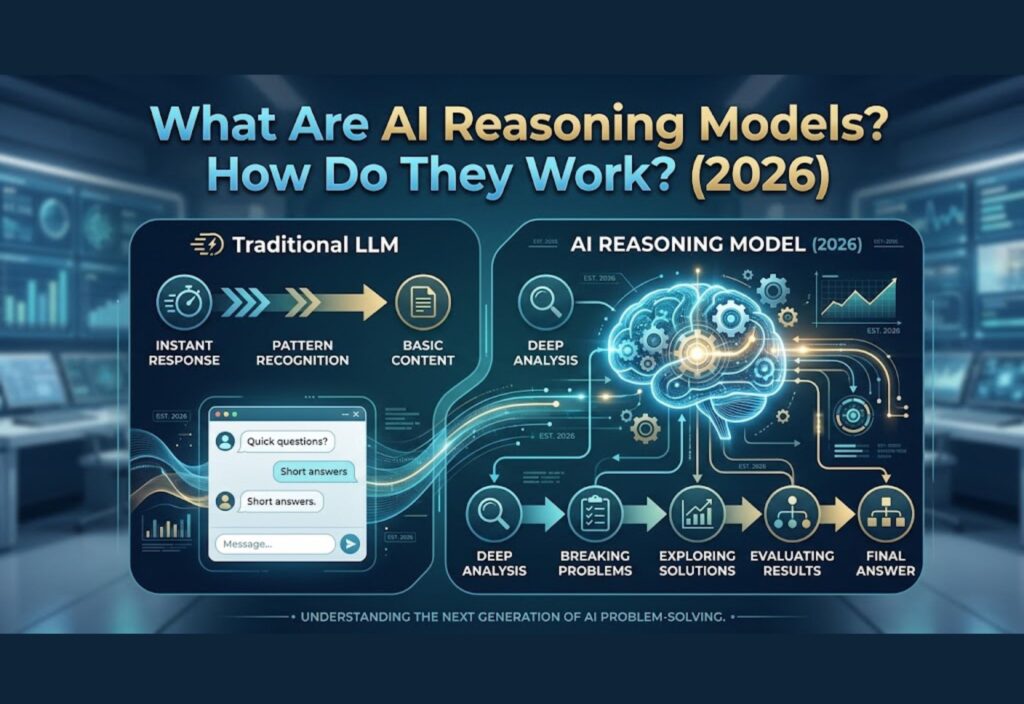
Artificial intelligence has evolved rapidly over the past few years. Early AI systems were mainly designed to recognize patterns, answer simple questions, and generate basic content. Modern AI systems, however, are becoming much better at solving difficult problems that require multiple steps of analysis.
One of the most important developments in this area is the rise of AI reasoning models.
Unlike systems that focus mainly on producing an immediate response, reasoning models are designed to spend additional computational effort on difficult tasks before delivering a final answer. This can make them especially useful for mathematics, programming, scientific research, logical problems, planning, and complex analysis.
Reasoning models are sometimes also called thinking models because they are designed to perform additional internal computation before producing their final output. The underlying technology is still based largely on modern language-model architectures, but training and inference methods are optimized for more difficult problem-solving tasks.
In this complete beginner-friendly guide, we will explain what AI reasoning models are, how they work, how they differ from traditional LLMs, where they are used, their benefits and limitations, and what the future of AI reasoning could look like in 2026 and beyond.
What Are AI Reasoning Models?
AI reasoning models are artificial intelligence models designed to solve complex problems by using additional computational effort and multi-step problem-solving before generating a final answer.
A traditional language model may respond quickly after processing a user’s prompt. A reasoning model can instead spend more time analyzing the problem, considering possible approaches, checking intermediate results, and selecting a stronger solution.
For example, imagine asking an AI this question:
A business has 500 customers. Its customer base increases by 20% during the first year and decreases by 10% during the second year. How many customers does it have after two years?
A simple approach might try to calculate the answer immediately.
A reasoning-oriented approach can break the problem into stages:
Start with 500 customers.
Calculate the 20% increase.
Determine the new customer total.
Apply the 10% decrease to the new total.
Check the calculation.
Provide the final answer.
This type of multi-step processing is particularly useful when a problem cannot be solved reliably with a quick response.
Reasoning models are therefore not simply about having more information. They are about improving how a model handles complex problem-solving tasks.
How Do AI Reasoning Models Work?
AI reasoning models are generally built on technologies related to modern language models, including transformer-based architectures. What makes reasoning systems different is largely how they are trained and how much computation they are allowed to use during inference.
A simplified workflow looks like this:
User Problem → Understand → Break Down → Analyze → Evaluate → Verify → Final Answer
The exact implementation differs between AI systems, and the internal reasoning process is not necessarily exposed to users.
Research and industry discussions commonly associate modern reasoning systems with techniques such as reinforcement learning, inference-time scaling, verification, and additional test-time computation.
1. Understanding the Problem
The first step is understanding what the user is actually asking.
Consider a programming question. It might include:
A description of the problem
Existing source code
Error messages
Expected output
Technical requirements
Restrictions
Before suggesting a solution, the AI needs to determine the actual objective and identify the important information.
2. Breaking the Problem Into Smaller Tasks
Complex problems are often easier to solve when divided into smaller components.
For example, a business analysis task may require the model to:
Examine the available information
Identify relevant metrics
Compare different values
Find relationships
Consider possible causes
Develop a conclusion
Breaking a task into smaller parts can make complicated problems easier to process.
3. Exploring Possible Solutions
Some problems have more than one possible solution.
A reasoning model can evaluate different approaches and determine which one appears most suitable.
This can be useful for:
Mathematics
Coding
Logic
Planning
Scientific analysis
Business problems
The model does not necessarily need to expose every internal step to the user. The important goal is to produce a more reliable final result.
4. Evaluating the Result
A reasoning system may also evaluate whether its proposed solution is consistent with the problem.
For example, when solving a mathematical problem, the result can be checked against the original requirements.
When generating code, the model can examine whether the proposed implementation actually addresses the reported issue.
For some tasks, external verification can be especially valuable because it provides an objective way to test an answer.
5. Producing the Final Response
After the system has processed the problem, it generates the final response.
Users generally receive the answer or a concise explanation rather than a complete private internal reasoning trace.
This distinction is important because sophisticated internal computation does not mean that every internal step should be displayed to the user.
AI Reasoning Models vs Traditional LLMs
AI reasoning models and traditional large language models are closely related.
Both can understand prompts and generate text, but they can be optimized differently.
Traditional LLMs are often excellent at:
Writing
Summarization
Translation
Brainstorming
Conversation
Content generation
Basic question answering
Reasoning models are particularly useful for:
Complex mathematics
Advanced coding
Logical problems
Multi-step analysis
Planning
Scientific reasoning
Complicated decision-support tasks
The distinction is not absolute. Modern AI systems can combine general language capabilities with reasoning capabilities.
Simple Comparison
Traditional LLM vs AI Reasoning Model
Text Generation
- Traditional LLM: Excellent
- Reasoning Model: Excellent
Complex Mathematics
- Traditional LLM: Varies
- Reasoning Model: Often stronger
Multi-Step Logic
- Traditional LLM: Varies
- Reasoning Model: Strong
Advanced Coding
- Traditional LLM: Good to Excellent
- Reasoning Model: Often stronger
Response Speed
- Traditional LLM: Often faster
- Reasoning Model: May take longer
Computational Effort
- Traditional LLM: Usually lower
- Reasoning Model: May be higher
The best choice depends on the task.
If you need a quick product description or email draft, a general LLM may be enough. If you need help analyzing a difficult mathematical, programming, or planning problem, a reasoning model may be more suitable.
Why Are AI Reasoning Models Important?
The development of reasoning models represents an important change in how AI performance is improved.
For many years, increasing model size and training data were major ways to improve AI capabilities. More recently, researchers and developers have increasingly explored giving models more computational effort during inference for difficult problems.
This approach is often described as test-time compute or inference-time scaling.
This matters because many real-world problems cannot be solved effectively through simple pattern matching.
For example, a software developer debugging a complicated application may need to understand several components, trace dependencies, identify an error, and determine the most likely cause.
Similarly, a researcher may need to compare evidence, identify relationships, and reach a carefully supported conclusion.
These tasks involve multiple stages.
Reasoning models are designed to perform better on this type of work.
Key Technologies Behind AI Reasoning Models
AI reasoning does not depend on one single technology.
Several techniques contribute to the development of reasoning-capable systems.
Transformer Architecture
Transformers are a fundamental technology behind many modern language models.
They allow models to process relationships between tokens and work with contextual information across a sequence.
Many reasoning models continue to use transformer-based architectures while adding specialized training and inference strategies.
The key difference is therefore not necessarily a completely different architecture. Training methods and inference-time computation can play a major role in improving reasoning performance.
Reinforcement Learning
Reinforcement learning (RL) is a machine learning approach in which a system learns to improve its behavior through rewards or feedback.
For reasoning models, training can encourage the system to produce better solutions to difficult tasks.
For example, if an AI repeatedly attempts mathematical problems and receives stronger feedback for correct solutions, the training process can favor behaviors associated with successful problem-solving.
Reinforcement Learning With Verifiable Rewards
Some problems have answers that can be automatically verified.
Mathematics is a useful example.
If a problem has a known correct answer, a system can determine whether the model’s final result is correct.
Programming provides another opportunity. Generated code can sometimes be tested automatically against predefined requirements.
These types of verifiable tasks can provide useful feedback during training and evaluation.
Test-Time Compute
One of the most important ideas behind modern reasoning systems is test-time compute.
Traditional systems may be optimized primarily for producing an answer quickly.
Reasoning systems can instead use additional computation while solving a difficult problem.
A simplified idea is:
Harder problem → More computational effort → More analysis → Potentially better result
This does not mean that more computation guarantees correctness. However, research and industry work increasingly show that additional inference-time computation can improve performance on suitable reasoning tasks.
What Is the Difference Between Reasoning and Memorization?
A common misunderstanding is that an AI reasons simply because it has a huge amount of information.
That is not necessarily true.
A model may know many facts but still struggle with an unfamiliar problem that requires several steps.
Reasoning involves applying information to reach a conclusion.
For example, knowing mathematical rules is different from applying those rules to solve a new problem.
Similarly, knowing programming syntax is different from identifying why a complex application is failing.
Reasoning models are designed to improve the ability to work through these types of problems.
Researchers also recognize that evaluating reasoning is difficult because strong performance can sometimes be influenced by memorization or familiarity with benchmark-style questions. Modern evaluations therefore increasingly attempt to distinguish general problem-solving from simple recall.
Real-World Applications of AI Reasoning Models
AI reasoning models can support many industries and professional workflows.
1. Mathematics
Mathematical problem-solving is one of the most obvious applications.
Reasoning models can assist with:
Algebra
Geometry
Probability
Statistics
Calculus
Word problems
Mathematical proofs
They can work through problems that require multiple operations or logical steps.
However, important mathematical results should still be verified.
2. Software Development
Reasoning models can be highly useful for developers.
They can assist with:
Debugging
Code generation
Code review
Architecture planning
Algorithm design
Testing
Refactoring
Understanding unfamiliar code
For example, a developer may provide an error and several related files. The AI may need to analyze how the components interact before identifying a likely cause.
This is much more complex than generating a short code snippet.
3. Scientific Research
Scientific research often requires analyzing relationships between different pieces of information.
Reasoning models can assist with:
Literature analysis
Hypothesis development
Data interpretation
Experimental planning
Research summaries
Comparing findings
AI can help researchers process information more efficiently, but scientific conclusions should still be reviewed by qualified experts.
4. Business Analysis
Businesses generate large amounts of data and information.
Reasoning systems can help analyze:
Sales performance
Customer behavior
Market trends
Business processes
Financial reports
Operational problems
For example, a company could ask an AI system to analyze several months of sales information and identify possible reasons for declining performance.
The AI may need to compare multiple variables before producing a useful explanation.
5. Education
AI reasoning models can also support education.
They can help students understand:
Mathematics
Programming
Science
Logic
Complex concepts
Problem-solving methods
Instead of simply providing an answer, an AI tutor can explain concepts and demonstrate how a problem can be approached.
Students should still use AI as a learning aid rather than relying on it to replace their own understanding.
6. Research and Knowledge Work
Professionals frequently need to compare and organize large amounts of information.
Reasoning-capable AI can assist with:
Research
Document analysis
Comparisons
Structured reports
Planning
Information synthesis
This can reduce the time required for certain knowledge-work tasks.
7. Cybersecurity
Cybersecurity requires careful analysis of patterns, events, and potential threats.
AI reasoning systems can assist with:
Log analysis
Threat investigation
Incident analysis
Security alerts
Vulnerability assessment
Security documentation
However, cybersecurity decisions should involve qualified security professionals because incorrect decisions can create serious risks.
Benefits of AI Reasoning Models
AI reasoning models offer several potential advantages.
Better Performance on Complex Problems
Their main advantage is their focus on difficult tasks that require multiple steps.
Instead of immediately generating an answer, they can dedicate additional computational effort to analyzing the problem.
Improved Problem Solving
Reasoning-focused training can improve performance on areas such as:
Mathematics
Programming
Logic
Planning
Scientific tasks
This makes reasoning models particularly valuable for advanced knowledge work.
More Useful for Professional Work
As AI becomes better at complex reasoning, it can support professionals with tasks beyond basic content generation.
Developers, researchers, analysts, educators, and other professionals can use reasoning systems as assistants for difficult workflows.
Better Handling of Multi-Step Instructions
A reasoning model can be useful when a task contains multiple requirements.
For example:
Analyze the information.
Identify the main problems.
Compare possible solutions.
Select an appropriate approach.
Explain the recommendation.
This type of workflow can benefit from stronger reasoning capabilities.
Limitations of AI Reasoning Models
Despite their capabilities, reasoning models are not perfect.
They Can Still Make Mistakes
A reasoning model can produce an incorrect answer even when its response appears convincing.
Additional computation can improve performance, but it does not guarantee correctness.
Higher Computational Cost
Reasoning can require additional computation.
This can lead to:
Higher operating costs
Longer response times
Increased token usage
Greater hardware requirements
For simple tasks, using a powerful reasoning model may therefore be unnecessary.
Hallucinations Still Exist
AI models can still produce false or unsupported information.
A reasoning model may make a detailed argument and still arrive at the wrong conclusion.
Users should verify important information, especially when the consequences of an error are significant.
Complex Reasoning Can Still Fail
Some problems contain:
Missing information
Ambiguous instructions
Incorrect assumptions
Contradictory evidence
Unclear objectives
A reasoning model may struggle when the problem itself is poorly defined.
Not a Replacement for Human Judgment
AI reasoning models should generally be treated as tools that support human decision-making.
Important decisions involving medicine, law, finance, security, or other high-stakes areas require appropriate human expertise and verification.
Are AI Reasoning Models the Same as AGI?
No.
AI reasoning models should not automatically be considered Artificial General Intelligence (AGI).
AGI generally refers to a hypothetical form of AI capable of performing a broad range of intellectual tasks with highly general capabilities.
A reasoning model can be extremely capable at mathematics, coding, research, or planning while still having significant limitations.
Strong reasoning is an important AI capability, but it does not by itself establish that a system has achieved AGI.
Reasoning Models and AI Agents
Reasoning models are becoming increasingly important components of AI agents.
An AI agent may need to:
Understand a goal.
Create a plan.
Decide which actions are necessary.
Use external tools.
Evaluate results.
Change its plan when necessary.
Complete the task.
This requires more than generating a single response.
For example, an AI research agent may need to determine what information is required, search for relevant sources, analyze the results, identify missing information, and organize the final findings.
Reasoning capabilities can help AI agents make better decisions during these workflows.
This is one reason AI reasoning and Agentic AI are becoming increasingly connected.
Reasoning Models and Tool Use
Modern AI systems can also interact with external tools.
Depending on the system, AI may be able to use:
Calculators
Code execution environments
Search systems
Databases
APIs
File-processing tools
Business software
Tool use can improve reliability because an AI does not always need to rely entirely on its internal model knowledge.
For example, instead of estimating a complex calculation, an AI can use a calculator or execute code.
Similarly, instead of relying on potentially outdated information, a connected AI system can retrieve current information from an appropriate external source.
This combination of reasoning + tools can make AI systems more useful for real-world tasks.
Do Reasoning Models Think Like Humans?
Not necessarily.
The term “reasoning” can make AI systems sound similar to human minds, but artificial reasoning and human thought are not identical.
AI models operate through computational processes learned during training.
Humans have consciousness, emotions, personal experiences, biological processes, and many other characteristics that are not automatically present in AI systems.
Therefore, it is more accurate to describe reasoning models according to their problem-solving capabilities rather than assuming they think exactly like humans.
How to Choose Between an LLM and a Reasoning Model
The right model depends on the task.
Choose a General LLM For:
Email writing
Blog drafting
Summarization
Translation
Brainstorming
Simple questions
Everyday conversations
Basic content creation
Consider a Reasoning Model For:
Difficult mathematics
Complex programming
Multi-step analysis
Advanced logic
Detailed planning
Complicated research
Problems involving several dependent decisions
In real-world applications, organizations may use both approaches.
A fast model can handle simple tasks while a reasoning model can be reserved for difficult problems where additional computational effort provides more value.
How AI Reasoning Could Change Work in 2026
AI reasoning is becoming increasingly relevant to professional workflows.
Instead of using AI only to generate text, organizations can use advanced systems to assist with complicated knowledge-work processes.
For example, a marketing team could use AI to:
Analyze campaign performance
Identify weak-performing content
Compare customer segments
Develop campaign ideas
Create an optimization plan
A software team could use AI to:
Analyze bugs
Review code
Suggest architectural improvements
Generate tests
Investigate performance issues
The broader direction is moving from AI that simply generates content toward AI that can help solve problems, plan tasks, use tools, and complete workflows.
Future of AI Reasoning Models
The future of AI reasoning is likely to involve several important developments.
More Efficient Reasoning
Reasoning can require significant computational resources.
Future systems may become better at determining when deep reasoning is necessary and when a faster response is sufficient.
This could make AI systems more efficient and reduce unnecessary computational costs.
Better Tool Integration
Reasoning models are likely to become increasingly capable of using external tools.
This could allow AI systems to combine reasoning with:
Real-time information
Databases
APIs
Software tools
Calculators
Code execution
This combination can make AI more useful for practical workflows.
Stronger AI Agents
Improved reasoning capabilities can contribute to more capable AI agents that plan and execute longer tasks.
Instead of responding to one question at a time, future systems may be able to manage workflows involving many connected steps.
Improved Reliability
Researchers and AI developers are also working on improving the reliability of reasoning systems.
Better evaluation methods, verification techniques, training approaches, and external tools can help reduce errors.
However, perfect reliability remains a difficult goal.
Frequently Asked Questions About AI Reasoning Models
What Is an AI Reasoning Model?
An AI reasoning model is an AI system designed to handle complex problems using additional computational effort and multi-step problem-solving before producing a final answer.
Are Reasoning Models Better Than Normal LLMs?
Not for every task. Reasoning models can be stronger for difficult mathematics, coding, logic, planning, and complex analysis, while general LLMs can be faster and more efficient for simple writing, summarization, and everyday questions.
Do Reasoning Models Always Give Correct Answers?
No. Reasoning models can still make mistakes, hallucinate information, or misunderstand a problem. Important outputs should be independently verified.
Are Reasoning Models Part of Generative AI?
Yes. Reasoning models are part of the broader generative AI ecosystem. They can generate text, code, and other outputs while applying additional computational effort to difficult tasks.
Are AI Reasoning Models AGI?
No. Strong reasoning capabilities do not automatically mean that an AI system has achieved AGI.
Can AI Reasoning Models Help Programmers?
Yes. They can assist with debugging, code generation, code review, testing, architecture planning, and complex programming problems.
Why Can Reasoning Models Take Longer to Answer?
Some reasoning systems use additional computation during inference to analyze difficult problems before producing their final response. This can increase latency compared with systems optimized mainly for speed.
Conclusion
AI reasoning models represent an important development in the evolution of artificial intelligence.
Traditional LLMs have transformed writing, communication, search, and content generation. Reasoning-focused models extend these capabilities by targeting problems that require multiple stages of analysis.
They can be useful for mathematics, programming, scientific research, education, business analysis, cybersecurity, planning, and many other areas.
However, reasoning models are not perfect. They can still produce incorrect information, misunderstand ambiguous problems, require significant computational resources, and make mistakes even when their answers appear convincing.
For this reason, AI reasoning models should be treated as powerful tools rather than infallible decision-makers.
As AI continues to develop in 2026, the industry is increasingly focused not only on generating fluent responses but also on building systems that can reason, use tools, verify results, plan tasks, and solve increasingly complex problems.
Understanding AI reasoning models is therefore becoming important for anyone who wants to understand the next generation of artificial intelligence. The combination of language understanding, reasoning, tool use, and AI agents could play a major role in how people and businesses use AI in the years ahead.