Artificial intelligence is changing how people search for information online. Today, users can ask detailed questions and receive direct answers from AI-powered search tools. Instead of opening many websites, they can sometimes get a useful summary within seconds.
This change is creating new opportunities for website owners and content creators. Traditional SEO is still important, but websites now also need content that AI systems can understand and use effectively.
AI SEO focuses on making website content clear, useful, trustworthy, and easy for search engines and AI-powered systems to understand.
In this complete guide, you will learn what AI SEO is, how AI search works, how it differs from traditional SEO, and how to optimize your website for AI search in 2026.
What Is AI SEO?
AI SEO is the process of optimizing website content so search engines and AI-powered systems can understand, discover, evaluate, and use the information more effectively.
Traditional SEO mainly focuses on improving visibility in search engine results. AI SEO adds another layer by considering conversational questions, topic relationships, context, and AI-generated answers.
For example, a traditional SEO strategy may target the keyword:
AI SEO
However, users may search for longer questions such as:
What is AI SEO?
How does AI SEO work?
How can I optimize my website for AI search?
What is the difference between AI SEO and traditional SEO?
How can my content appear in AI-generated answers?
Therefore, AI SEO is not simply about repeating keywords. Instead, it focuses on creating useful information that answers real questions and provides enough context to understand the topic.
Why Is AI SEO Important in 2026?
Search behavior is changing rapidly. People are becoming more comfortable asking complete questions instead of entering only short keywords.
For example, someone may search:
Best AI SEO tools
Another person may ask:
Which AI SEO tools are useful for a small business website?
The second query gives more context about the user’s needs. As a result, modern search systems need to understand the meaning and intent behind a question.
AI-powered search can also summarize information and provide direct answers. Consequently, websites have another opportunity to become visible when their content provides useful information.
Traditional rankings still matter. However, website owners should now consider how their content can help both people and AI-powered search systems.
What Is AI Search?
AI search is a search experience that uses artificial intelligence to understand questions, find relevant information, and provide useful answers.
Traditional search usually presents a list of web pages. Users then visit those pages to find the information they need.
AI search can take a different approach. It may understand the question, find relevant information, and create a summarized response.
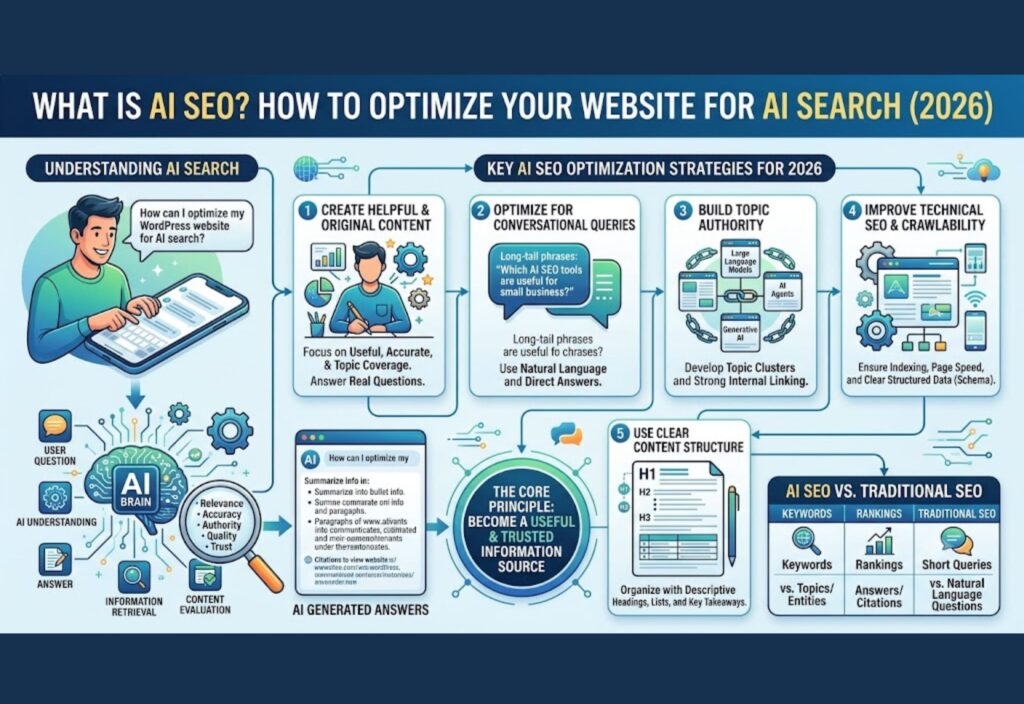
A simplified process looks like this:
User Question → AI Understanding → Information Retrieval → Content Evaluation → Answer
Because of this process, website content should be clear, well organized, and useful.
How Does AI Search Work?
Different AI search systems use different technologies. Nevertheless, the basic process can be explained through several steps.
1. AI Understands the User’s Question
First, the system analyzes the user’s query.
For example:
How can I optimize my WordPress website for AI search?
The system can identify the main subject, website platform, and user’s goal.
Therefore, content should use natural language and answer the actual question. Keyword repetition alone is not enough.
2. The System Finds Relevant Information
Next, the search system looks for useful information.
Depending on the platform, this information may come from websites, documents, databases, or other available sources.
For this reason, technical SEO remains important. If search engines cannot access your pages, your content may be harder to discover.
3. Information Is Evaluated
After finding possible sources, the system needs to determine which information is useful for the question.
Important qualities can include:
Relevance
Accuracy
Content quality
Authority
Freshness
Trust
Topic coverage
As a result, a complete and useful article can provide more value than a thin page created only around one keyword.
4. AI Generates an Answer
Finally, the system can use relevant information to create a response.
Depending on the platform, the response may contain:
Direct answers
Summaries
Bullet points
Comparisons
Recommendations
Source links
Follow-up questions
Therefore, important information should be easy to find and understand.
AI SEO vs Traditional SEO
AI SEO and traditional SEO share many important principles. However, their visibility goals can be slightly different.
| Traditional SEO | AI SEO |
|---|---|
| Focuses mainly on search rankings | Also considers AI-generated answers |
| Targets keywords | Targets topics, entities, and questions |
| Focuses on search results | Focuses on search and AI experiences |
| Often focuses on clicks | Can also focus on mentions and citations |
| Uses on-page SEO | Uses clear and useful information |
| Builds backlinks and authority | Builds trust and topical authority |
| Targets search queries | Targets natural-language questions |
Still, traditional SEO is not dead.
Technical SEO, indexing, internal linking, website architecture, and useful content remain important.
In other words, AI SEO should complement traditional SEO rather than replace it.
How to Optimize Your Website for AI Search
The good news is that many AI SEO practices are based on strong SEO fundamentals.
You do not need to completely change your website. Instead, improve the quality, structure, and usefulness of your existing content.
Create Helpful and Original Content
Useful content is the foundation of AI SEO.
Before writing an article, think about the reader’s problem. What does the person want to learn? What information will help them make a decision or complete a task?
For example, an article about AI agents should not only provide a definition. It can also explain:
How AI agents work
Main components
Real-world examples
Benefits
Limitations
Popular frameworks
Common mistakes
As a result, readers can understand the subject without visiting many different pages.
Moreover, complete coverage allows you to answer related questions naturally.
Understand Search Intent
Search intent is the reason behind a user’s search.
A person looking for educational information has a different goal from someone comparing products. Therefore, understanding intent should be part of your content planning process.
Informational Intent
The user wants to learn something.
Examples include:
What is AI SEO?
What is an LLM?
How does RAG work?
Commercial Intent
The user is comparing different options.
Examples include:
Best AI SEO tools
Best AI writing tools
ChatGPT vs Claude
Transactional Intent
The user is ready to take action.
Examples include:
Buy SEO software
Subscribe to an AI tool
Download an AI application
Navigational Intent
The user wants to reach a specific website or service.
Examples include:
Google Search Console
ChatGPT
OpenAI API
Therefore, always identify the search intent before creating an article.
Answer Questions Directly
AI search users often want quick and clear answers.
For this reason, important questions should be answered directly.
For example:
What Is AI SEO?
AI SEO is the process of optimizing website content so search engines and AI-powered systems can understand, discover, and use the information effectively.
After providing the direct answer, explain the topic in greater detail.
This approach helps readers find important information quickly. At the same time, it creates a clear structure for the rest of the article.
Use Clear H2 and H3 Headings
A clear heading structure makes long articles easier to read.
For example:
H1: What Is AI SEO?
H2: What Is AI Search?
H2: How Does AI Search Work?
H2: AI SEO vs Traditional SEO
H2: How to Optimize Your Website for AI Search
H3: Create Helpful Content
H3: Understand Search Intent
H3: Improve Internal Linking
H3: Improve Technical SEO
Furthermore, headings help readers understand the subject before reading each section.
Do not add keywords to headings only for SEO. Instead, make every heading useful and descriptive.
Build Topic Clusters
One article is usually not enough to establish authority around a broad subject.
Instead, create several related articles and connect them through internal links.
For an AI website, a topic cluster could include:
What Are Large Language Models?
What Is Generative AI?
What Is RAG?
What Is AI SEO?
What Is AI Search?
What Is Agentic AI?
What Are AI Agents?
What Are AI Tokens?
What Is a Vector Database?
What Is Multimodal AI?
These articles can support one another.
Consequently, readers can explore related subjects while search engines can better understand the overall topic structure of your website.
Improve Internal Linking
Internal linking connects related pages on your website.
Suppose you already have an article about Large Language Models. When discussing LLMs in an AI SEO article, you can naturally link to that detailed guide.
The same approach can be used for:
RAG
AI Agents
AI Tokens
Vector Databases
Generative AI
AI Hallucinations
Multimodal AI
Use descriptive anchor text whenever possible.
For example, instead of:
Click here
use:
learn how Large Language Models work
This tells readers what they can expect after clicking.
Add Real Examples
Examples make technical subjects easier to understand.
For instance, imagine a website publishing an article about AI agents.
A useful article could explain:
What an AI agent is
How it makes decisions
Which tools it can use
How it connects to APIs
What problems it can solve
What limitations it has
Therefore, readers receive practical information rather than only a short definition.
Real examples can also make your content more useful than generic articles.
Show Experience and Expertise
Trust is important when publishing technical content.
If you have practical experience with a subject, include useful details from that experience.
For example, a WordPress website owner can explain:
How blog posts are optimized
How internal links are added
How indexing is monitored
How page speed is improved
How old content is updated
These details can make an article more useful.
In addition, a clear author bio can help visitors understand who created the content.
Keep Your Information Accurate
AI and SEO technologies change quickly.
Therefore, information can become outdated over time.
Review important articles regularly and update information when tools, search features, or best practices change.
Check areas such as:
Statistics
Software features
Pricing
Links
Examples
Screenshots
Technical recommendations
However, avoid unsupported claims.
For example, do not say:
This technique guarantees that ChatGPT will cite your website.
Instead, use more accurate language:
These practices can help AI systems understand your content more clearly.
This makes your content more trustworthy.
Improve Technical SEO
Technical SEO remains important for AI search.
Search systems need to discover, crawl, and understand your website.
Check these areas regularly:
Website crawling
Indexing
XML sitemap
Robots.txt
Canonical URLs
Mobile usability
HTTPS
Page speed
Internal links
URL structure
Also, use Google Search Console to monitor indexing and search performance.
If important pages cannot be crawled or indexed, content optimization alone may not solve the problem.
How to Write Content for AI Search
Writing for AI search does not mean making content sound robotic.
Instead, write naturally while keeping the information clear and organized.
Use questions that people actually ask.
For example:
What is AI SEO?
How does AI SEO work?
What is AI search?
How can I optimize my website for AI search?
Does traditional SEO still matter?
How can I improve AI search visibility?
Then answer these questions in simple language.
Use Simple Definitions
When introducing a new term, define it first.
For example:
RAG, or Retrieval-Augmented Generation, is an AI method that allows a language model to retrieve information from external sources before generating an answer.
Afterward, explain how the technology works and why it matters.
This method helps beginners understand difficult topics. At the same time, it provides clear context about the subject.
Explain Related Concepts
AI systems understand information in context.
Therefore, explain how different technologies are connected.
For example:
LLM → Embeddings → Vector Database → RAG → AI Application
Similarly, an AI agent may use:
LLM → Tools → APIs → Memory → RAG → Actions
These relationships help readers understand how different AI technologies work together.
Use Lists and Tables
Long paragraphs can sometimes be difficult to scan.
Therefore, use bullet points when they make information easier to understand.
For example:
Benefits of AI SEO
Better content structure
Clearer answers
Stronger topic coverage
Better user experience
Useful internal linking
Better preparation for AI search
Tables are also useful when comparing technologies or strategies.
However, do not add tables when a simple explanation would be clearer.
Optimize Images
Images can improve the user experience when they support the content.
Use descriptive image filenames.
For example:
Poor filename:
image123.jpg
Better filename:
ai-seo-ai-search-guide-2026.jpg
Also add useful alt text.
Example:
Alt text:
AI SEO workflow for optimizing website content for AI search
Furthermore, compress images before uploading them.
Smaller image files can help improve page loading speed.
Use Structured Data Correctly
Structured data can help search engines understand certain types of information.
Depending on the page, suitable schema types may include:
Article
Organization
Product
Event
Breadcrumb
Use structured data only when it accurately represents the page.
Do not add false or misleading schema simply to gain more visibility.
Correct implementation is more important than adding as much schema as possible.
Make Your Website Easy to Crawl
Search visibility starts with discoverability.
Important pages should be easy for search engines to find.
Check whether your content is affected by:
Noindex tags
Incorrect robots.txt rules
Broken canonical URLs
Broken internal links
Missing sitemap entries
Login restrictions
As a result, technical checks should be part of your regular SEO process.
Build a Strong Content Structure
AI SEO works better when a website has a clear content structure.
For example, an AI-focused website can have these sections:
AI Basics
Artificial Intelligence Explained
Machine Learning Explained
Deep Learning Explained
Generative AI Explained
Large Language Models
What Are LLMs?
AI Tokens Explained
Context Windows Explained
LLM Fine-Tuning Explained
AI Agents
What Is Agentic AI?
AI Agents vs Chatbots
How AI Agents Work
How to Build AI Agents
AI Search and SEO
What Is AI Search?
What Is AI SEO?
AI Search vs Google Search
How to Optimize Content for AI Search
This structure makes your website easier to navigate.
It also creates natural opportunities for internal links.
Update Your Content Regularly
AI technology changes quickly.
Because of this, important articles should be reviewed from time to time.
During an update, check:
Old statistics
Broken links
Outdated examples
Software features
Screenshots
Search features
Technical advice
Only update information when there is a real improvement to make.
This helps keep your content useful and accurate.
Common AI SEO Mistakes
AI SEO is still developing.
Therefore, avoid tactics that focus on shortcuts instead of quality.
Keyword Stuffing
Repeating a keyword too many times can make content difficult to read.
Instead, use natural language and related terms.
Publishing Low-Quality AI Content
AI tools can help with research and writing.
However, content should be reviewed and improved before publication.
Add useful examples, original explanations, practical information, and reliable sources.
Copying Competitors
Competitor research can help you understand search intent.
Nevertheless, copying their content or simply rewriting their sentences does not provide much additional value.
Find information gaps and create better answers.
Writing Only for Search Engines
Readers should remain your first priority.
If people find your content confusing or repetitive, they may leave the page quickly.
Therefore, focus on helpful information first and SEO optimization second.
Making Guaranteed Ranking Claims
No SEO method can guarantee that a page will appear in an AI-generated answer.
Search systems use complex algorithms and can change over time.
Consequently, focus on quality, relevance, trust, and technical accessibility.
Does Traditional SEO Still Matter?
Yes, traditional SEO still matters.
AI search depends on many of the same basic website elements.
These include:
Quality content
Technical SEO
Crawlability
Indexing
Internal linking
Website structure
Relevant information
Authority
For that reason, do not stop using traditional SEO.
Instead, combine traditional SEO with modern AI search optimization.
A simple strategy is:
Traditional SEO + Helpful Content + Semantic SEO + AI Search Optimization
Together, these elements create a stronger foundation for long-term visibility.
AI SEO Checklist for 2026
Use this checklist before publishing an article.
Content
Does the article match search intent?
Is the information useful?
Is the content original?
Are important questions answered?
Are examples included?
Are factual claims accurate?
On-Page SEO
Is the focus keyphrase used naturally?
Is the title clear?
Is the meta description useful?
Are H2 and H3 headings organized?
Are internal links included?
Is the URL short and clear?
Are images optimized?
Does every useful image have suitable alt text?
AI Search
Are important terms clearly defined?
Are questions answered directly?
Is the information easy to understand?
Are related topics explained?
Are important claims supported?
Does the article provide useful information?
Technical SEO
Can search engines crawl the page?
Can the page be indexed?
Is the canonical URL correct?
Is the XML sitemap working?
Is the website mobile-friendly?
Is HTTPS enabled?
Are internal links working?
How to Build an AI SEO Content Strategy
A good strategy starts with your audience.
First, identify what your readers want to learn. Then research the questions they are asking.
After that, organize those questions into topic groups.
For example, your main topic could be:
AI SEO
Supporting topics can include:
AI Search
Google AI Search
AI Overviews
AI Search Optimization
AI SEO Tools
AI SEO for WordPress
AI Search vs Traditional Search
Next, create detailed articles for each topic.
Finally, connect those articles with relevant internal links.
This approach creates a strong content network instead of isolated blog posts.
What Is the Future of AI SEO?
Search is becoming more conversational.
Users can ask detailed questions, compare options, summarize information, and request recommendations from AI-powered systems.
In the future, AI may become even more involved in research and decision-making.
Therefore, websites should prepare by creating content that is:
Clear
Accurate
Useful
Well organized
Trustworthy
Easy to understand
Technically accessible
At the same time, traditional search will continue to matter.
For this reason, the best strategy is not to choose between traditional SEO and AI SEO.
Instead, combine both approaches.
Final Thoughts
AI SEO is an important part of modern search optimization in 2026.
The goal is not to find a secret method that forces an AI system to mention your website.
Instead, focus on becoming a useful and trusted source of information.
Start by understanding search intent. Then create helpful content that answers real questions. Afterward, organize your website with clear headings, strong internal links, useful examples, and related topic clusters.
At the same time, maintain good technical SEO. Make sure important pages can be crawled, indexed, and understood.
Finally, keep your information accurate and update important content when needed.
The most effective AI SEO strategy can be summarized simply:
Create useful content → Organize it clearly → Build topical authority → Improve technical SEO → Answer real questions → Keep information accurate.
When your website consistently provides valuable answers, it can build a stronger foundation for visibility across Google Search and AI-powered search experiences in 2026 and beyond.