
Artificial intelligence is changing how people work, learn, and use technology. From chatbots to coding tools, AI models can now perform many useful tasks. However, running these models can require a lot of computer memory and processing power.
This is where AI model quantization becomes useful. It helps reduce the memory needed to store and run an AI model. In some cases, it can also make the model respond faster.
In 2026, quantization is an important technique for developers who want to run AI models on laptops, mobile devices, and smaller servers. Moreover, it can help businesses reduce some of the costs linked to AI deployment.
In this guide, you will learn what AI model quantization means, how it works, its main types, and how it can improve AI performance. You will also discover its limitations and practical uses.
What Is AI Model Quantization?
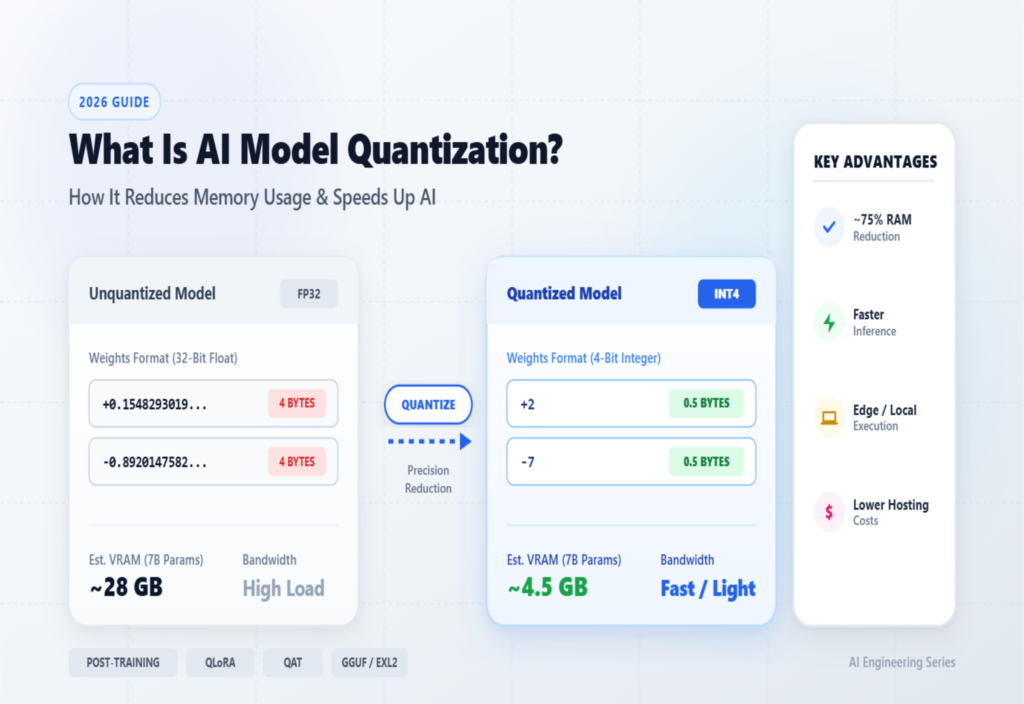
AI model quantization is a process that uses fewer bits to store some of the numerical values inside a machine learning model.
An AI model contains values called weights. These values help the model process information and produce results. Many models use 32-bit floating-point numbers, also called FP32, to store these values.
However, 32-bit values require more memory than lower-precision formats. Quantization allows developers to represent suitable values using formats such as 16-bit floating point, 8-bit integers, or 4-bit values.
As a result, the model may require less memory. Furthermore, compatible hardware can sometimes process these smaller values more efficiently.
For example, an AI model may store its weights using 32-bit values before quantization. After quantization, the same weights may use 8-bit or 4-bit representations.
This change reduces the space needed to store the weights. However, it may also affect the model’s output because lower-precision values cannot represent every original number exactly.
The main goal is to make AI models more efficient while keeping their results useful and reliable.
How Does AI Model Quantization Work?
Quantization works by changing how numerical values are stored and used inside a model. The exact process depends on the model, the chosen method, and the hardware.
Here is a simple explanation of the main steps.
1. The Model Starts With Numerical Values
During training, an AI model learns many numerical values called weights. These weights influence how the model handles information.
For example, a large language model uses its weights to process text and generate responses. Models with billions of parameters can require several gigabytes of memory just to store these values.
Therefore, reducing the size of these values can make a noticeable difference.
2. The Values Use Fewer Bits
A bit is the smallest unit of digital information. When a model uses fewer bits for each weight, the storage required for those weights decreases.
For example, a 32-bit value uses twice as much storage as a 16-bit value. Similarly, an 8-bit value uses half as much storage as a 16-bit value.
Quantization methods map the original values to a smaller set of possible values. Although this saves space, it introduces some approximation.
3. The Model Uses the Quantized Values
Once quantization is complete, a compatible AI system can load the model and use its lower-precision values during inference.
Inference means running a trained model to produce an answer, prediction, or other result.
Depending on the hardware and software, the model may perform calculations directly with quantized values or convert some values during processing.
As a result, the system may use less memory and complete certain tasks more efficiently.
4. Developers Test the Results
After quantization, developers should compare the new model with the original version.
They need to check memory usage, response speed, and output quality. If the model loses too much accuracy, another quantization method may be a better choice.
Therefore, testing is an important part of the process.
How Much Memory Can AI Quantization Save?
Memory savings depend on the number of model parameters and the format used to store them.
Consider a hypothetical AI model containing one billion parameters. If every parameter uses the same number of bits, its weight storage can be estimated as follows.
FP32: About 4 GB of weight storage.
FP16: About 2 GB of weight storage.
8-bit: About 1 GB of weight storage.
4-bit: About 0.5 GB of weight storage.
These figures are approximate decimal estimates. They cover the weights alone, not the total memory needed to run the model.
In practice, additional space may be required for scaling information, temporary calculations, activations, and other model components.
Even so, the comparison shows why quantization can be valuable for large AI models.
For example, an 8-bit representation requires about one-quarter of the weight storage used by FP32. Meanwhile, a 4-bit representation requires about one-eighth, assuming the same number of parameters and ignoring additional storage.
However, lower memory use does not always mean faster performance. The result depends on the model and the hardware running it.
Why Is AI Model Quantization Important in 2026?
AI models continue to support more applications, including writing assistants, image tools, coding systems, and document analysis software.
However, larger models can be difficult to run on devices with limited memory. Quantization helps developers manage this challenge.
Running AI Models on Smaller Computers
Some AI models need more memory than a normal laptop can provide. Quantization can reduce the memory required to load certain models.
As a result, developers may be able to run a suitable model on consumer hardware instead of using a more powerful computer.
Still, the model’s size, context length, and processing needs must fit the available resources.
Supporting AI on Mobile Devices
On-device AI allows a phone or tablet to perform selected AI tasks locally.
For example, a compatible device may use an AI model to summarize text, classify images, or process certain types of language input.
Quantization can help reduce the model’s memory requirements. In addition, local processing may reduce the need to send some information to a remote server.
However, mobile devices still have limits involving battery life, heat, memory, and processing power.
Reducing AI Running Costs
Businesses often pay for the computing resources needed to run AI applications.
If quantization reduces memory use or improves processing efficiency, a business may be able to run its model with fewer resources. Consequently, some deployments may become less expensive.
The actual savings depend on the workload, hardware, software, and number of requests being processed.
Improving Response Speed
Users usually prefer AI tools that respond quickly.
Quantization can reduce the amount of data that needs to move through memory. Moreover, some processors can handle lower-precision calculations more efficiently.
These benefits may reduce response time or increase the number of requests a system can handle.
However, quantization does not guarantee faster results in every situation.
Main Types of AI Model Quantization
Developers can choose from several quantization methods. Each method has its own benefits and limitations.
1. Post-Training Quantization
Post-training quantization, or PTQ, is applied after a model has already been trained.
This method is useful because developers may not need to train the entire model again. Depending on the approach, they may also use a small sample of data to help select suitable numerical ranges.
Post-training quantization includes several approaches.
Dynamic quantization
Dynamic quantization usually reduces the precision of model weights ahead of time. Some activation values are then quantized during execution.
This method can work well for supported models and tasks. However, the results depend on the model and the software being used.
Static quantization
Static quantization uses sample data to estimate the ranges of values used during model execution.
These estimates help the system choose suitable numerical representations. As a result, static quantization can improve efficiency on hardware that supports the required operations.
Weight-only quantization
Weight-only quantization reduces the precision of model weights while leaving many other calculations at a higher precision.
This approach is especially relevant to large language models because their weights can use a large amount of memory.
2. Quantization-Aware Training
Quantization-aware training, or QAT, introduces the effects of quantization during model training or fine-tuning.
This helps the model adapt to the changes caused by lower-precision values.
As a result, QAT may preserve accuracy better than a basic post-training method for certain models.
However, this approach requires a suitable training process and additional computing resources. Therefore, it may not be necessary for every project.
3. 8-Bit Quantization
8-bit quantization uses eight bits to represent selected model values.
It can reduce weight storage considerably compared with FP32. At the same time, many models can maintain useful output quality with a well-chosen 8-bit method.
For this reason, 8-bit quantization can be a practical starting point for developers who want to reduce memory use without making the most aggressive reduction in precision.
Even so, results should be tested on the intended task.
4. 4-Bit Quantization
Four-bit quantization uses fewer bits than 8-bit quantization to represent selected values, often model weights.
Consequently, it can make some large language models easier to load on devices with limited memory.
However, using fewer bits can increase the risk of changes in output quality. Some methods manage this risk through better value mapping, calibration, or other techniques.
Therefore, developers should compare the results before choosing a 4-bit model for important work.
5. Mixed-Precision Quantization
Mixed-precision quantization uses different numerical formats for different parts of a model.
For example, most weights might use 4-bit values, while selected components use 8-bit or 16-bit values.
This approach can provide a balance between memory savings and model quality. In addition, it can help protect components that are more sensitive to lower precision.
However, the best configuration depends on the model architecture and available hardware.
FP32, FP16, 8-Bit, and 4-Bit Explained
These formats describe how numerical values are represented inside a model.
FP32: This format uses 32-bit floating-point values. It requires more memory for weights but provides relatively high numerical precision.
FP16: This format uses 16-bit floating-point values. It can reduce memory use and may improve speed on compatible hardware.
8-bit quantization: This approach uses eight-bit representations for selected values. Depending on the method, these may be integer or other low-precision formats.
4-bit quantization: This approach uses four-bit representations for selected values, commonly model weights. It offers greater compression but may require more careful quality testing.
It is important to remember that FP16 is a lower-precision floating-point format, while INT8 commonly refers to an integer format. They are related optimization options, but they are not identical.
How Quantization Can Make AI Faster
Quantization may improve inference speed in several ways.
Less Data Needs to Move
AI models often move large amounts of data between memory and the processor.
Smaller weight representations reduce the amount of data that needs to be stored and transferred. As a result, some workloads can run more efficiently.
Better Hardware Support
Modern processors and AI accelerators may support specialized operations for lower-precision formats.
When the selected quantization method matches the hardware, the system may perform certain calculations faster.
However, unsupported operations or inefficient software can reduce these benefits.
More Efficient Use of Memory
A smaller model may leave more memory available for other tasks.
For example, an AI server may be able to load more model instances or process additional requests. Consequently, overall throughput may improve.
Throughput means the amount of work a system completes within a given period.
Better Performance on Limited Devices
Quantization can make certain models fit within the memory limits of a device.
This may allow developers to run tasks locally instead of moving them to a larger server.
Nevertheless, actual speed depends on the processor, model architecture, and software implementation.
Practical Example: Running a Quantized AI Model
Suppose a developer wants to run a large language model on a computer with limited GPU memory.
The original model may not fit in the available memory. Instead of immediately upgrading the hardware, the developer can try a supported quantized version.
The process generally involves these steps:
Select a suitable pretrained model.
Check its licence and hardware requirements.
Choose a supported quantization method.
Load the model with a compatible software library.
Measure memory usage and response speed.
Test output quality on realistic prompts.
Compare the results with the original model.
For supported models, the Hugging Face Transformers library and bitsandbytes provide tools for loading models with lower-precision weights.
The following example demonstrates one possible approach using 4-bit quantization.
import torch
from transformers import (
    AutoModelForCausalLM,
    AutoTokenizer,
    BitsAndBytesConfig,
)

model_name = "YOUR_SUPPORTED_MODEL_ID"

quantization_config = BitsAndBytesConfig(
    load_in_4bit=True,
    bnb_4bit_quant_type="nf4",
    bnb_4bit_compute_dtype=torch.float16,
)

tokenizer = AutoTokenizer.from_pretrained(model_name)

model = AutoModelForCausalLM.from_pretrained(
    model_name,
    quantization_config=quantization_config,
    device_map="auto",
)

prompt = "Explain AI model quantization in simple words."

inputs = tokenizer(prompt, return_tensors="pt")
inputs = {
    key: value.to(model.device)
    for key, value in inputs.items()
}

with torch.no_grad():
    output = model.generate(
        **inputs,
        max_new_tokens=150,
    )

print(tokenizer.decode(output[0], skip_special_tokens=True))
This example requires compatible versions of PyTorch, Transformers, Accelerate, and bitsandbytes. Replace the placeholder with a model that supports the selected configuration.
Furthermore, some models require different loading methods or hardware. Therefore, check the model documentation before running the code.
How to Test a Quantized Model
Before using a quantized model in a real application, developers should test its performance carefully.
Check Memory Usage
First, measure how much memory the model uses after loading. Then, test it with realistic prompts and output lengths.
This is important because the memory required during execution may be higher than the model’s file size.
Measure Response Time
Next, check how long the model takes to start responding and complete a task.
For language models, time to first token and the speed of generating later tokens can provide useful information.
Compare Output Quality
Test the model on tasks that match its intended purpose.
For example, a coding assistant should be tested on code generation and debugging tasks. Similarly, a summarization tool should be checked for accuracy and coverage of important information.
Test Different Settings
Finally, compare different quantization formats where possible.
An 8-bit version may provide a useful balance between memory and quality. On the other hand, a 4-bit version may be more suitable when memory is the main limitation.
The best option is the one that meets the project’s requirements.
Advantages of AI Model Quantization
Quantization offers several benefits for AI development.
Lower memory use: Smaller numerical values can reduce the space required to store model weights.
Potential speed improvements: Compatible hardware may process lower-precision operations more efficiently.
Lower deployment costs: Some applications may need fewer computing resources after quantization.
Support for local AI: Smaller models may fit on laptops and other devices with limited memory.
More flexible deployment: Developers can test models on a wider range of hardware.
Potential energy savings: Efficient computation may reduce energy use in certain workloads.
Easier experimentation: Independent developers and smaller teams may be able to run selected models without expensive hardware.
However, these benefits depend on the model and implementation. Testing is necessary to confirm the actual results.
Limitations of AI Model Quantization
Although quantization can improve efficiency, it also has some limitations.
Possible Changes in Accuracy
Lower-precision values cannot represent every original number exactly.
As a result, the quantized model may produce different answers. For many applications, the difference may be small. However, other tasks may be more sensitive to numerical changes.
Hardware Compatibility
Not every processor supports every quantized format efficiently.
A model may load successfully but run slowly if the available hardware lacks optimized operations for its format.
Extra Memory Requirements
Quantization mainly reduces the memory used by the components it converts.
Other parts of a model, such as temporary buffers and attention caches, may still require considerable memory. Therefore, a small model file does not guarantee low total memory use.
More Testing May Be Needed
Developers may need to compare several quantization methods before finding a suitable configuration.
In addition, some models may need calibration or more advanced techniques to maintain output quality.
Speed Is Not Guaranteed
Quantization can sometimes make a model slower because of conversion overhead or inefficient software.
For this reason, real-world benchmarks are more useful than assuming that fewer bits always mean faster results.
Quantization vs Pruning vs Knowledge Distillation
Quantization is not the only way to make AI models more efficient. Developers can also use pruning and knowledge distillation.
Quantization reduces the precision used to represent selected numerical values. Its main goal is to reduce memory use and potentially improve computational efficiency.
Pruning removes selected weights, connections, or model structures. It can reduce model size, although speed improvements depend on whether the resulting model can run efficiently on the target hardware.
Knowledge distillation trains a smaller model to learn useful behaviour from a larger model. This creates a separate model that may require fewer resources.
These methods can also be combined. For example, a smaller model created through distillation may be quantized to reduce its memory requirements further.
The right choice depends on the task, hardware, and required output quality.
Real-World Uses of AI Model Quantization
Mobile Applications
Quantization can help selected AI models run on smartphones and tablets.
Possible uses include image classification, text processing, and language-related features. However, the device must have enough memory and processing power for the chosen model.
AI Chatbots
Developers can use quantized language models to build chatbots that run on local computers or compatible servers.
This may reduce memory requirements and help some systems handle more requests.
Image Recognition
Computer vision models can use quantization to reduce their memory needs when processing images.
For example, an embedded device may use a quantized model to identify objects in images. Still, the developer must test whether the reduced precision affects detection quality.
Document Processing
Some local AI tools use language models to summarize files, answer questions, or organize information.
Quantization may help these models run on personal computers with limited resources. However, privacy also depends on how the application handles stored files, logs, and network connections.
Robotics and Embedded Devices
Robots and embedded systems often have strict memory and power limits.
Quantization can help suitable models fit these limits. Nevertheless, the complete system must still meet its speed and reliability requirements.
Healthcare Research
Researchers may explore quantization to run selected machine learning models more efficiently.
However, medical applications require appropriate testing, privacy protections, and relevant regulatory checks. Lower memory use alone does not prove that a model is suitable for medical decisions.
Does Quantization Make AI More Intelligent?
No, quantization does not automatically make an AI model more intelligent.
Its main purpose is to reduce the resources needed to store or run a model. It does not necessarily add new knowledge or increase the number of parameters.
A quantized model may perform similarly to the original model on many tasks. However, its results can also change because some numerical values are approximated.
Therefore, quantization is best understood as an optimization technique rather than a way to increase intelligence.
The model’s design, training data, and training process continue to affect its abilities.
Is Quantization the Same as AI Training?
No, these are two different processes.
Training adjusts model parameters using data and an optimization method. By contrast, quantization changes how selected numerical values are stored or processed.
Post-training quantization can be applied after training is complete. As a result, developers may optimize an existing model without training it from the beginning.
Quantization-aware training is different because it includes quantization effects during training or fine-tuning.
This distinction matters because training a large model can require significant computing resources, while some post-training quantization methods need much less additional work.
What Is QLoRA, and How Is It Related to Quantization?
QLoRA is a technique for fine-tuning certain large language models with reduced memory requirements.
It combines a quantized base model with trainable low-rank adapter parameters. This allows developers to update selected model behaviour without fully fine-tuning every parameter in the original model.
Quantization helps reduce the memory used by the base model. Meanwhile, the adapters provide a way to learn task-specific changes.
However, QLoRA still requires resources for training, activations, adapters, and other operations. Its memory needs depend on the model and training setup.
How to Choose the Right Quantization Method
The best method depends on your main goal.
Choose 8-bit quantization if you want to reduce memory use while starting with a relatively moderate reduction in precision.
Consider 4-bit quantization if memory is a major limitation and the model maintains acceptable output quality.
Consider static quantization if you have suitable calibration data and compatible hardware.
Consider dynamic quantization if your model and software support it and you want a simpler optimization approach.
Consider quantization-aware training if post-training methods reduce accuracy too much and you have resources for further training.
Consider mixed precision if some model components need more precision than others.
These are general guidelines rather than strict rules. Always check the model documentation and test the final configuration on the intended device.
The Future of AI Model Quantization
AI developers continue to look for ways to make models more efficient.
New quantization methods aim to reduce memory use while preserving useful model quality. In addition, developers are exploring better numerical formats, improved inference software, and hardware designed for AI workloads.
Quantization can also work alongside other optimization methods, such as efficient attention systems, model distillation, and caching improvements.
Each technique addresses a different challenge. Therefore, combining them may provide better results than relying on a single method.
In 2026, quantization remains a useful option for developers who want to run AI models within limited memory and computing budgets.
However, the best results come from measuring actual performance rather than assuming that a specific format will work equally well for every model.
Frequently Asked Questions
What is AI model quantization in simple words?
AI model quantization reduces the number of bits used to represent selected values inside an AI model. As a result, the model may need less memory and may run more efficiently on compatible hardware.
How much memory can quantization save?
Theoretical weight storage can fall to about one-quarter when moving from FP32 to 8-bit values. With 4-bit values, it can fall to about one-eighth. However, actual savings depend on extra storage and runtime requirements.
Does quantization reduce AI accuracy?
It can. Lower-precision values approximate the original numbers, which may change the model’s results. The effect depends on the model, method, and task.
Is 4-bit quantization better than 8-bit quantization?
Not always. Four-bit quantization usually saves more memory, while 8-bit quantization may preserve output quality more easily for some models. Testing helps determine which option is more suitable.
Can I run a quantized AI model on a normal computer?
Yes, some quantized models can run on consumer computers. However, the required memory, processor, model size, and software support determine whether a specific model will work.
Does quantization always make AI faster?
No. It may improve speed when the hardware supports efficient lower-precision operations. In other cases, conversion overhead or software limitations can reduce performance.
Is quantization used for large language models?
Yes. Developers commonly use quantization to reduce the memory requirements of large language models and make some local deployments more practical.
What is the difference between quantization and QLoRA?
Quantization reduces the precision of selected model values. QLoRA uses a quantized base model and trainable adapters to support memory-efficient fine-tuning.
Is AI model quantization useful for beginners?
Yes. Beginners can start by learning about FP32, FP16, 8-bit, and 4-bit formats. They can then compare supported models and measure memory use and output quality.
Conclusion
AI model quantization is a useful way to reduce the memory required to store and run suitable AI models.
By using fewer bits for selected numerical values, developers can make some models smaller and potentially improve inference speed. Moreover, quantization may help AI applications run on laptops, mobile devices, and smaller servers.
However, lower memory use does not guarantee faster execution or unchanged output quality. The results depend on the model, numerical format, software, and hardware.
Therefore, developers should test different quantization methods before choosing one for a real project.
The key takeaway: AI model quantization helps make AI more resource-efficient. When used carefully, it can reduce memory requirements while preserving the level of performance needed for a particular task.