Mobile apps have become an important part of everyday life. People use them to learn new skills, manage their businesses, communicate with customers, organize their finances, shop online, and complete daily tasks. As more businesses rely on smartphones, the demand for useful and reliable mobile applications continues to create opportunities for developers.
In 2026, building mobile apps can be a way to earn money online, start a small technology business, or develop a long-term source of income. You do not always need a large team or an expensive office. With the right skills, a computer, an internet connection, and a clear plan, you can begin creating applications for clients or build your own products.
However, earning money from mobile apps is not automatic. A good app needs to solve a real problem, provide a smooth user experience, protect customer information, and reach the right audience. Developers must also choose a suitable business model and continue improving their products after launch.
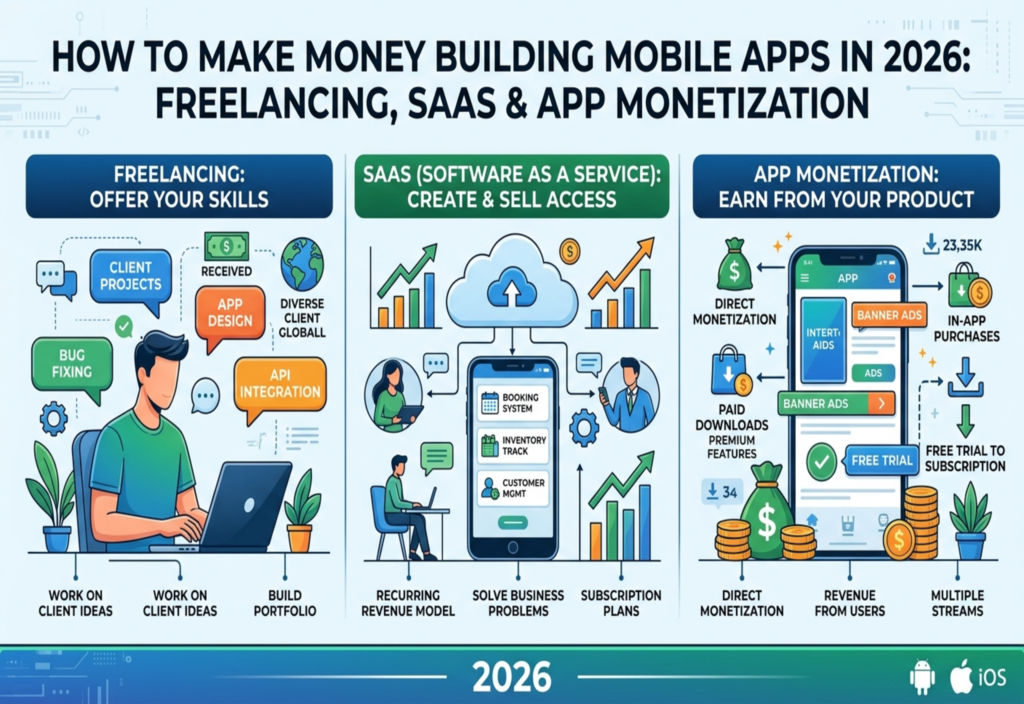
There are several ways to earn from app development, including freelancing, Software as a Service (SaaS), paid downloads, subscriptions, in-app purchases, and advertising. Each method has different advantages, costs, and challenges.
This guide explains how to make money building mobile apps in 2026, how beginners can get started, and how to approach app development from an Islamic point of view.
What Is Mobile App Development?
Mobile app development is the process of designing, building, testing, and maintaining applications for smartphones and tablets. These applications can run on Android, iOS, or both platforms.
Mobile apps serve many purposes. Some help businesses manage orders, while others allow students to learn, customers to book appointments, and users to organize their daily activities.
For example, a developer might create an appointment booking app for a salon, an inventory management app for a small shop, or a learning app for an online teacher.
Businesses may pay developers to create these applications because a well-designed app can save time, improve customer service, and make daily operations easier.
Mobile app development usually involves several important tasks:
Understanding the problem the app needs to solve.
Planning its features and user experience.
Designing the interface.
Writing and testing the code.
Connecting databases, APIs, and payment systems when needed.
Publishing the app and maintaining it after launch.
You do not have to master every part of development on your first day. Beginners can start with small projects and gradually learn more advanced skills.
Why Mobile App Development Can Be a Good Earning Opportunity in 2026
Mobile technology creates opportunities for both individual developers and businesses. Many small companies cannot afford a large software development team, so they hire freelancers or purchase affordable tools that meet their needs.
At the same time, business owners increasingly look for software that helps them manage bookings, communicate with customers, track sales, and automate repetitive work.
A developer who understands a particular industry’s problems may be able to create a useful solution and charge for building or maintaining it.
There are several reasons why this field may be worth exploring.
1. Businesses Need Digital Solutions
A restaurant may need an ordering application. A fitness trainer may want an app for workout plans and client progress. A school may need a system for attendance and communication with parents.
These are practical problems that software can help solve.
Rather than building a complicated application for everyone, beginners can focus on one type of customer and develop a product that meets a specific need.
2. You Can Work With International Clients
Freelance platforms and professional networks allow developers to connect with clients in different countries. A developer living in Pakistan can potentially work with a business in the United Kingdom, the United States, or another market without relocating.
International projects can provide access to different budgets, but competition is also strong. Communication, technical ability, reliability, and a convincing portfolio are important for winning projects.
3. You Can Build Products You Own
Freelancing usually means getting paid to complete work for a client. Building your own application offers another possibility: creating a product that many customers can use.
For example, you could develop a simple appointment management system and sell access to multiple salons. After the core product is built, you can improve it for different customers without starting from zero each time.
This approach can create recurring revenue, although it also requires marketing, customer support, maintenance, and ongoing investment.
4. You Can Start With Small Projects
You do not need to build a large social network or a complex banking application to begin earning.
A simple app with a clear purpose may be enough for a first portfolio project or freelance assignment.
Examples include a booking app, a stock tracking tool, a local business directory, or a basic educational application.
Starting small makes it easier to learn, test your work, and avoid spending too much time on an idea that has not been validated.
1. Make Money Building Mobile Apps Through Freelancing
Freelancing is one of the most direct ways to earn money from mobile app development. Instead of creating your own product and waiting for customers, you provide development services to people or businesses that already need an application.
Clients may hire you to build a complete app, fix existing problems, add new features, improve performance, or connect an app to an external service.
You can work independently or collaborate with designers, developers, and project managers.
What Mobile App Development Services Can You Offer?
Beginners should choose services that match their current skills. As their experience grows, they can take on larger projects.
App UI development: Build clean, easy-to-use screens from a client’s design or requirements.
Bug fixing: Identify and repair crashes, layout problems, broken buttons, and other technical issues.
API integration: Connect an app to services such as maps, booking systems, product databases, or customer management tools.
Business app development: Create applications for shops, restaurants, schools, clinics, or service providers.
App redesign: Improve navigation, readability, loading speed, and overall usability.
Maintenance and updates: Keep an existing app compatible with supported devices and fix problems as they appear.
Offering a specific service can make your profile more convincing than simply claiming to build every kind of application.
Where Can You Find Freelance Clients?
You can explore platforms such as Upwork and Fiverr, professional communities, business groups, and direct outreach to potential customers.
Your portfolio should show what you can actually build. Even if you have never worked with a paying client, you can create demonstration projects that prove your ability.
For example, build a salon booking app with service listings, appointment selection, and confirmation messages. Explain which features work, which technologies you used, and how the project solves a business problem.
Never present a demonstration project as paid client work if it was not.
How Should You Price Freelance Projects?
Pricing depends on the scope of work, your experience, the technology involved, the deadline, and the level of support required.
You may charge an hourly rate, a fixed project fee, or an agreed fee for ongoing maintenance.
Before giving a price, clarify the number of screens, required features, supported platforms, backend needs, testing requirements, and delivery date. A small prototype should not be priced like a complete commercial platform.
Written agreements can also explain payment milestones, revisions, ownership of source code, confidentiality, and what happens if the project scope changes.
How Can Freelancing Become a Stable Source of Income?
One completed project does not guarantee future work. To improve stability, focus on client satisfaction, clear communication, and long-term relationships.
After launching an app, a client may need monthly maintenance, performance improvements, security updates, or new features.
You can offer these services through a separate support agreement. Make sure the client understands what is included and what will cost extra.
This approach can gradually help you build a business around repeat customers instead of constantly searching for new projects.
2. Build a SaaS Mobile App for Recurring Revenue
SaaS stands for Software as a Service. It is a business model in which customers access software over the internet, often through a monthly or annual subscription.
A SaaS product may have a mobile app, a web dashboard, or both. The important part is that customers pay to use a service that continues to provide value.
For example, a developer could create a booking system for salons. Salon owners would use it to manage appointments, while their customers could book services through a mobile interface.
Instead of charging every salon for a completely new application, the developer could offer access to the same core platform with different business accounts.
SaaS Ideas for Mobile App Developers
Appointment management: Help salons, tutors, consultants, and repair services manage bookings.
Inventory tracking: Allow small retailers to record stock levels, receive low-stock alerts, and review product movement.
Customer management: Help small businesses store customer records, track enquiries, and organize follow-ups.
Staff scheduling: Enable businesses to manage shifts, assignments, and availability.
Educational management: Provide tools for teachers to organize lessons, homework, attendance, and student communication.
Field service management: Help cleaning companies, technicians, and maintenance teams schedule visits and record completed work.
The best idea is not necessarily the one with the most features. It is the one that solves an important problem for a group of customers who are willing to pay for a reliable solution.
How Does a SaaS App Make Money?
A SaaS business may offer several subscription plans.
A basic plan could include essential features for a small business. A higher-priced plan might offer multiple staff accounts, advanced reporting, automated reminders, or integrations.
For example, suppose a product charges $15 per month and has 50 paying customers.
Its monthly recurring revenue would be:
50 × $15 = $750 per month.
If it later reaches 200 customers at the same price, its monthly recurring revenue would be $3,000.
These figures are illustrations, not income promises. Actual profit would be lower after payment processing, hosting, platform fees, support, marketing, taxes, refunds, and other expenses. Customers may also cancel their subscriptions.
How Can You Build a SaaS Product Without Spending Too Much?
Start with a minimum viable product, often called an MVP. This is a small but usable version of your product that includes only the features needed to solve the main problem.
For a booking app, the first version might include:
Business registration and login.
Service and availability management.
Appointment booking.
Booking confirmation.
A basic dashboard.
Advanced analytics, complex automation, and numerous integrations can be added after you understand what customers actually need.
Speak with potential customers before building the full product. Ask how they currently manage the problem, what difficulties they face, and whether they would consider paying for a better solution.
This helps you avoid spending months building something that people do not want.
Why SaaS Requires Ongoing Work
Subscription income is not completely passive. Customers expect the service to remain available, their information to be protected, and problems to be fixed.
You may need to pay for servers, databases, backups, customer support, and security improvements. You also need a clear cancellation process and honest pricing.
A sustainable SaaS business grows by delivering ongoing value, not by making it difficult for customers to leave.
3. Earn Money Through App Subscriptions
Subscriptions are suitable for apps that provide continuing value. Users pay monthly or annually to access features, services, content, or tools.
Examples include language learning apps, business productivity tools, cloud services, and advanced photo editing applications.
A subscription makes sense when the app offers something useful over time. If an application performs one simple task that users rarely repeat, a one-time purchase may be more suitable.
How to Design a Fair Subscription Model
A good subscription plan should clearly explain what customers receive, how much they pay, and when the payment renews.
You might provide a free version with essential features and a paid plan with additional benefits. For example, a study planner could offer basic schedules for free while charging for advanced progress reports and cross-device synchronization.
Avoid hiding important costs or making cancellation unnecessarily difficult.
If a free trial automatically converts into a paid subscription, explain the terms before users sign up. Send clear notices when appropriate and follow the payment platform’s requirements.
How Much Can Subscriptions Earn?
Consider an app with 100 paying customers who each pay $5 per month.
Its gross monthly subscription revenue would be $500.
If the app grows to 1,000 paying customers at the same price, gross monthly revenue would be $5,000.
However, these examples do not account for operating costs, taxes, payment fees, refunds, cancellations, or app store commissions where applicable. A large number of downloads does not guarantee that enough people will subscribe.
The key is to build a product that users find valuable enough to keep using.
4. Monetize Your App With Advertising
Advertising is another way to earn money from a free mobile app. Instead of charging every user, you may receive revenue when ads are displayed or when users interact with them, depending on the advertising network and campaign.
This model can work for apps that attract a regular audience, such as free educational tools, utility apps, or content platforms.
However, advertising income varies. It depends on factors such as audience location, advertiser demand, app category, user engagement, and the number of eligible ad impressions.
Types of Mobile App Ads
Banner ads: Small advertisements displayed in a designated area of the interface.
Interstitial ads: Full-screen advertisements shown at suitable breaks, such as between game levels.
Rewarded ads: Users voluntarily watch an advertisement to receive an optional in-app benefit.
Native ads: Advertisements designed to fit the layout of the surrounding content while remaining