
Technology has become an important part of our daily lives. People use computers, smartphones, websites, and online banking services every day. Businesses also depend on digital tools to manage their work and store important information. However, this growing use of technology brings new security risks.
Cybersecurity helps protect computers, networks, websites, and personal information from online threats. As a result, many organizations need skilled people who can keep their digital systems safe.
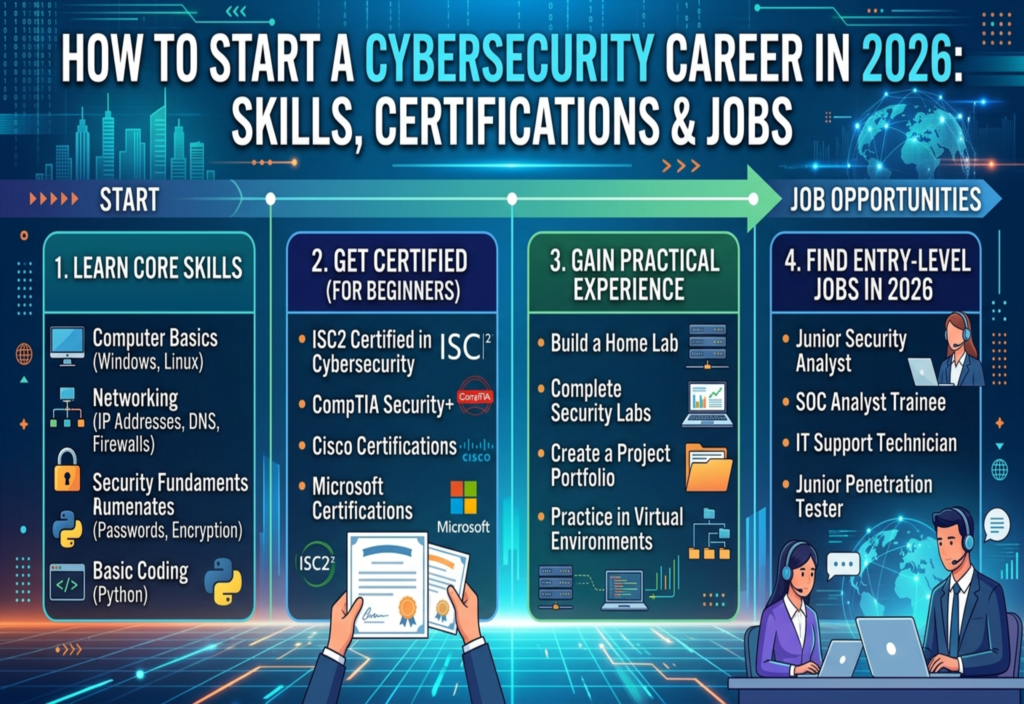
If you want to start a cybersecurity career in 2026, you do not need to know everything from the beginning. Instead, you can start with basic computer skills and learn one topic at a time. With regular practice, you can build the knowledge needed to apply for suitable entry-level jobs.
This guide explains how to learn cybersecurity, choose useful certifications, build practical projects, and find job opportunities. It also covers Islamic values that matter in this field, including honesty, privacy, lawful earning, and protecting others from harm.
What Is Cybersecurity?
Cybersecurity is the process of protecting computers, networks, websites, and digital information from theft, damage, and unauthorized access.
For example, imagine that an online store keeps customers’ names, addresses, and payment details. If someone steals this information, customers may face financial loss or privacy problems. Cybersecurity experts help prevent such incidents by finding weaknesses and improving security.
Cybersecurity includes several important areas.
Network Security
Network security protects the connections between computers, servers, and other devices. Security experts use firewalls, access rules, and monitoring tools to reduce risks.
Application Security
Application security focuses on websites, mobile apps, and software. Experts look for weaknesses and help developers fix them before attackers can take advantage of them.
Cloud Security
Many businesses store information and run applications through cloud services. Therefore, cloud security helps protect online storage, user accounts, and cloud-based systems.
Information Security
Information security protects sensitive data from unauthorized access or changes. It also helps make sure that people can access information when they need it.
Incident Response
Sometimes, security problems still occur despite strong protection. In these situations, incident response teams investigate what happened, reduce the damage, and help restore normal operations.
Each area has different responsibilities. Consequently, beginners can explore several options before choosing a career path.
Why Choose a Cybersecurity Career in 2026?
Cybersecurity can be a good option for people who enjoy technology, solving problems, and learning new skills. It also offers different career paths for people with different interests.
1. Growing Need for Digital Protection
Businesses use online systems to manage customer information, payments, communication, and daily operations. However, these systems can face phishing, account theft, malware, and other security threats.
For this reason, organizations need people who understand how to reduce these risks. The exact number of available jobs depends on the country, industry, and experience level.
2. Different Career Options
Cybersecurity is not limited to hacking or testing websites. You can work in security monitoring, network protection, cloud security, digital investigations, or security policies.
For example, a person who enjoys solving technical problems may prefer security operations. On the other hand, someone who likes writing and reviewing documents may prefer security compliance.
3. Opportunities to Learn New Skills
Technology changes regularly, so cybersecurity professionals need to keep learning. New software, cloud services, and digital threats create fresh challenges.
As a result, people who enjoy learning may find this field interesting. You can also improve your skills over time and move into more advanced roles.
4. Remote Work Opportunities
Some cybersecurity jobs offer remote or hybrid work. This means you may be able to work from home or divide your time between home and an office.
However, not every employer offers this option. Some jobs require on-site work because of security rules or the nature of the systems being protected.
5. Meaningful Work
Cybersecurity professionals help protect people from online fraud and data theft. For example, they may help a hospital protect patient records or assist a business in securing customer accounts.
Therefore, this career can offer a sense of purpose as well as professional development.
How to Start a Cybersecurity Career With No Experience
Starting a new career can feel difficult when you have little technical knowledge. Fortunately, you can follow a clear learning path and improve your skills step by step.
Step 1: Learn Basic Computer Skills
First, learn how computers work and how to use them safely. These skills will help you understand more advanced security topics later.
Focus on the following areas:
Computer hardware and software
Windows and Linux basics
Files and folders
User accounts and permissions
Installing software and updates
Basic troubleshooting
Safe internet use
For example, understanding user permissions can help you learn why one account should not have access to every file on a computer.
You can study these topics through free lessons, beginner courses, and practical exercises. In addition, practise on your own computer to become more comfortable with everyday tasks.
Step 2: Understand Computer Networks
Networking is one of the most important parts of cybersecurity. Computers communicate through networks, so you need to understand how information moves between devices.
Start with these basic concepts.
IP addresses: These help identify devices on a network.
DNS: This system connects website names with their corresponding IP addresses.
TCP and UDP: These are methods that applications use to send information across networks.
HTTP and HTTPS: These protocols allow web browsers and websites to exchange information. HTTPS also helps protect communication through encryption.
Firewalls: These tools control network traffic according to security rules.
VPNs: These can create protected connections across untrusted networks when properly configured.
Once you understand these terms, practise explaining how they work together. For example, learn what happens when you enter a website address into your browser.
Step 3: Learn Linux Basics
Linux is widely used in servers and technical environments. Therefore, learning basic Linux commands can help you prepare for cybersecurity work.
Begin with a few simple commands:
pwdshows your current directory.lslists files and folders.cdchanges your current directory.mkdircreates a new directory.catdisplays the contents of a text file.grepsearches text for matching words or patterns.ipdisplays network information on supported systems.
You do not need to learn every command at once. Instead, practise a few commands each day and understand what each one does.
For safe practice, use a Linux virtual machine or an authorized training environment. Never use your new skills to access someone else’s computer without permission.
Step 4: Study Cybersecurity Fundamentals
After learning computers and networking, begin studying basic security concepts.
Important topics include:
Password protection
Multifactor authentication
Encryption and hashing
Phishing and malware
Access control
Security updates
Data backups
Risk management
Security monitoring
Incident response
One useful concept is the CIA triad. It describes three major goals of information security.
Confidentiality means keeping information private from unauthorized people.
Integrity means protecting information from unauthorized changes.
Availability means keeping systems and information accessible when needed.
For example, an online banking service must protect customer details, prevent unauthorized changes to transactions, and remain available to legitimate users.
These principles will help you understand how security tools protect real systems.
Step 5: Choose Your Career Path
Cybersecurity has many specializations. Therefore, explore a few areas before deciding where to focus your attention.
If you enjoy investigating unusual activity, security operations may suit you. Alternatively, if you like examining software for weaknesses, application security or penetration testing may be a better choice.
Here are some common career paths:
Security analyst
Security operations center analyst
Network security specialist
Cloud security specialist
Penetration tester
Digital forensics specialist
Security compliance assistant
You can start with general IT knowledge and move toward a more specialized role as your skills improve.
Essential Cybersecurity Skills to Learn in 2026
Employers often look for a combination of technical knowledge, practical ability, communication, and good judgment. However, the skills you need will depend on the job you want.
1. Networking Skills
Learn how devices communicate and how network services operate. You should understand IP addresses, ports, DNS, firewalls, and basic troubleshooting.
These skills can help you investigate suspicious traffic and identify common network problems.
2. Windows and Linux Skills
Many organizations use Windows computers, Linux servers, or a mixture of both. Therefore, understanding these systems can make you more useful in technical roles.
Learn how to manage users, check permissions, install updates, and review system logs.
3. Security Monitoring
Security teams review alerts and logs to identify possible threats. For example, repeated failed login attempts may indicate that someone is trying to access an account.
Learn how to examine sample logs, recognize unusual activity, and record your findings. Later, you can explore security monitoring platforms used by professional teams.
4. Basic Programming
You do not need advanced programming skills for every cybersecurity job. Nevertheless, learning Python can help you automate simple tasks and work with data.
Start with variables, loops, conditions, and functions. Then, create small projects such as a script that counts failed login attempts in a sample log file.
Similarly, basic command-line scripting can help you complete routine tasks more efficiently.
5. Cloud Security
Many businesses use cloud platforms to store files and run applications. Consequently, cloud security has become an important area of study.
Learn about user permissions, secure configurations, access policies, and multifactor authentication. After that, choose one cloud platform and explore its basic security features.
6. Problem-Solving Skills
Cybersecurity professionals often investigate problems without knowing the answer immediately. They must collect evidence, compare possible explanations, and choose suitable actions.
For example, if an account shows unusual activity, an analyst may check login records, device details, and recent account changes.
Therefore, practise following evidence instead of making quick assumptions.
7. Communication Skills
Technical knowledge is important, but you must also explain problems clearly. Security experts often prepare reports for managers, customers, and other technical teams.
Learn to describe what happened, why it matters, and how the problem can be fixed. Clear writing can help you stand out when applying for jobs.
Best Cybersecurity Certifications for Beginners
Certifications can help demonstrate your knowledge to employers. However, they do not guarantee employment, so choose one that matches your skills and career goals.
1. ISC2 Certified in Cybersecurity
The ISC2 Certified in Cybersecurity certification is designed for people who want to learn the basics of the field.
It covers areas such as security principles, access management, network security concepts, and security operations.
For beginners, it can provide a structured way to study important topics. Check the official ISC2 certification website for current exam details, costs, and training options.
2. CompTIA Security+
CompTIA Security+ is a well-known certification that covers important cybersecurity concepts. These include threats, risk management, security operations, and network protection.
It may be useful if you already understand basic computer systems and networking. Before booking the exam, review the latest objectives and compare them with your current knowledge.
3. Cisco Networking Certifications
Cisco offers networking certifications that can help you understand how networks are built, managed, and maintained.
This knowledge is valuable because many security problems involve network settings or communication between devices.
However, you do not need to complete every networking certification before starting cybersecurity studies. Choose a course that supports your specific learning goals.
4. Microsoft Security Certifications
Microsoft provides training and certifications related to security, identity, and cloud services.
These options may be useful if you want to work with Microsoft-based business systems. Since certification names and requirements can change, check the official catalog before enrolling.
5. Advanced Security Certifications
Later in your career, you may consider advanced certifications in penetration testing, cloud security, or security management.
However, expensive advanced certifications are not always necessary for beginners. First, build your fundamentals and gain practical experience.
Helpful advice: One relevant certification combined with real projects can be more useful than several certificates without practical skills.
Best Free Resources to Learn Cybersecurity
You can begin learning without spending a large amount of money. Many educational resources explain cybersecurity concepts and provide exercises for beginners.
1. Cisco Networking Academy
Cisco Networking Academy offers learning resources related to networking and technology. These can help you understand basic network concepts before moving into more advanced security topics.
2. Microsoft Learn
Microsoft Learn provides educational material about Microsoft products, cloud services, and security-related subjects.
It can be helpful if you want to learn about user accounts, cloud systems, and enterprise security.
3. Official Cybersecurity Guidance
The National Institute of Standards and Technology provides resources about cybersecurity careers and professional skills.
Visit its cybersecurity career resources to explore different roles and career pathways.
4. Authorized Practice Labs
Online cybersecurity labs let you practise in environments designed for learning. Some offer free exercises, while others require payment.
Choose reputable platforms and follow their rules. In particular, do not test real websites or networks unless you have permission.
5. Practice With Your Own Computer
Your own computer can be a useful learning environment. You can practise account security, review logs, install updates, and explore basic system settings.
In addition, keep notes about each exercise. These notes can later help you prepare for interviews and build a portfolio.
Practical Cybersecurity Projects for Beginners
Practical projects help you show what you have learned. They can also help you understand how security concepts work outside a textbook.
Project 1: Build a Home Security Lab
Create a small learning environment using a virtual machine. Practise creating user accounts, managing permissions, installing updates, and reviewing system logs.
Then, write a short report explaining the setup and the security improvements you made.
Project 2: Analyze Sample Login Logs
Use sample logs from a training course or your own test system. Look for repeated failed logins and unusual activity.
Afterward, describe what you found and explain which details would need further investigation.
Remember that repeated failed logins do not always prove an attack. Your report should separate evidence from assumptions.
Project 3: Create a Password Safety Guide
Write a simple guide that explains strong passwords, password managers, multifactor authentication, and phishing.
This project can demonstrate both your security knowledge and your ability to explain technical topics to ordinary users.
Project 4: Create a Python Log Analyzer
Write a basic Python script that reads sample logs and counts selected events.
For example, the script could count how many times a sample account failed to log in. You can then explain how the script works and what its results mean.
Project 5: Complete an Authorized Security Exercise
Use a training lab that allows you to investigate intentionally vulnerable systems.
Document the weakness, its possible impact, and the recommended fix. In addition, explain what you learned from the exercise.
Project 6: Improve Your Own Account Security
Enable multifactor authentication on your personal accounts, review recovery options, and remove access you no longer need.
You can write a report describing the risks you considered and the steps you took to reduce them.
Never include passwords, private keys, or other sensitive information in your public portfolio.
Entry-Level Cybersecurity Jobs in 2026
You do not have to begin your career as an expert hacker. In fact, general IT positions can help you develop the experience needed for security work.
1. Junior Security Analyst
Junior security analysts help review security alerts, investigate unusual activity, and document possible incidents.
They may also support experienced team members during investigations. Basic networking, operating system knowledge, and careful record-keeping are useful for this role.
2. SOC Analyst
A security operations center analyst monitors systems for suspicious activity.
For example, the analyst may investigate unusual logins, unexpected software activity, or alerts generated by security tools.
This job can be a good option if you enjoy solving problems and working with technical information.
3. IT Support Technician
IT support technicians help users solve computer, software, and account problems.
Although this is not always a cybersecurity position, it can teach you about operating systems, user permissions, updates, and common security risks.
As your knowledge improves, you can apply for more specialized roles.
4. Junior Network Administrator
Network administrators help maintain network connections, devices, and access settings.
This experience can provide a useful foundation for network security. However, some positions require previous IT experience, so read each job description carefully.
5. Junior Penetration Tester
Penetration testers examine systems for weaknesses with the owner’s permission.
Junior team members may help document findings, validate vulnerabilities, and prepare reports. Employers may expect knowledge of networking, web applications, and safe testing methods.
6. Security Compliance Assistant
Security compliance assistants help organizations maintain security policies, records, and risk documents.
This path may suit people who enjoy research, writing, and organized work. It can also provide an introduction to security management.
7. Security Awareness Assistant
These professionals help teach employees how to recognize phishing, protect accounts, and handle information safely.
For example, they may prepare training materials or help organize awareness sessions.
Strong communication skills can be especially useful in this role.
A Six-Month Cybersecurity Learning Plan
A learning plan can help you study in a more organized way. The schedule below is an example, not a promise that you will get a job within six months.
Month 1: Learn Computer Basics
Start with Windows, Linux, files, folders, user accounts, and basic troubleshooting.
Goal: Understand how computers work and how to manage them safely.
Month 2: Study Networking
Learn about IP addresses, DNS, ports, firewalls, and common network protocols.
Next, practise basic troubleshooting in your own network or an authorized lab.
Goal: Understand how computers communicate.
Month 3: Learn Security Fundamentals
Study passwords, authentication, encryption, phishing, malware, and access control.
In addition, learn how organizations monitor threats and respond to incidents.
Goal: Understand common digital risks and basic protection methods.
Month 4: Complete Practical Projects
Build a home lab, analyze sample logs, or create a basic Python script.
Record your work and explain the lessons you learned from each project.
Goal: Build practical evidence of your skills.
Month 5: Prepare for a Certification
Choose a suitable beginner certification and study its official exam objectives.
Use practice questions to find areas that need more attention. However, do not rely only on memorizing answers.
Goal: Strengthen your knowledge and prepare for an appropriate qualification.
Month 6: Build Your Portfolio and Apply for Jobs
Prepare a clear résumé and organize your projects. Then, look for internships, IT support jobs, and suitable junior security positions.
Continue studying while applying for opportunities. If you need more time, extend your plan rather than rushing through important topics.
Goal: Start applying for realistic opportunities and improve your skills through continued practice.
How to Find Cybersecurity Jobs in 2026
After building your basic skills, begin looking for positions that match your experience.
Prepare a Strong Résumé
Your résumé should include your education, relevant skills, certifications, and practical projects.
For example, you could describe a project in which you analyzed sample login records or improved the security of your own computer.
Be honest about your experience. Employers need to understand what you can actually do.
Create a Professional Profile
Use a professional networking platform to describe your skills and career interests.
You can also share useful project summaries and learning notes. However, never publish confidential information or private security findings.
Search for Beginner-Friendly Jobs
Look for positions such as junior security analyst, SOC analyst trainee, IT support technician, network support technician, and security compliance intern.
Some jobs may still require experience. Therefore, compare each advertisement with your current skills before applying.
Prepare for Interviews
Practise explaining basic security concepts in simple words.
You should also be ready to discuss your projects, describe how you investigated a problem, and explain how you would protect a user account.
If you do not know an answer, be honest and explain how you would find reliable information.
Avoid Fake Job Offers
Be careful with recruiters who promise guaranteed employment in exchange for suspicious payments.
Similarly, never share your passwords or give remote access to your personal computer to an unverified recruiter.
Always check the company’s official website and confirm that the job offer is genuine.
Can You Start Cybersecurity Without a Degree?
Yes, some people enter cybersecurity without a university degree. However, requirements differ between employers and job levels.
Certain companies focus on practical skills and relevant experience. Others require a degree, particularly for specialized or senior positions.
If you do not have a degree, you can still work toward a career by following these steps:
Learn computer and networking basics.
Complete suitable cybersecurity training.
Practise through authorized labs.
Build a portfolio of practical projects.
Consider a relevant certification.
Apply for internships and suitable junior roles.
A degree can be valuable, so do not assume that employers will always ignore formal education. Instead, review real job advertisements and identify the qualifications that matter in your target market.
Is Cybersecurity a Good Career for Women?
Yes, women can pursue any cybersecurity specialization that matches their skills and interests.
For example, women can work as security analysts, penetration testers, cloud security specialists, digital investigators, or compliance professionals.
You do not need to be an expert before you start learning. Begin with the basics and build your confidence through regular practice.
In addition, online learning communities, mentors, and professional groups can help beginners exchange knowledge and learn about job opportunities.
The most important qualities are technical understanding, patience, problem-solving, and responsible decision-making.
Cybersecurity From an Islamic Point of View
Cybersecurity can be a beneficial profession when the work is lawful and ethical. Protecting private information, preventing fraud, and helping organizations keep their systems safe can serve useful purposes.
However, technical skills must be used responsibly. The same tools can protect people or harm them, depending on how they are used.
1. Honesty and Trust
Islam teaches Muslims to fulfil their trusts and act honestly. Allah says in the Qur’an:
“Indeed, Allah commands you to render trusts to whom they are due.” — Qur’an 4:58
Cybersecurity workers may have access to private records, passwords, and confidential business information. Therefore, they should protect this information and use it only for legitimate work.
For example, a security worker should never sell customer details or share private files for personal benefit.
2. Respect for Privacy
Privacy is an important part of responsible cybersecurity.
Having technical access to a device does not automatically mean that you have permission to read every file or message on it.
Instead, follow the agreed scope of work and applicable laws. Never enter another person’s account or examine private information without proper authorization.
3. Avoiding Harm and Fraud
Islamic ethics place importance on avoiding injustice, deception, and harm.
Cybersecurity skills should not be used to steal money, spread malware, damage websites, or take control of private accounts.
For example, ethical hackers test systems only with appropriate permission and within agreed limits. Without that permission, even a test carried out with good intentions may violate someone’s rights or the law.
4. Earning Money Through Lawful Work
Cybersecurity offers several services that can be provided through legitimate agreements.
These include security monitoring, authorized penetration testing, vulnerability assessments, system protection, incident response, and security awareness training.
To keep the work ethical, provide honest reports and charge fairly for agreed services. Never invent security problems or threaten a business to force it to pay you.
The permissibility of a specific job can depend on its actual duties, the client, and how the work is performed. If you have doubts about a particular contract, ask a qualified Islamic scholar who understands the details.
5. Protecting People and Businesses
Cybersecurity can help protect individuals, schools, hospitals, and businesses from online threats.
For example, helping a small business secure its customer records may reduce the risk of fraud. Similarly, teaching people to recognize fake messages may help them protect their savings.
Therefore, using technical knowledge to prevent harm can be a meaningful way to serve others.
6. Responsible Use of Technical Knowledge
A cybersecurity professional should report findings accurately, respect confidentiality, and follow the law.
If you discover a security weakness, report it through an authorized channel. Do not exploit it to steal information or demand money.
Overall, a cybersecurity career can fit Islamic values when it involves lawful work, honesty, respect for privacy, and a genuine effort to protect others. However, not every job is automatically permissible simply because it belongs to the technology industry.
Common Mistakes Beginners Should Avoid
Many beginners waste time by trying to learn too many things at once. Fortunately, a clear plan can help you avoid common problems.
Trying to Learn Everything at Once
Cybersecurity includes many specialties, so studying all of them at the same time can become confusing.
Instead, learn computer basics first. After that, move to networking and security fundamentals before choosing a specialization.
Collecting Certificates Without Practice
Certifications can help you show your knowledge. However, they do not replace practical experience.
For this reason, combine courses with projects that demonstrate what you can do.
Ignoring Basic Networking
Some beginners jump straight into advanced security tools without learning how networks work.
This can make it harder to understand alerts and investigate problems. Therefore, spend enough time learning networking and operating systems.
Testing Systems Without Permission
Never test a random website or network simply because you want to practise.
Use your own systems or authorized training labs. In addition, read the rules of any security testing program before starting.
Expecting a Job Immediately
Completing one course does not guarantee employment. Some people need more time to gain experience and prepare for interviews.
Set realistic goals and keep improving your skills. Meanwhile, consider related IT positions that can help you gain useful experience.
Spending Too Much Money
You do not need to purchase every course or certification you find online.
Start with free learning materials and basic projects. Later, pay for training or exams when they support your goals and fit your budget.
Frequently Asked Questions
How long does it take to start a cybersecurity career?
The time required depends on your current knowledge, study schedule, and target job. Some learners may become ready to apply for certain junior roles within several months, while others need a year or longer.
Is coding necessary for cybersecurity?
Not every role requires advanced programming. However, basic Python and command-line skills can help you automate tasks and understand technical problems.
Which cybersecurity certification is best for beginners?
ISC2 Certified in Cybersecurity can be a useful starting point. CompTIA Security+ may also suit learners who already understand basic IT and networking. Compare current requirements before choosing.
Can I learn cybersecurity for free?
Yes, many introductory lessons, official guides, and authorized practice exercises are available without charge. However, some courses, exams, and advanced labs require payment.
Is ethical hacking legal?
Ethical hacking requires appropriate authorization and must follow applicable laws. Good intentions alone do not make unauthorized testing legal.
Can I work from home as a cybersecurity professional?
Some jobs allow remote work, while others require office attendance or access to restricted systems. Opportunities depend on the employer, location, and role.
Is a cybersecurity career suitable for beginners?
Yes, beginners can enter the field by learning computer basics, networking, operating systems, and security fundamentals. Afterward, they can build projects and apply for suitable entry-level positions.
Is cybersecurity permissible in Islam?
Cybersecurity work can be compatible with Islamic principles when it involves lawful protection, honest service, respect for privacy, and avoidance of harm. However, specific jobs should be judged according to their duties and methods.
Conclusion
Starting a cybersecurity career in 2026 is possible if you are willing to learn patiently and practise regularly. You do not need to master every topic at once. Instead, begin with computer basics, networking, Linux, and essential security concepts.
Next, choose a career path that matches your interests. Build practical projects, consider a suitable certification, and prepare a clear résumé. In addition, keep improving your communication skills and learn how to explain technical problems in simple words.
Remember that cybersecurity is not only about tools and technology. It also requires honesty, responsibility, and respect for other people’s information.
From an Islamic point of view, using your knowledge for lawful work, protecting people from digital harm, and respecting privacy can make this career a beneficial professional path. By combining technical skills with ethical conduct, you can work toward a career that supports your development while helping others stay safer online.