Artificial Intelligence (AI) is changing the way people work, communicate, and run businesses. In 2026, companies of every size are using AI to improve productivity, reduce costs, and deliver better customer experiences. As AI technology continues to evolve, two terms appear more frequently than ever: AI Automation and AI Agents.
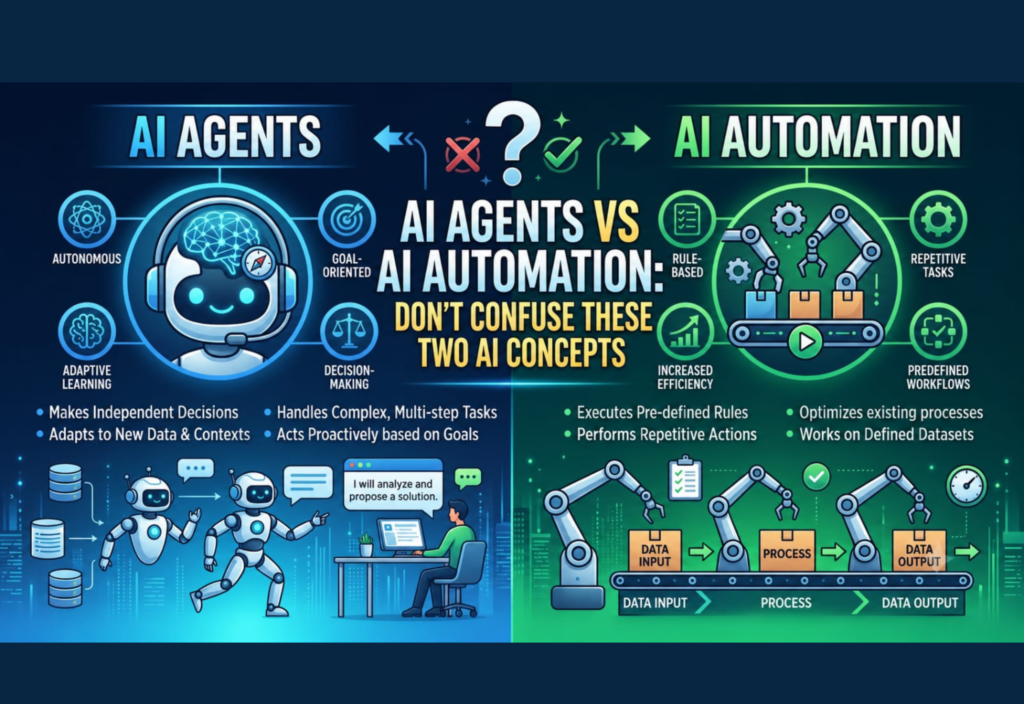
Although these terms are often used together, they do not mean the same thing. Many people assume that AI automation and AI agents work in the same way. In reality, they solve different problems and offer different levels of intelligence. While AI automation follows predefined rules, AI agents can analyze information, make decisions, and adapt to changing situations.
If you are a business owner, marketer, freelancer, developer, or simply interested in artificial intelligence, understanding this difference will help you choose the right technology for your needs.
In this guide, you’ll learn how AI automation works, what AI agents do, their advantages, limitations, and when each solution is the better choice.
What Is AI Automation?
AI Automation is the process of using artificial intelligence to complete repetitive tasks without requiring continuous human involvement. Instead of performing the same activity manually every day, businesses can automate those tasks using software and AI-powered workflows.
Unlike intelligent systems that make independent decisions, AI automation follows a predefined sequence of instructions. Every action depends on rules, conditions, and triggers created by humans. As a result, the system performs the same task consistently whenever the required condition is met.
For example, when a customer submits a contact form, an automated workflow can instantly send a welcome email, notify the sales team, and create a customer record in a CRM. The system works quickly, but it only follows the rules that have already been programmed.
Therefore, AI automation is best suited for structured and repetitive processes.
How Does AI Automation Work?
Most AI automation systems follow a simple workflow. First, a trigger starts the process. Next, the system checks predefined conditions. Finally, it performs the assigned action automatically.
A typical workflow looks like this:
- A user completes an action, such as filling out a form.
- The automation system detects the trigger.
- Predefined rules are applied.
- The required task is completed automatically.
- The same workflow repeats whenever the trigger occurs again.
Because every step is planned in advance, the outcome remains predictable and consistent.
Common Examples of AI Automation
Today, organizations use AI automation in almost every department. Some of the most common examples include:
- Sending welcome emails after user registration
- Scheduling social media posts automatically
- Creating invoices for customers
- Organizing emails into folders
- Backing up important business data
- Generating monthly reports
- Updating customer records in CRM software
- Sending appointment reminders
- Processing online orders
- Managing employee attendance records
Each of these tasks follows a fixed workflow and usually requires little or no human decision-making.
Key Features of AI Automation
AI automation offers several characteristics that make it valuable for businesses.
Rule-Based Operations
Every workflow follows predefined rules. Consequently, the system performs tasks in the same way every time.
Fast Processing
Automation completes tasks within seconds. Therefore, businesses save valuable time while improving efficiency.
Consistent Results
Since the workflow never changes unless updated, businesses receive reliable and predictable outcomes.
Low Human Intervention
After setup, most automated processes run independently. Employees only monitor the system when necessary.
Limited Flexibility
Although automation is efficient, it cannot adapt to unexpected situations without human intervention.
Benefits of AI Automation
Businesses continue to invest in AI automation because it delivers several important advantages.
Saves Time
Employees spend less time performing repetitive work. Instead, they can focus on creative and strategic activities.
Reduces Human Errors
Manual work often leads to mistakes. However, automation follows the same rules every time, reducing the risk of errors.
Improves Productivity
Since automated systems work around the clock, organizations can complete more work in less time.
Lowers Operating Costs
Automation reduces manual labor, which helps businesses decrease operational expenses over time.
Enhances Customer Experience
Customers receive faster responses, quicker confirmations, and more reliable service through automated workflows.
Limitations of AI Automation
Despite its many benefits, AI automation is not suitable for every situation.
Cannot Think Independently
Automation follows instructions exactly as programmed. It does not analyze situations or make intelligent decisions.
Struggles With Complex Problems
If a situation changes unexpectedly, the system usually cannot respond without new rules.
No Continuous Learning
Traditional automation does not improve automatically through experience or feedback.
Depends on Predefined Rules
Every workflow must be designed before automation begins. Consequently, unexpected situations often require manual intervention.
What Are AI Agents?
AI Agents are intelligent software systems that can understand goals, analyze information, make decisions, and perform tasks with minimal human supervision.
Unlike traditional automation, AI agents do not simply follow fixed instructions. Instead, they evaluate the current situation, choose the best action, and adjust their behavior when conditions change.
Because of this ability, AI agents behave more like intelligent digital assistants than simple automation tools.
For instance, an AI customer support agent can understand customer questions, search for relevant information, recommend solutions, and continue the conversation naturally. Instead of following a single script, it adapts based on the user’s needs.
As AI technology becomes more advanced, businesses are increasingly using AI agents to improve productivity and provide personalized experiences.
How Do AI Agents Work?
AI agents perform tasks through a more intelligent process than standard automation.
Typically, the workflow includes the following steps:
- The agent receives a goal.
- It gathers relevant information.
- It analyzes the available data.
- It decides on the best possible action.
- It completes the task.
- It evaluates the results.
- It improves future performance whenever possible.
Because AI agents understand context, they can respond differently depending on the situation.
Real-World Examples of AI Agents
Many businesses already use AI agents to perform advanced tasks.
Some popular examples include:
- AI customer support assistants that answer complex questions
- AI sales agents that qualify leads and schedule meetings
- AI research assistants that collect and summarize information
- AI writing assistants that generate content
- AI coding assistants that write and improve software
- AI marketing agents that optimize advertising campaigns
- AI productivity assistants that organize calendars and priorities
- AI financial assistants that analyze spending and generate insights
Unlike automation, these systems make decisions based on context rather than simply following a fixed workflow.
Key Features of AI Agents
AI agents include several advanced capabilities that make them more intelligent than traditional automation.
Goal-Oriented Decision Making
Instead of simply following instructions, AI agents focus on achieving a specific objective.
Context Awareness
They understand the situation before responding. As a result, their decisions are often more accurate.
Adaptability
When circumstances change, AI agents can modify their approach without requiring completely new workflows.
Learning Capability
Many AI agents improve over time by analyzing feedback, user interactions, and historical data.
Autonomous Task Execution
After receiving a goal, AI agents can complete multiple connected tasks with minimal supervision.
AI Agents vs AI Automation: Key Differences
Although AI Automation and AI Agents both improve productivity, they work in completely different ways. The easiest way to understand the difference is by comparing their core features.
1. Level of Intelligence
AI Automation:
AI automation follows predefined rules. It performs the same task every time without understanding the situation.
AI Agents:
AI agents analyze information, understand the context, and choose the best action to achieve a goal.
2. Decision-Making Ability
AI Automation:
It cannot make independent decisions. Every action depends on rules created by humans.
AI Agents:
They evaluate different options before taking action. Therefore, they can solve problems more effectively.
3. Flexibility
AI Automation:
Automation works well only when the workflow remains the same.
AI Agents:
They can adapt to changing situations and respond differently based on new information.
4. Learning Capability
AI Automation:
Traditional automation does not learn from previous tasks.
AI Agents:
Many AI agents improve their performance by learning from user interactions, feedback, and data.
5. Type of Tasks
AI Automation:
It is ideal for repetitive and predictable work.
Examples include:
- Sending welcome emails
- Creating invoices
- Scheduling social media posts
- Updating CRM records
AI Agents:
They are designed for tasks that require intelligence and reasoning.
Examples include:
- AI customer support
- AI sales assistants
- AI coding assistants
- AI research assistants
- AI marketing agents
6. Human Involvement
AI Automation:
Requires human setup but needs very little attention afterward.
AI Agents:
Can work independently for many tasks while making intelligent decisions.
Real-Life Business Examples
Understanding real-world use cases makes the difference much clearer.
AI Automation in Business
Businesses use AI automation for repetitive daily operations such as:
- Sending order confirmation emails
- Scheduling social media content
- Creating monthly sales reports
- Processing employee attendance
- Updating customer databases
- Sending payment reminders
Since these tasks follow fixed rules, automation performs them quickly and accurately.
AI Agents in Business
AI agents are used for more advanced work that requires thinking and decision-making.
Some examples include:
- AI chatbots that understand customer questions
- AI sales assistants that qualify leads
- AI marketing agents that improve advertising campaigns
- AI research assistants that summarize information
- AI financial assistants that analyze business data
- AI coding assistants that generate and improve code
Because these systems understand context, they provide smarter and more personalized results.
Why Do People Confuse AI Agents and AI Automation?
Many people believe both technologies are identical because they share several similarities.
For example, both:
- Reduce manual work
- Improve business efficiency
- Save time
- Use artificial intelligence
- Operate with minimal human intervention
However, there is one major difference.
AI Automation follows instructions.
AI Agents understand the goal and decide how to achieve it.
This difference changes how each technology performs in real business situations.
A Simple Analogy
Imagine you own a restaurant.
An automated coffee machine always prepares the same drink after someone presses a button. It never changes the recipe.
An experienced chef, however, checks the available ingredients, understands customer preferences, adjusts the recipe, and prepares the best possible meal.
That is the difference between automation and an AI agent.
You can also remember it this way:
- Automation = Following instructions
- AI Agent = Thinking before acting
Which One Should You Choose?
The right solution depends on your business needs.
Choose AI Automation If:
- Your tasks are repetitive.
- Your workflow is predictable.
- You want to save time.
- You want fewer manual errors.
- Your processes follow fixed rules.
Choose AI Agents If:
- Your tasks are complex.
- Customer needs change frequently.
- You need intelligent recommendations.
- Decisions must be made in real time.
- Personalization is important.
Many businesses use both technologies together because each one solves different problems.
The Future of AI in 2026 and Beyond
Artificial intelligence continues to evolve every year. As a result, businesses are combining AI automation with AI agents instead of choosing only one solution.
For example:
- AI automation manages repetitive backend tasks.
- AI agents analyze data and make intelligent decisions.
- Automation completes routine workflows.
- AI agents improve customer interactions and business strategies.
Together, they help organizations:
- Save valuable time
- Reduce operating costs
- Improve customer satisfaction
- Increase productivity
- Make smarter business decisions
- Scale operations more efficiently
Therefore, combining both technologies is becoming the preferred approach for modern businesses.
Final Thoughts
AI Automation and AI Agents are both essential technologies, but they serve different purposes.
AI automation is designed to complete repetitive tasks quickly and consistently. It follows predefined rules and delivers reliable results for structured workflows.
AI agents, on the other hand, understand goals, analyze information, make decisions, and adapt to changing situations. Because of these capabilities, they are better suited for complex and dynamic tasks.
Rather than replacing each other, AI automation and AI agents work best together. Automation handles routine operations, while AI agents provide intelligence where decision-making is required.
As AI technology continues to advance, businesses that combine both solutions will improve efficiency, deliver better customer experiences, and stay ahead of the competition.