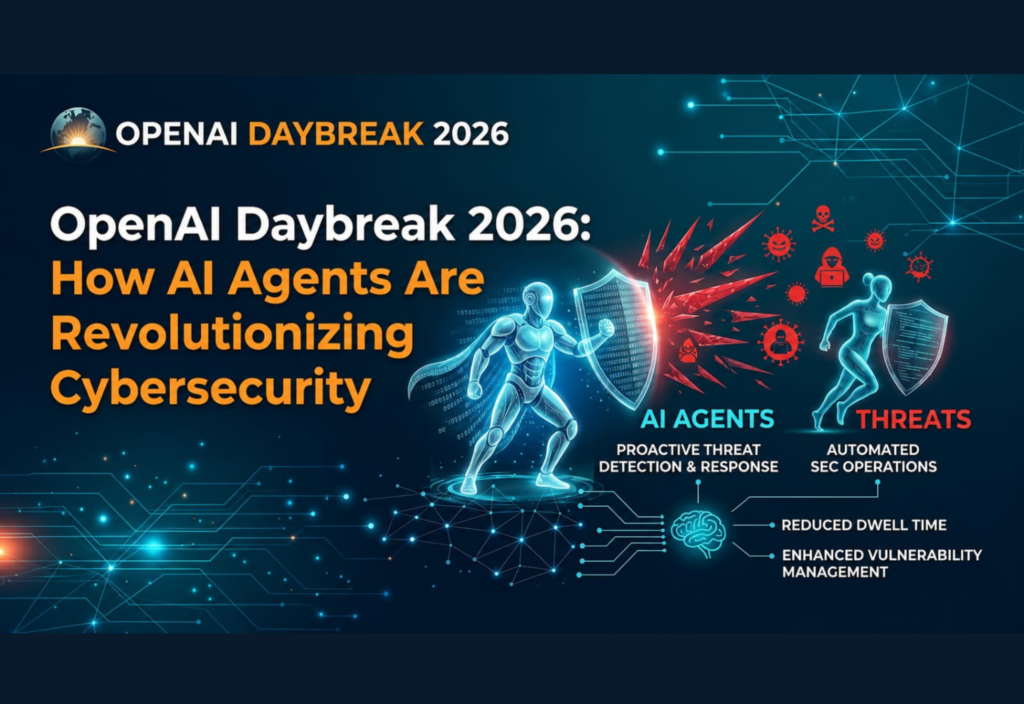
Cybersecurity is becoming one of the most discussed topics in the technology world. As cyber threats continue to evolve, businesses need security solutions that can detect attacks faster, respond more intelligently, and reduce the workload on security teams. OpenAI Daybreak 2026 AI Agents Cybersecurity highlights how AI agents are moving beyond simple chatbots to become intelligent digital assistants capable of monitoring systems, analyzing threats, and supporting cybersecurity professionals in real time.
Rather than replacing human experts, these AI agents work alongside them to improve efficiency, strengthen digital defenses, and help organizations stay ahead of increasingly sophisticated cybercriminals.
What Is OpenAI Daybreak 2026?
OpenAI Daybreak 2026 represents a new generation of AI technology focused on intelligent agents that can perform complex tasks with minimal human guidance. Unlike traditional AI tools that simply answer questions or follow fixed rules, AI agents are designed to understand goals, gather information, make decisions, and complete multi-step workflows.
In cybersecurity, these AI agents act as digital security assistants. They continuously monitor networks, review system logs, identify unusual behavior, and alert security teams before a minor issue becomes a major security incident. Their ability to process enormous amounts of security data within seconds makes them valuable for organizations of every size.
The growing adoption of cloud computing, remote work, and Internet of Things (IoT) devices has expanded the attack surface for businesses. Security teams often struggle to investigate thousands of alerts every day. AI agents help reduce this burden by filtering low-priority notifications and highlighting the threats that require immediate attention.
Why Cybersecurity Needs AI Agents
Cybersecurity has become one of the biggest priorities for businesses in 2026. Every organization stores valuable digital assets, including customer records, financial information, employee data, and confidential business documents. Losing this information can result in financial losses, legal consequences, and long-term reputational damage.
Traditional security software mainly relies on predefined rules and known attack signatures. While these systems remain effective against familiar threats, they often struggle to recognize sophisticated or previously unknown attacks.
AI agents provide a more intelligent approach by analyzing behavior instead of relying only on fixed rules. They learn from historical data, compare current activities with normal user behavior, and identify suspicious actions that may indicate an ongoing cyberattack.
This intelligent detection enables organizations to identify threats much earlier than traditional security systems.
How AI Agents Improve Cybersecurity
One of the greatest advantages of AI agents is their ability to automate repetitive cybersecurity tasks while allowing security professionals to focus on higher-level investigations and strategic decisions.
Instead of manually reviewing thousands of security logs, analysts receive prioritized alerts generated by AI systems. These alerts include details such as:
- Affected devices
- Suspicious user activities
- Possible attack methods
- Recommended response actions
AI agents also collect information from multiple security sources simultaneously. They combine network traffic, endpoint activity, cloud services, authentication logs, and application events into a single investigation timeline.
Because AI operates around the clock, organizations receive continuous protection without interruption.
Key Features of OpenAI Daybreak AI Agents
Continuous Threat Monitoring
AI agents constantly monitor servers, cloud platforms, endpoints, business applications, and networks. Unlike human analysts, they never become tired or distracted.
Every login attempt, file modification, software installation, and network connection is analyzed in real time.
Continuous monitoring allows organizations to detect suspicious activity almost immediately, reducing the chances of attackers remaining hidden inside networks for extended periods.
Intelligent Threat Detection
Modern cyberattacks rarely follow predictable patterns. AI agents use behavioral analysis and advanced pattern recognition to identify unusual activities.
Examples include:
- Multiple failed login attempts
- Access from unfamiliar locations
- Unexpected file encryption
- Large data transfers
- Unauthorized privilege escalation
- Suspicious network communications
Instead of depending only on malware signatures, AI evaluates behavior, making it possible to detect completely new attack techniques.
Automated Incident Investigation
Cybersecurity investigations often require collecting information from many systems.
AI agents automate this process by:
- Gathering security logs
- Identifying affected users
- Tracking suspicious activities
- Building attack timelines
- Creating investigation reports
This dramatically reduces response time and enables security teams to contain attacks before they spread.
Benefits for Businesses
Organizations adopting AI-powered cybersecurity gain several important advantages.
Faster threat detection enables security teams to respond before attacks spread across systems. Automated investigations reduce manual work, allowing experts to focus on complex security challenges rather than repetitive tasks.
Businesses also benefit from improved operational efficiency because AI agents continuously analyze security events without requiring additional staffing.
Small businesses, which often lack dedicated cybersecurity teams, especially benefit from AI-assisted monitoring and intelligent threat detection.
Another major advantage is scalability. As businesses grow, AI agents can monitor increasing amounts of data without significantly increasing operational costs.
Management also benefits from AI-generated reports that summarize:
- Security incidents
- Risk levels
- Response actions
- Recommended improvements
These reports help decision-makers understand security risks without requiring deep technical knowledge.
Real-World Applications of AI Agents in Cybersecurity
AI agents are already strengthening cybersecurity across multiple industries, including banking, healthcare, education, government agencies, manufacturing, and e-commerce.
Email Security
Phishing remains one of the most successful attack methods.
AI agents inspect incoming emails for:
- Suspicious links
- Fake sender addresses
- Malicious attachments
- Unusual writing styles
Potential threats are blocked before employees interact with them.
Cloud Security
As organizations migrate more systems to cloud environments, protecting cloud infrastructure becomes increasingly important.
AI agents monitor cloud resources for:
- Unauthorized access
- Configuration errors
- Excessive permissions
- Suspicious user behavior
- Security policy violations
Early detection helps organizations prevent attackers from exploiting vulnerabilities.
Endpoint Protection
Every laptop, desktop, smartphone, and server connected to a company network is a potential attack target.
AI agents monitor endpoints for:
- Ransomware behavior
- Unauthorized software installation
- Suspicious processes
- Unexpected file modifications
When threats are detected, security teams receive immediate alerts.
Identity and Access Management
Compromised passwords continue to be one of the biggest cybersecurity challenges.
AI agents monitor authentication behavior to detect:
- Logins from unusual locations
- Impossible travel activity
- Unexpected access to sensitive files
- Abnormal user behavior
The system can automatically require additional verification before granting access.
AI Agents vs Traditional Security Automation
Traditional automation follows predefined rules.
For example:
- If malware matches a known signature → Block it.
- If a suspicious IP address appears → Deny access.
While effective, this approach struggles against new attack methods.
AI agents operate differently.
Instead of asking:
“Does this match a known threat?”
They ask:
“Does this behavior look suspicious compared to normal activity?”
This behavioral approach makes AI-powered cybersecurity much more adaptive against evolving cyber threats.
Challenges and Limitations
Although AI agents offer significant advantages, they cannot completely replace experienced cybersecurity professionals.
Human oversight remains essential for strategic decision-making, incident response, and ethical governance.
Some common challenges include:
False Positives
AI systems may occasionally classify legitimate activity as suspicious, requiring manual investigation.
Privacy and Data Protection
AI analyzes enormous volumes of organizational data.
Businesses must ensure compliance with privacy regulations while protecting sensitive information.
AI-Powered Cyber Threats
Cybercriminals are also using artificial intelligence to develop smarter phishing campaigns, malware, and automated attacks.
Organizations must continuously improve both AI systems and cybersecurity strategies.
Best Practices for Using AI Agents
Businesses should treat AI agents as intelligent assistants rather than complete replacements for cybersecurity teams.
Recommended best practices include:
- Keep AI systems updated regularly.
- Review AI-generated recommendations before taking critical actions.
- Train employees to recognize phishing attacks.
- Enable multi-factor authentication (MFA).
- Perform regular vulnerability assessments.
- Maintain secure backups.
- Continuously review AI performance.
- Update cybersecurity policies as threats evolve.
Combining these practices with AI-powered monitoring creates a much stronger security posture.
The Future of AI Agents in Cybersecurity
The role of AI agents will continue expanding over the coming years.
Future systems are expected to become:
- More autonomous
- More accurate
- Better at predicting attacks
- Faster at responding
- Smarter at preventing security incidents
Instead of simply reacting to cyberattacks, AI agents will increasingly identify weak points, recommend security improvements, and automatically apply protective measures where appropriate.
We are also likely to see deeper integration between AI agents, cloud platforms, endpoint security tools, identity management systems, and Security Operations Centers (SOCs).
However, cybersecurity will always require collaboration between advanced technology and experienced professionals. AI can process information at incredible speed, but human judgment remains essential for strategic decisions, compliance, and ethical oversight.
Conclusion
OpenAI Daybreak 2026 demonstrates how intelligent AI agents are reshaping the future of cybersecurity. These systems help organizations detect threats faster, automate repetitive security tasks, improve incident response, and reduce the workload on cybersecurity professionals.
As cyber threats continue to evolve, businesses that combine AI-powered security with experienced human oversight will be better prepared to protect sensitive information and maintain customer trust.
AI agents are not replacing cybersecurity experts—they are giving them smarter tools to defend against increasingly sophisticated digital threats.
Investing in intelligent cybersecurity today will help organizations build stronger, more resilient security strategies for the future.